
Ever wondered what you and a tiny bacterium have in...
 Biology6 wyświetleń·Zaktualizowano Jun 12, 2026·5 strony
Exploring the Building Blocks of Life: Cells
1 / 5
1
of 5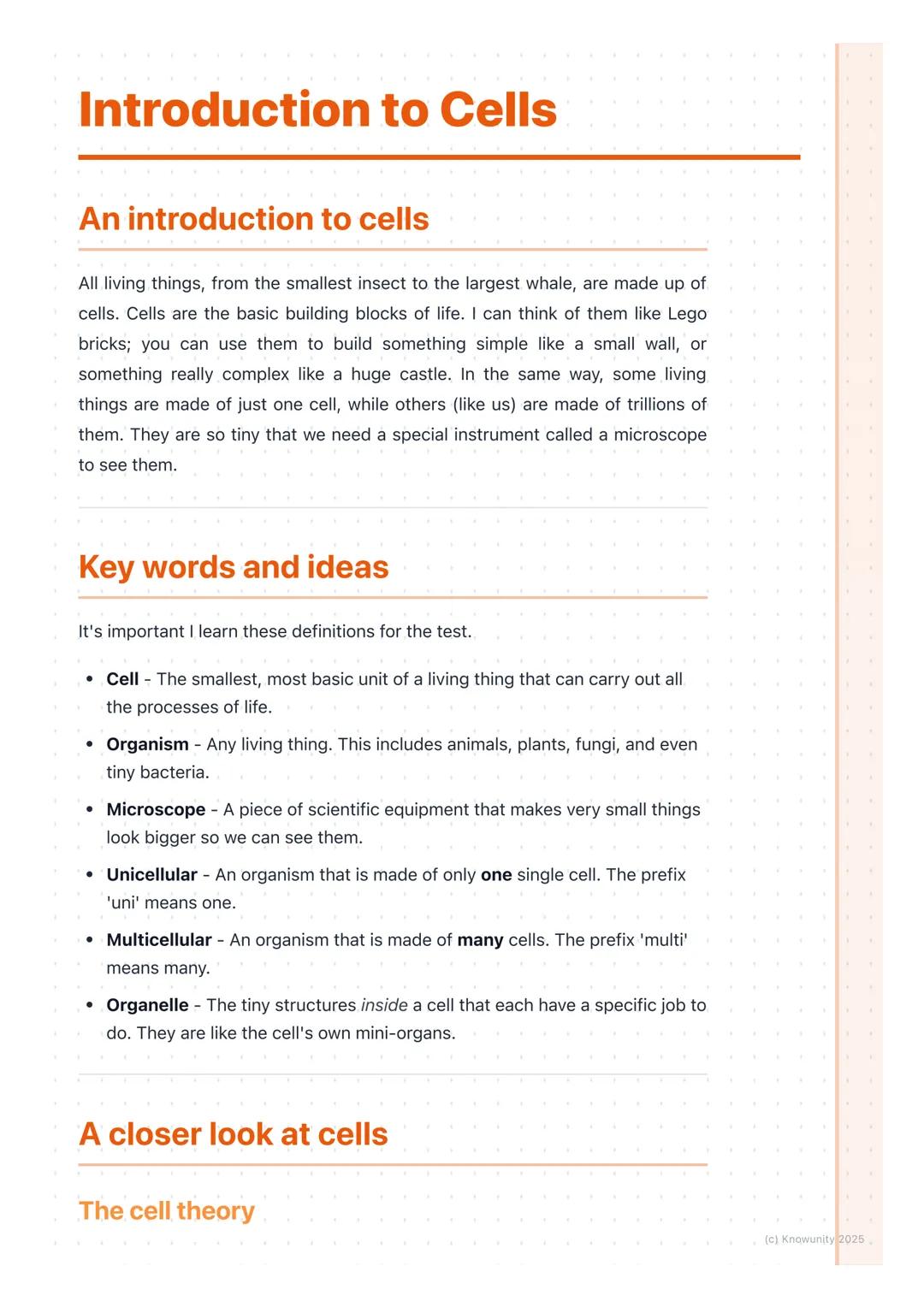
Introduction to Cells
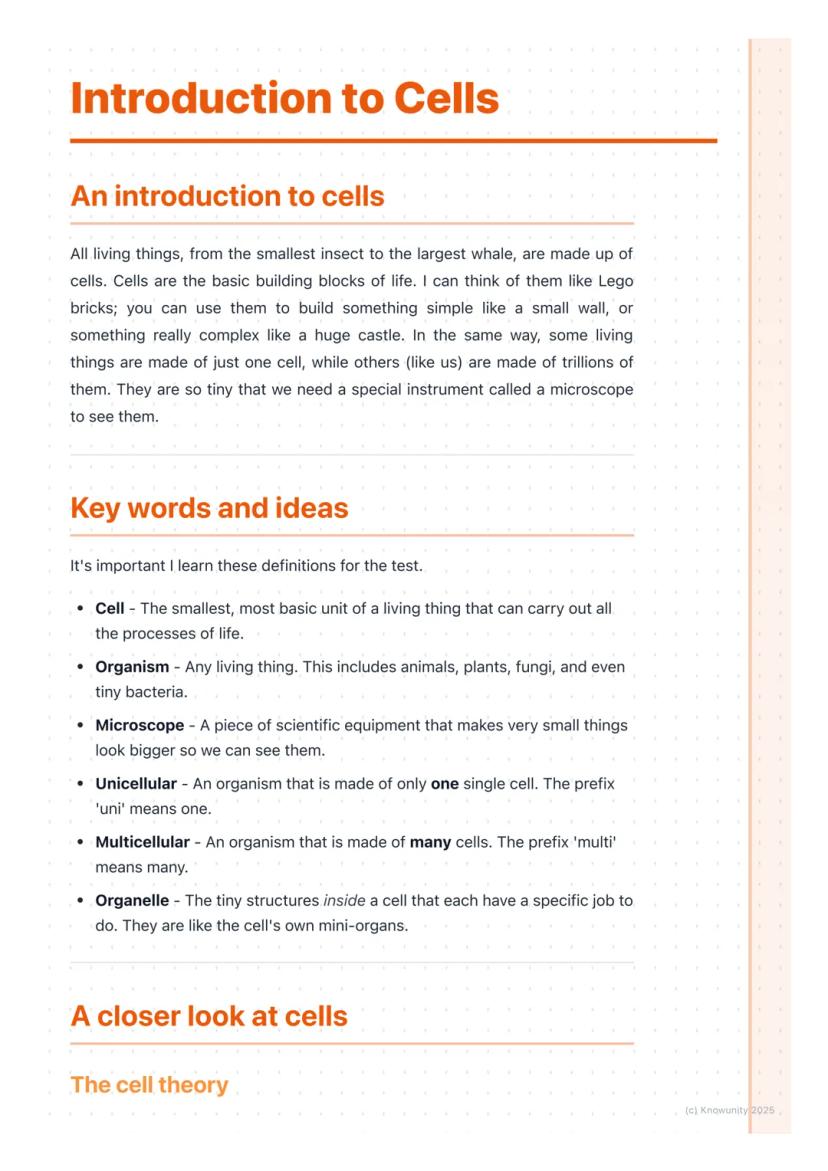
Think of cells as biological Lego bricks that can build anything from simple single-celled bacteria to complex organisms like yourself. Every living thing on Earth, whether it's a microscopic germ or a massive whale, is made up of these tiny units of life.
Cells are so small that you need a microscope to see them properly. Despite their tiny size, they're incredibly powerful - each one can carry out all the basic processes needed for life, like eating, growing, and getting rid of waste.
Some organisms are made of just one cell (unicellular), while others like humans are built from trillions of cells working together (multicellular). It's amazing to think that something so small can be the foundation of something as complex as you!
Remember: Cells are the basic unit of LIFE, whilst atoms are the basic unit of MATTER - don't mix these up in your test!
2
of 5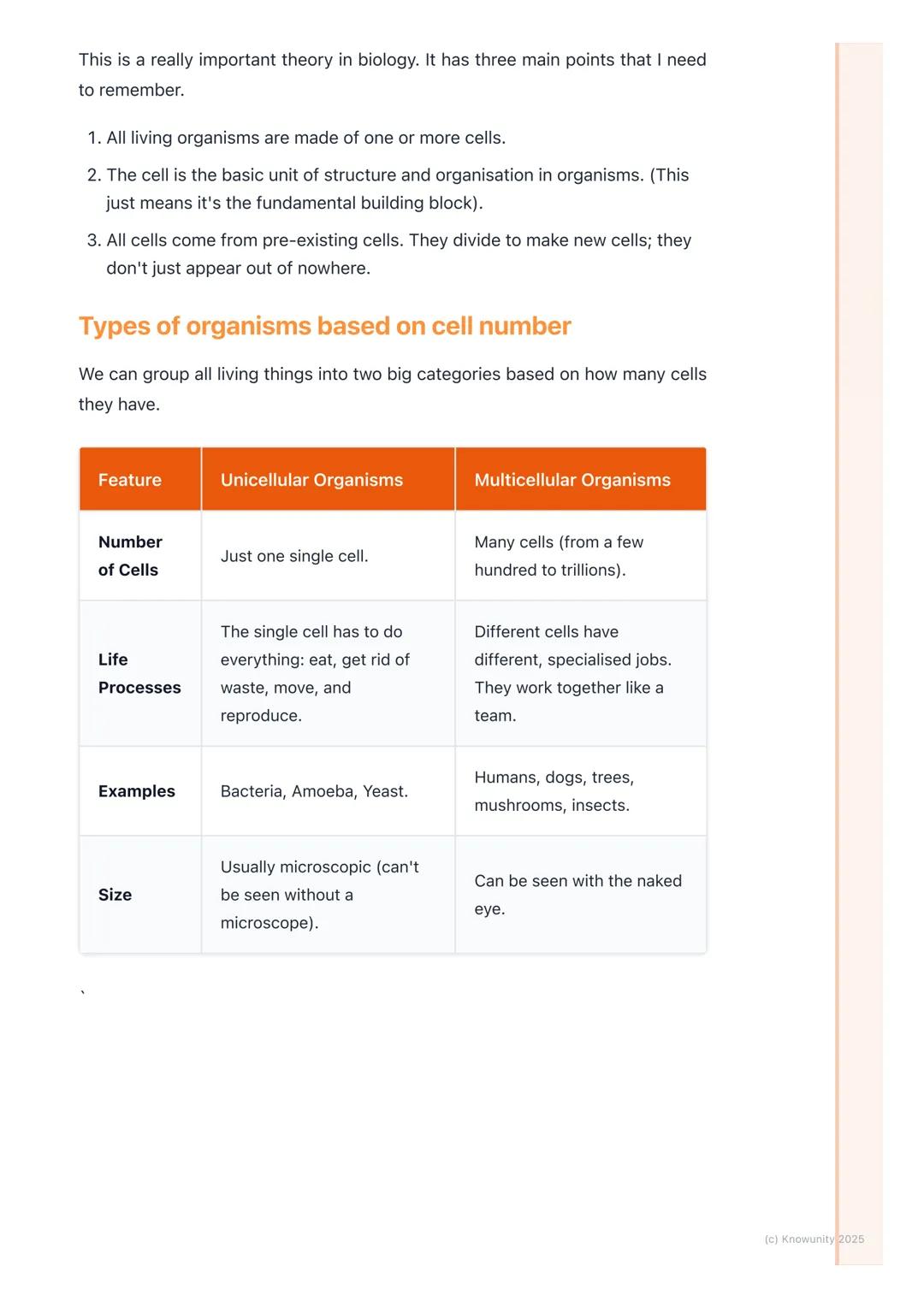
Cell Theory and Types of Organisms
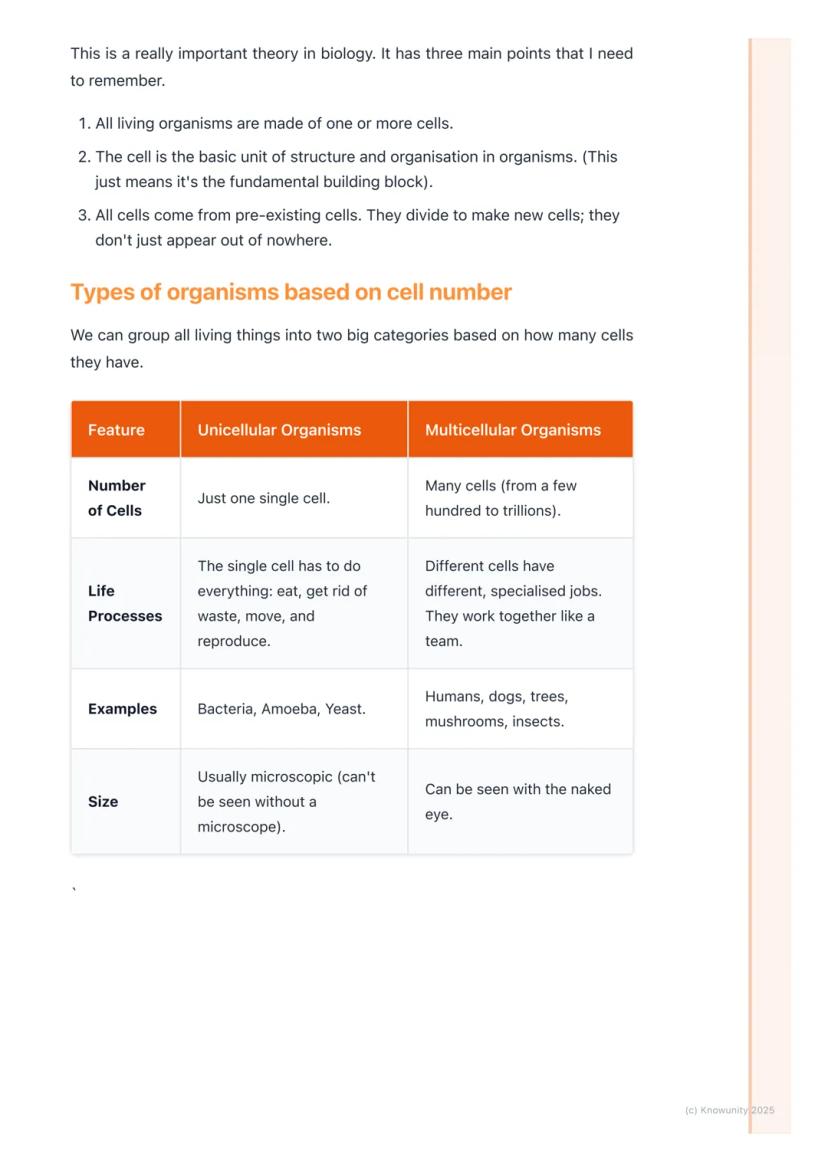
The Cell Theory has three simple rules that explain how all life works. First, every living thing is made of one or more cells. Second, cells are life's basic building blocks. Third, all cells come from other cells - they don't just magically appear!
Unicellular organisms are complete living things made of just one cell. Think of bacteria or the amoeba you might see in pond water - that single cell has to do everything: find food, move around, and reproduce by splitting in two.
Multicellular organisms like you, your dog, or an oak tree are made of many cells working as a team. Different cells become specialised for specific jobs - your nerve cells carry messages, whilst your red blood cells transport oxygen around your body.
Memory trick: Unicycle has one wheel, so unicellular has one cell. Multiply means many, so multicellular has many cells!
3
of 5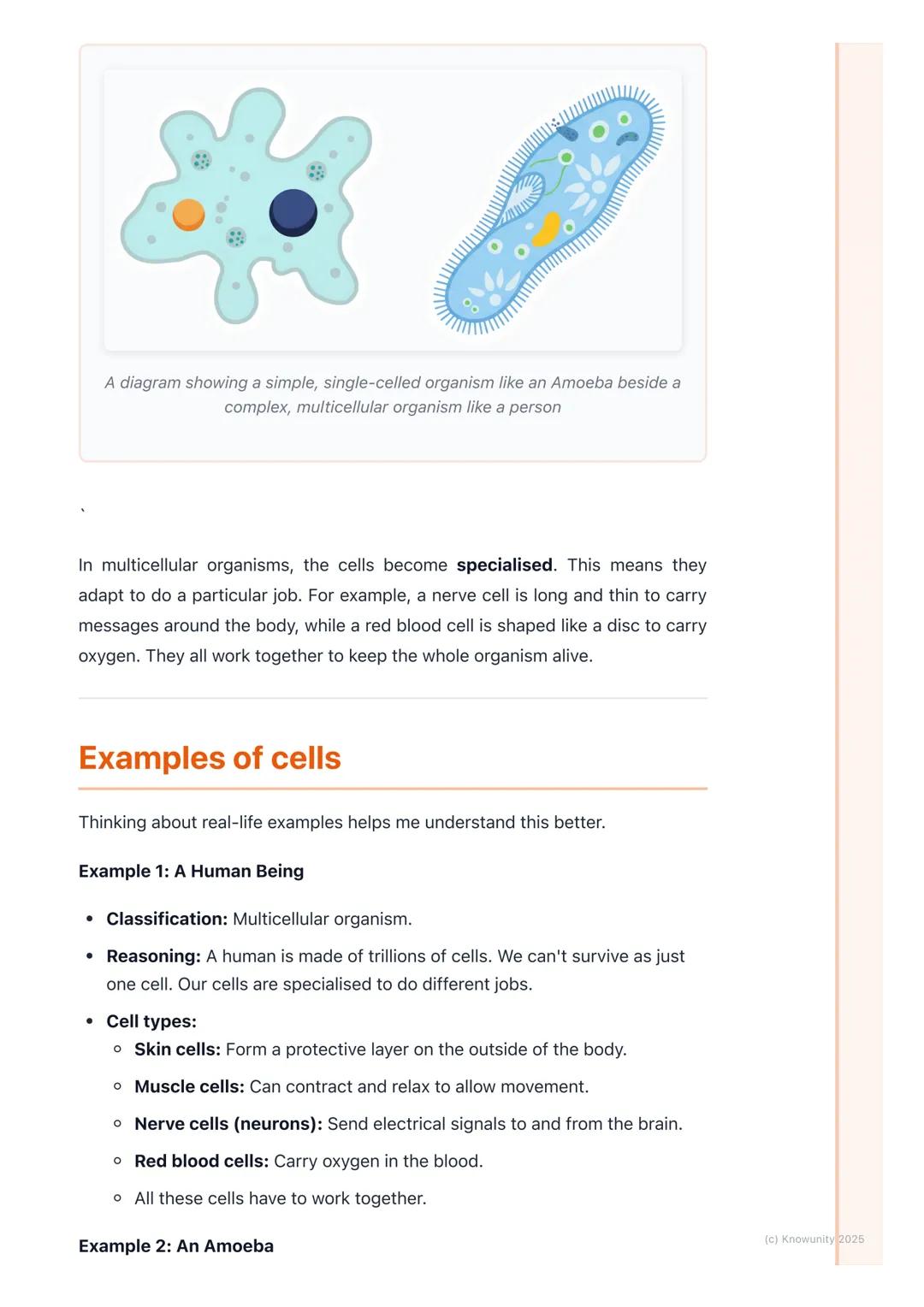
Examples of Cells in Action
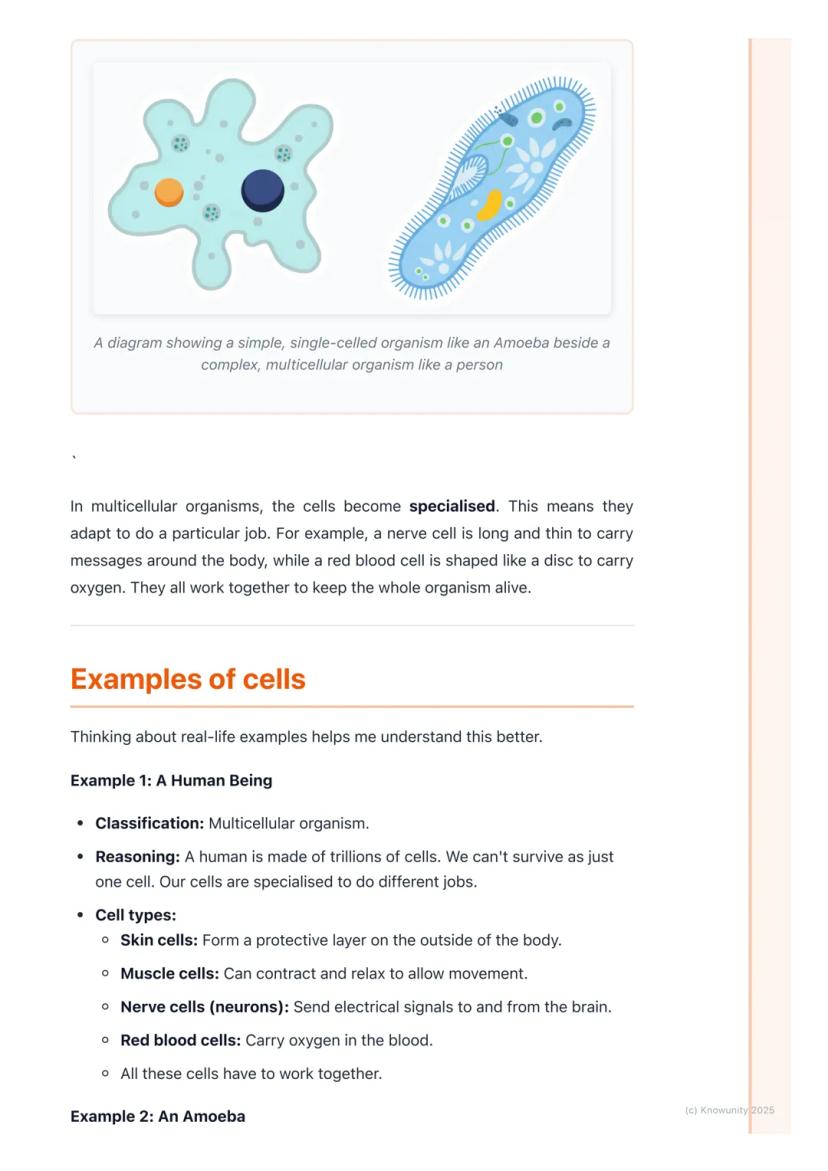
Let's look at how this works in real life. Humans are brilliant examples of multicellular organisms with trillions of specialised cells. Your skin cells protect you, muscle cells help you move, and nerve cells send lightning-fast messages to your brain.
An amoeba shows how unicellular life works perfectly. This tiny pond creature is just one cell, but it's a complete living thing that moves by changing shape, surrounds its food to eat it, and reproduces by simply splitting in half.
Oak trees prove that plants are multicellular too. Their root hair cells soak up water from soil, leaf cells capture sunlight for photosynthesis, and xylem cells form tubes that transport water from roots to leaves like a natural plumbing system.
Cool fact: Even though you're made of trillions of cells, you started life as just one single cell that kept dividing!
4
of 5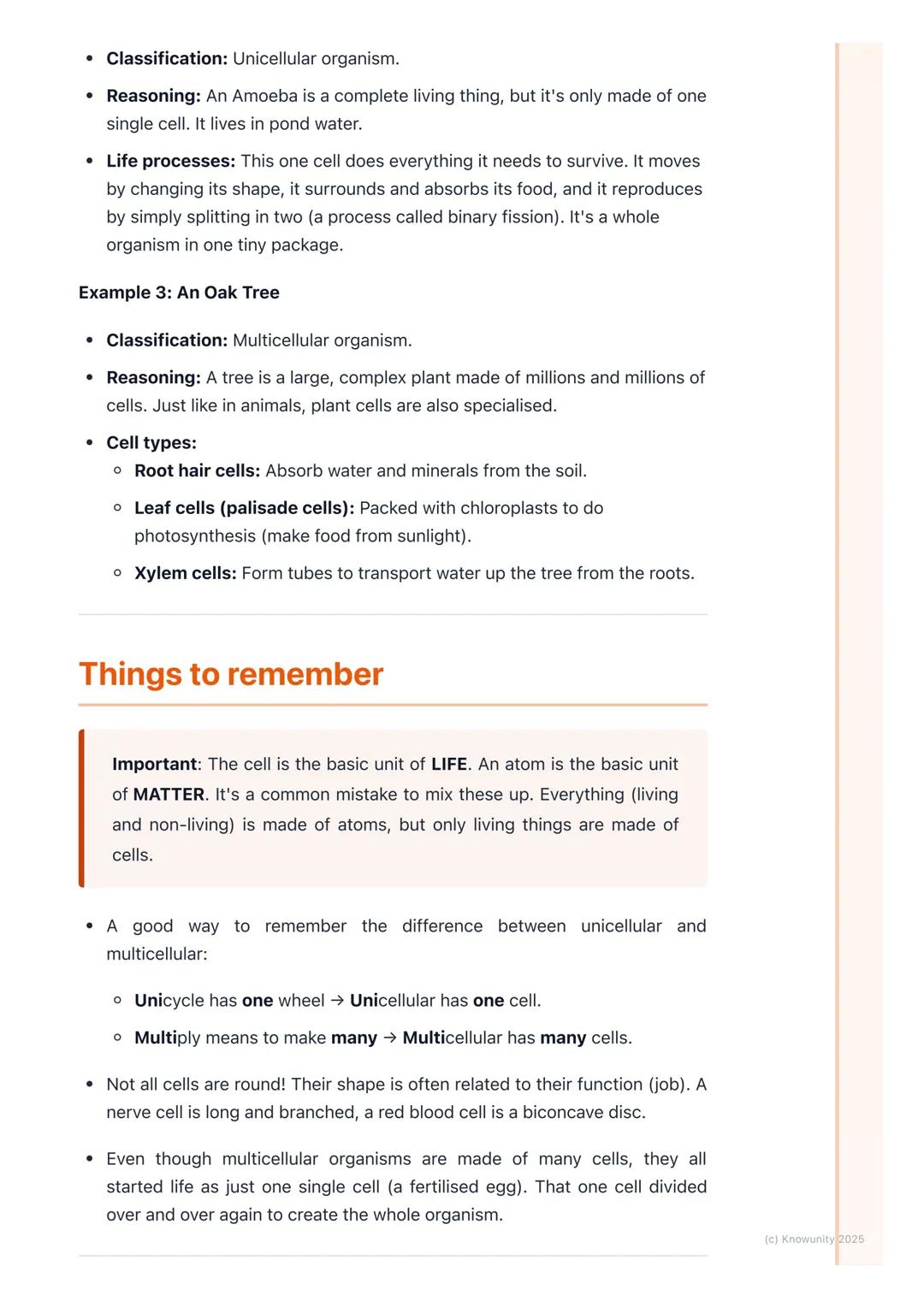
Cell Shapes and Functions
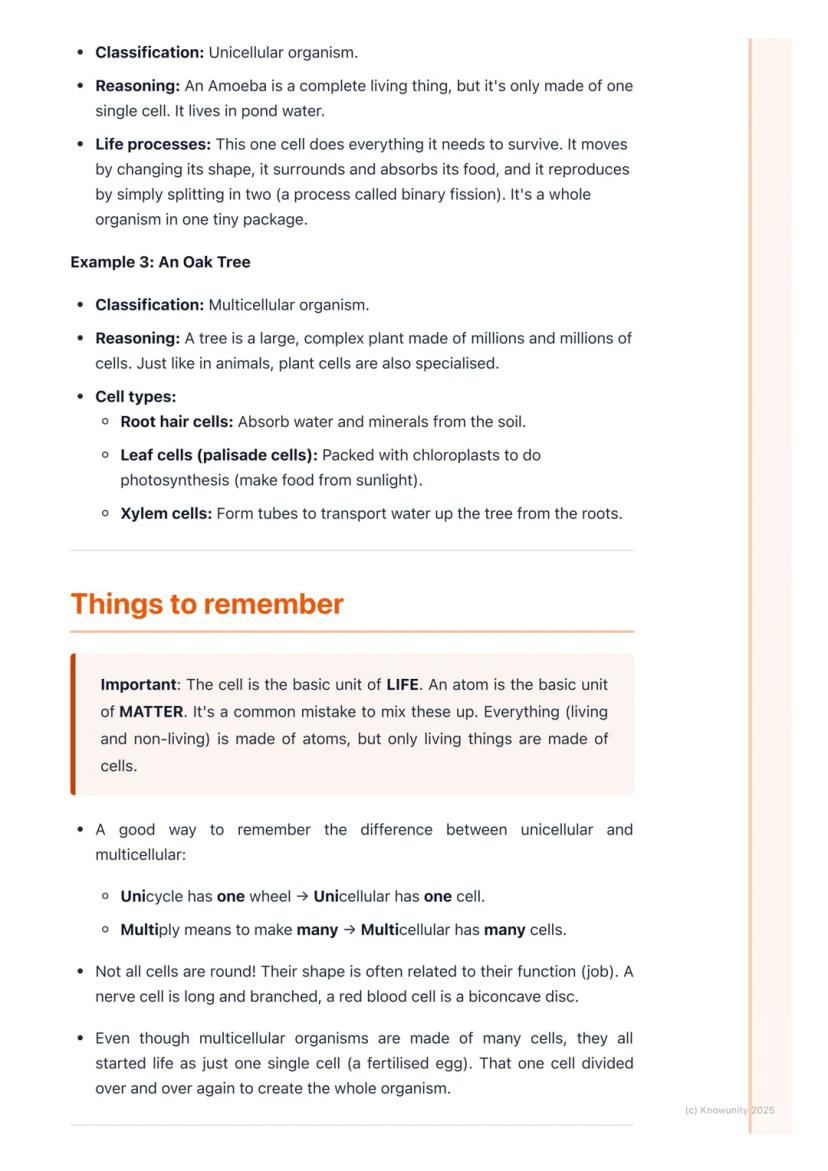
Here's something fascinating - cells aren't all round blobs! Their shape usually matches their job perfectly. Nerve cells are long and branched like electrical wires to carry signals across your body, whilst red blood cells are shaped like tiny discs to squeeze through narrow blood vessels.
Specialisation is what makes multicellular life so successful. Instead of one cell trying to do everything (like in unicellular organisms), different cells become experts at specific tasks and work together as an incredible team.
This teamwork is why multicellular organisms can grow so large and complex. Your body is like a massive city where every cell has its own important job, from the muscle cells that help you kick a football to the brain cells that help you understand this biology!
Test tip: Remember that cell shape relates to function - this connection often appears in exam questions!
5
of 5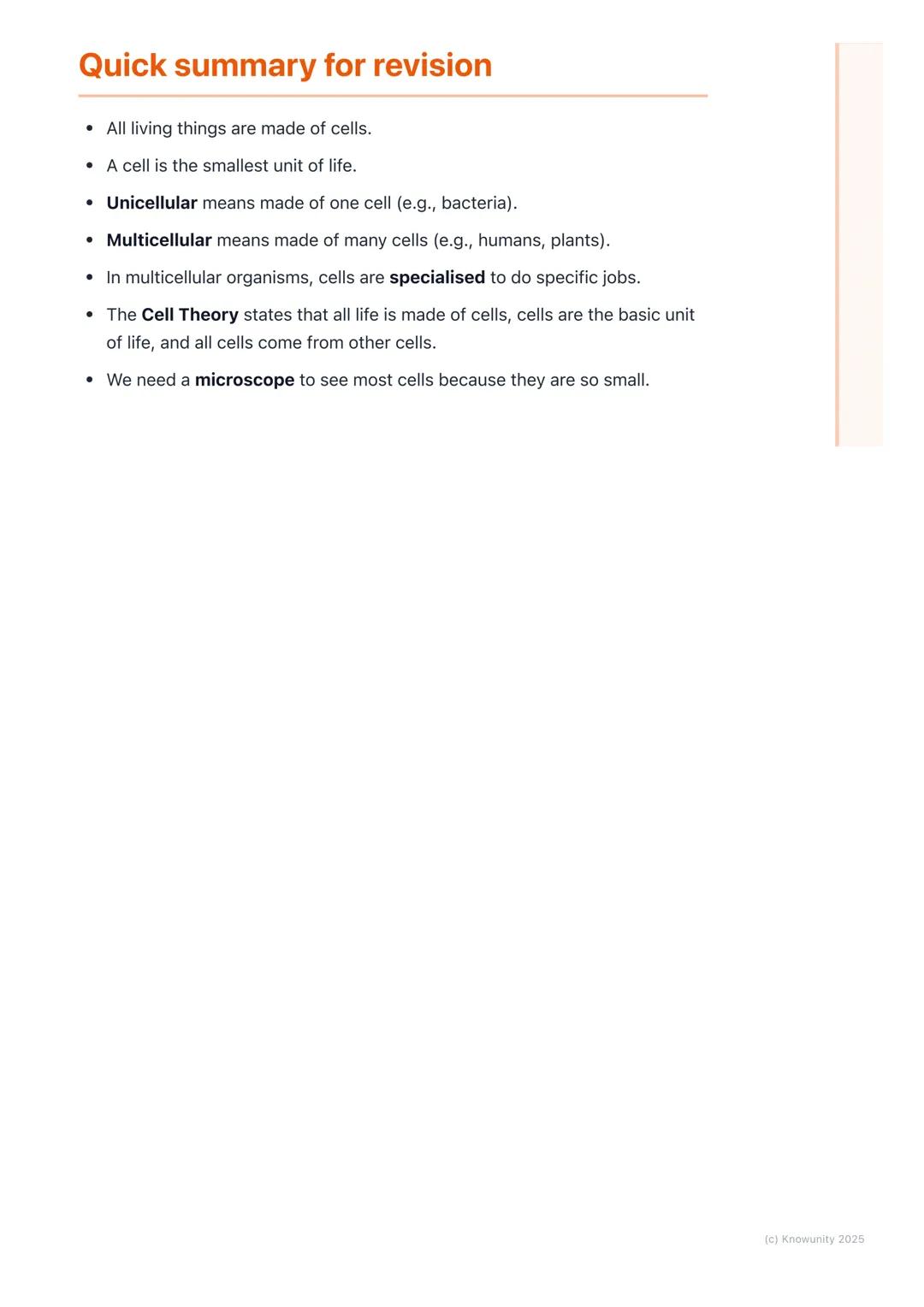
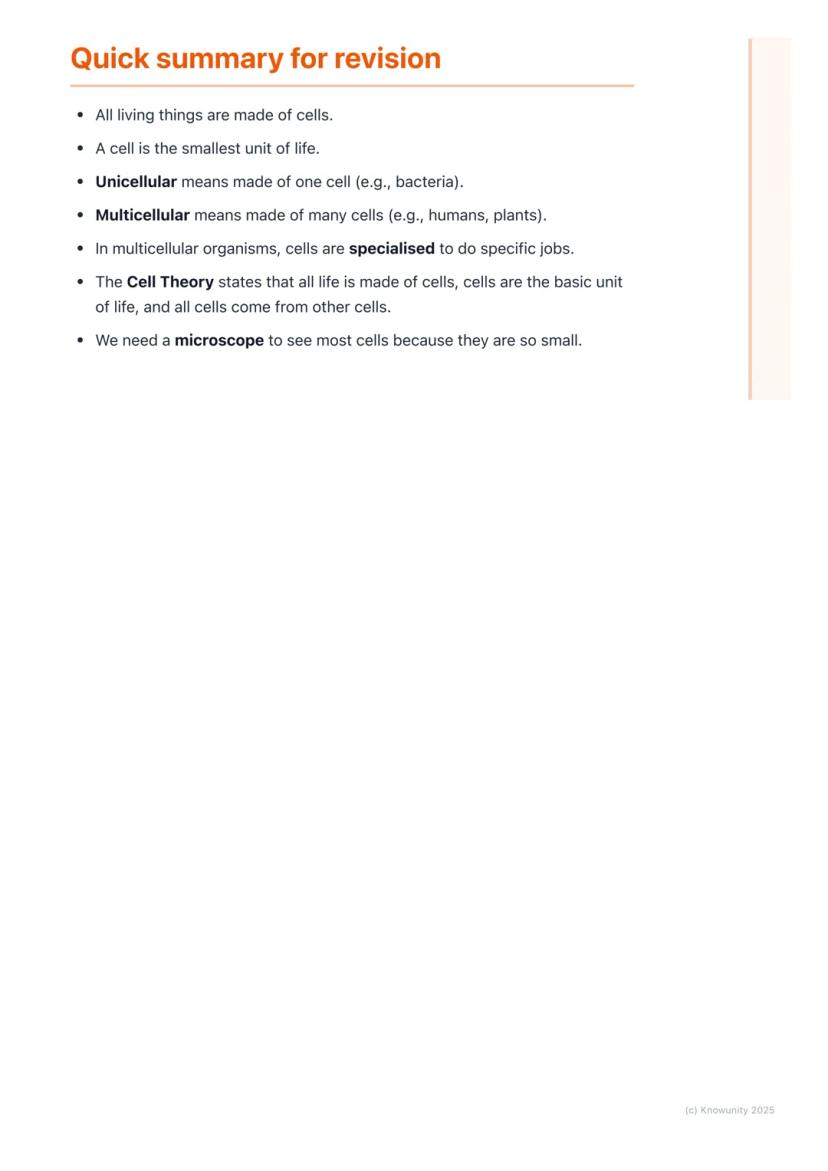
Quick Revision Summary
You've now mastered the basics of cell biology! All living things are made of cells - it's that simple. Whether it's a single-celled bacterium or a complex human being, cells are life's universal building blocks.
Unicellular organisms like bacteria are complete living things in one cell, whilst multicellular organisms like you are made of many specialised cells working together. The Cell Theory explains that all life comes from cells, cells are life's basic units, and new cells only come from existing cells.
Remember that we need microscopes to see most cells because they're incredibly tiny, yet they're powerful enough to carry out all life's essential processes. You're basically a walking, talking collection of trillions of these amazing microscopic factories!
Final reminder: Master these definitions and examples - they're the foundation for everything else you'll learn in biology this year!
Myśleliśmy, że nigdy nie zapytasz...
Czym jest Towarzysz AI z Knowunity?
Nasz asystent AI jest specjalnie dostosowany do potrzeb uczniów. W oparciu o miliony treści, które mamy na platformie, możemy udzielać uczniom naprawdę znaczących i trafnych odpowiedzi. Ale nie chodzi tylko o odpowiedzi, towarzysz prowadzi również uczniów przez codzienne wyzwania związane z nauką, ze spersonalizowanymi planami nauki, quizami lub treściami na czacie i 100% personalizacją opartą na umiejętnościach i rozwoju uczniów.
Gdzie mogę pobrać aplikację Knowunity?
Aplikację możesz pobrać z Google Play i Apple Store.
Czy aplikacja Knowunity naprawdę jest darmowa?
Tak, masz całkowicie darmowy dostęp do wszystkich notatek w aplikacji, możesz w każdej chwili rozmawiać z Ekspertami lub ich obserwować. Możesz użyć punktów, aby odblokować pewne funkcje w aplikacji, które również możesz otrzymać za darmo. Dodatkowo oferujemy usługę Knowunity Premium, która pozwala na odblokowanie większej liczby funkcji.
Najpopularniejsze notatki z Biology
8BiologyEcology introduction notes!
Start of the leaving cert ecology chapter
6th Year131
BiologyDNA & RNA
All notes on DNA & RNA including protein synthesis which is a HL topic
5th Year250
BiologyVertebrates and Invertebrates
Students will distinguish between animals that have a backbone (vertebrates) and those that do not (invertebrates), identifying examples of each.
2nd Year240
BiologyBiomolecules: chapter 8
Summary and easily understandable notes to revise chapter 8 biomolecules. Includes good labelled diagrams for visual learners
5th Year210
BiologyCirculatory System
Students will learn about the heart, blood, and blood vessels, and how this system transports oxygen, nutrients, and waste products around the body.
3rd Year140
BiologyRespiration
All respiration notes including simple diagrams and glycolysis and the Krebs cycle
5th Year120
BiologyPhotosynthesis : Biology
Photosynthesis
6th Year371
BiologyPlant Cells
Learning about the unique structures found in plant cells, such as the cell wall, chloroplasts, and large vacuole, and how they differ from animal cells.
1st Year80
Najpopularniejsze notatki
9 Irish
IrishIrish oral questions and answers
Questions and answers for the leaving cert oral
5th Year4264
 English
Key Quotes : Sive
Key Quotes and explanations: Sive
6th Year2842
IrishIrish oral questions
Outline of oral questions
5th Year2055
IrishIníon- le hÁine Durkin
Aine Durkin’s poem, Iníon: Themes & summary
5th Year890
IrishIrish poetry 2027
Iníon + Dínit an Bhróin
5th Year1153
IrishLC HL notes- Iníon (poem)
Includes poem in English and Irish, theme, key words & phrases
5th Year2304
EnglishCultural Context : Shawshank Redemption : Sive : Small Things Like These
Comparative Study : Cultural Context : Shawshank Redemption, Sive and Small Things Like These
6th Year1430
IrishMo Ghrá-sa (Idir Lúibíní)
Notes on mo ghrá-sa
5th Year380
IrishAn Gaeilge Aiste
Irish Language essay
6th Year1320
Nie ma nic odpowiedniego? Sprawdź inne przedmioty.
Zobacz, co mówią o nas nasi użytkownicy. Pokochali nas — pokochasz też i Ty.
4.6/5App Store
4.7/5Google Play
Aplikacja jest bardzo prosta i dobrze przemyślana. Do tej pory znalazłem wszystko, czego szukałem i mogłem się wiele nauczyć z innych notatek! Na pewno wykorzystam aplikację do pomocy przy robieniu prac domowych! No i oczywiście bardzo pomaga też jako inspiracja do robienia swoich notatek.
Stefan Sużytkownik iOS
Ta aplikacja jest naprawdę świetna. Jest tak wiele notatek i pomocnych informacji [...]. Moim problematycznym przedmiotem jest język niemiecki, a w aplikacji jest w czym wybierać. Dzięki tej aplikacji poprawiłam swój niemiecki. Polecam ją każdemu.
Samantha Klichużytkownik Androida
Wow, jestem w szoku. Właśnie wypróbowałam aplikację, ponieważ widziałam ją kilka razy reklamowaną na TikToku jestem absolutnie w szoku. Ta aplikacja jest POMOCĄ, której potrzebujesz w szkole i przede wszystkim oferuje tak wiele rzeczy jak notatki czy streszczenia, które są BARDZO pomocne w moim przypadku.
Annaużytkownik iOS
Biology6 wyświetleń·Zaktualizowano Jun 12, 2026·5 stronyExploring the Building Blocks of Life: Cells
Ever wondered what you and a tiny bacterium have in common? You're both made of cells - the incredible building blocks that make all life possible. Understanding cells is like unlocking the secret code of life itself.
1
of 5
Zarejestruj się, aby zobaczyć notatkę. To nic nie kosztuje!
- Dostęp do wszystkich materiałów
- Popraw swoje oceny
- Dołącz do milionów studentów
Introduction to Cells
Think of cells as biological Lego bricks that can build anything from simple single-celled bacteria to complex organisms like yourself. Every living thing on Earth, whether it's a microscopic germ or a massive whale, is made up of these tiny units of life.
Cells are so small that you need a microscope to see them properly. Despite their tiny size, they're incredibly powerful - each one can carry out all the basic processes needed for life, like eating, growing, and getting rid of waste.
Some organisms are made of just one cell (unicellular), while others like humans are built from trillions of cells working together (multicellular). It's amazing to think that something so small can be the foundation of something as complex as you!
Remember: Cells are the basic unit of LIFE, whilst atoms are the basic unit of MATTER - don't mix these up in your test!
2
of 5Zarejestruj się, aby zobaczyć notatkę. To nic nie kosztuje!
- Dostęp do wszystkich materiałów
- Popraw swoje oceny
- Dołącz do milionów studentów
Cell Theory and Types of Organisms
The Cell Theory has three simple rules that explain how all life works. First, every living thing is made of one or more cells. Second, cells are life's basic building blocks. Third, all cells come from other cells - they don't just magically appear!
Unicellular organisms are complete living things made of just one cell. Think of bacteria or the amoeba you might see in pond water - that single cell has to do everything: find food, move around, and reproduce by splitting in two.
Multicellular organisms like you, your dog, or an oak tree are made of many cells working as a team. Different cells become specialised for specific jobs - your nerve cells carry messages, whilst your red blood cells transport oxygen around your body.
Memory trick: Unicycle has one wheel, so unicellular has one cell. Multiply means many, so multicellular has many cells!
3
of 5Zarejestruj się, aby zobaczyć notatkę. To nic nie kosztuje!
- Dostęp do wszystkich materiałów
- Popraw swoje oceny
- Dołącz do milionów studentów
Examples of Cells in Action
Let's look at how this works in real life. Humans are brilliant examples of multicellular organisms with trillions of specialised cells. Your skin cells protect you, muscle cells help you move, and nerve cells send lightning-fast messages to your brain.
An amoeba shows how unicellular life works perfectly. This tiny pond creature is just one cell, but it's a complete living thing that moves by changing shape, surrounds its food to eat it, and reproduces by simply splitting in half.
Oak trees prove that plants are multicellular too. Their root hair cells soak up water from soil, leaf cells capture sunlight for photosynthesis, and xylem cells form tubes that transport water from roots to leaves like a natural plumbing system.
Cool fact: Even though you're made of trillions of cells, you started life as just one single cell that kept dividing!
4
of 5Zarejestruj się, aby zobaczyć notatkę. To nic nie kosztuje!
- Dostęp do wszystkich materiałów
- Popraw swoje oceny
- Dołącz do milionów studentów
Cell Shapes and Functions
Here's something fascinating - cells aren't all round blobs! Their shape usually matches their job perfectly. Nerve cells are long and branched like electrical wires to carry signals across your body, whilst red blood cells are shaped like tiny discs to squeeze through narrow blood vessels.
Specialisation is what makes multicellular life so successful. Instead of one cell trying to do everything (like in unicellular organisms), different cells become experts at specific tasks and work together as an incredible team.
This teamwork is why multicellular organisms can grow so large and complex. Your body is like a massive city where every cell has its own important job, from the muscle cells that help you kick a football to the brain cells that help you understand this biology!
Test tip: Remember that cell shape relates to function - this connection often appears in exam questions!
5
of 5Zarejestruj się, aby zobaczyć notatkę. To nic nie kosztuje!
- Dostęp do wszystkich materiałów
- Popraw swoje oceny
- Dołącz do milionów studentów
Quick Revision Summary
You've now mastered the basics of cell biology! All living things are made of cells - it's that simple. Whether it's a single-celled bacterium or a complex human being, cells are life's universal building blocks.
Unicellular organisms like bacteria are complete living things in one cell, whilst multicellular organisms like you are made of many specialised cells working together. The Cell Theory explains that all life comes from cells, cells are life's basic units, and new cells only come from existing cells.
Remember that we need microscopes to see most cells because they're incredibly tiny, yet they're powerful enough to carry out all life's essential processes. You're basically a walking, talking collection of trillions of these amazing microscopic factories!
Final reminder: Master these definitions and examples - they're the foundation for everything else you'll learn in biology this year!
Myśleliśmy, że nigdy nie zapytasz...
Czym jest Towarzysz AI z Knowunity?
Nasz asystent AI jest specjalnie dostosowany do potrzeb uczniów. W oparciu o miliony treści, które mamy na platformie, możemy udzielać uczniom naprawdę znaczących i trafnych odpowiedzi. Ale nie chodzi tylko o odpowiedzi, towarzysz prowadzi również uczniów przez codzienne wyzwania związane z nauką, ze spersonalizowanymi planami nauki, quizami lub treściami na czacie i 100% personalizacją opartą na umiejętnościach i rozwoju uczniów.
Gdzie mogę pobrać aplikację Knowunity?
Aplikację możesz pobrać z Google Play i Apple Store.
Czy aplikacja Knowunity naprawdę jest darmowa?
Tak, masz całkowicie darmowy dostęp do wszystkich notatek w aplikacji, możesz w każdej chwili rozmawiać z Ekspertami lub ich obserwować. Możesz użyć punktów, aby odblokować pewne funkcje w aplikacji, które również możesz otrzymać za darmo. Dodatkowo oferujemy usługę Knowunity Premium, która pozwala na odblokowanie większej liczby funkcji.
Najpopularniejsze notatki z Biology
8BiologyEcology introduction notes!
Start of the leaving cert ecology chapter
6th Year131
BiologyDNA & RNA
All notes on DNA & RNA including protein synthesis which is a HL topic
5th Year250
BiologyVertebrates and Invertebrates
Students will distinguish between animals that have a backbone (vertebrates) and those that do not (invertebrates), identifying examples of each.
2nd Year240
BiologyBiomolecules: chapter 8
Summary and easily understandable notes to revise chapter 8 biomolecules. Includes good labelled diagrams for visual learners
5th Year210
BiologyCirculatory System
Students will learn about the heart, blood, and blood vessels, and how this system transports oxygen, nutrients, and waste products around the body.
3rd Year140
BiologyRespiration
All respiration notes including simple diagrams and glycolysis and the Krebs cycle
5th Year120
BiologyPhotosynthesis : Biology
Photosynthesis
6th Year371
BiologyPlant Cells
Learning about the unique structures found in plant cells, such as the cell wall, chloroplasts, and large vacuole, and how they differ from animal cells.
1st Year80
Najpopularniejsze notatki
9IrishIrish oral questions and answers
Questions and answers for the leaving cert oral
5th Year4264
EnglishKey Quotes : Sive
Key Quotes and explanations: Sive
6th Year2842
IrishIrish oral questions
Outline of oral questions
5th Year2055
IrishIníon- le hÁine Durkin
Aine Durkin’s poem, Iníon: Themes & summary
5th Year890
IrishIrish poetry 2027
Iníon + Dínit an Bhróin
5th Year1153
IrishLC HL notes- Iníon (poem)
Includes poem in English and Irish, theme, key words & phrases
5th Year2304
EnglishCultural Context : Shawshank Redemption : Sive : Small Things Like These
Comparative Study : Cultural Context : Shawshank Redemption, Sive and Small Things Like These
6th Year1430
IrishMo Ghrá-sa (Idir Lúibíní)
Notes on mo ghrá-sa
5th Year380
IrishAn Gaeilge Aiste
Irish Language essay
6th Year1320
Nie ma nic odpowiedniego? Sprawdź inne przedmioty.
Zobacz, co mówią o nas nasi użytkownicy. Pokochali nas — pokochasz też i Ty.
4.6/5App Store
4.7/5Google Play
Aplikacja jest bardzo prosta i dobrze przemyślana. Do tej pory znalazłem wszystko, czego szukałem i mogłem się wiele nauczyć z innych notatek! Na pewno wykorzystam aplikację do pomocy przy robieniu prac domowych! No i oczywiście bardzo pomaga też jako inspiracja do robienia swoich notatek.
Stefan Sużytkownik iOS
Ta aplikacja jest naprawdę świetna. Jest tak wiele notatek i pomocnych informacji [...]. Moim problematycznym przedmiotem jest język niemiecki, a w aplikacji jest w czym wybierać. Dzięki tej aplikacji poprawiłam swój niemiecki. Polecam ją każdemu.
Samantha Klichużytkownik Androida
Wow, jestem w szoku. Właśnie wypróbowałam aplikację, ponieważ widziałam ją kilka razy reklamowaną na TikToku jestem absolutnie w szoku. Ta aplikacja jest POMOCĄ, której potrzebujesz w szkole i przede wszystkim oferuje tak wiele rzeczy jak notatki czy streszczenia, które są BARDZO pomocne w moim przypadku.
Annaużytkownik iOS