
Ever wondered why you have your mum's eyes or your... Pokaż więcej
 Biology
 Irish
Irish English
 Geography
Zarejestruj się, aby zobaczyć notatkęTo nic nie kosztuje!
Dostęp do wszystkich materiałów
Popraw swoje oceny
Dołącz do milionów studentów
Knowunity AI
Przedmioty
Triangle Congruence and Similarity Theorems
Triangle Properties and Classification
Linear Equations and Graphs
Geometric Angle Relationships
Trigonometric Functions and Identities
Equation Solving Techniques
Circle Geometry Fundamentals
Division Operations and Methods
Basic Differentiation Rules
Exponent and Logarithm Properties
Pokaż wszystkie tematy
Human Organ Systems
Reproductive Cell Cycles
Biological Sciences Subdisciplines
Cellular Energy Metabolism
Autotrophic Energy Processes
Inheritance Patterns and Principles
Biomolecular Structure and Organization
Cell Cycle and Division Mechanics
Cellular Organization and Development
Biological Structural Organization
Pokaż wszystkie tematy
Chemical Sciences and Applications
Atomic Structure and Composition
Molecular Electron Structure Representation
Atomic Electron Behavior
Matter Properties and Water
Mole Concept and Calculations
Gas Laws and Behavior
Periodic Table Organization
Chemical Thermodynamics Fundamentals
Chemical Bond Types and Properties
Pokaż wszystkie tematy
European Renaissance and Enlightenment
European Cultural Movements 800-1920
American Revolution Era 1763-1797
American Civil War 1861-1865
Global Imperial Systems
Mongol and Chinese Dynasties
U.S. Presidents and World Leaders
Historical Sources and Documentation
World Wars Era and Impact
World Religious Systems
Pokaż wszystkie tematy
Classic and Contemporary Novels
Literary Character Analysis
Rhetorical Theory and Practice
Classic Literary Narratives
Reading Analysis and Interpretation
Narrative Structure and Techniques
English Language Components
Influential English-Language Authors
Basic Sentence Structure
Narrative Voice and Perspective
Pokaż wszystkie tematy
44
•
Zaktualizowano May 10, 2026
•
Ever wondered why you have your mum's eyes or your... Pokaż więcej
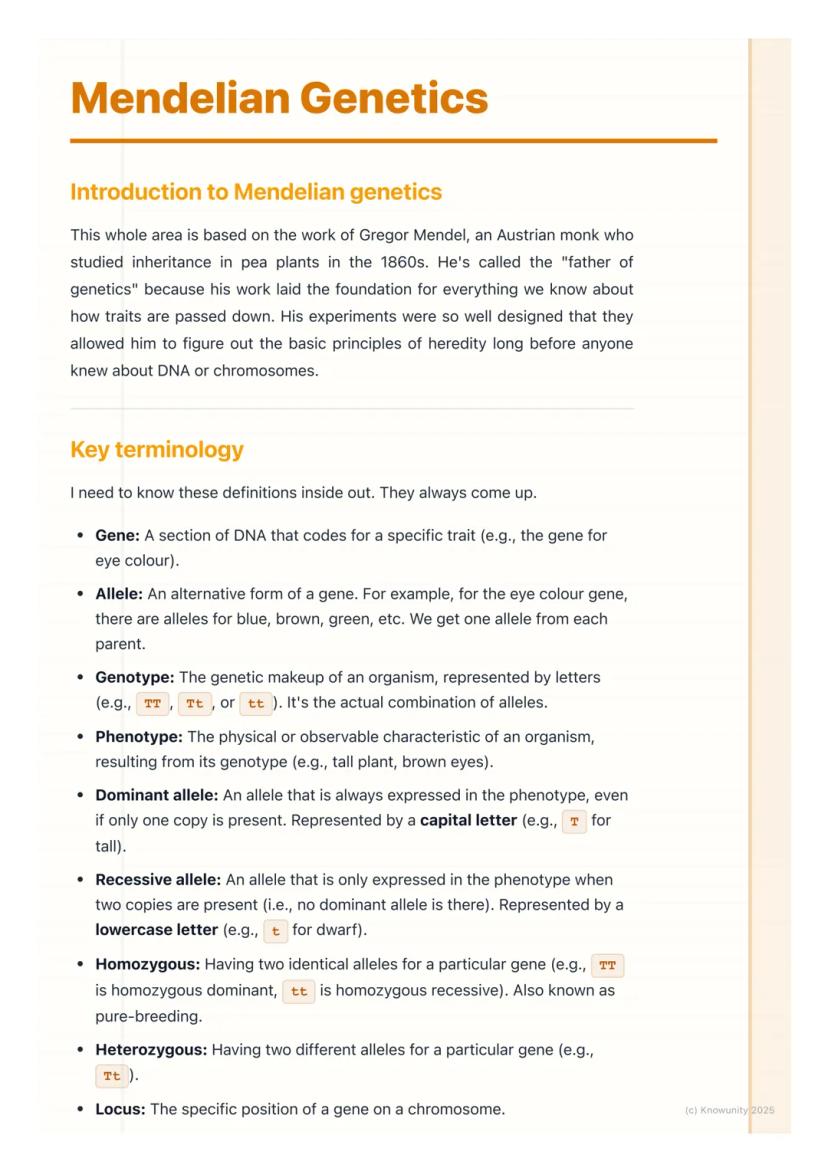
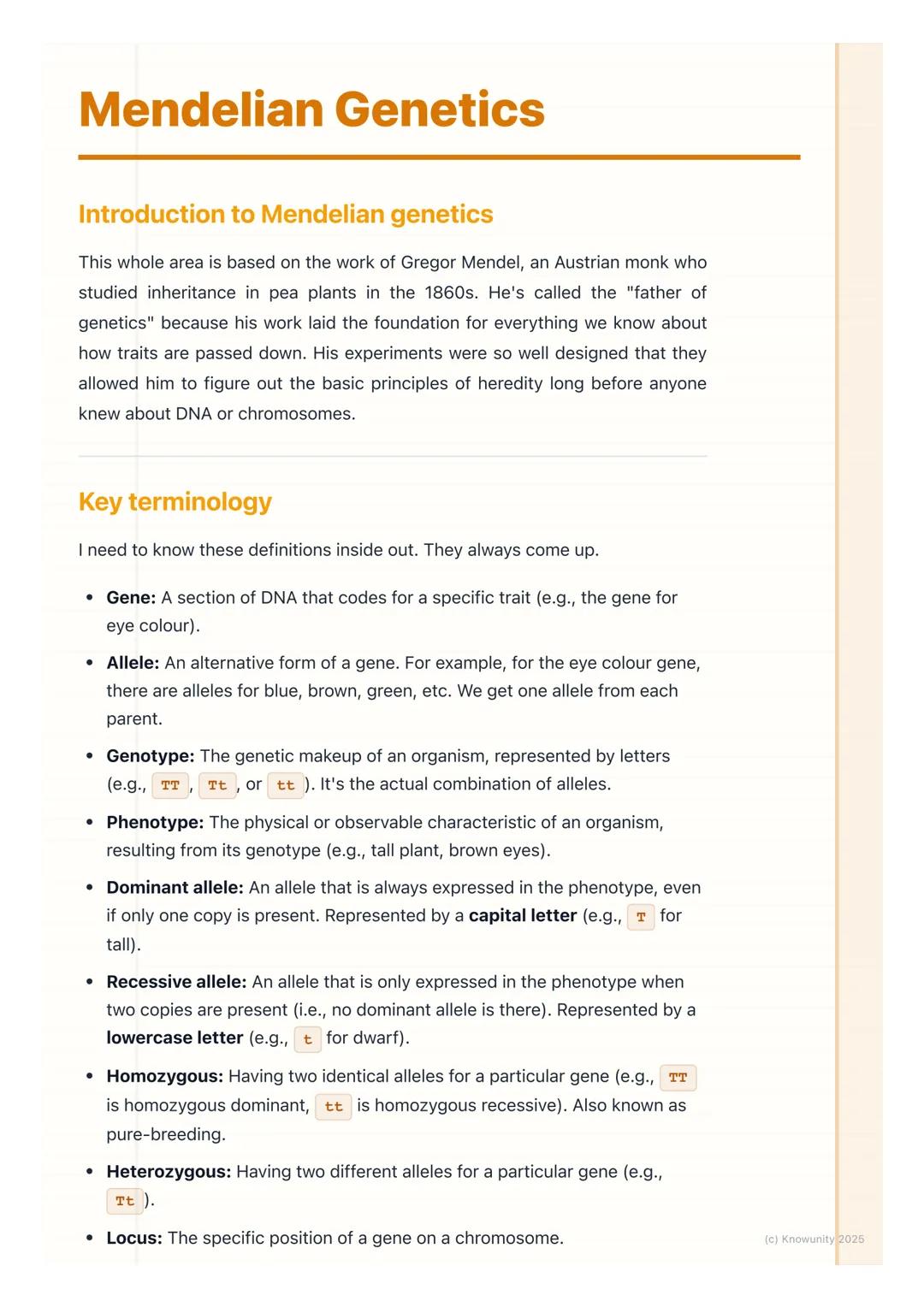
You'll need to nail the key terms first - they're the building blocks for everything else in genetics. A gene is basically a section of DNA that controls a specific trait, like eye colour. Alleles are different versions of the same gene (think blue eyes vs brown eyes).
Your genotype is the actual genetic code you carry (written as letters like TT or Tt), whilst your phenotype is what you actually look like. Dominant alleles (capital letters) always show up in your appearance, even if you only have one copy. Recessive alleles (lowercase letters) only appear when you have two copies.
Homozygous means having two identical alleles (like TT or tt), whilst heterozygous means having two different ones (like Tt). The generations have special names too: P generation (parents), F1 (first offspring), and F2 (second generation offspring).
Quick Tip: Think of alleles like different flavours of the same ice cream - same product, different varieties!
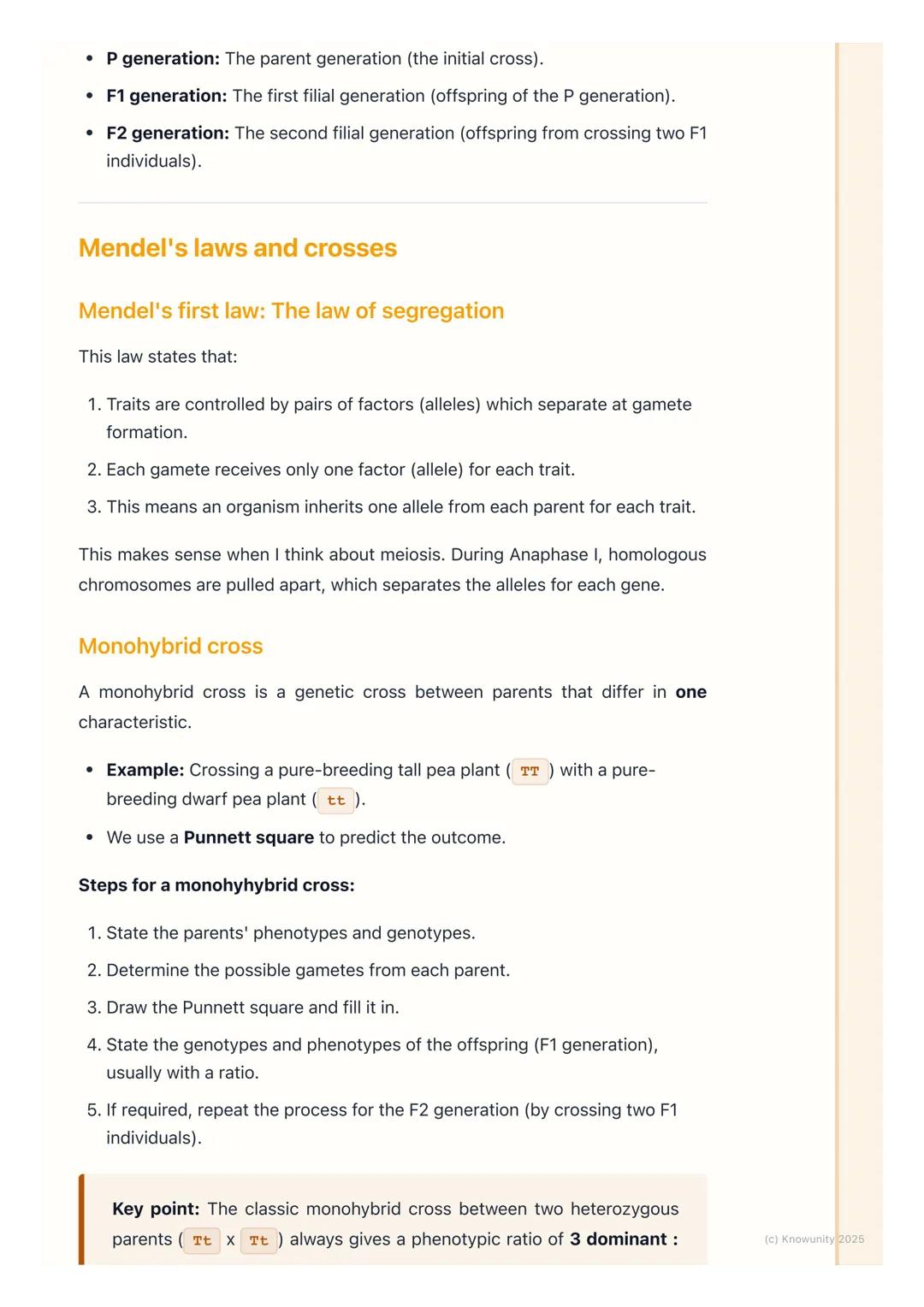
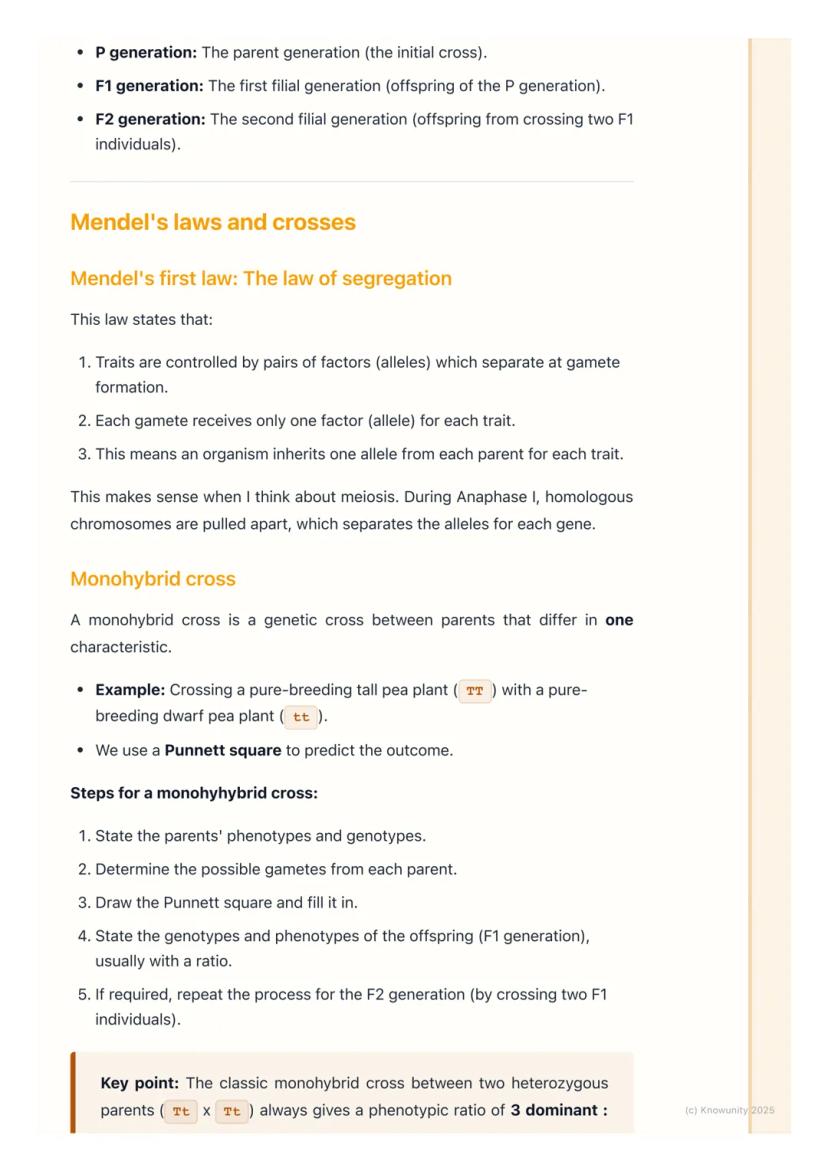
Mendel's first law (segregation) tells us that trait-controlling factors separate during gamete formation, so each parent only passes on one allele for each trait. This happens during meiosis when chromosomes get pulled apart.
A monohybrid cross tracks just one characteristic at a time. You'll use Punnett squares to predict outcomes - they're like genetic calculators! The classic example is crossing two heterozygous parents (Tt × Tt).
Here's your step-by-step process: state parent phenotypes and genotypes, work out possible gametes, draw your Punnett square, fill it in, then state the offspring ratios. The magic ratio you'll see constantly is 3:1 for phenotypes (3 dominant : 1 recessive) and 1:2:1 for genotypes.
Exam Gold: That 3:1 ratio from Tt × Tt crosses appears in loads of questions - memorise it!
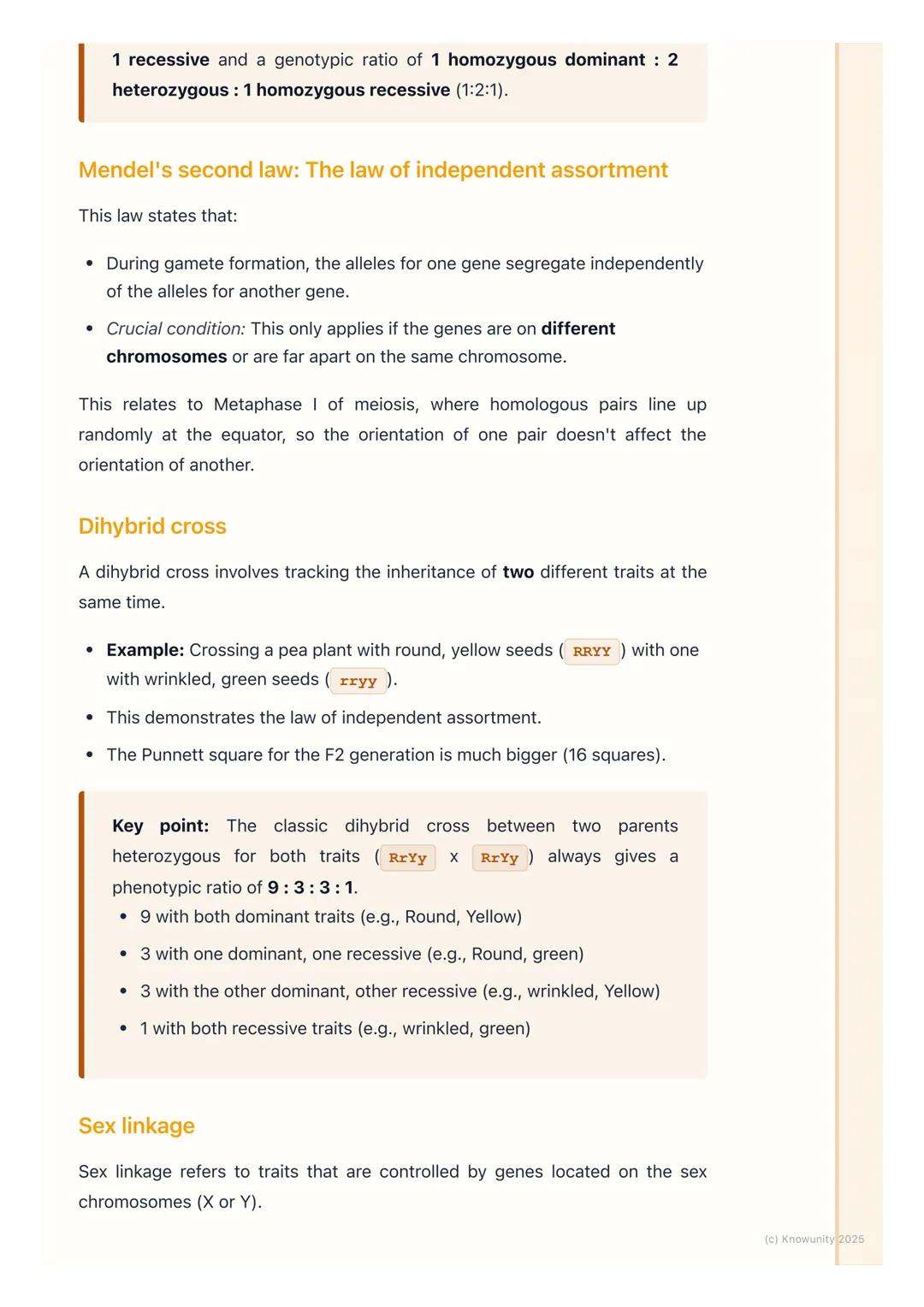
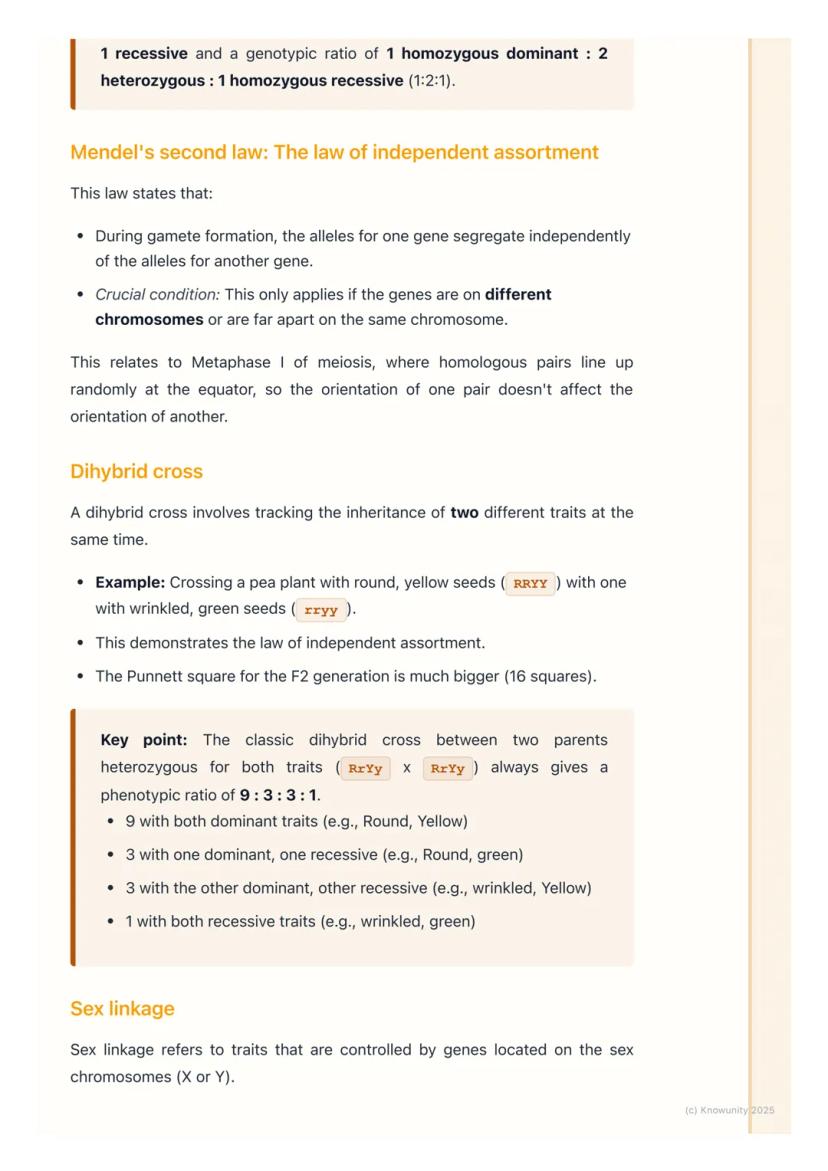
Mendel's second law (independent assortment) shows that different genes get inherited independently - but only if they're on different chromosomes or far apart on the same one. This relates to how chromosomes line up randomly during meiosis.
Dihybrid crosses track two traits simultaneously, like seed shape and colour. The Punnett square becomes much bigger (16 squares instead of 4), but don't panic - the process is the same.
When you cross two parents who are heterozygous for both traits (like RrYy × RrYy), you get the famous 9:3:3:1 ratio. That's 9 with both dominant traits, 3 with each mixed combination, and 1 with both recessive traits.
Sex linkage happens when genes sit on sex chromosomes. Most sex-linked traits are X-linked, which means males are more likely to show recessive traits since they only have one X chromosome.
Memory Trick: For dihybrid crosses, remember "9-3-3-1" - it's the genetic equivalent of a phone number!
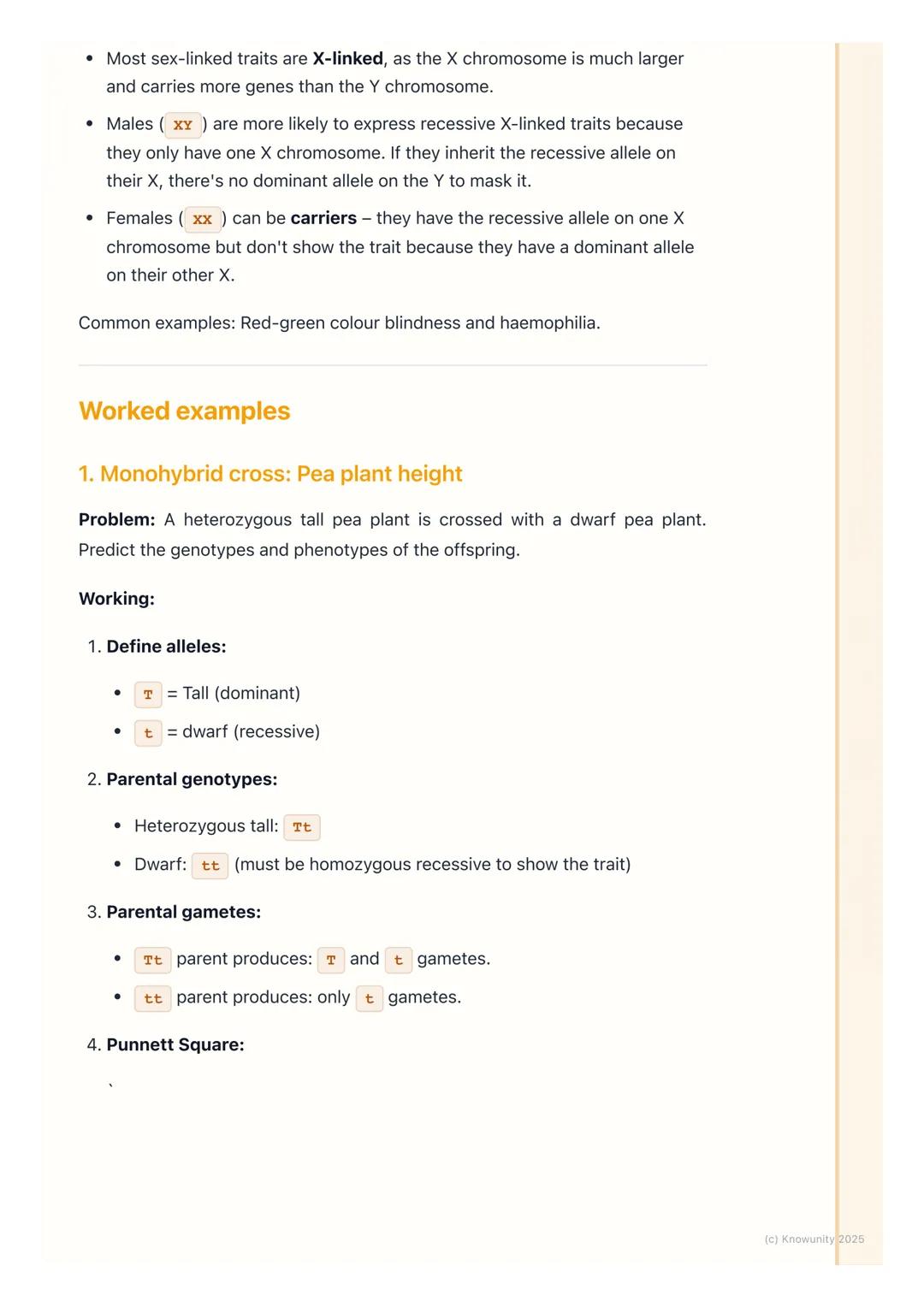
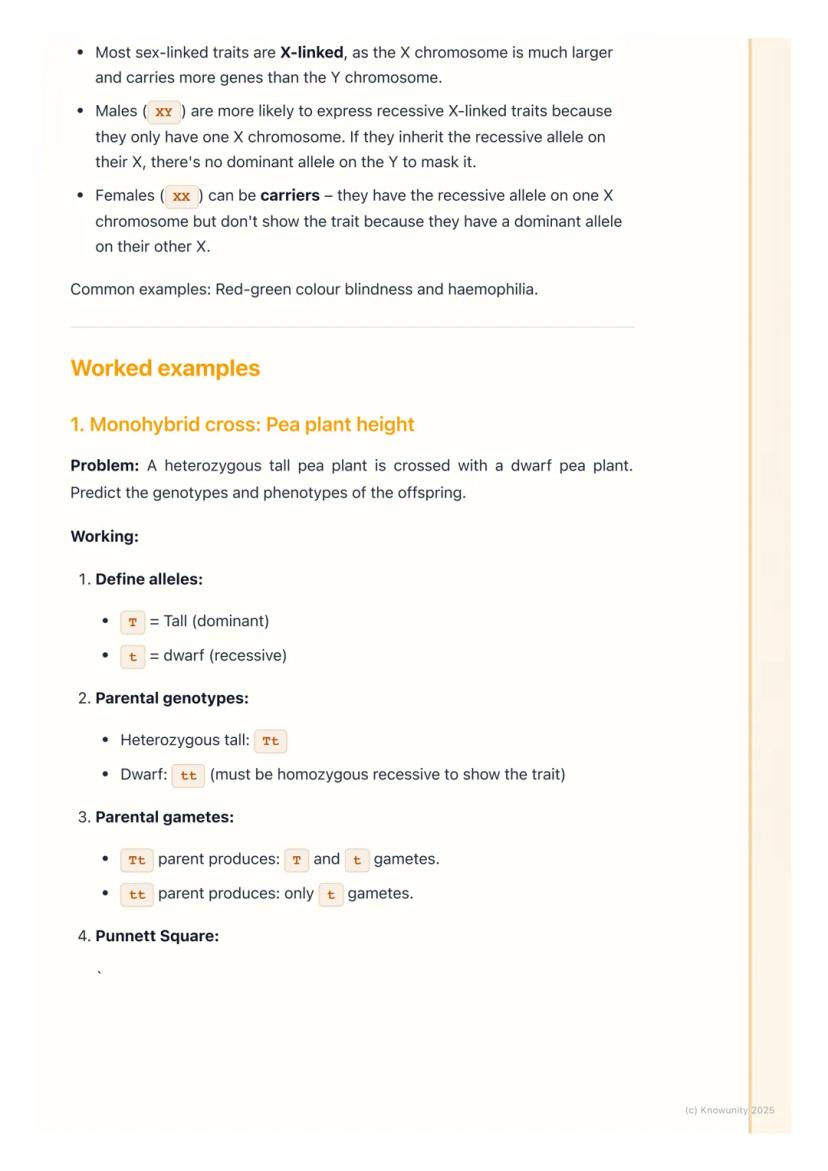
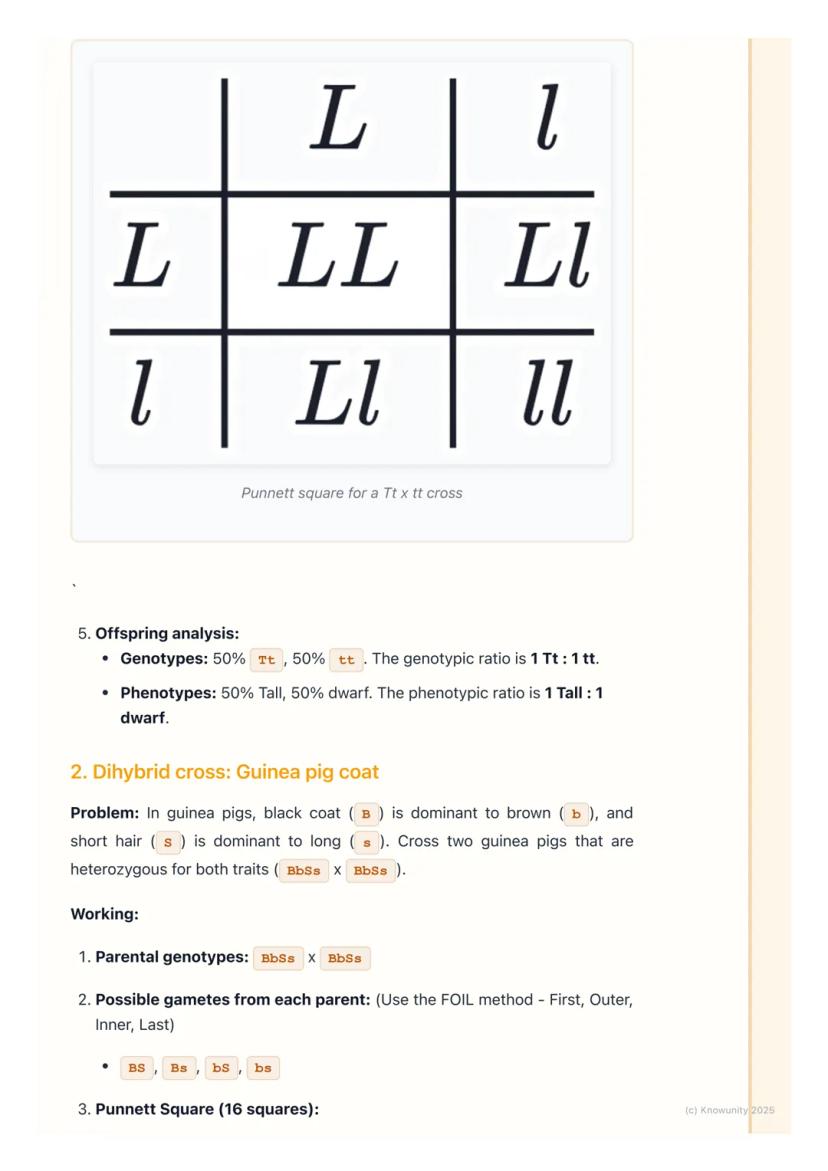
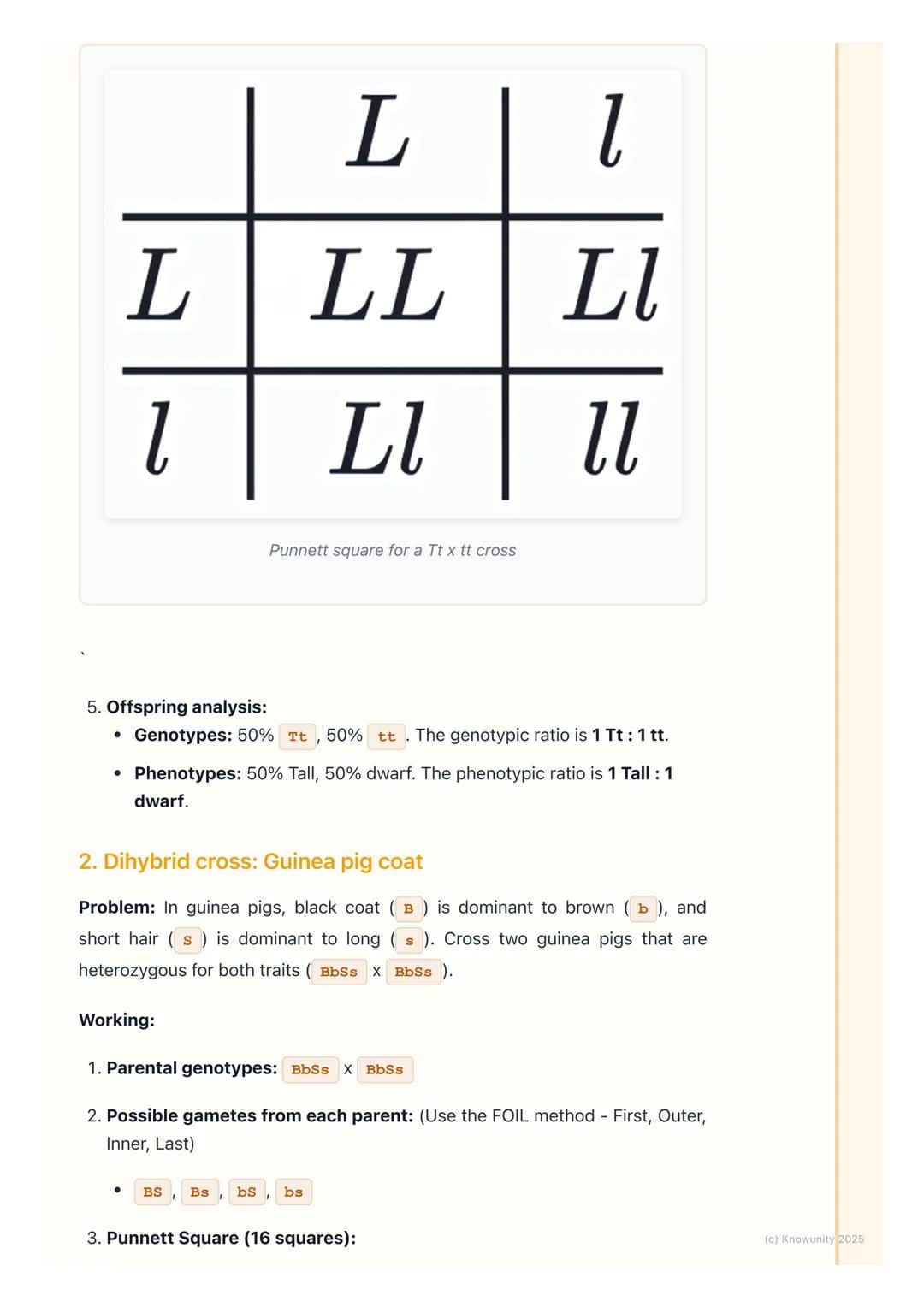
Let's tackle a monohybrid cross step by step. Say you're crossing a heterozygous tall plant (Tt) with a dwarf plant (tt). The tall plant produces T and t gametes, whilst the dwarf only produces t gametes.
Your Punnett square gives you 50% Tt (tall) and 50% tt (dwarf) offspring. Notice how this gives a 1:1 ratio instead of 3:1 - that's because one parent is homozygous recessive.
For sex-linked problems, always write alleles as superscripts on the X chromosome . Remember that the Y chromosome carries no allele for most X-linked traits.
The key is reading questions carefully - are they asking for the probability of any child having a trait, or specifically a son or daughter? Your answer format matters too (percentage, fraction, or ratio).
Pro Tip: Always show your working - even if you get the final answer wrong, you can still pick up marks for correct method!
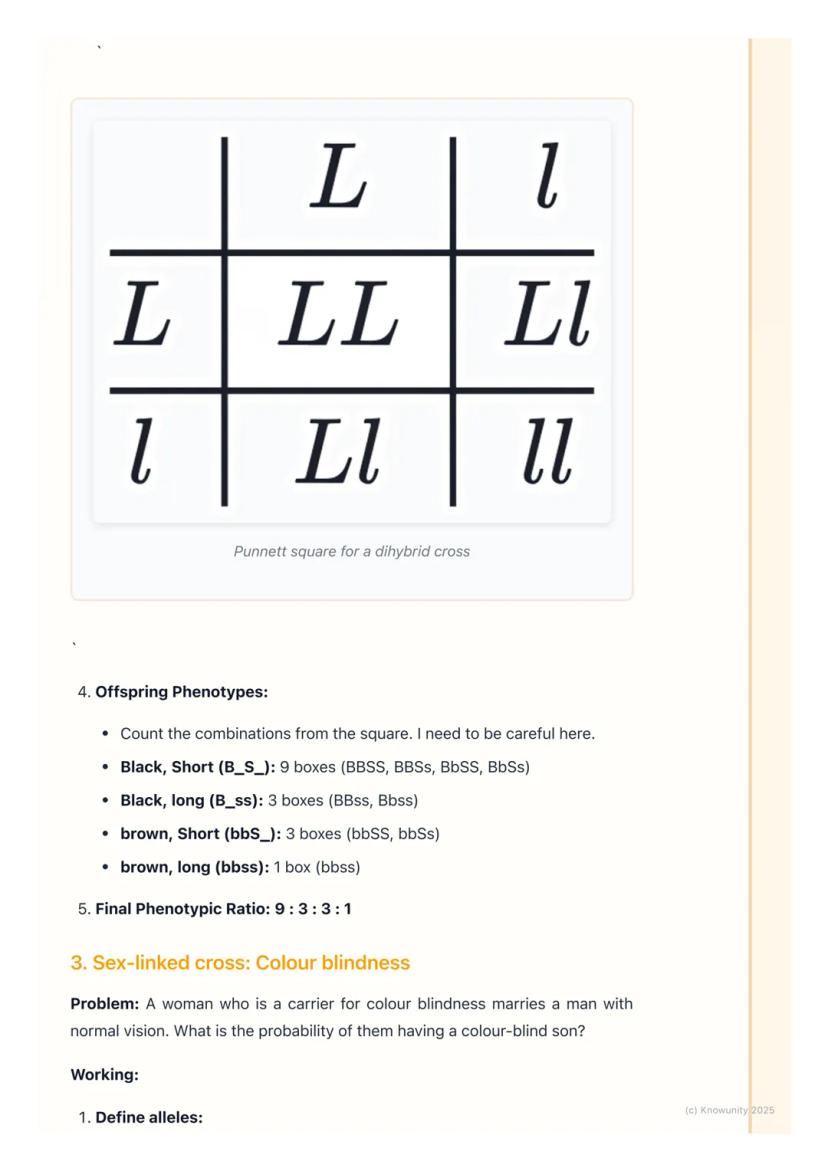
Guinea pig genetics makes a perfect dihybrid example! With black coat (B) dominant over brown (b), and short hair (S) dominant over long (s), let's cross two heterozygous parents (BbSs × BbSs).
Each parent can produce four different gamete types: BS, Bs, bS, and bs. Use the FOIL method (First, Outer, Inner, Last) to work these out systematically.
Your 16-square Punnett square will show the classic 9:3:3:1 phenotypic ratio. Count carefully: 9 black short-haired, 3 black long-haired, 3 brown short-haired, and 1 brown long-haired guinea pig.
This ratio appears whenever you cross two individuals who are heterozygous for both traits. It's one of the most important patterns in genetics, so make sure you can recognise and reproduce it.
Study Hack: Practice drawing 16-square Punnett squares until you can do them quickly - they're exam favourites!
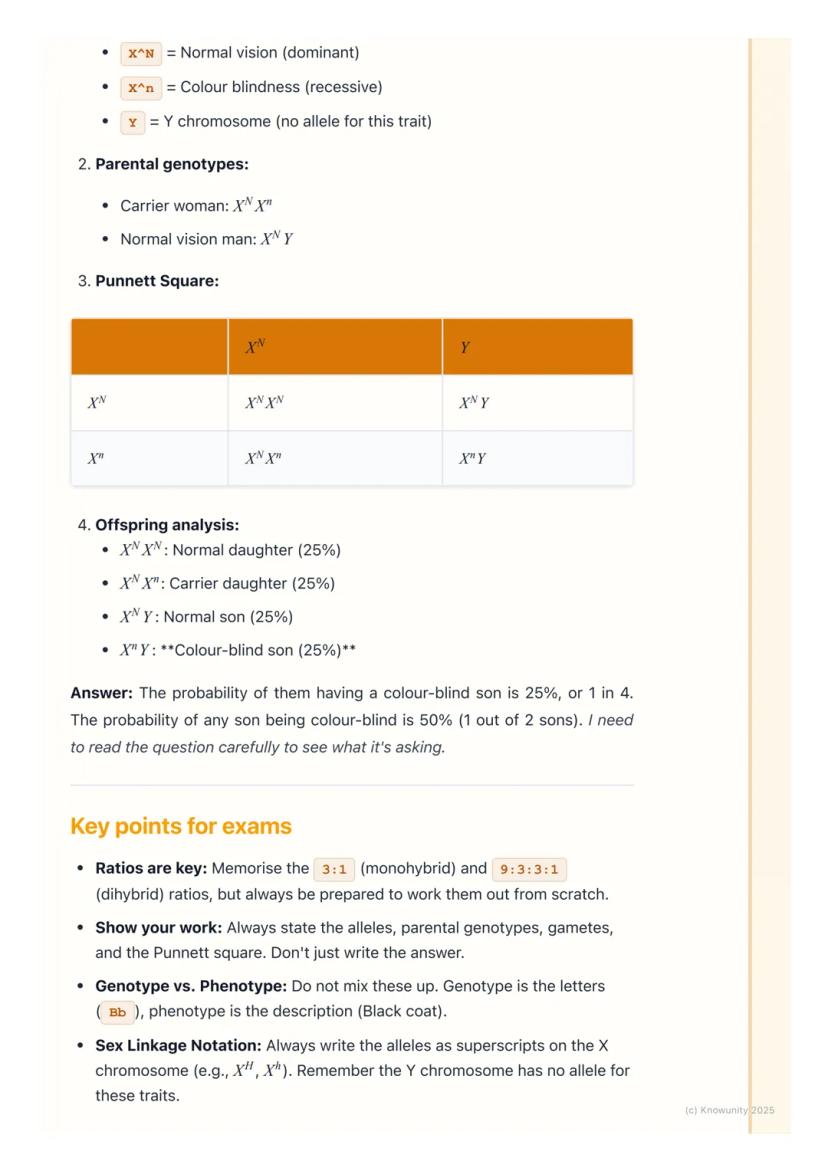
Sex-linked crosses work differently because the inheritance pattern depends on whether you're male or female. Let's look at colour blindness: a carrier woman married to a normal-vision man .
Their Punnett square shows four possible outcomes. Daughters can be normal or carriers , whilst sons can be normal or colour-blind .
The probability of having a colour-blind son is 25% of all children, but 50% of all sons. Always check what the question is actually asking for!
Males show X-linked recessive traits more often because they only need one copy of the recessive allele. Females need two copies, which is much less likely.
Remember: In sex-linkage, it's all about that X chromosome - males get their only copy from mum!
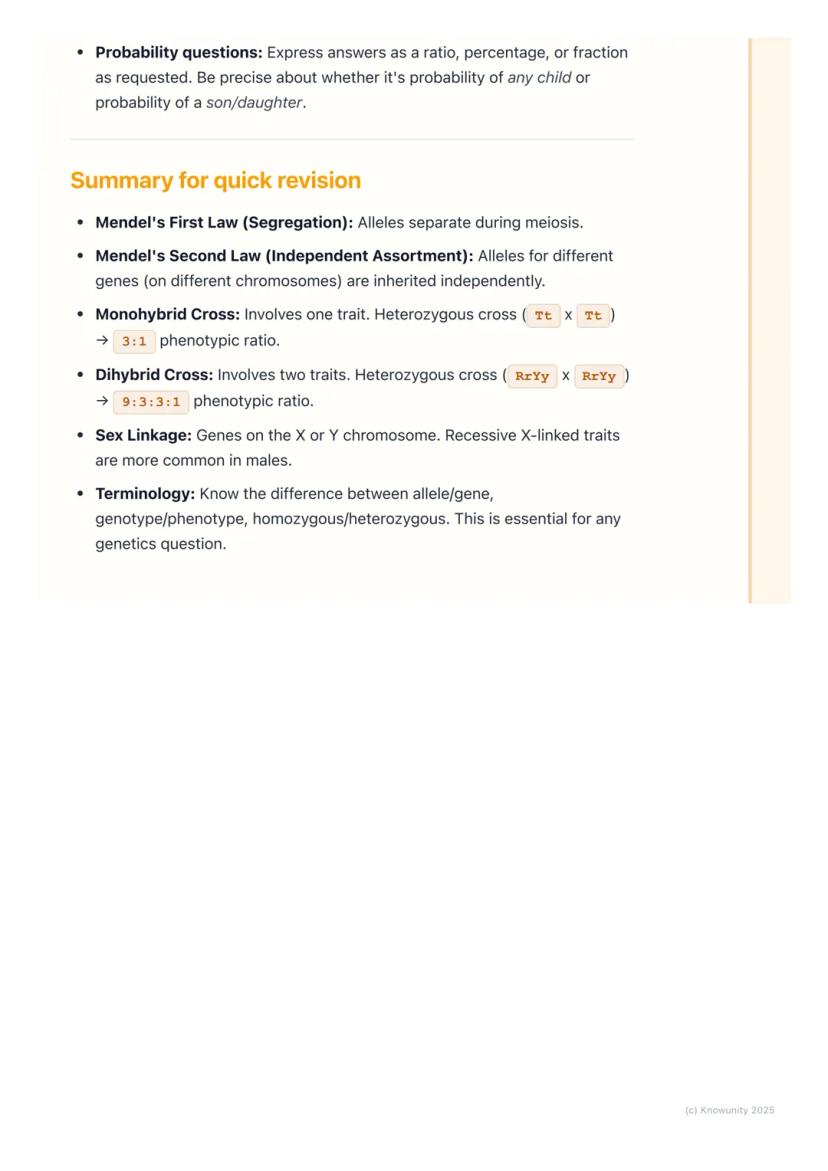
Your exam toolkit needs these essential ratios: 3:1 for monohybrid crosses and 9:3:3:1 for dihybrid crosses. But don't just memorise them - understand where they come from so you can work them out from scratch.
Always show your complete working: state your alleles, write parental genotypes, list possible gametes, draw your Punnett square, and calculate ratios. Even if you make an error early on, you can still earn marks for correct method.
Never mix up genotype (the letters like Bb) with phenotype (the description like "black coat"). This is a classic mistake that costs easy marks.
For probability questions, express answers exactly as requested - ratio, percentage, or fraction. Be precise about whether it's probability of any child or specifically a son or daughter having the trait.
Final Tip: Practice past paper questions until genetic crosses become second nature - repetition builds confidence!
Mendel's laws form the foundation: segregation (alleles separate during meiosis) and independent assortment (different genes inherit independently if on different chromosomes).
Cross types you must know: monohybrid (one trait, gives 3:1 ratio when both parents heterozygous) and dihybrid (two traits, gives 9:3:3:1 ratio when both parents heterozygous for both traits).
Sex-linkage means genes on sex chromosomes, with X-linked recessive traits more common in males since they only have one X chromosome.
Master your terminology: the difference between allele/gene, genotype/phenotype, and homozygous/heterozygous. These distinctions appear in every genetics question, so getting them right is non-negotiable for success.
Revision Gold: Create flashcards for all key terms - you'll need instant recall under exam pressure!
Nasz asystent AI jest specjalnie dostosowany do potrzeb uczniów. W oparciu o miliony treści, które mamy na platformie, możemy udzielać uczniom naprawdę znaczących i trafnych odpowiedzi. Ale nie chodzi tylko o odpowiedzi, towarzysz prowadzi również uczniów przez codzienne wyzwania związane z nauką, ze spersonalizowanymi planami nauki, quizami lub treściami na czacie i 100% personalizacją opartą na umiejętnościach i rozwoju uczniów.
Aplikację możesz pobrać z Google Play i Apple Store.
Tak, masz całkowicie darmowy dostęp do wszystkich notatek w aplikacji, możesz w każdej chwili rozmawiać z Ekspertami lub ich obserwować. Możesz użyć punktów, aby odblokować pewne funkcje w aplikacji, które również możesz otrzymać za darmo. Dodatkowo oferujemy usługę Knowunity Premium, która pozwala na odblokowanie większej liczby funkcji.
App Store
Google Play
Aplikacja jest bardzo prosta i dobrze przemyślana. Do tej pory znalazłem wszystko, czego szukałem i mogłem się wiele nauczyć z innych notatek! Na pewno wykorzystam aplikację do pomocy przy robieniu prac domowych! No i oczywiście bardzo pomaga też jako inspiracja do robienia swoich notatek.
Stefan S
użytkownik iOS
Ta aplikacja jest naprawdę świetna. Jest tak wiele notatek i pomocnych informacji [...]. Moim problematycznym przedmiotem jest język niemiecki, a w aplikacji jest w czym wybierać. Dzięki tej aplikacji poprawiłam swój niemiecki. Polecam ją każdemu.
Samantha Klich
użytkownik Androida
Wow, jestem w szoku. Właśnie wypróbowałam aplikację, ponieważ widziałam ją kilka razy reklamowaną na TikToku jestem absolutnie w szoku. Ta aplikacja jest POMOCĄ, której potrzebujesz w szkole i przede wszystkim oferuje tak wiele rzeczy jak notatki czy streszczenia, które są BARDZO pomocne w moim przypadku.
Anna
użytkownik iOS
Kocham tę aplikację! Pomaga mi w zadaniach domowych, motywuje mnie i polepsza mi dzień. Dzięki tej aplikacji moje oceny się poprawiły. Lepszej aplikacji nie znajdę!🩷
Patrycja
użytkowniczka iOS
Super aplikacja! Ma odpowiedzi na wszystkie zadania. Testuję ją od paru miesięcy i jest po prostu perfekcyjna.
Szymon
użytkownik Android
Super aplikacja do nauki i sprawdzania wiedzy. Można znaleźć notatki z WSZYSTKICH przedmiotów. Polecam tym, którzy celują w oceny 5 i 6 😄
Szymon
użytkownik iOS
Aplikacja jest po prostu świetna! Wystarczy, że wpiszę w pasku wyszukiwania swój temat i od razu mam wyniki. Nie muszę oglądać 10 filmów na YouTube, żeby coś zrozumieć, więc oszczędzam swój czas. Po prostu polecam!
Kuba T
użytkownik Androida
W szkole byłem bardzo kiepski z matematyki, ale dzięki tej aplikacji radzę sobie teraz lepiej. Jestem bardzo wdzięczny, że ją stworzyliście.
Kriss
użytkownik Androida
Korzystam z Knowunity od ponad roku i jest mega! Najlepsze opcje z tej apki: ⭐️ Gotowe notatki ⭐️ Spersonalizowane treści ⭐️ Dostęp do chatu GPT W WERSJI SZKOLNEJ ⭐️ Konwersacje z innymi uczniami 🤍 NAUKA WRESZCIE NIE JEST NUDNA 🤍
Gosia
użytkowniczka Android
Bardzo lubię aplikację Knowunity, ponieważ pomaga mi w nauce. Odkąd ją mam moje oceny się poprawiają :)
Sara
użytkowniczka iOS
QUIZY I FISZKI SĄ SUPER PRZYDATNE I UWIELBIAM Knowunity AI. TO JEST DOSŁOWNIE JAK CHATGPT ALE MĄDRZEJSZY!! POMÓGŁ MI NAWET Z PROBLEMAMI Z TUSZEM DO RZĘS!! A TAKŻE Z PRAWDZIWYMI PRZEDMIOTAMI! OCZYWIŚCIE 😍😁😲🤑💗✨🎀😮
Krzysztof
użytkownik Android
Bardzo fajna aplikacja. Pomaga przygotować się do sprawdzianu, kartkówki lub odpowiedzi ustnej.
Oliwia
użytkowniczka iOS
Aplikacja jest bardzo prosta i dobrze przemyślana. Do tej pory znalazłem wszystko, czego szukałem i mogłem się wiele nauczyć z innych notatek! Na pewno wykorzystam aplikację do pomocy przy robieniu prac domowych! No i oczywiście bardzo pomaga też jako inspiracja do robienia swoich notatek.
Stefan S
użytkownik iOS
Ta aplikacja jest naprawdę świetna. Jest tak wiele notatek i pomocnych informacji [...]. Moim problematycznym przedmiotem jest język niemiecki, a w aplikacji jest w czym wybierać. Dzięki tej aplikacji poprawiłam swój niemiecki. Polecam ją każdemu.
Samantha Klich
użytkownik Androida
Wow, jestem w szoku. Właśnie wypróbowałam aplikację, ponieważ widziałam ją kilka razy reklamowaną na TikToku jestem absolutnie w szoku. Ta aplikacja jest POMOCĄ, której potrzebujesz w szkole i przede wszystkim oferuje tak wiele rzeczy jak notatki czy streszczenia, które są BARDZO pomocne w moim przypadku.
Anna
użytkownik iOS
Kocham tę aplikację! Pomaga mi w zadaniach domowych, motywuje mnie i polepsza mi dzień. Dzięki tej aplikacji moje oceny się poprawiły. Lepszej aplikacji nie znajdę!🩷
Patrycja
użytkowniczka iOS
Super aplikacja! Ma odpowiedzi na wszystkie zadania. Testuję ją od paru miesięcy i jest po prostu perfekcyjna.
Szymon
użytkownik Android
Super aplikacja do nauki i sprawdzania wiedzy. Można znaleźć notatki z WSZYSTKICH przedmiotów. Polecam tym, którzy celują w oceny 5 i 6 😄
Szymon
użytkownik iOS
Aplikacja jest po prostu świetna! Wystarczy, że wpiszę w pasku wyszukiwania swój temat i od razu mam wyniki. Nie muszę oglądać 10 filmów na YouTube, żeby coś zrozumieć, więc oszczędzam swój czas. Po prostu polecam!
Kuba T
użytkownik Androida
W szkole byłem bardzo kiepski z matematyki, ale dzięki tej aplikacji radzę sobie teraz lepiej. Jestem bardzo wdzięczny, że ją stworzyliście.
Kriss
użytkownik Androida
Korzystam z Knowunity od ponad roku i jest mega! Najlepsze opcje z tej apki: ⭐️ Gotowe notatki ⭐️ Spersonalizowane treści ⭐️ Dostęp do chatu GPT W WERSJI SZKOLNEJ ⭐️ Konwersacje z innymi uczniami 🤍 NAUKA WRESZCIE NIE JEST NUDNA 🤍
Gosia
użytkowniczka Android
Bardzo lubię aplikację Knowunity, ponieważ pomaga mi w nauce. Odkąd ją mam moje oceny się poprawiają :)
Sara
użytkowniczka iOS
QUIZY I FISZKI SĄ SUPER PRZYDATNE I UWIELBIAM Knowunity AI. TO JEST DOSŁOWNIE JAK CHATGPT ALE MĄDRZEJSZY!! POMÓGŁ MI NAWET Z PROBLEMAMI Z TUSZEM DO RZĘS!! A TAKŻE Z PRAWDZIWYMI PRZEDMIOTAMI! OCZYWIŚCIE 😍😁😲🤑💗✨🎀😮
Krzysztof
użytkownik Android
Bardzo fajna aplikacja. Pomaga przygotować się do sprawdzianu, kartkówki lub odpowiedzi ustnej.
Oliwia
użytkowniczka iOS
Ever wondered why you have your mum's eyes or your dad's height? It all comes down to genetics! Gregor Mendel, an Austrian monk from the 1860s, figured out the basic rules of inheritance by studying pea plants, and his discoveries... Pokaż więcej
Dostęp do wszystkich materiałów
Popraw swoje oceny
Dołącz do milionów studentów
You'll need to nail the key terms first - they're the building blocks for everything else in genetics. A gene is basically a section of DNA that controls a specific trait, like eye colour. Alleles are different versions of the same gene (think blue eyes vs brown eyes).
Your genotype is the actual genetic code you carry (written as letters like TT or Tt), whilst your phenotype is what you actually look like. Dominant alleles (capital letters) always show up in your appearance, even if you only have one copy. Recessive alleles (lowercase letters) only appear when you have two copies.
Homozygous means having two identical alleles (like TT or tt), whilst heterozygous means having two different ones (like Tt). The generations have special names too: P generation (parents), F1 (first offspring), and F2 (second generation offspring).
Quick Tip: Think of alleles like different flavours of the same ice cream - same product, different varieties!
Dostęp do wszystkich materiałów
Popraw swoje oceny
Dołącz do milionów studentów
Mendel's first law (segregation) tells us that trait-controlling factors separate during gamete formation, so each parent only passes on one allele for each trait. This happens during meiosis when chromosomes get pulled apart.
A monohybrid cross tracks just one characteristic at a time. You'll use Punnett squares to predict outcomes - they're like genetic calculators! The classic example is crossing two heterozygous parents (Tt × Tt).
Here's your step-by-step process: state parent phenotypes and genotypes, work out possible gametes, draw your Punnett square, fill it in, then state the offspring ratios. The magic ratio you'll see constantly is 3:1 for phenotypes (3 dominant : 1 recessive) and 1:2:1 for genotypes.
Exam Gold: That 3:1 ratio from Tt × Tt crosses appears in loads of questions - memorise it!
Dostęp do wszystkich materiałów
Popraw swoje oceny
Dołącz do milionów studentów
Mendel's second law (independent assortment) shows that different genes get inherited independently - but only if they're on different chromosomes or far apart on the same one. This relates to how chromosomes line up randomly during meiosis.
Dihybrid crosses track two traits simultaneously, like seed shape and colour. The Punnett square becomes much bigger (16 squares instead of 4), but don't panic - the process is the same.
When you cross two parents who are heterozygous for both traits (like RrYy × RrYy), you get the famous 9:3:3:1 ratio. That's 9 with both dominant traits, 3 with each mixed combination, and 1 with both recessive traits.
Sex linkage happens when genes sit on sex chromosomes. Most sex-linked traits are X-linked, which means males are more likely to show recessive traits since they only have one X chromosome.
Memory Trick: For dihybrid crosses, remember "9-3-3-1" - it's the genetic equivalent of a phone number!
Dostęp do wszystkich materiałów
Popraw swoje oceny
Dołącz do milionów studentów
Let's tackle a monohybrid cross step by step. Say you're crossing a heterozygous tall plant (Tt) with a dwarf plant (tt). The tall plant produces T and t gametes, whilst the dwarf only produces t gametes.
Your Punnett square gives you 50% Tt (tall) and 50% tt (dwarf) offspring. Notice how this gives a 1:1 ratio instead of 3:1 - that's because one parent is homozygous recessive.
For sex-linked problems, always write alleles as superscripts on the X chromosome . Remember that the Y chromosome carries no allele for most X-linked traits.
The key is reading questions carefully - are they asking for the probability of any child having a trait, or specifically a son or daughter? Your answer format matters too (percentage, fraction, or ratio).
Pro Tip: Always show your working - even if you get the final answer wrong, you can still pick up marks for correct method!
Dostęp do wszystkich materiałów
Popraw swoje oceny
Dołącz do milionów studentów
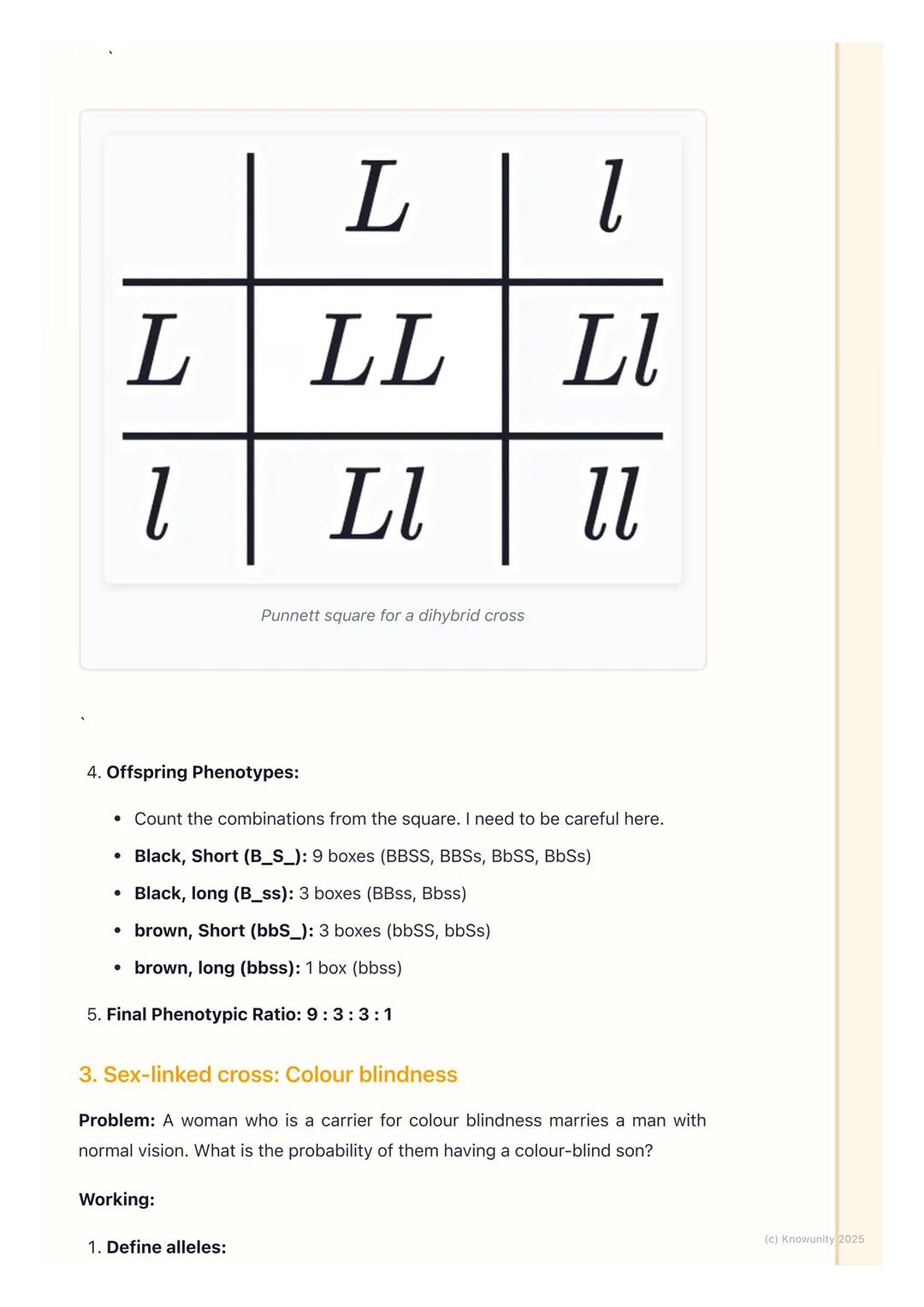
Guinea pig genetics makes a perfect dihybrid example! With black coat (B) dominant over brown (b), and short hair (S) dominant over long (s), let's cross two heterozygous parents (BbSs × BbSs).
Each parent can produce four different gamete types: BS, Bs, bS, and bs. Use the FOIL method (First, Outer, Inner, Last) to work these out systematically.
Your 16-square Punnett square will show the classic 9:3:3:1 phenotypic ratio. Count carefully: 9 black short-haired, 3 black long-haired, 3 brown short-haired, and 1 brown long-haired guinea pig.
This ratio appears whenever you cross two individuals who are heterozygous for both traits. It's one of the most important patterns in genetics, so make sure you can recognise and reproduce it.
Study Hack: Practice drawing 16-square Punnett squares until you can do them quickly - they're exam favourites!
Dostęp do wszystkich materiałów
Popraw swoje oceny
Dołącz do milionów studentów
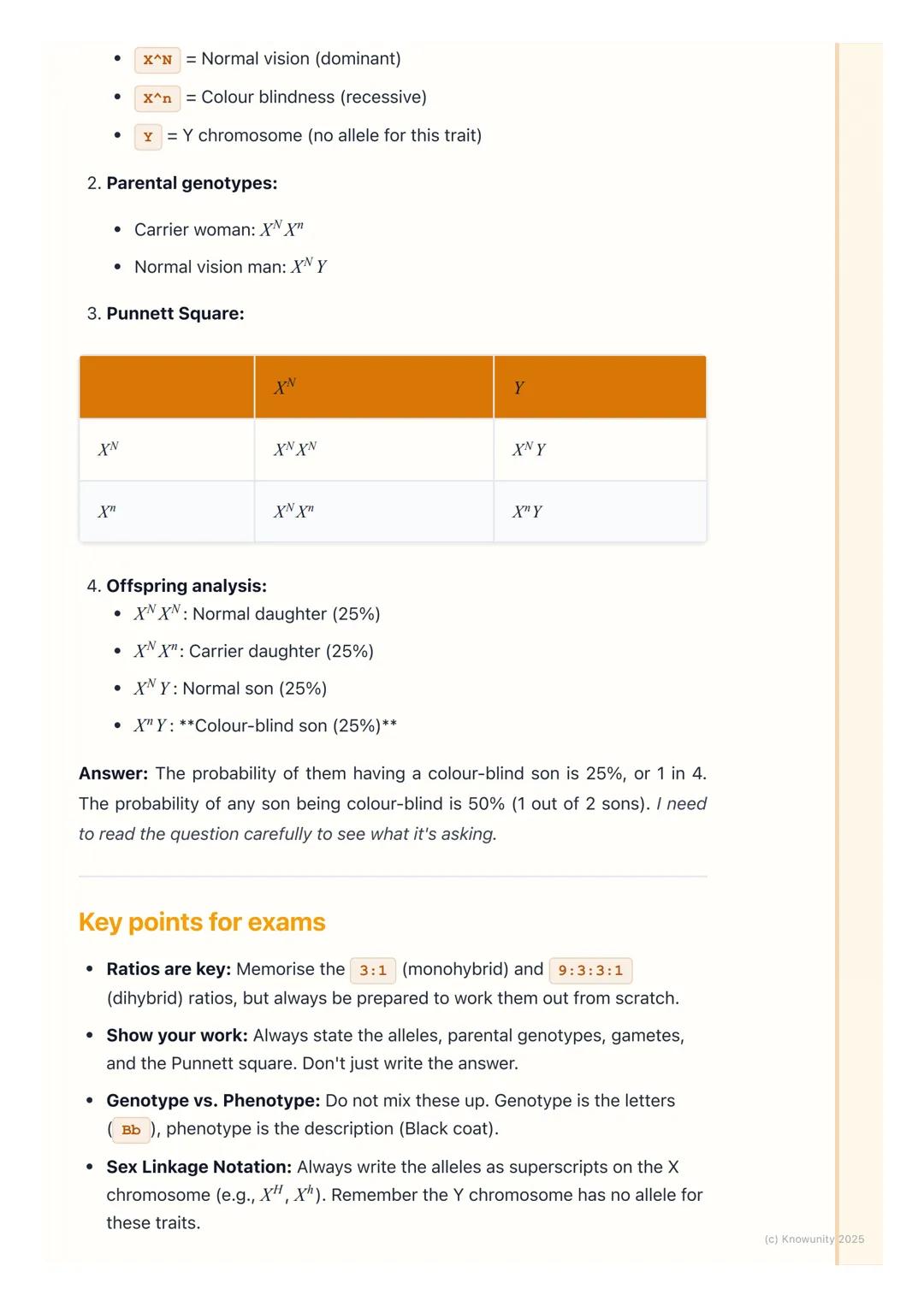
Sex-linked crosses work differently because the inheritance pattern depends on whether you're male or female. Let's look at colour blindness: a carrier woman married to a normal-vision man .
Their Punnett square shows four possible outcomes. Daughters can be normal or carriers , whilst sons can be normal or colour-blind .
The probability of having a colour-blind son is 25% of all children, but 50% of all sons. Always check what the question is actually asking for!
Males show X-linked recessive traits more often because they only need one copy of the recessive allele. Females need two copies, which is much less likely.
Remember: In sex-linkage, it's all about that X chromosome - males get their only copy from mum!
Dostęp do wszystkich materiałów
Popraw swoje oceny
Dołącz do milionów studentów
Your exam toolkit needs these essential ratios: 3:1 for monohybrid crosses and 9:3:3:1 for dihybrid crosses. But don't just memorise them - understand where they come from so you can work them out from scratch.
Always show your complete working: state your alleles, write parental genotypes, list possible gametes, draw your Punnett square, and calculate ratios. Even if you make an error early on, you can still earn marks for correct method.
Never mix up genotype (the letters like Bb) with phenotype (the description like "black coat"). This is a classic mistake that costs easy marks.
For probability questions, express answers exactly as requested - ratio, percentage, or fraction. Be precise about whether it's probability of any child or specifically a son or daughter having the trait.
Final Tip: Practice past paper questions until genetic crosses become second nature - repetition builds confidence!
Dostęp do wszystkich materiałów
Popraw swoje oceny
Dołącz do milionów studentów
Mendel's laws form the foundation: segregation (alleles separate during meiosis) and independent assortment (different genes inherit independently if on different chromosomes).
Cross types you must know: monohybrid (one trait, gives 3:1 ratio when both parents heterozygous) and dihybrid (two traits, gives 9:3:3:1 ratio when both parents heterozygous for both traits).
Sex-linkage means genes on sex chromosomes, with X-linked recessive traits more common in males since they only have one X chromosome.
Master your terminology: the difference between allele/gene, genotype/phenotype, and homozygous/heterozygous. These distinctions appear in every genetics question, so getting them right is non-negotiable for success.
Revision Gold: Create flashcards for all key terms - you'll need instant recall under exam pressure!
Nasz asystent AI jest specjalnie dostosowany do potrzeb uczniów. W oparciu o miliony treści, które mamy na platformie, możemy udzielać uczniom naprawdę znaczących i trafnych odpowiedzi. Ale nie chodzi tylko o odpowiedzi, towarzysz prowadzi również uczniów przez codzienne wyzwania związane z nauką, ze spersonalizowanymi planami nauki, quizami lub treściami na czacie i 100% personalizacją opartą na umiejętnościach i rozwoju uczniów.
Aplikację możesz pobrać z Google Play i Apple Store.
Tak, masz całkowicie darmowy dostęp do wszystkich notatek w aplikacji, możesz w każdej chwili rozmawiać z Ekspertami lub ich obserwować. Możesz użyć punktów, aby odblokować pewne funkcje w aplikacji, które również możesz otrzymać za darmo. Dodatkowo oferujemy usługę Knowunity Premium, która pozwala na odblokowanie większej liczby funkcji.
0
Inteligentne Narzędzia NOWE
Przekształć te notatki w: ✓ 50+ Pytań Testowych ✓ Interaktywne Fiszki ✓ Pełny egzamin próbny ✓ Plany Eseju
App Store
Google Play
Aplikacja jest bardzo prosta i dobrze przemyślana. Do tej pory znalazłem wszystko, czego szukałem i mogłem się wiele nauczyć z innych notatek! Na pewno wykorzystam aplikację do pomocy przy robieniu prac domowych! No i oczywiście bardzo pomaga też jako inspiracja do robienia swoich notatek.
Stefan S
użytkownik iOS
Ta aplikacja jest naprawdę świetna. Jest tak wiele notatek i pomocnych informacji [...]. Moim problematycznym przedmiotem jest język niemiecki, a w aplikacji jest w czym wybierać. Dzięki tej aplikacji poprawiłam swój niemiecki. Polecam ją każdemu.
Samantha Klich
użytkownik Androida
Wow, jestem w szoku. Właśnie wypróbowałam aplikację, ponieważ widziałam ją kilka razy reklamowaną na TikToku jestem absolutnie w szoku. Ta aplikacja jest POMOCĄ, której potrzebujesz w szkole i przede wszystkim oferuje tak wiele rzeczy jak notatki czy streszczenia, które są BARDZO pomocne w moim przypadku.
Anna
użytkownik iOS
Kocham tę aplikację! Pomaga mi w zadaniach domowych, motywuje mnie i polepsza mi dzień. Dzięki tej aplikacji moje oceny się poprawiły. Lepszej aplikacji nie znajdę!🩷
Patrycja
użytkowniczka iOS
Super aplikacja! Ma odpowiedzi na wszystkie zadania. Testuję ją od paru miesięcy i jest po prostu perfekcyjna.
Szymon
użytkownik Android
Super aplikacja do nauki i sprawdzania wiedzy. Można znaleźć notatki z WSZYSTKICH przedmiotów. Polecam tym, którzy celują w oceny 5 i 6 😄
Szymon
użytkownik iOS
Aplikacja jest po prostu świetna! Wystarczy, że wpiszę w pasku wyszukiwania swój temat i od razu mam wyniki. Nie muszę oglądać 10 filmów na YouTube, żeby coś zrozumieć, więc oszczędzam swój czas. Po prostu polecam!
Kuba T
użytkownik Androida
W szkole byłem bardzo kiepski z matematyki, ale dzięki tej aplikacji radzę sobie teraz lepiej. Jestem bardzo wdzięczny, że ją stworzyliście.
Kriss
użytkownik Androida
Korzystam z Knowunity od ponad roku i jest mega! Najlepsze opcje z tej apki: ⭐️ Gotowe notatki ⭐️ Spersonalizowane treści ⭐️ Dostęp do chatu GPT W WERSJI SZKOLNEJ ⭐️ Konwersacje z innymi uczniami 🤍 NAUKA WRESZCIE NIE JEST NUDNA 🤍
Gosia
użytkowniczka Android
Bardzo lubię aplikację Knowunity, ponieważ pomaga mi w nauce. Odkąd ją mam moje oceny się poprawiają :)
Sara
użytkowniczka iOS
QUIZY I FISZKI SĄ SUPER PRZYDATNE I UWIELBIAM Knowunity AI. TO JEST DOSŁOWNIE JAK CHATGPT ALE MĄDRZEJSZY!! POMÓGŁ MI NAWET Z PROBLEMAMI Z TUSZEM DO RZĘS!! A TAKŻE Z PRAWDZIWYMI PRZEDMIOTAMI! OCZYWIŚCIE 😍😁😲🤑💗✨🎀😮
Krzysztof
użytkownik Android
Bardzo fajna aplikacja. Pomaga przygotować się do sprawdzianu, kartkówki lub odpowiedzi ustnej.
Oliwia
użytkowniczka iOS
Aplikacja jest bardzo prosta i dobrze przemyślana. Do tej pory znalazłem wszystko, czego szukałem i mogłem się wiele nauczyć z innych notatek! Na pewno wykorzystam aplikację do pomocy przy robieniu prac domowych! No i oczywiście bardzo pomaga też jako inspiracja do robienia swoich notatek.
Stefan S
użytkownik iOS
Ta aplikacja jest naprawdę świetna. Jest tak wiele notatek i pomocnych informacji [...]. Moim problematycznym przedmiotem jest język niemiecki, a w aplikacji jest w czym wybierać. Dzięki tej aplikacji poprawiłam swój niemiecki. Polecam ją każdemu.
Samantha Klich
użytkownik Androida
Wow, jestem w szoku. Właśnie wypróbowałam aplikację, ponieważ widziałam ją kilka razy reklamowaną na TikToku jestem absolutnie w szoku. Ta aplikacja jest POMOCĄ, której potrzebujesz w szkole i przede wszystkim oferuje tak wiele rzeczy jak notatki czy streszczenia, które są BARDZO pomocne w moim przypadku.
Anna
użytkownik iOS
Kocham tę aplikację! Pomaga mi w zadaniach domowych, motywuje mnie i polepsza mi dzień. Dzięki tej aplikacji moje oceny się poprawiły. Lepszej aplikacji nie znajdę!🩷
Patrycja
użytkowniczka iOS
Super aplikacja! Ma odpowiedzi na wszystkie zadania. Testuję ją od paru miesięcy i jest po prostu perfekcyjna.
Szymon
użytkownik Android
Super aplikacja do nauki i sprawdzania wiedzy. Można znaleźć notatki z WSZYSTKICH przedmiotów. Polecam tym, którzy celują w oceny 5 i 6 😄
Szymon
użytkownik iOS
Aplikacja jest po prostu świetna! Wystarczy, że wpiszę w pasku wyszukiwania swój temat i od razu mam wyniki. Nie muszę oglądać 10 filmów na YouTube, żeby coś zrozumieć, więc oszczędzam swój czas. Po prostu polecam!
Kuba T
użytkownik Androida
W szkole byłem bardzo kiepski z matematyki, ale dzięki tej aplikacji radzę sobie teraz lepiej. Jestem bardzo wdzięczny, że ją stworzyliście.
Kriss
użytkownik Androida
Korzystam z Knowunity od ponad roku i jest mega! Najlepsze opcje z tej apki: ⭐️ Gotowe notatki ⭐️ Spersonalizowane treści ⭐️ Dostęp do chatu GPT W WERSJI SZKOLNEJ ⭐️ Konwersacje z innymi uczniami 🤍 NAUKA WRESZCIE NIE JEST NUDNA 🤍
Gosia
użytkowniczka Android
Bardzo lubię aplikację Knowunity, ponieważ pomaga mi w nauce. Odkąd ją mam moje oceny się poprawiają :)
Sara
użytkowniczka iOS
QUIZY I FISZKI SĄ SUPER PRZYDATNE I UWIELBIAM Knowunity AI. TO JEST DOSŁOWNIE JAK CHATGPT ALE MĄDRZEJSZY!! POMÓGŁ MI NAWET Z PROBLEMAMI Z TUSZEM DO RZĘS!! A TAKŻE Z PRAWDZIWYMI PRZEDMIOTAMI! OCZYWIŚCIE 😍😁😲🤑💗✨🎀😮
Krzysztof
użytkownik Android
Bardzo fajna aplikacja. Pomaga przygotować się do sprawdzianu, kartkówki lub odpowiedzi ustnej.
Oliwia
użytkowniczka iOS