
Ever wondered why bridges aren't made of glass or why... Pokaż więcej
 Engineering2 wyświetleń·Zaktualizowano May 27, 2026·6 strony
Understanding the Properties of Materials: A Comprehensive Guide
1 / 6
1
of 6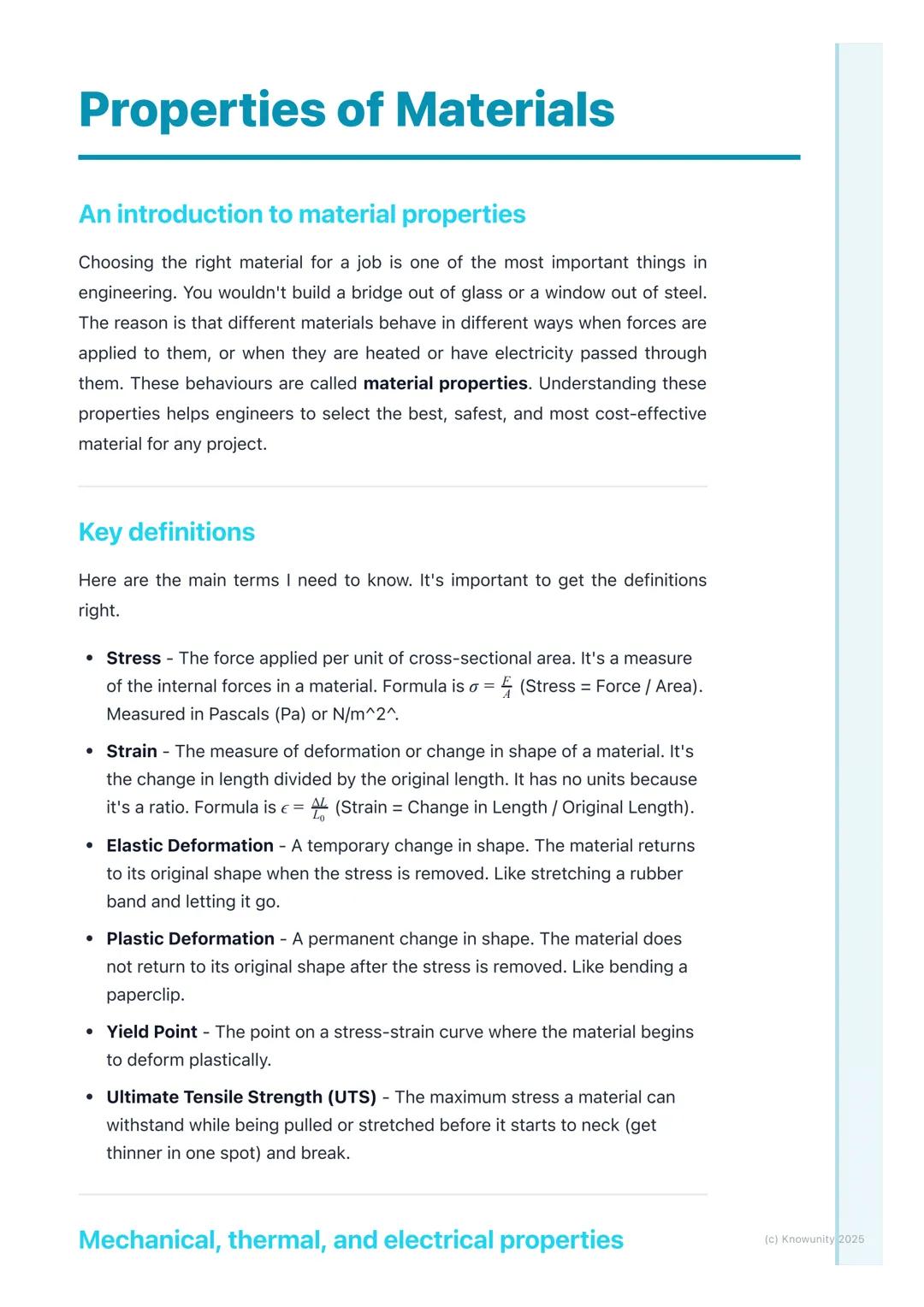
Understanding the Basics
Before diving into specific properties, you need to grasp a few key concepts that form the foundation of materials science. Stress is the force applied per unit area , measured in Pascals. Think of it as how much pressure you're putting on a material.
Strain is how much a material deforms compared to its original size . Unlike stress, strain has no units because it's just a ratio. These two concepts work together to describe how materials respond to forces.
Materials can undergo two types of deformation. Elastic deformation is temporary - like stretching a rubber band that snaps back. Plastic deformation is permanent - like bending a paperclip that stays bent. The yield point marks where elastic becomes plastic, whilst ultimate tensile strength shows the maximum stress before breaking.
Key Insight: Understanding stress and strain is crucial for predicting how any material will behave under real-world conditions.
2
of 6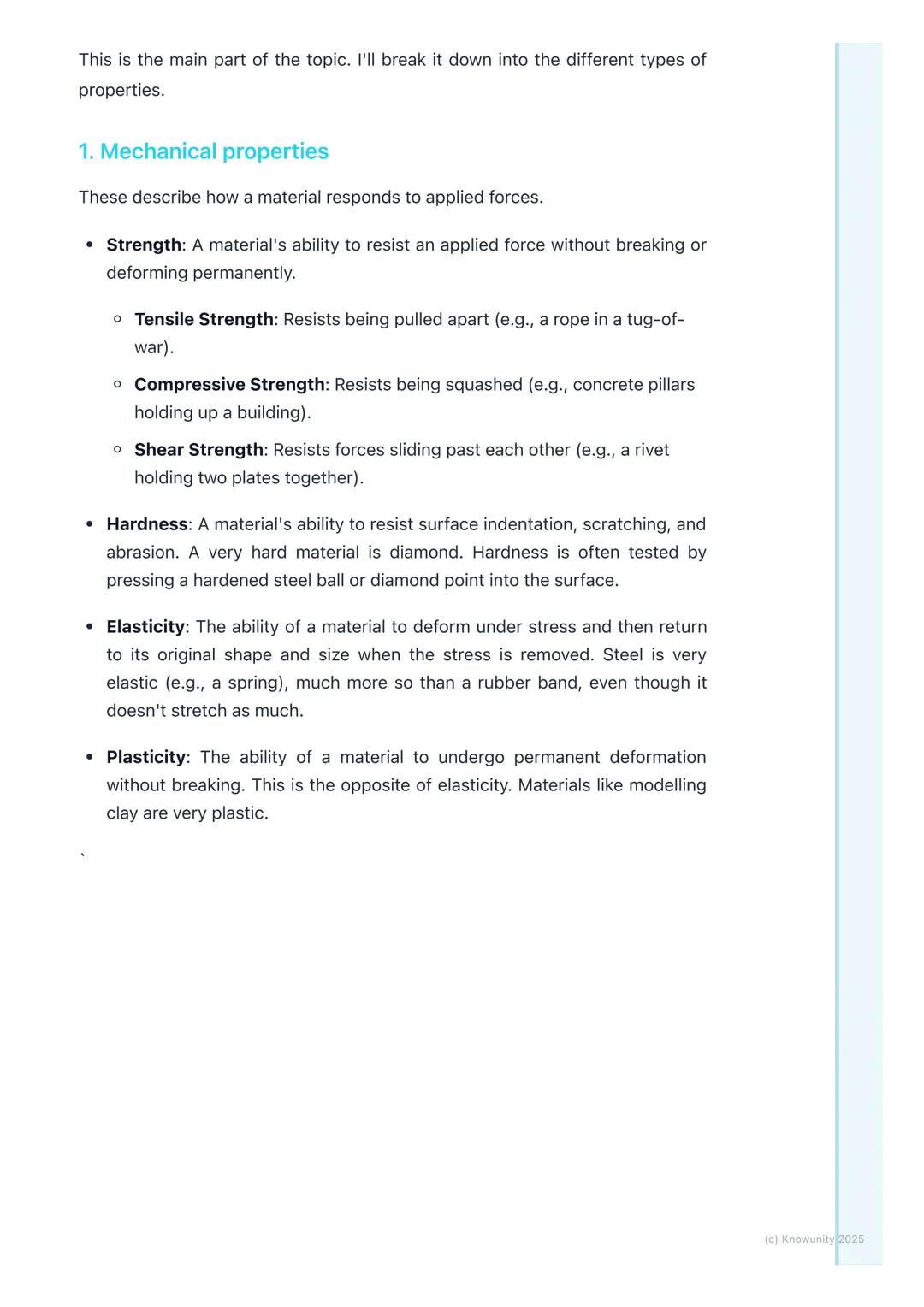
Mechanical Properties - How Materials Handle Forces
Mechanical properties determine how materials respond to different types of forces, making them essential for engineering applications. Strength describes a material's ability to resist applied forces without breaking or permanently deforming.
There are three main types of strength to remember. Tensile strength resists pulling forces , compressive strength resists crushing forces (concrete pillars), and shear strength resists sliding forces (rivets holding plates together).
Hardness measures resistance to surface damage like scratching or denting - diamond tops this scale. Elasticity allows materials to return to their original shape after deformation, whilst plasticity enables permanent reshaping without breaking.
Don't confuse ductility (ability to be drawn into wires) with malleability (ability to be hammered into sheets). Copper wire demonstrates ductility, whilst aluminium foil shows malleability.
Study Tip: Remember "Ductile = Drawn" and "Malleable = Moulded" to keep these properties straight.
3
of 6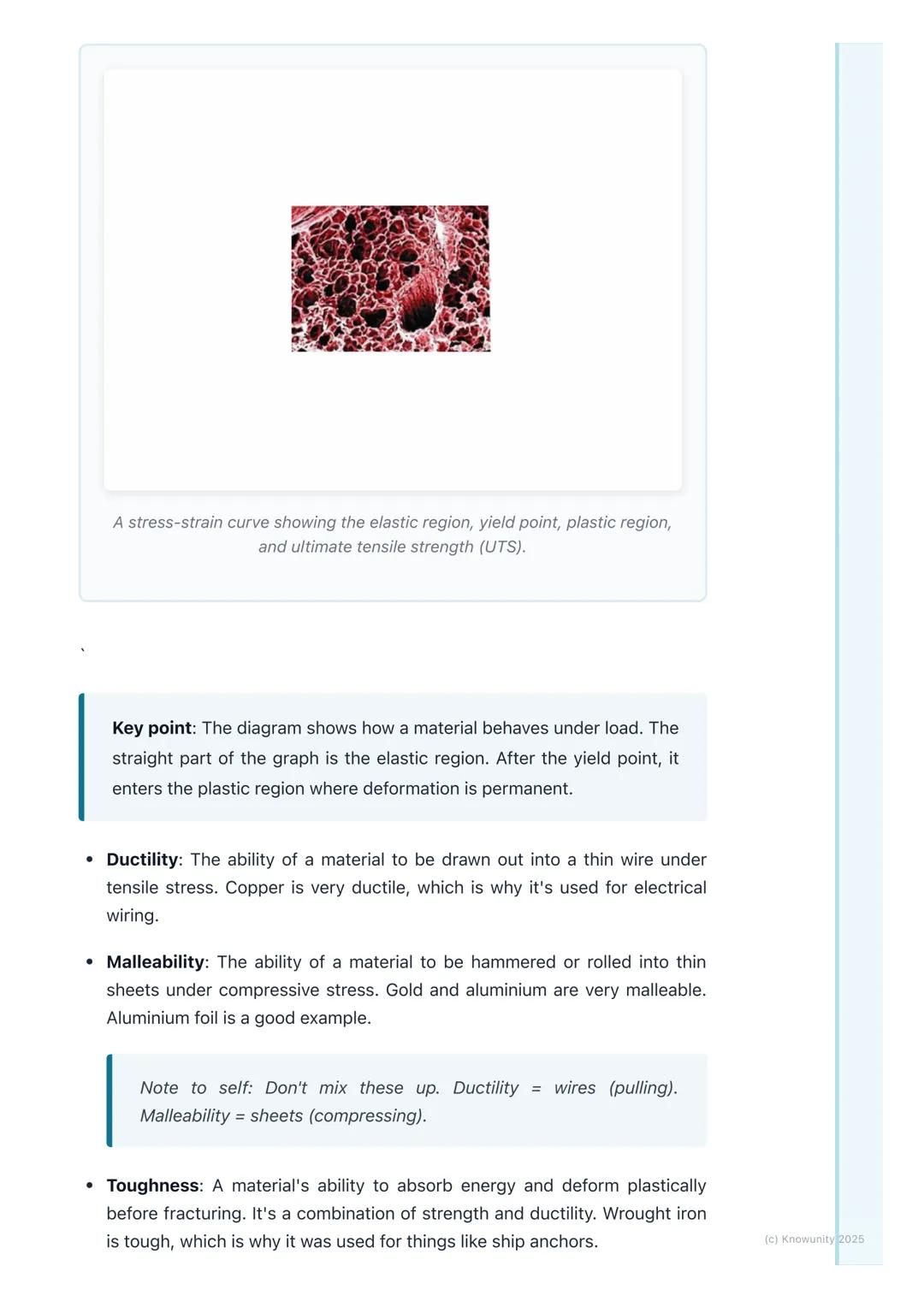
More Mechanical Properties and Stress-Strain Curves
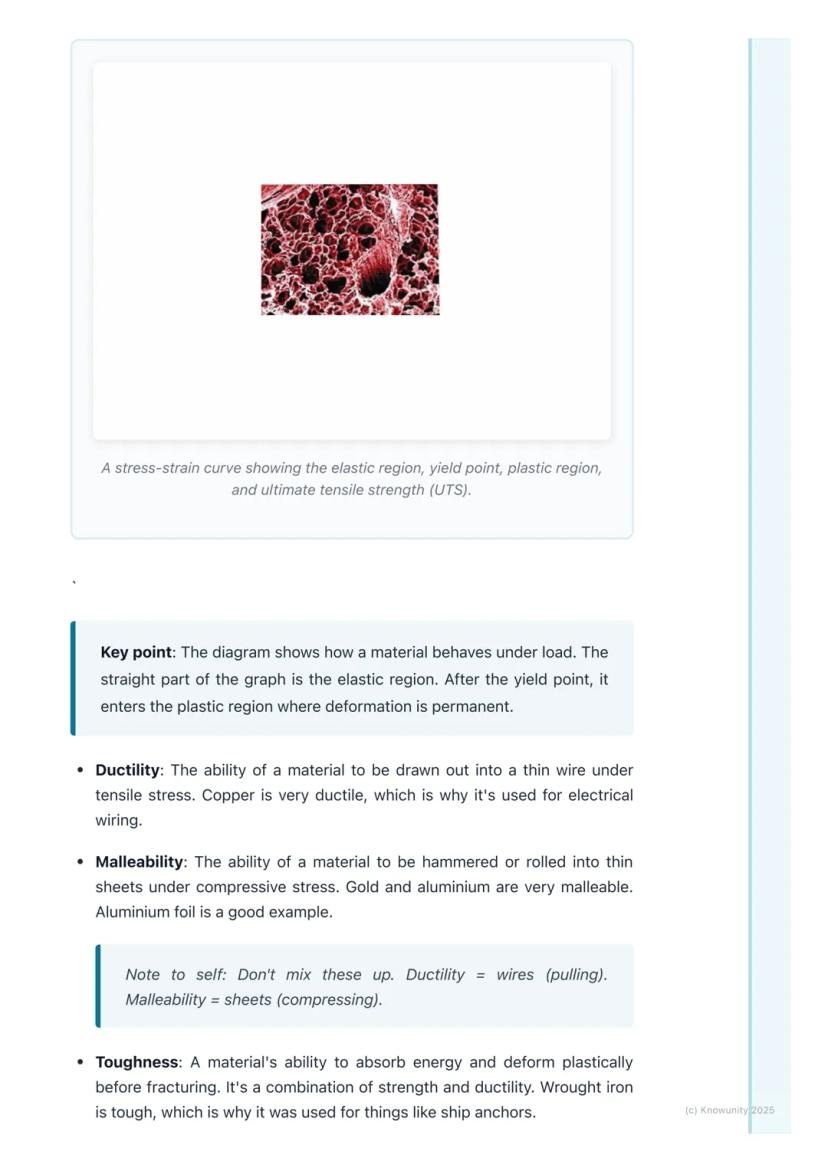
The stress-strain curve is your roadmap for understanding material behaviour under load. The straight portion represents the elastic region where deformation is temporary. After the yield point, you enter the plastic region where changes become permanent.
Toughness combines strength and ductility - it's a material's ability to absorb energy before fracturing. Wrought iron exemplifies toughness, which is why it was perfect for ship anchors. Brittleness sits at the opposite end, describing materials that fracture suddenly with minimal deformation.
Glass and ceramics are classic brittle materials - they simply snap without warning. This brittleness makes them unsuitable for applications requiring impact resistance, despite their impressive compressive strength.
Understanding these properties helps predict failure modes. Tough materials bend and absorb energy before breaking, giving warning signs. Brittle materials fail catastrophically without notice.
Real-World Application: Engineers choose tough materials for safety-critical applications where sudden failure could be dangerous.
4
of 6
Thermal and Electrical Properties
Thermal properties describe how materials respond to temperature changes. Thermal conductivity determines how well heat flows through a material - metals like copper excel here, making them perfect for saucepans and radiators.
Materials with low thermal conductivity act as insulators. Wood, plastic, and fibreglass keep heat from transferring, which is why saucepan handles use these materials. Thermal expansion causes materials to change size with temperature - large bridges need expansion joints to prevent buckling in summer heat.
Electrical properties govern how materials interact with electricity. Conductors like copper and silver allow current to flow easily, making them ideal for wiring. Insulators like rubber and plastic resist current flow, providing essential safety in electrical applications.
Semiconductors like silicon sit between conductors and insulators. Their unique properties enable all modern electronics - your phone's processor relies entirely on semiconductor behaviour.
Connect the Dots: The same copper used in electrical wiring also appears in cookware because it conducts both electricity and heat exceptionally well.
5
of 6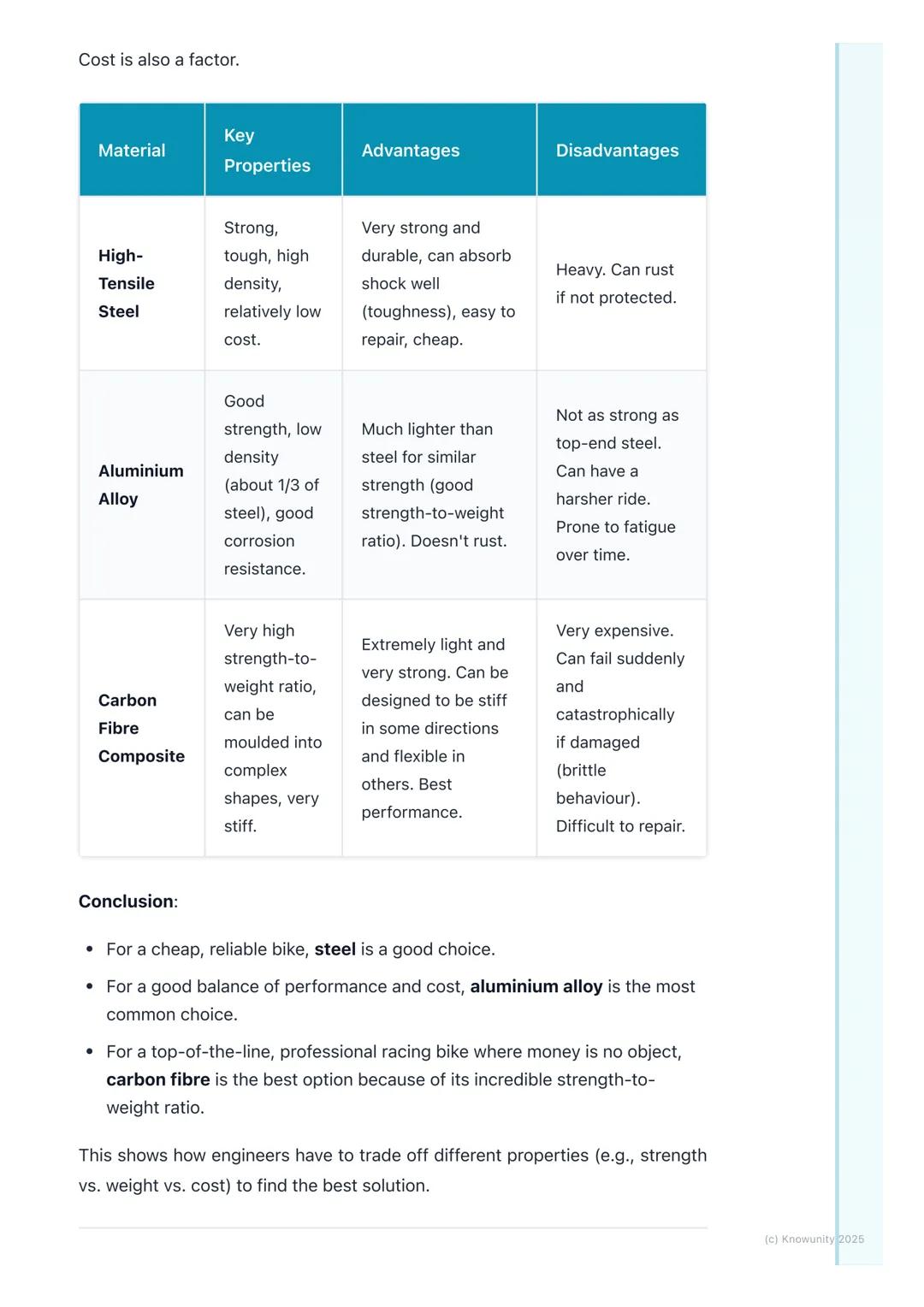
Choosing Materials - The Bicycle Frame Example
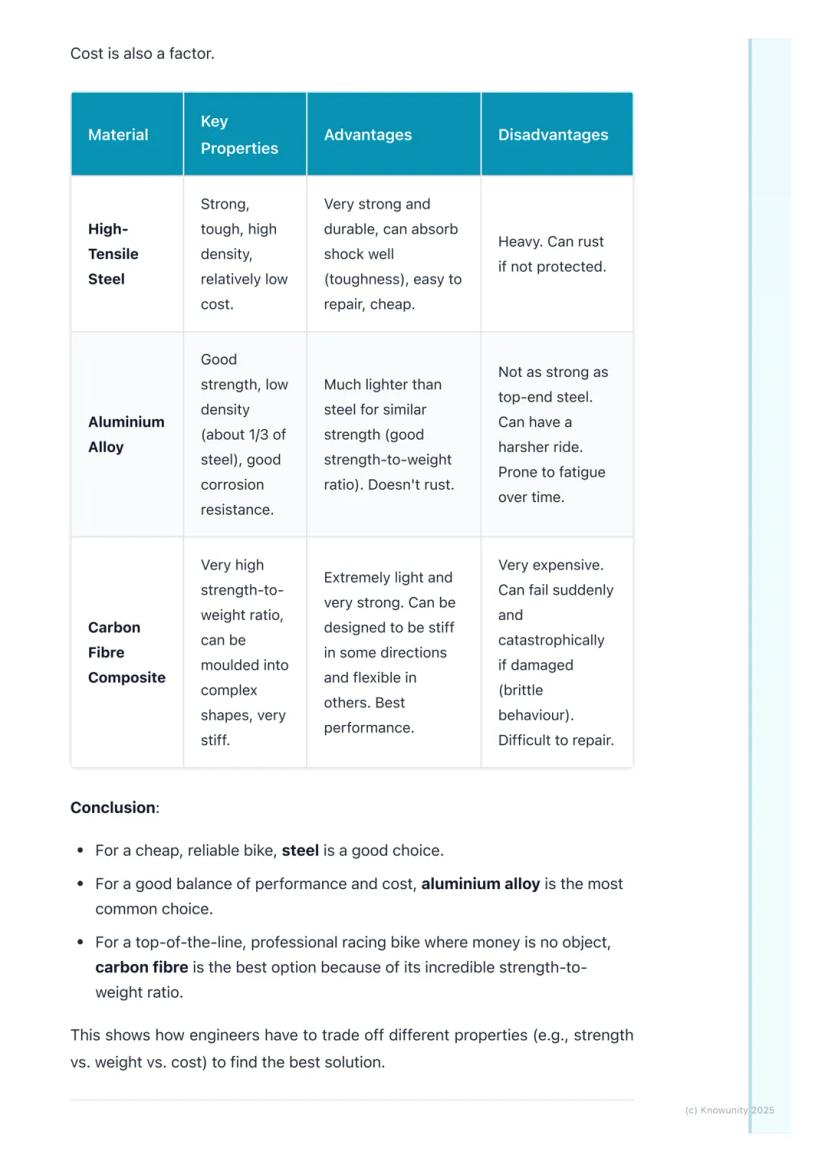
Real engineering involves balancing multiple properties to find the best solution. Consider designing a racing bicycle frame where you need high strength, low weight, and good stiffness whilst managing costs.
High-tensile steel offers excellent strength and toughness at low cost. It's durable, absorbs shock well, and repairs easily. However, steel's high density makes it heavy, and it can rust without protection.
Aluminium alloy provides the best balance for most applications. With about one-third the density of steel but similar strength, it offers an excellent strength-to-weight ratio. It doesn't rust either, though it may provide a harsher ride and can suffer fatigue over time.
Carbon fibre composite represents the premium choice. Its exceptional strength-to-weight ratio and ability to be moulded into complex shapes make it perfect for professional racing. The trade-offs include high cost, brittle failure modes, and difficult repairs.
Engineering Reality: The "best" material depends entirely on your priorities - there's no universal winner.
6
of 6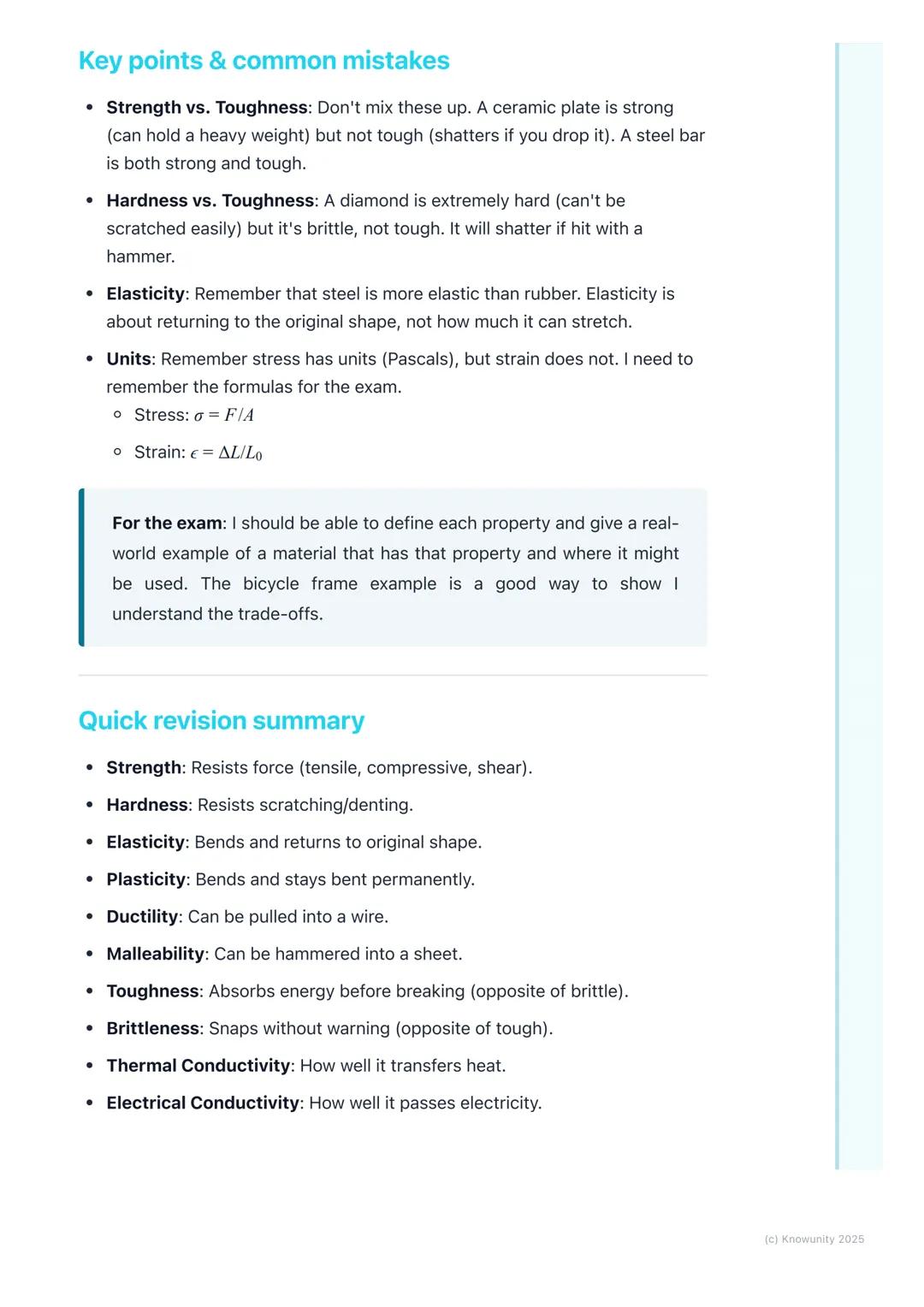
Key Points and Common Mistakes
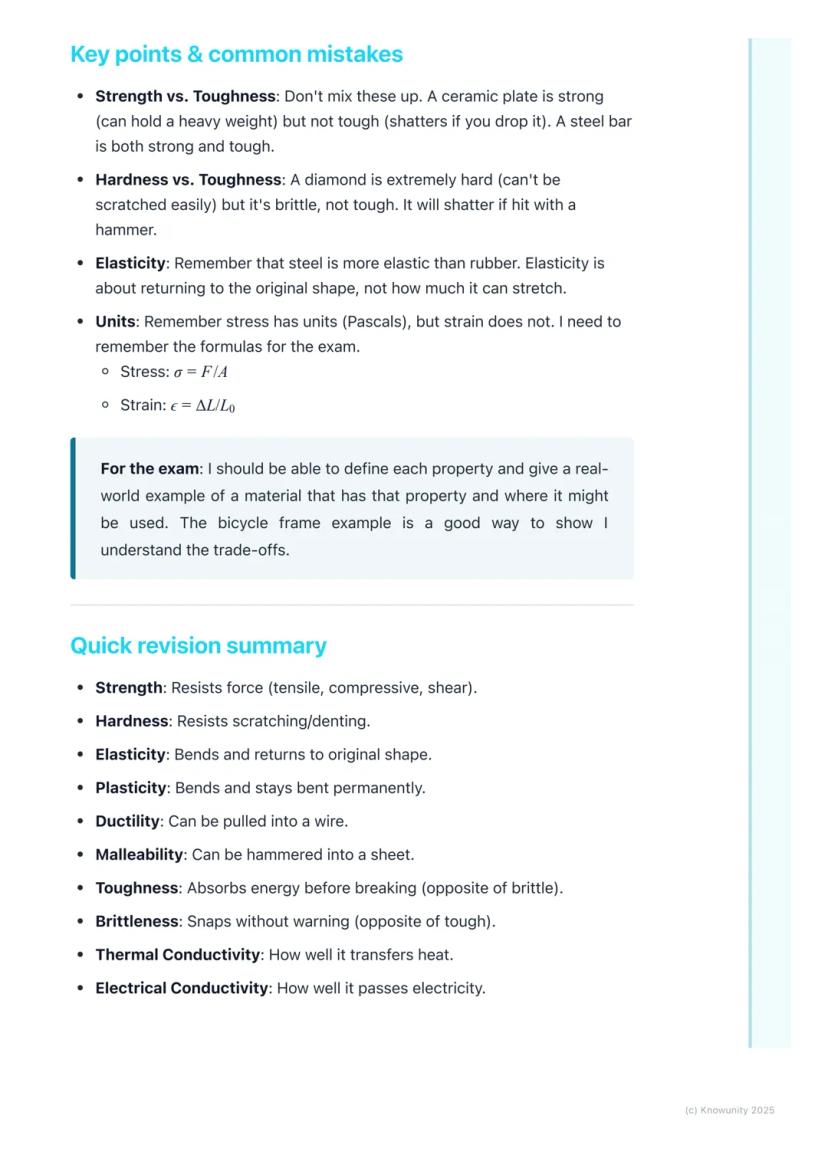
Understanding the differences between similar-sounding properties prevents costly mistakes. Strength versus toughness often confuses students - a ceramic plate can support heavy weight (strong) but shatters when dropped (not tough). Steel bars are both strong and tough.
Hardness versus toughness creates another common mix-up. Diamond is incredibly hard but brittle (shatters easily). Don't assume hard materials are tough. Elasticity also trips up students - steel is more elastic than rubber because elasticity measures the ability to return to original shape, not how much something stretches.
For calculations, remember that stress has units (Pascals) whilst strain is unitless. The formulas σ = F/A and ε = ΔL/L₀ are essential for solving problems.
Master these key properties for quick revision: strength (resists force), hardness (resists scratching), elasticity (returns to shape), plasticity (permanent deformation), ductility , malleability , toughness (energy absorption), brittleness (sudden failure), thermal conductivity (heat transfer), and electrical conductivity (current flow).
Exam Success: Practice identifying real-world examples of each property and explain why specific materials are chosen for particular applications.
Myśleliśmy, że nigdy nie zapytasz...
Czym jest Towarzysz AI z Knowunity?
Nasz asystent AI jest specjalnie dostosowany do potrzeb uczniów. W oparciu o miliony treści, które mamy na platformie, możemy udzielać uczniom naprawdę znaczących i trafnych odpowiedzi. Ale nie chodzi tylko o odpowiedzi, towarzysz prowadzi również uczniów przez codzienne wyzwania związane z nauką, ze spersonalizowanymi planami nauki, quizami lub treściami na czacie i 100% personalizacją opartą na umiejętnościach i rozwoju uczniów.
Gdzie mogę pobrać aplikację Knowunity?
Aplikację możesz pobrać z Google Play i Apple Store.
Czy aplikacja Knowunity naprawdę jest darmowa?
Tak, masz całkowicie darmowy dostęp do wszystkich notatek w aplikacji, możesz w każdej chwili rozmawiać z Ekspertami lub ich obserwować. Możesz użyć punktów, aby odblokować pewne funkcje w aplikacji, które również możesz otrzymać za darmo. Dodatkowo oferujemy usługę Knowunity Premium, która pozwala na odblokowanie większej liczby funkcji.
Najpopularniejsze notatki z Engineering
1Najpopularniejsze notatki
9Nie ma nic odpowiedniego? Sprawdź inne przedmioty.
Zobacz, co mówią o nas nasi użytkownicy. Pokochali nas — pokochasz też i Ty.
4.6/5App Store
4.7/5Google Play
Aplikacja jest bardzo prosta i dobrze przemyślana. Do tej pory znalazłem wszystko, czego szukałem i mogłem się wiele nauczyć z innych notatek! Na pewno wykorzystam aplikację do pomocy przy robieniu prac domowych! No i oczywiście bardzo pomaga też jako inspiracja do robienia swoich notatek.
Stefan Sużytkownik iOS
Ta aplikacja jest naprawdę świetna. Jest tak wiele notatek i pomocnych informacji [...]. Moim problematycznym przedmiotem jest język niemiecki, a w aplikacji jest w czym wybierać. Dzięki tej aplikacji poprawiłam swój niemiecki. Polecam ją każdemu.
Samantha Klichużytkownik Androida
Wow, jestem w szoku. Właśnie wypróbowałam aplikację, ponieważ widziałam ją kilka razy reklamowaną na TikToku jestem absolutnie w szoku. Ta aplikacja jest POMOCĄ, której potrzebujesz w szkole i przede wszystkim oferuje tak wiele rzeczy jak notatki czy streszczenia, które są BARDZO pomocne w moim przypadku.
Annaużytkownik iOS
Engineering2 wyświetleń·Zaktualizowano May 27, 2026·6 stronyUnderstanding the Properties of Materials: A Comprehensive Guide
Ever wondered why bridges aren't made of glass or why electrical wires use copper instead of plastic? The secret lies in understanding material properties- the specific ways different materials behave when forces, heat, or electricity are applied to them.... Pokaż więcej
1
of 6Zarejestruj się, aby zobaczyć notatkę. To nic nie kosztuje!
- Dostęp do wszystkich materiałów
- Popraw swoje oceny
- Dołącz do milionów studentów
Understanding the Basics
Before diving into specific properties, you need to grasp a few key concepts that form the foundation of materials science. Stress is the force applied per unit area , measured in Pascals. Think of it as how much pressure you're putting on a material.
Strain is how much a material deforms compared to its original size . Unlike stress, strain has no units because it's just a ratio. These two concepts work together to describe how materials respond to forces.
Materials can undergo two types of deformation. Elastic deformation is temporary - like stretching a rubber band that snaps back. Plastic deformation is permanent - like bending a paperclip that stays bent. The yield point marks where elastic becomes plastic, whilst ultimate tensile strength shows the maximum stress before breaking.
Key Insight: Understanding stress and strain is crucial for predicting how any material will behave under real-world conditions.
2
of 6Zarejestruj się, aby zobaczyć notatkę. To nic nie kosztuje!
- Dostęp do wszystkich materiałów
- Popraw swoje oceny
- Dołącz do milionów studentów
Mechanical Properties - How Materials Handle Forces
Mechanical properties determine how materials respond to different types of forces, making them essential for engineering applications. Strength describes a material's ability to resist applied forces without breaking or permanently deforming.
There are three main types of strength to remember. Tensile strength resists pulling forces , compressive strength resists crushing forces (concrete pillars), and shear strength resists sliding forces (rivets holding plates together).
Hardness measures resistance to surface damage like scratching or denting - diamond tops this scale. Elasticity allows materials to return to their original shape after deformation, whilst plasticity enables permanent reshaping without breaking.
Don't confuse ductility (ability to be drawn into wires) with malleability (ability to be hammered into sheets). Copper wire demonstrates ductility, whilst aluminium foil shows malleability.
Study Tip: Remember "Ductile = Drawn" and "Malleable = Moulded" to keep these properties straight.
3
of 6Zarejestruj się, aby zobaczyć notatkę. To nic nie kosztuje!
- Dostęp do wszystkich materiałów
- Popraw swoje oceny
- Dołącz do milionów studentów
More Mechanical Properties and Stress-Strain Curves
The stress-strain curve is your roadmap for understanding material behaviour under load. The straight portion represents the elastic region where deformation is temporary. After the yield point, you enter the plastic region where changes become permanent.
Toughness combines strength and ductility - it's a material's ability to absorb energy before fracturing. Wrought iron exemplifies toughness, which is why it was perfect for ship anchors. Brittleness sits at the opposite end, describing materials that fracture suddenly with minimal deformation.
Glass and ceramics are classic brittle materials - they simply snap without warning. This brittleness makes them unsuitable for applications requiring impact resistance, despite their impressive compressive strength.
Understanding these properties helps predict failure modes. Tough materials bend and absorb energy before breaking, giving warning signs. Brittle materials fail catastrophically without notice.
Real-World Application: Engineers choose tough materials for safety-critical applications where sudden failure could be dangerous.
4
of 6Zarejestruj się, aby zobaczyć notatkę. To nic nie kosztuje!
- Dostęp do wszystkich materiałów
- Popraw swoje oceny
- Dołącz do milionów studentów
Thermal and Electrical Properties
Thermal properties describe how materials respond to temperature changes. Thermal conductivity determines how well heat flows through a material - metals like copper excel here, making them perfect for saucepans and radiators.
Materials with low thermal conductivity act as insulators. Wood, plastic, and fibreglass keep heat from transferring, which is why saucepan handles use these materials. Thermal expansion causes materials to change size with temperature - large bridges need expansion joints to prevent buckling in summer heat.
Electrical properties govern how materials interact with electricity. Conductors like copper and silver allow current to flow easily, making them ideal for wiring. Insulators like rubber and plastic resist current flow, providing essential safety in electrical applications.
Semiconductors like silicon sit between conductors and insulators. Their unique properties enable all modern electronics - your phone's processor relies entirely on semiconductor behaviour.
Connect the Dots: The same copper used in electrical wiring also appears in cookware because it conducts both electricity and heat exceptionally well.
5
of 6Zarejestruj się, aby zobaczyć notatkę. To nic nie kosztuje!
- Dostęp do wszystkich materiałów
- Popraw swoje oceny
- Dołącz do milionów studentów
Choosing Materials - The Bicycle Frame Example
Real engineering involves balancing multiple properties to find the best solution. Consider designing a racing bicycle frame where you need high strength, low weight, and good stiffness whilst managing costs.
High-tensile steel offers excellent strength and toughness at low cost. It's durable, absorbs shock well, and repairs easily. However, steel's high density makes it heavy, and it can rust without protection.
Aluminium alloy provides the best balance for most applications. With about one-third the density of steel but similar strength, it offers an excellent strength-to-weight ratio. It doesn't rust either, though it may provide a harsher ride and can suffer fatigue over time.
Carbon fibre composite represents the premium choice. Its exceptional strength-to-weight ratio and ability to be moulded into complex shapes make it perfect for professional racing. The trade-offs include high cost, brittle failure modes, and difficult repairs.
Engineering Reality: The "best" material depends entirely on your priorities - there's no universal winner.
6
of 6Zarejestruj się, aby zobaczyć notatkę. To nic nie kosztuje!
- Dostęp do wszystkich materiałów
- Popraw swoje oceny
- Dołącz do milionów studentów
Key Points and Common Mistakes
Understanding the differences between similar-sounding properties prevents costly mistakes. Strength versus toughness often confuses students - a ceramic plate can support heavy weight (strong) but shatters when dropped (not tough). Steel bars are both strong and tough.
Hardness versus toughness creates another common mix-up. Diamond is incredibly hard but brittle (shatters easily). Don't assume hard materials are tough. Elasticity also trips up students - steel is more elastic than rubber because elasticity measures the ability to return to original shape, not how much something stretches.
For calculations, remember that stress has units (Pascals) whilst strain is unitless. The formulas σ = F/A and ε = ΔL/L₀ are essential for solving problems.
Master these key properties for quick revision: strength (resists force), hardness (resists scratching), elasticity (returns to shape), plasticity (permanent deformation), ductility , malleability , toughness (energy absorption), brittleness (sudden failure), thermal conductivity (heat transfer), and electrical conductivity (current flow).
Exam Success: Practice identifying real-world examples of each property and explain why specific materials are chosen for particular applications.
Myśleliśmy, że nigdy nie zapytasz...
Czym jest Towarzysz AI z Knowunity?
Nasz asystent AI jest specjalnie dostosowany do potrzeb uczniów. W oparciu o miliony treści, które mamy na platformie, możemy udzielać uczniom naprawdę znaczących i trafnych odpowiedzi. Ale nie chodzi tylko o odpowiedzi, towarzysz prowadzi również uczniów przez codzienne wyzwania związane z nauką, ze spersonalizowanymi planami nauki, quizami lub treściami na czacie i 100% personalizacją opartą na umiejętnościach i rozwoju uczniów.
Gdzie mogę pobrać aplikację Knowunity?
Aplikację możesz pobrać z Google Play i Apple Store.
Czy aplikacja Knowunity naprawdę jest darmowa?
Tak, masz całkowicie darmowy dostęp do wszystkich notatek w aplikacji, możesz w każdej chwili rozmawiać z Ekspertami lub ich obserwować. Możesz użyć punktów, aby odblokować pewne funkcje w aplikacji, które również możesz otrzymać za darmo. Dodatkowo oferujemy usługę Knowunity Premium, która pozwala na odblokowanie większej liczby funkcji.
Najpopularniejsze notatki z Engineering
1Najpopularniejsze notatki
9Nie ma nic odpowiedniego? Sprawdź inne przedmioty.
Zobacz, co mówią o nas nasi użytkownicy. Pokochali nas — pokochasz też i Ty.
4.6/5App Store
4.7/5Google Play
Aplikacja jest bardzo prosta i dobrze przemyślana. Do tej pory znalazłem wszystko, czego szukałem i mogłem się wiele nauczyć z innych notatek! Na pewno wykorzystam aplikację do pomocy przy robieniu prac domowych! No i oczywiście bardzo pomaga też jako inspiracja do robienia swoich notatek.
Stefan Sużytkownik iOS
Ta aplikacja jest naprawdę świetna. Jest tak wiele notatek i pomocnych informacji [...]. Moim problematycznym przedmiotem jest język niemiecki, a w aplikacji jest w czym wybierać. Dzięki tej aplikacji poprawiłam swój niemiecki. Polecam ją każdemu.
Samantha Klichużytkownik Androida
Wow, jestem w szoku. Właśnie wypróbowałam aplikację, ponieważ widziałam ją kilka razy reklamowaną na TikToku jestem absolutnie w szoku. Ta aplikacja jest POMOCĄ, której potrzebujesz w szkole i przede wszystkim oferuje tak wiele rzeczy jak notatki czy streszczenia, które są BARDZO pomocne w moim przypadku.
Annaużytkownik iOS