
Learning the months of the year in French is essential...
 French3 wyświetleń·Zaktualizowano Jun 14, 2026·4 strony
Les Mois de l'Année en Français
1 / 4
1
of 4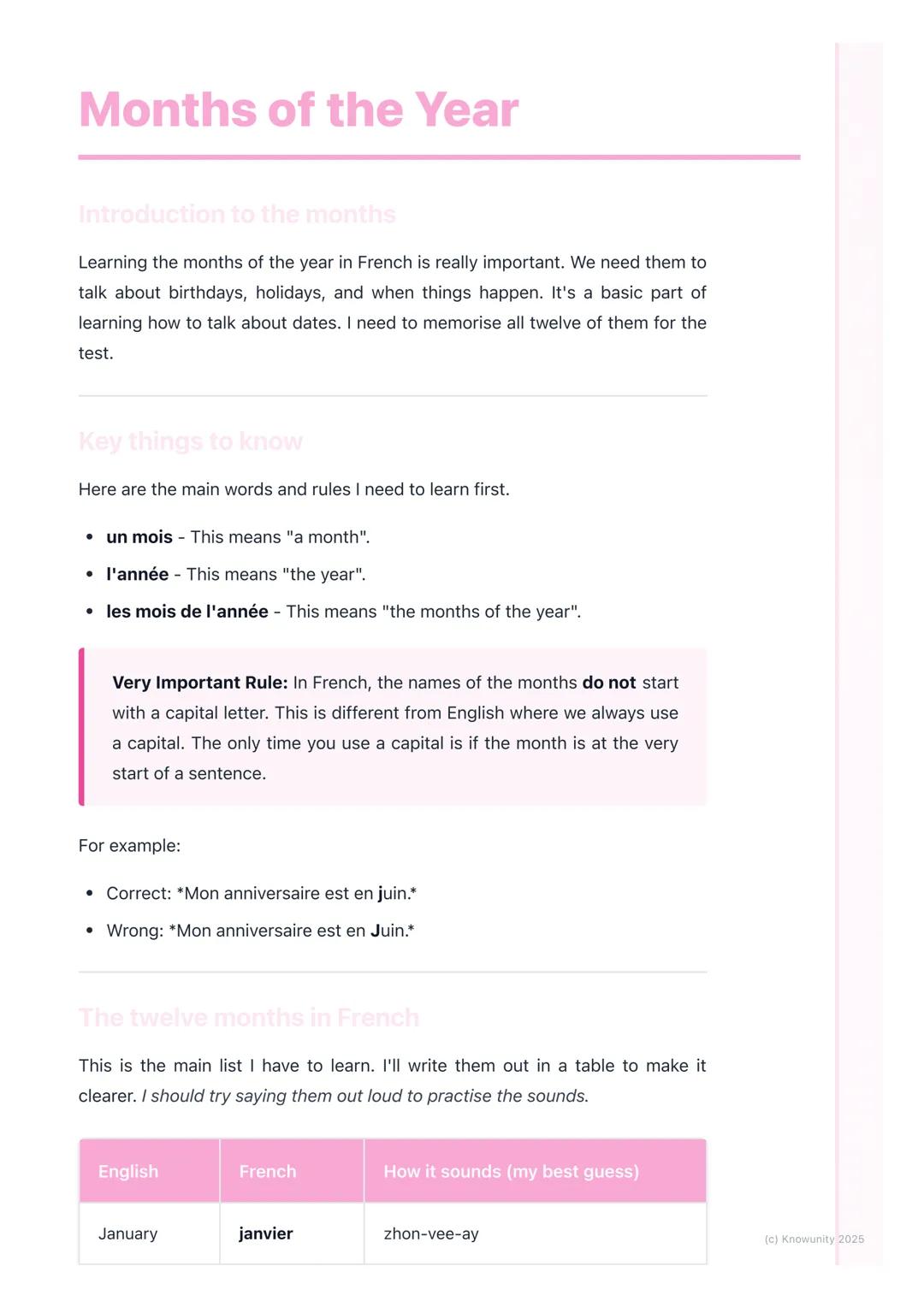
Getting Started with French Months
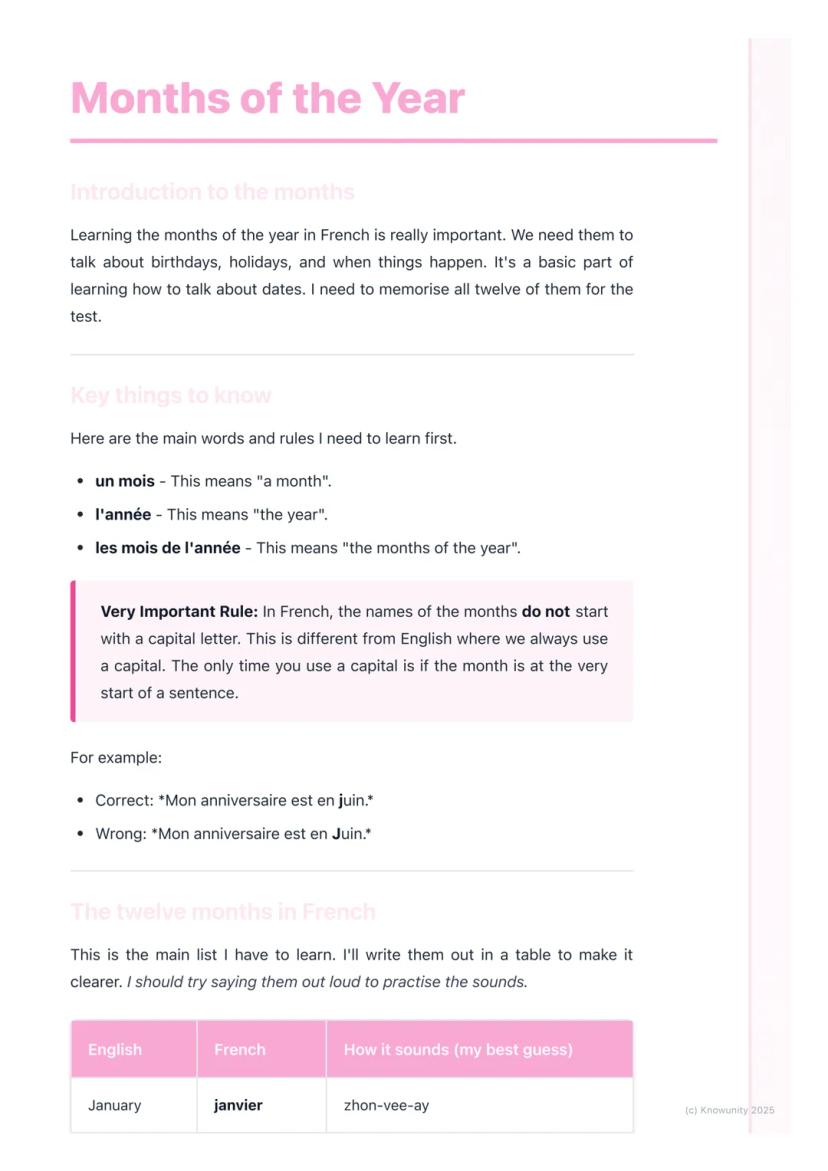
You'll use French months constantly - from talking about your birthday to planning holidays. The good news is that many of them look quite similar to English, so you're already halfway there!
There are three key terms to master first: un mois (a month), l'année (the year), and les mois de l'année (the months of the year). These will pop up everywhere when discussing dates.
Here's the game-changer that trips up loads of students: French months never start with capital letters unless they're at the beginning of a sentence. So it's "Mon anniversaire est en juin" (My birthday is in June), not "Mon anniversaire est en Juin."
Quick Tip: Practice saying the months out loud - hearing yourself say them helps with spelling and pronunciation!
2
of 4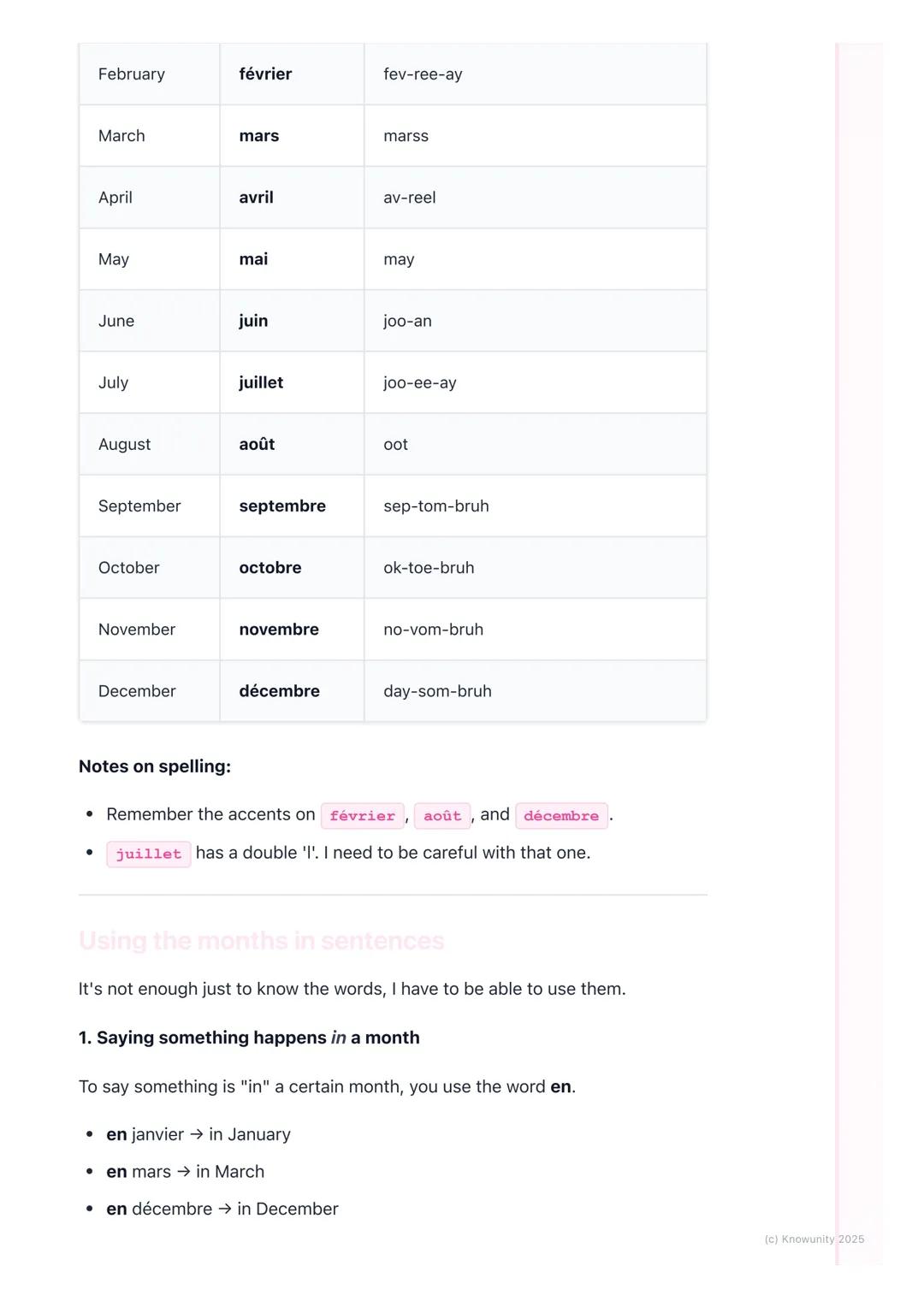
The Twelve Months You Need to Know
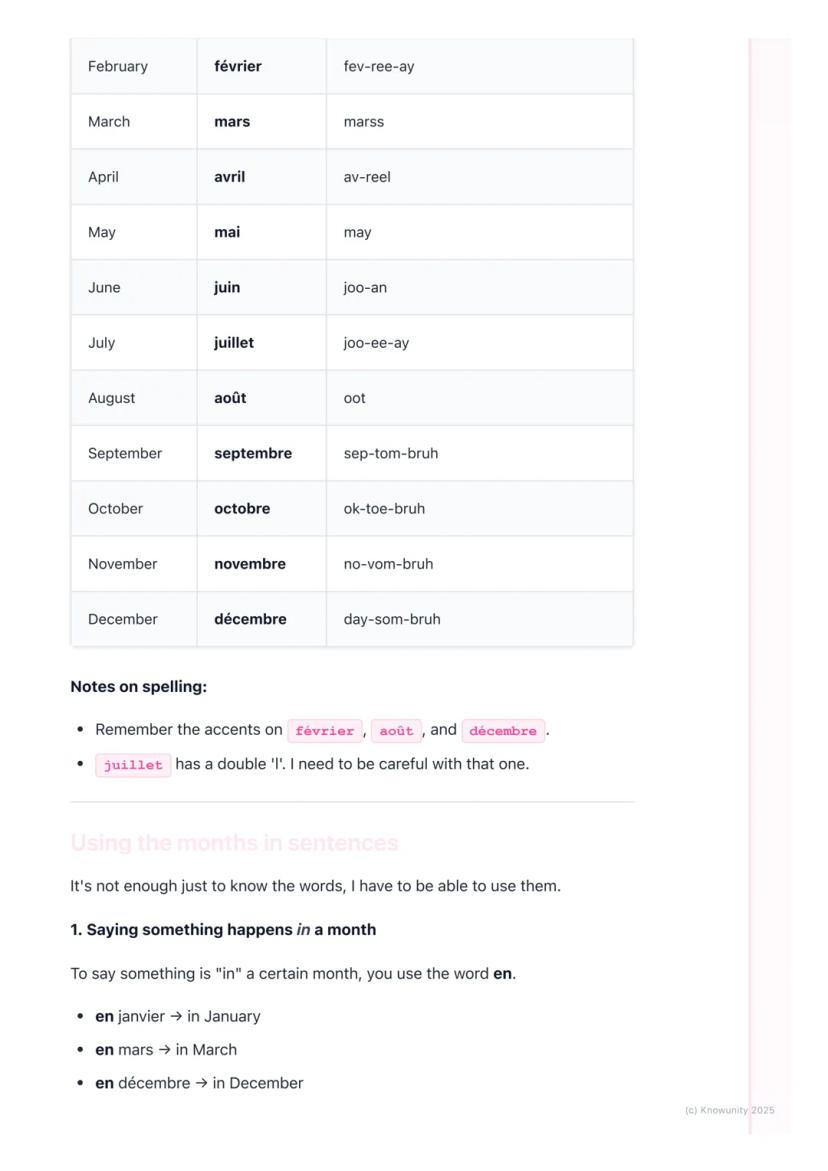
Here are all twelve months with their pronunciation guides. Don't worry about getting the pronunciation perfect straight away - just have a go and you'll improve with practice.
janvier , février , mars (marss), avril , mai (may), juin - these first six are quite different from English.
The summer and autumn months are more familiar: juillet , août (oot), septembre , octobre , novembre , décembre .
Watch out for the tricky spellings: février, août, and décembre all have accents, whilst juillet has a sneaky double 'l' that's easy to forget.
Memory Hack: The last four months (septembre, octobre, novembre, décembre) are dead similar to English - use these as your confidence boosters!
3
of 4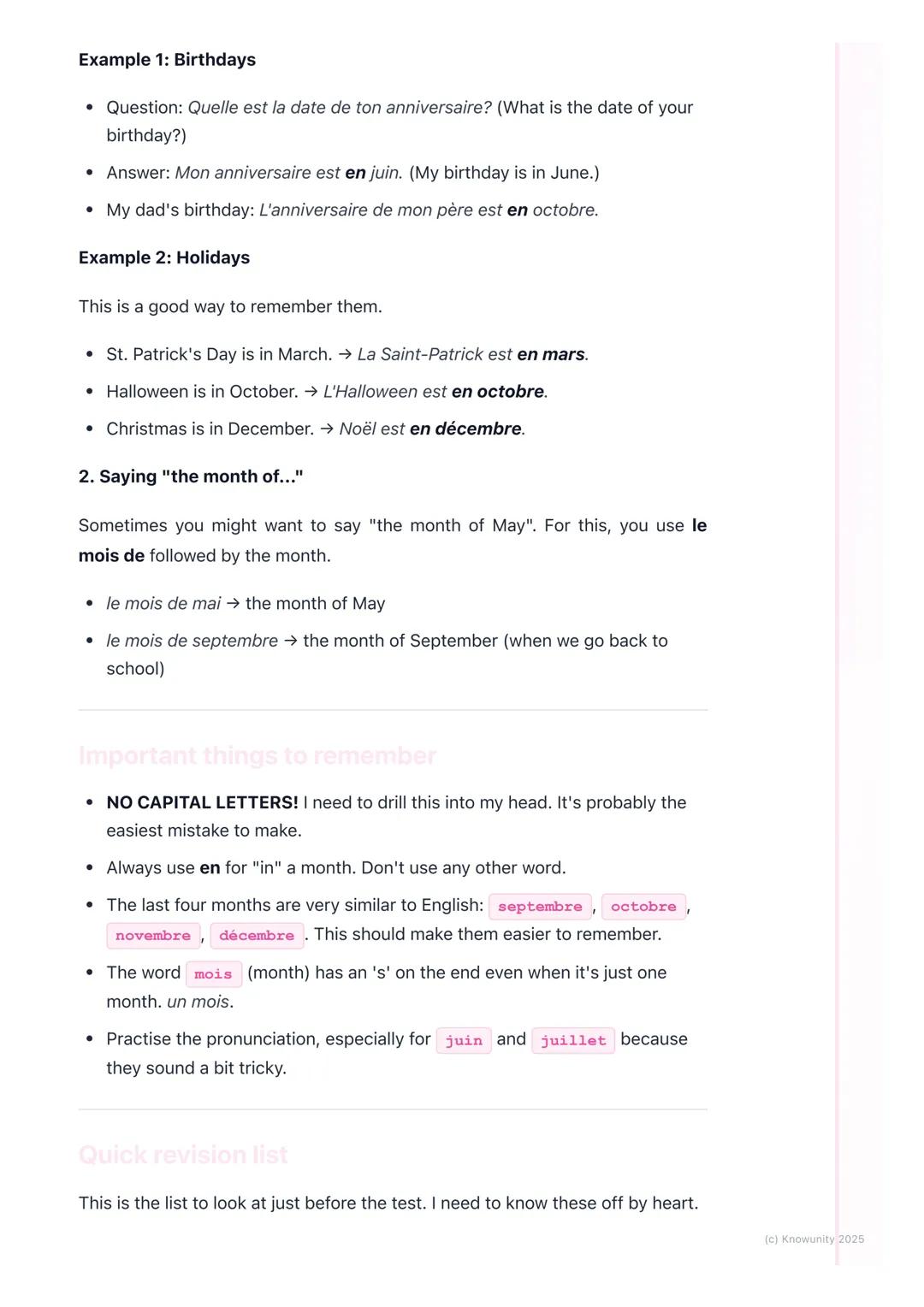
Using Months in Real Conversations
Now for the practical bit - actually using these months in sentences. This is where French gets really useful for everyday chat.
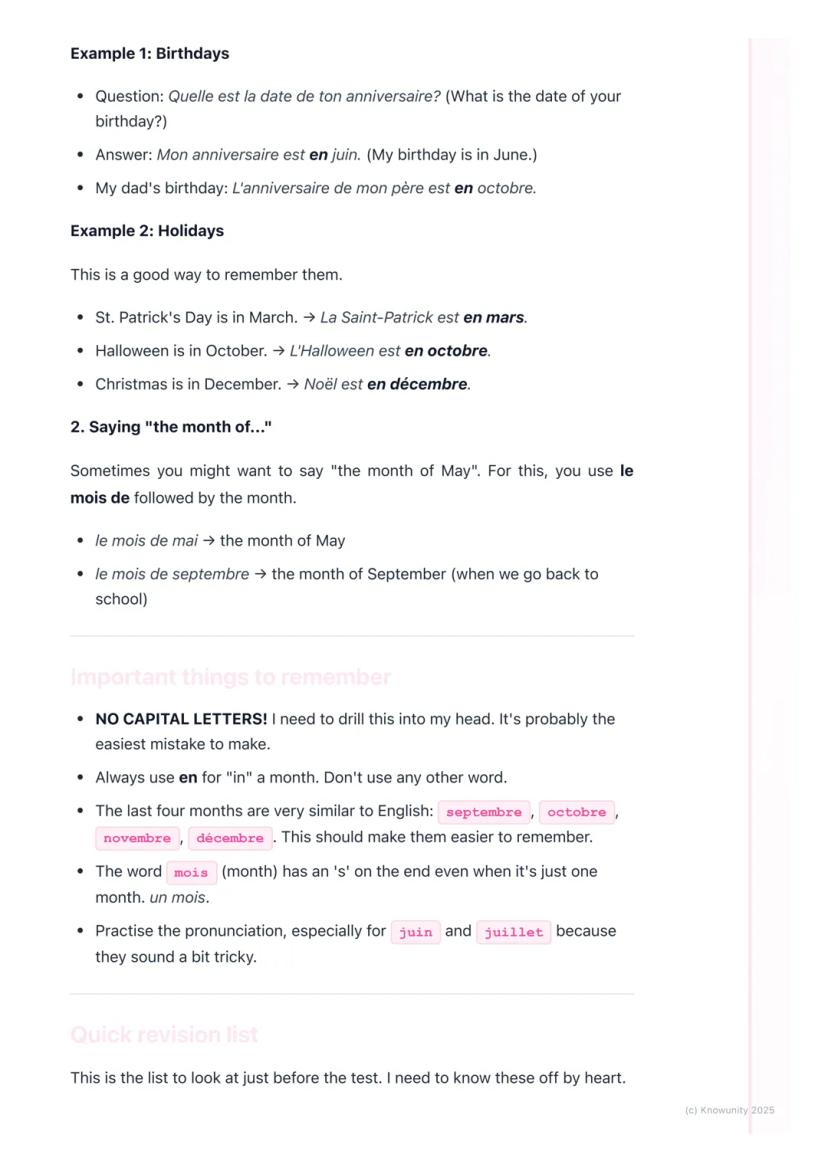
To say something happens "in" a month, you always use en. So "en janvier" means "in January", "en mars" means "in March", and so on. This works for absolutely everything - birthdays, holidays, school terms.
For birthdays, you'll often hear "Mon anniversaire est en juin" (My birthday is in June). For holidays, try "Noël est en décembre" (Christmas is in December) or "La Saint-Patrick est en mars" (St. Patrick's Day is in March).
Sometimes you might need to say "the month of..." - that's when you use le mois de followed by the month name, like "le mois de septembre" (the month of September).
Test Prep: Remember - always use 'en' for 'in' with months, never any other word. This is a common exam question!
4
of 4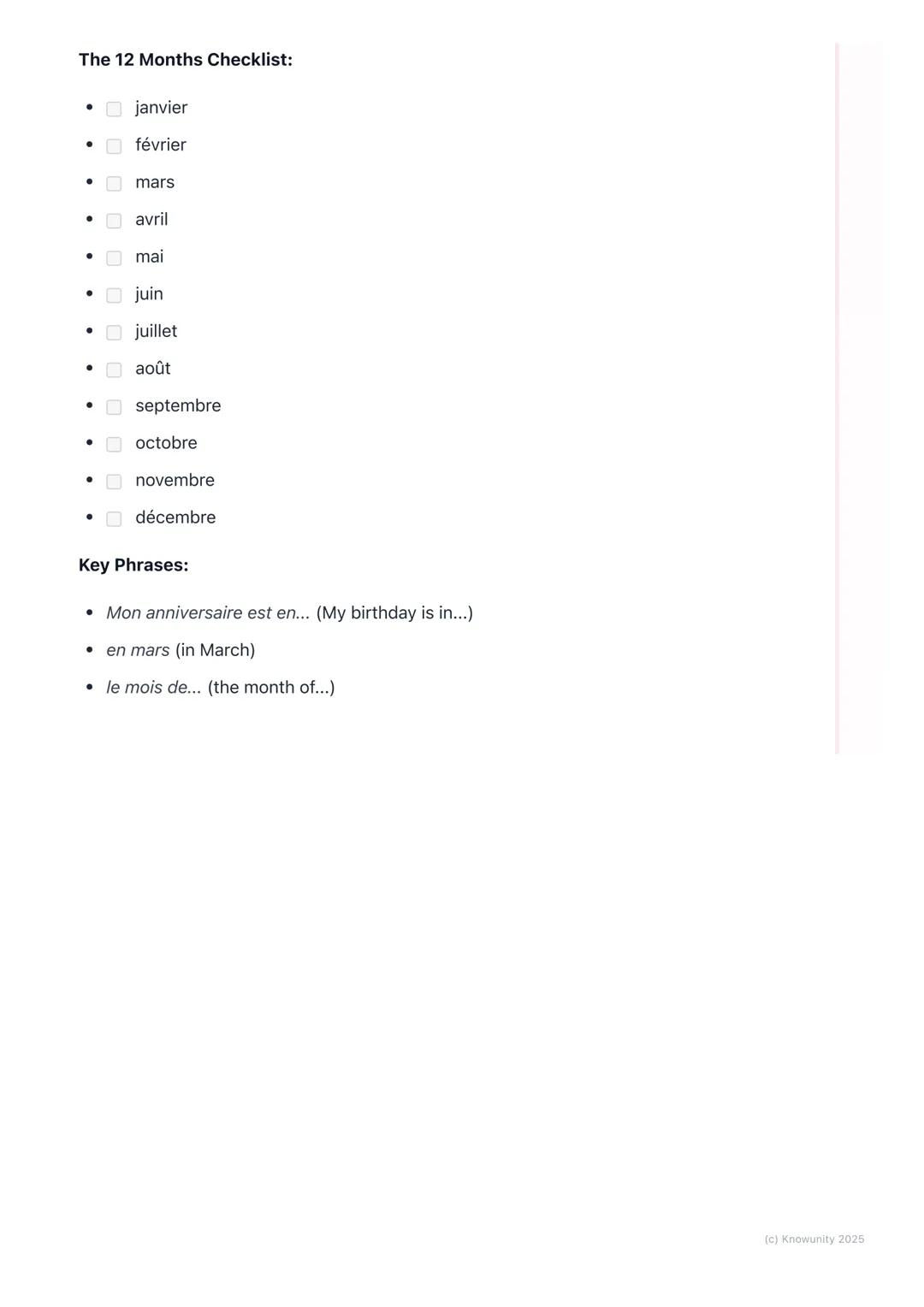
Your Final Revision Checklist
Right, here's your quick-fire revision list for before any test or when you need a speedy reminder.
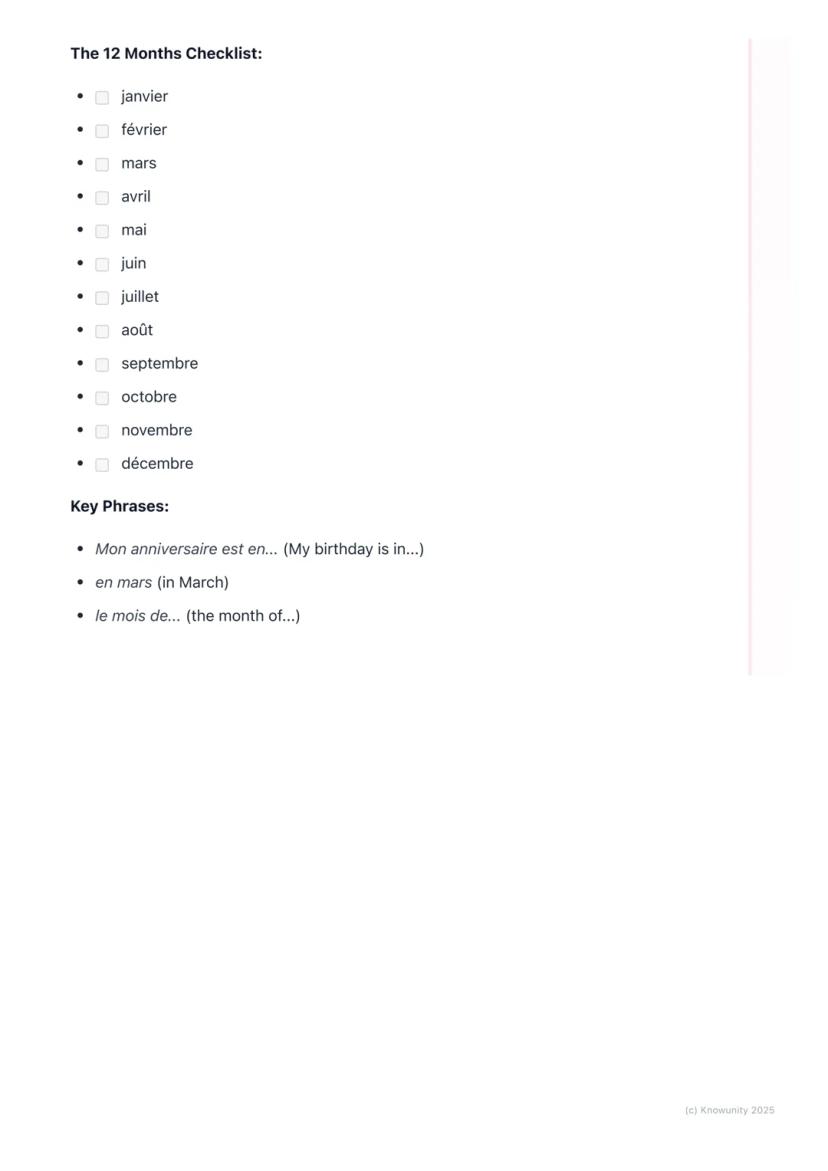
The twelve months in order: janvier, février, mars, avril, mai, juin, juillet, août, septembre, octobre, novembre, décembre. Run through these a few times until they flow naturally.
Your essential phrases are "Mon anniversaire est en..." (My birthday is in...), "en mars" (in March), and "le mois de..." (the month of...). These three patterns will cover most situations you'll encounter.
Remember the golden rules: no capitals unless it's the start of a sentence, always use 'en' for 'in', and don't panic about pronunciation - you'll get better with practice.
Confidence Booster: You've already got this! Many French months are similar to English, and with a bit of practice, you'll be using them naturally in conversations.
Myśleliśmy, że nigdy nie zapytasz...
Czym jest Towarzysz AI z Knowunity?
Nasz asystent AI jest specjalnie dostosowany do potrzeb uczniów. W oparciu o miliony treści, które mamy na platformie, możemy udzielać uczniom naprawdę znaczących i trafnych odpowiedzi. Ale nie chodzi tylko o odpowiedzi, towarzysz prowadzi również uczniów przez codzienne wyzwania związane z nauką, ze spersonalizowanymi planami nauki, quizami lub treściami na czacie i 100% personalizacją opartą na umiejętnościach i rozwoju uczniów.
Gdzie mogę pobrać aplikację Knowunity?
Aplikację możesz pobrać z Google Play i Apple Store.
Czy aplikacja Knowunity naprawdę jest darmowa?
Tak, masz całkowicie darmowy dostęp do wszystkich notatek w aplikacji, możesz w każdej chwili rozmawiać z Ekspertami lub ich obserwować. Możesz użyć punktów, aby odblokować pewne funkcje w aplikacji, które również możesz otrzymać za darmo. Dodatkowo oferujemy usługę Knowunity Premium, która pozwala na odblokowanie większej liczby funkcji.
Najpopularniejsze notatki z French
2Najpopularniejsze notatki
9 Irish
IrishIrish oral questions and answers
Questions and answers for the leaving cert oral
5th Year4264
 English
Key Quotes : Sive
Key Quotes and explanations: Sive
6th Year2842
IrishIrish oral questions
Outline of oral questions
5th Year2055
IrishIníon- le hÁine Durkin
Aine Durkin’s poem, Iníon: Themes & summary
5th Year890
IrishIrish poetry 2027
Iníon + Dínit an Bhróin
5th Year1153
IrishLC HL notes- Iníon (poem)
Includes poem in English and Irish, theme, key words & phrases
5th Year2304
EnglishCultural Context : Shawshank Redemption : Sive : Small Things Like These
Comparative Study : Cultural Context : Shawshank Redemption, Sive and Small Things Like These
6th Year1430
IrishMo Ghrá-sa (Idir Lúibíní)
Notes on mo ghrá-sa
5th Year380
IrishAn Gaeilge Aiste
Irish Language essay
6th Year1320
Nie ma nic odpowiedniego? Sprawdź inne przedmioty.
Zobacz, co mówią o nas nasi użytkownicy. Pokochali nas — pokochasz też i Ty.
4.6/5App Store
4.7/5Google Play
Aplikacja jest bardzo prosta i dobrze przemyślana. Do tej pory znalazłem wszystko, czego szukałem i mogłem się wiele nauczyć z innych notatek! Na pewno wykorzystam aplikację do pomocy przy robieniu prac domowych! No i oczywiście bardzo pomaga też jako inspiracja do robienia swoich notatek.
Stefan Sużytkownik iOS
Ta aplikacja jest naprawdę świetna. Jest tak wiele notatek i pomocnych informacji [...]. Moim problematycznym przedmiotem jest język niemiecki, a w aplikacji jest w czym wybierać. Dzięki tej aplikacji poprawiłam swój niemiecki. Polecam ją każdemu.
Samantha Klichużytkownik Androida
Wow, jestem w szoku. Właśnie wypróbowałam aplikację, ponieważ widziałam ją kilka razy reklamowaną na TikToku jestem absolutnie w szoku. Ta aplikacja jest POMOCĄ, której potrzebujesz w szkole i przede wszystkim oferuje tak wiele rzeczy jak notatki czy streszczenia, które są BARDZO pomocne w moim przypadku.
Annaużytkownik iOS
French3 wyświetleń·Zaktualizowano Jun 14, 2026·4 stronyLes Mois de l'Année en Français
Learning the months of the year in French is essential for talking about birthdays, holidays, and when events happen. It's one of the most practical things you'll use when speaking French, and once you get the hang of it, you'll...
1
of 4
Zarejestruj się, aby zobaczyć notatkę. To nic nie kosztuje!
- Dostęp do wszystkich materiałów
- Popraw swoje oceny
- Dołącz do milionów studentów
Getting Started with French Months
You'll use French months constantly - from talking about your birthday to planning holidays. The good news is that many of them look quite similar to English, so you're already halfway there!
There are three key terms to master first: un mois (a month), l'année (the year), and les mois de l'année (the months of the year). These will pop up everywhere when discussing dates.
Here's the game-changer that trips up loads of students: French months never start with capital letters unless they're at the beginning of a sentence. So it's "Mon anniversaire est en juin" (My birthday is in June), not "Mon anniversaire est en Juin."
Quick Tip: Practice saying the months out loud - hearing yourself say them helps with spelling and pronunciation!
2
of 4Zarejestruj się, aby zobaczyć notatkę. To nic nie kosztuje!
- Dostęp do wszystkich materiałów
- Popraw swoje oceny
- Dołącz do milionów studentów
The Twelve Months You Need to Know
Here are all twelve months with their pronunciation guides. Don't worry about getting the pronunciation perfect straight away - just have a go and you'll improve with practice.
janvier , février , mars (marss), avril , mai (may), juin - these first six are quite different from English.
The summer and autumn months are more familiar: juillet , août (oot), septembre , octobre , novembre , décembre .
Watch out for the tricky spellings: février, août, and décembre all have accents, whilst juillet has a sneaky double 'l' that's easy to forget.
Memory Hack: The last four months (septembre, octobre, novembre, décembre) are dead similar to English - use these as your confidence boosters!
3
of 4Zarejestruj się, aby zobaczyć notatkę. To nic nie kosztuje!
- Dostęp do wszystkich materiałów
- Popraw swoje oceny
- Dołącz do milionów studentów
Using Months in Real Conversations
Now for the practical bit - actually using these months in sentences. This is where French gets really useful for everyday chat.
To say something happens "in" a month, you always use en. So "en janvier" means "in January", "en mars" means "in March", and so on. This works for absolutely everything - birthdays, holidays, school terms.
For birthdays, you'll often hear "Mon anniversaire est en juin" (My birthday is in June). For holidays, try "Noël est en décembre" (Christmas is in December) or "La Saint-Patrick est en mars" (St. Patrick's Day is in March).
Sometimes you might need to say "the month of..." - that's when you use le mois de followed by the month name, like "le mois de septembre" (the month of September).
Test Prep: Remember - always use 'en' for 'in' with months, never any other word. This is a common exam question!
4
of 4Zarejestruj się, aby zobaczyć notatkę. To nic nie kosztuje!
- Dostęp do wszystkich materiałów
- Popraw swoje oceny
- Dołącz do milionów studentów
Your Final Revision Checklist
Right, here's your quick-fire revision list for before any test or when you need a speedy reminder.
The twelve months in order: janvier, février, mars, avril, mai, juin, juillet, août, septembre, octobre, novembre, décembre. Run through these a few times until they flow naturally.
Your essential phrases are "Mon anniversaire est en..." (My birthday is in...), "en mars" (in March), and "le mois de..." (the month of...). These three patterns will cover most situations you'll encounter.
Remember the golden rules: no capitals unless it's the start of a sentence, always use 'en' for 'in', and don't panic about pronunciation - you'll get better with practice.
Confidence Booster: You've already got this! Many French months are similar to English, and with a bit of practice, you'll be using them naturally in conversations.
Myśleliśmy, że nigdy nie zapytasz...
Czym jest Towarzysz AI z Knowunity?
Nasz asystent AI jest specjalnie dostosowany do potrzeb uczniów. W oparciu o miliony treści, które mamy na platformie, możemy udzielać uczniom naprawdę znaczących i trafnych odpowiedzi. Ale nie chodzi tylko o odpowiedzi, towarzysz prowadzi również uczniów przez codzienne wyzwania związane z nauką, ze spersonalizowanymi planami nauki, quizami lub treściami na czacie i 100% personalizacją opartą na umiejętnościach i rozwoju uczniów.
Gdzie mogę pobrać aplikację Knowunity?
Aplikację możesz pobrać z Google Play i Apple Store.
Czy aplikacja Knowunity naprawdę jest darmowa?
Tak, masz całkowicie darmowy dostęp do wszystkich notatek w aplikacji, możesz w każdej chwili rozmawiać z Ekspertami lub ich obserwować. Możesz użyć punktów, aby odblokować pewne funkcje w aplikacji, które również możesz otrzymać za darmo. Dodatkowo oferujemy usługę Knowunity Premium, która pozwala na odblokowanie większej liczby funkcji.
Najpopularniejsze notatki z French
2Najpopularniejsze notatki
9IrishIrish oral questions and answers
Questions and answers for the leaving cert oral
5th Year4264
EnglishKey Quotes : Sive
Key Quotes and explanations: Sive
6th Year2842
IrishIrish oral questions
Outline of oral questions
5th Year2055
IrishIníon- le hÁine Durkin
Aine Durkin’s poem, Iníon: Themes & summary
5th Year890
IrishIrish poetry 2027
Iníon + Dínit an Bhróin
5th Year1153
IrishLC HL notes- Iníon (poem)
Includes poem in English and Irish, theme, key words & phrases
5th Year2304
EnglishCultural Context : Shawshank Redemption : Sive : Small Things Like These
Comparative Study : Cultural Context : Shawshank Redemption, Sive and Small Things Like These
6th Year1430
IrishMo Ghrá-sa (Idir Lúibíní)
Notes on mo ghrá-sa
5th Year380
IrishAn Gaeilge Aiste
Irish Language essay
6th Year1320
Nie ma nic odpowiedniego? Sprawdź inne przedmioty.
Zobacz, co mówią o nas nasi użytkownicy. Pokochali nas — pokochasz też i Ty.
4.6/5App Store
4.7/5Google Play
Aplikacja jest bardzo prosta i dobrze przemyślana. Do tej pory znalazłem wszystko, czego szukałem i mogłem się wiele nauczyć z innych notatek! Na pewno wykorzystam aplikację do pomocy przy robieniu prac domowych! No i oczywiście bardzo pomaga też jako inspiracja do robienia swoich notatek.
Stefan Sużytkownik iOS
Ta aplikacja jest naprawdę świetna. Jest tak wiele notatek i pomocnych informacji [...]. Moim problematycznym przedmiotem jest język niemiecki, a w aplikacji jest w czym wybierać. Dzięki tej aplikacji poprawiłam swój niemiecki. Polecam ją każdemu.
Samantha Klichużytkownik Androida
Wow, jestem w szoku. Właśnie wypróbowałam aplikację, ponieważ widziałam ją kilka razy reklamowaną na TikToku jestem absolutnie w szoku. Ta aplikacja jest POMOCĄ, której potrzebujesz w szkole i przede wszystkim oferuje tak wiele rzeczy jak notatki czy streszczenia, które są BARDZO pomocne w moim przypadku.
Annaużytkownik iOS