
Ever wondered what's actually beneath your feet? The Earth isn't... Pokaż więcej
 Geography5 wyświetleń·Zaktualizowano May 29, 2026·5 strony
The Earth's Layers Explained
1 / 5
1
of 5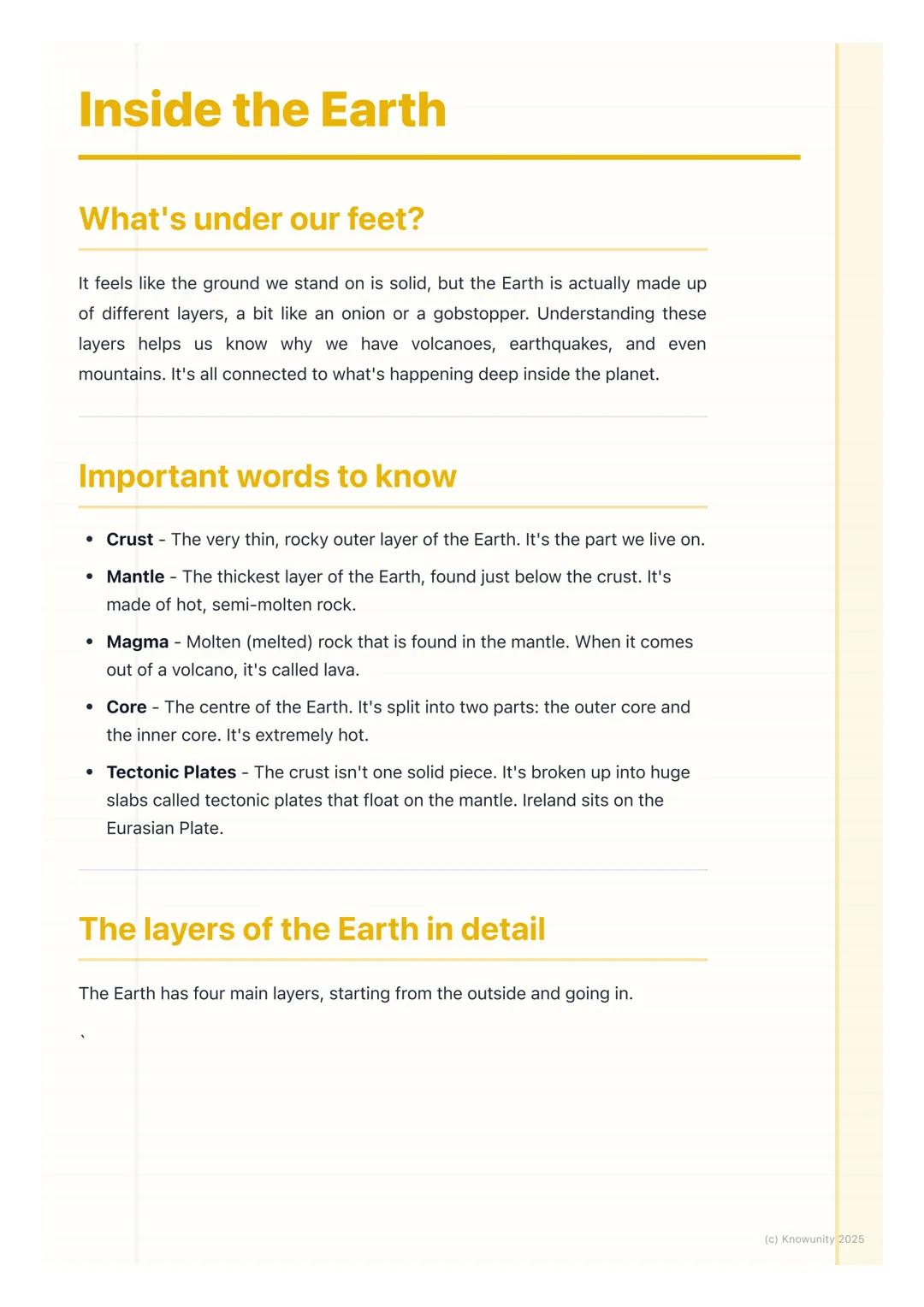
What's Under Our Feet?
Think of the Earth like a giant jawbreaker sweet - it has different layers that get more intense as you go deeper. The ground feels solid, but there's actually a lot of action happening beneath us that affects our daily lives.
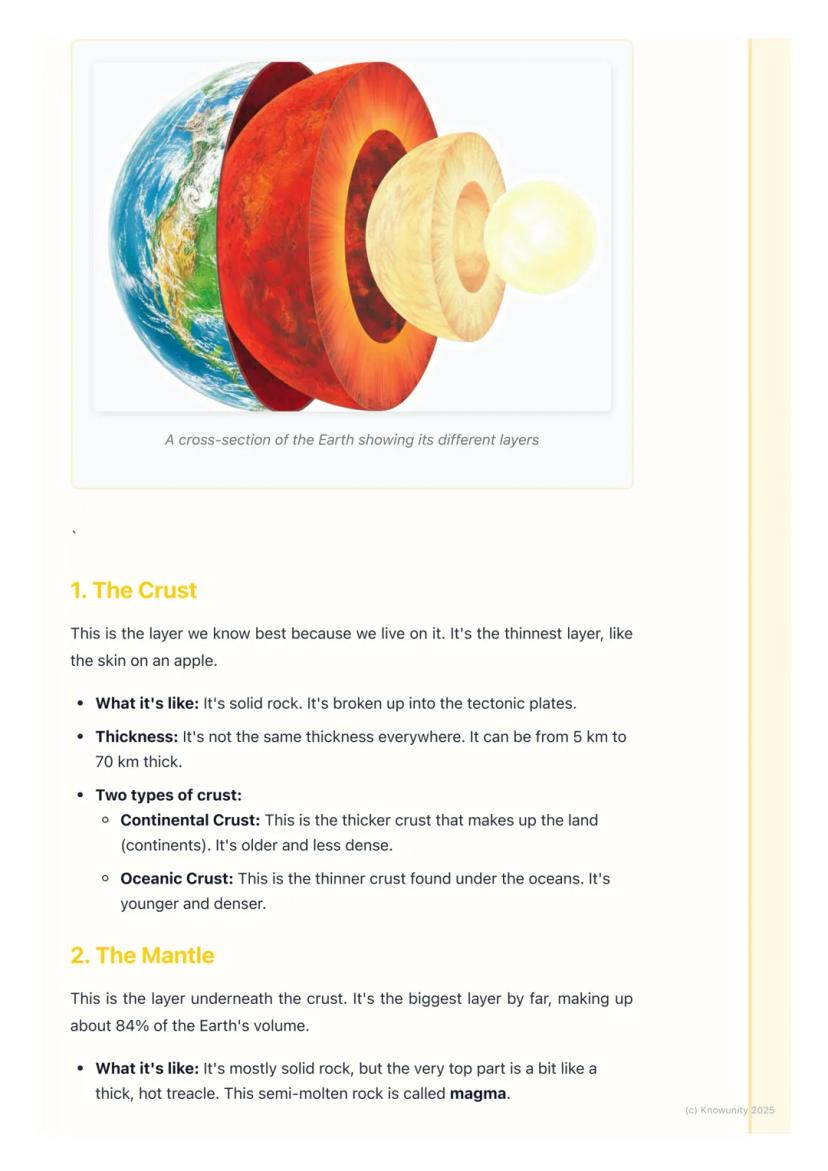
The Earth's structure is made up of four main layers: the crust, mantle, outer core, and inner core. Each layer has different temperatures, pressures, and materials. What's really cool is that Ireland sits on something called the Eurasian Plate, which is basically a massive piece of the Earth's outer shell.
Understanding these layers isn't just academic stuff - it explains why we have the Giant's Causeway in Northern Ireland and why earthquakes happen around the world.
Quick Tip: Remember the layers from outside to inside as "Crust Meets Outer Inner" - this simple phrase will help you ace any test question about Earth's structure!
2
of 5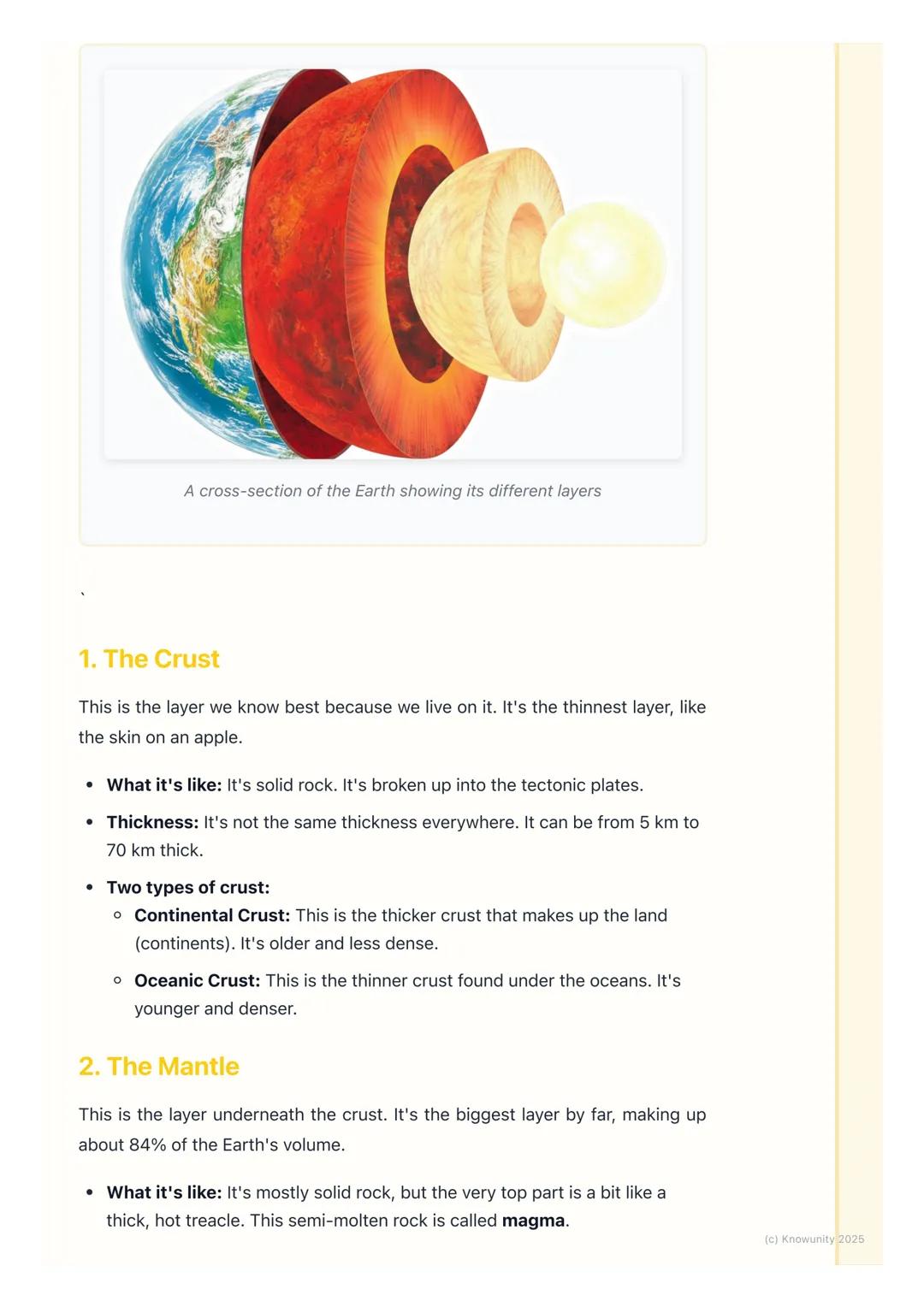
The Crust - Our Home Layer
The crust is literally the ground beneath your feet, and it's surprisingly thin compared to the other layers. Imagine the Earth as an apple - the crust would be thinner than the apple's skin!
This rocky outer layer varies in thickness from just 5km under the oceans to 70km under mountain ranges. There are two types: continental crust (the thicker stuff that makes up Ireland and other landmasses) and oceanic crust (the thinner layer under the sea).
Here's what makes the crust special - it's not one solid piece. It's broken up into huge slabs called tectonic plates that float around on the layer beneath. These plates are constantly moving, which is why we get earthquakes and volcanoes.
Did You Know? Ireland sits on the Eurasian Plate, which is slowly drifting eastward at about 2cm per year - roughly the same speed your fingernails grow!
3
of 5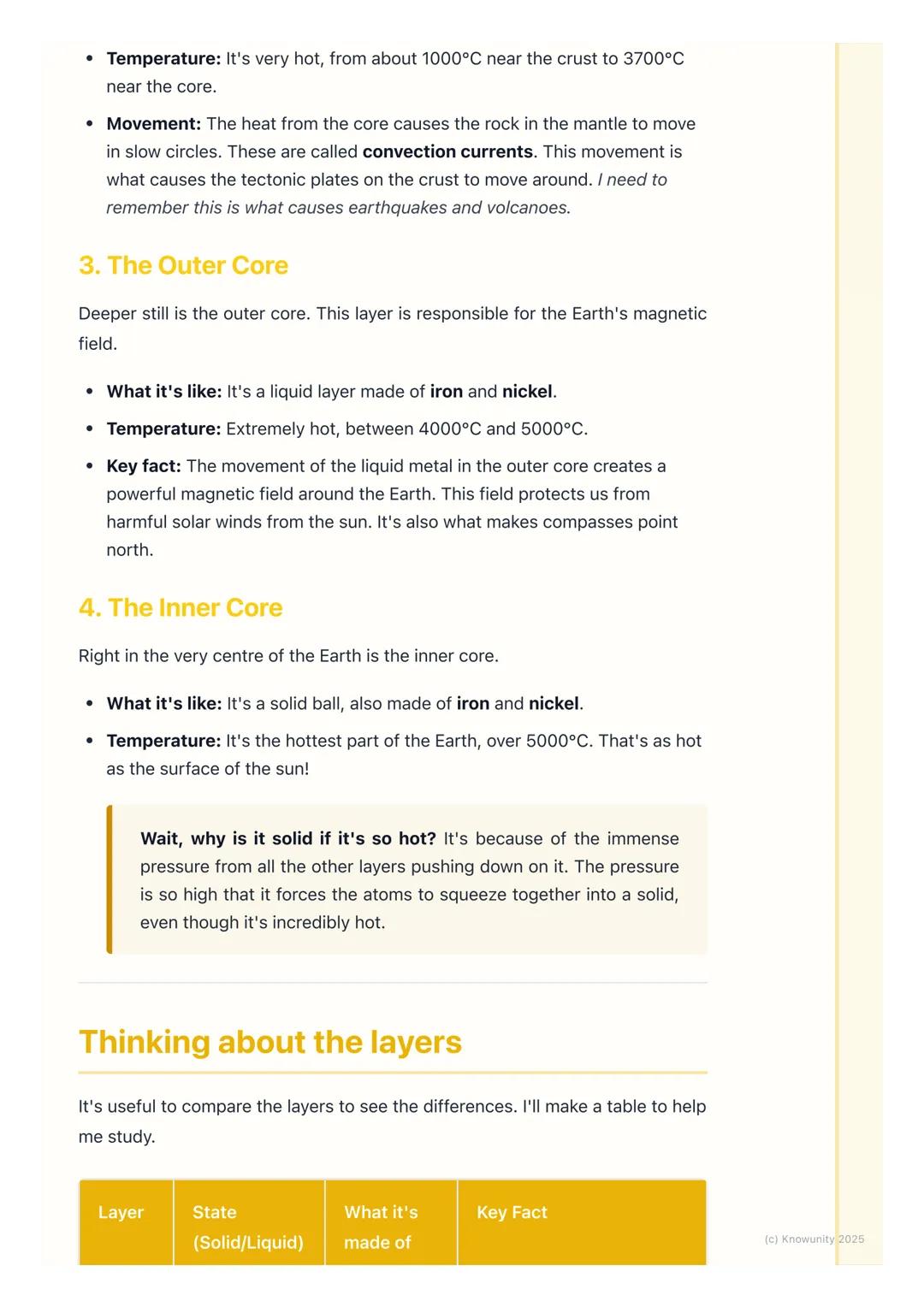
The Mantle - The Engine Room
The mantle is absolutely massive - it makes up about 84% of Earth's total volume. Think of it as the engine that powers everything happening on the surface.
This layer is mostly solid rock, but the extreme heat (between 1000°C and 3700°C) makes parts of it behave like thick, hot treacle. This semi-molten rock is called magma, and it's constantly moving in slow circles called convection currents.
These convection currents are crucial because they're what moves the tectonic plates around on the surface. When the mantle moves, it drags the crust along with it, causing earthquakes, mountain formation, and volcanic activity.
Key Point: The mantle's movement is the reason we have volcanoes in places like Iceland and earthquakes around the world - it's all connected to this underground circulation system!
4
of 5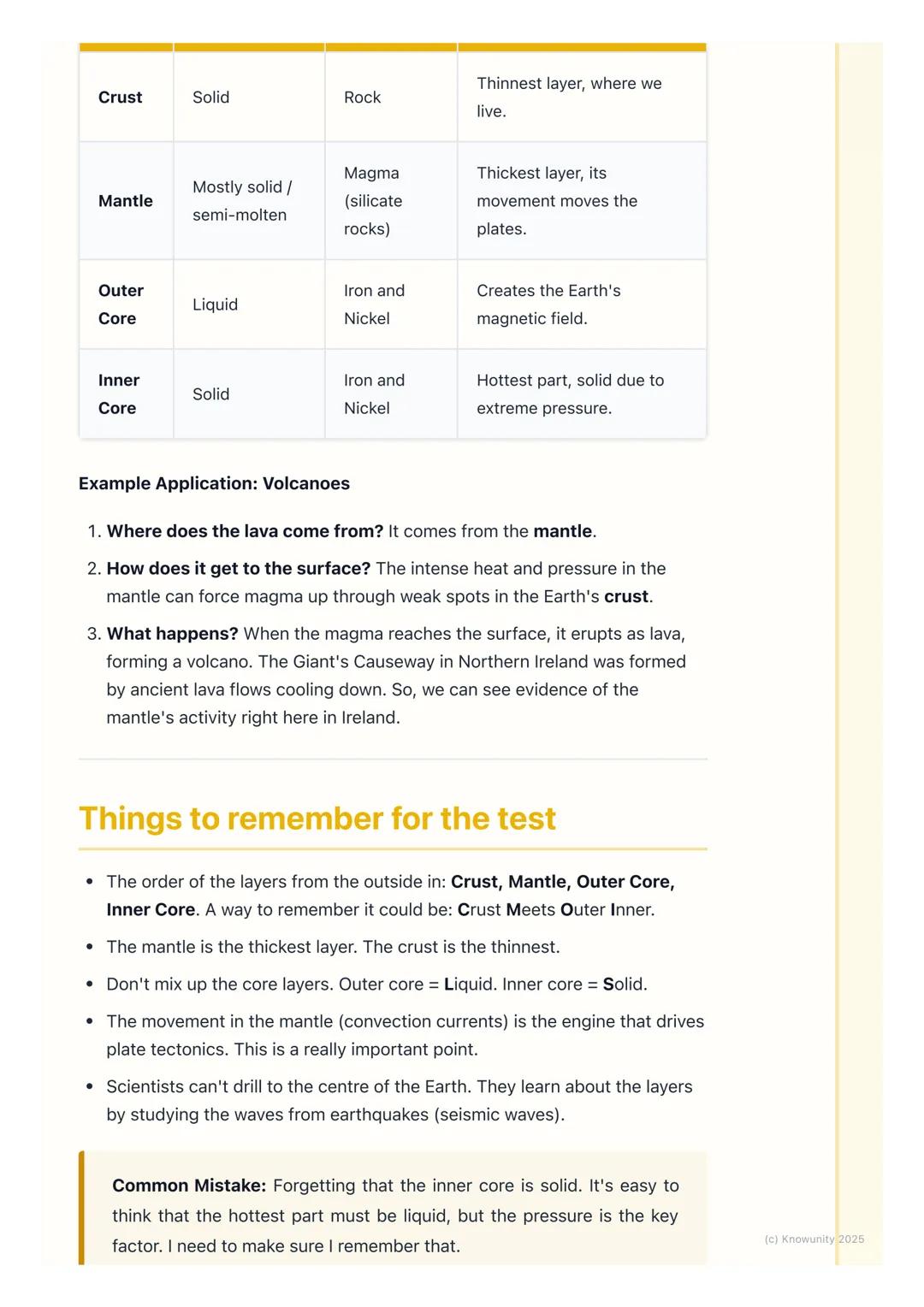
The Core - Earth's Powerhouse
The Earth's core is split into two parts, and both are incredibly important for life on our planet. The outer core is a liquid layer made of iron and nickel, spinning around at temperatures between 4000°C and 5000°C.
This liquid metal movement creates Earth's magnetic field, which acts like an invisible shield protecting us from harmful solar radiation. Without it, compasses wouldn't work and life on Earth would be impossible.
The inner core is even more extreme - it's over 5000°C (as hot as the sun's surface!) but it's actually solid. This seems impossible, but the immense pressure from all the layers above squeezes the atoms so tightly that they can't move around as a liquid.
Mind-Blowing Fact: Scientists can't drill to the Earth's centre, so they study earthquake waves to learn about these deep layers - it's like using the Earth as a giant X-ray machine!
5
of 5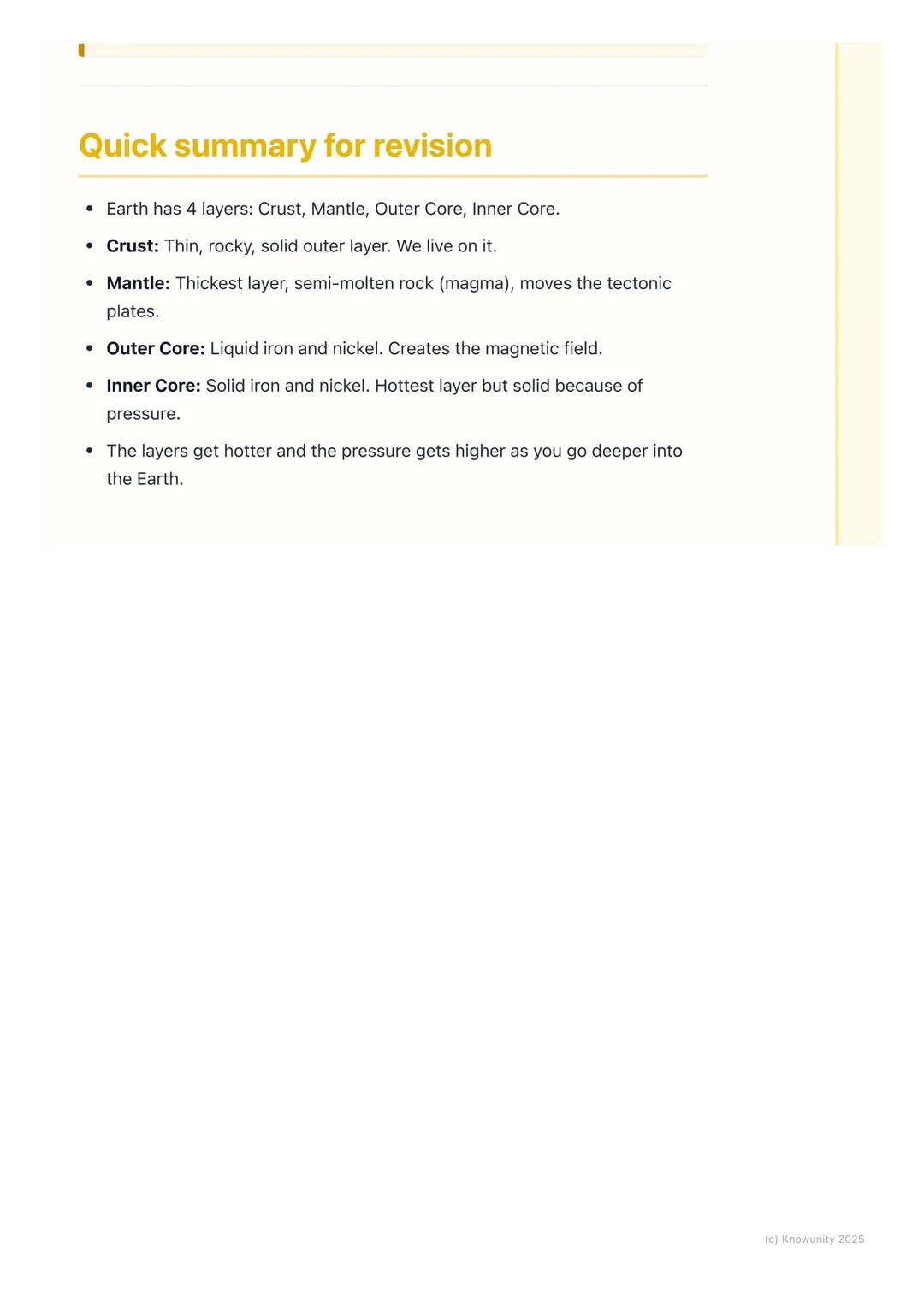
Putting It All Together
Now you can see how everything connects! When magma from the mantle finds weak spots in the crust, it erupts as lava, creating volcanoes. The Giant's Causeway in Northern Ireland was formed exactly this way from ancient lava flows.
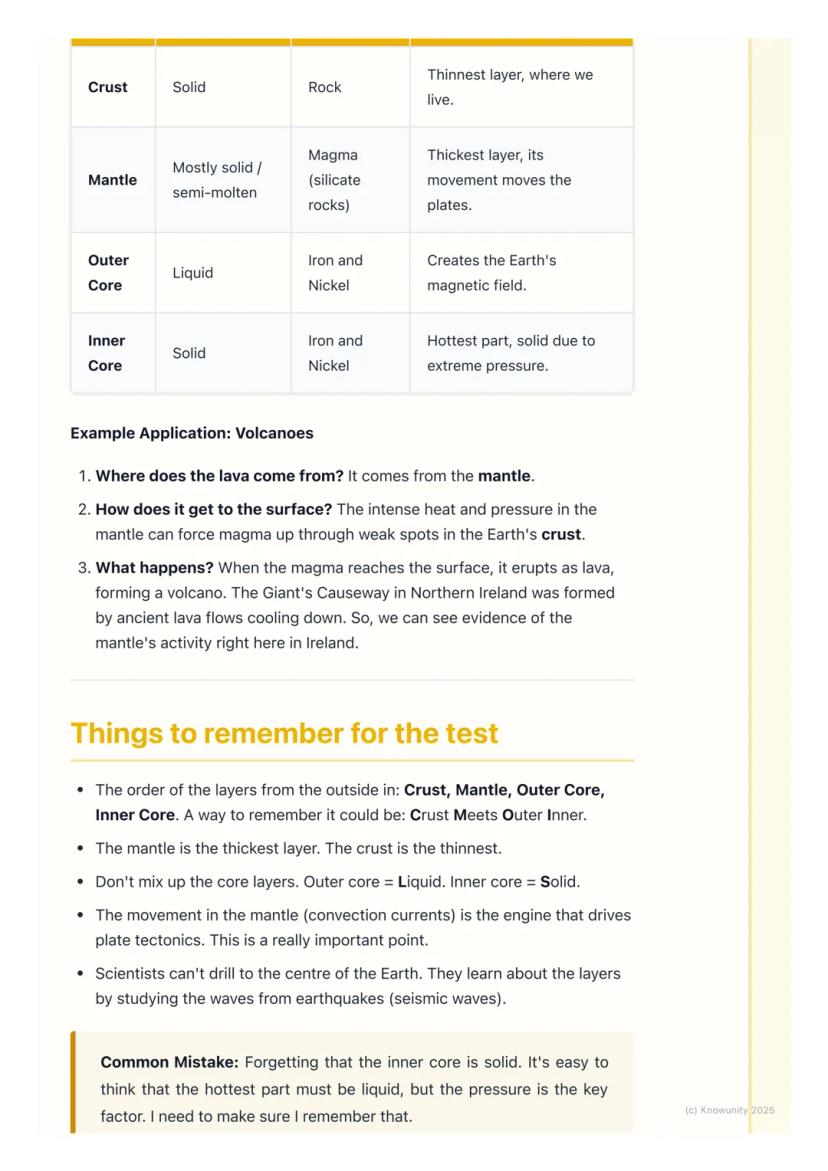
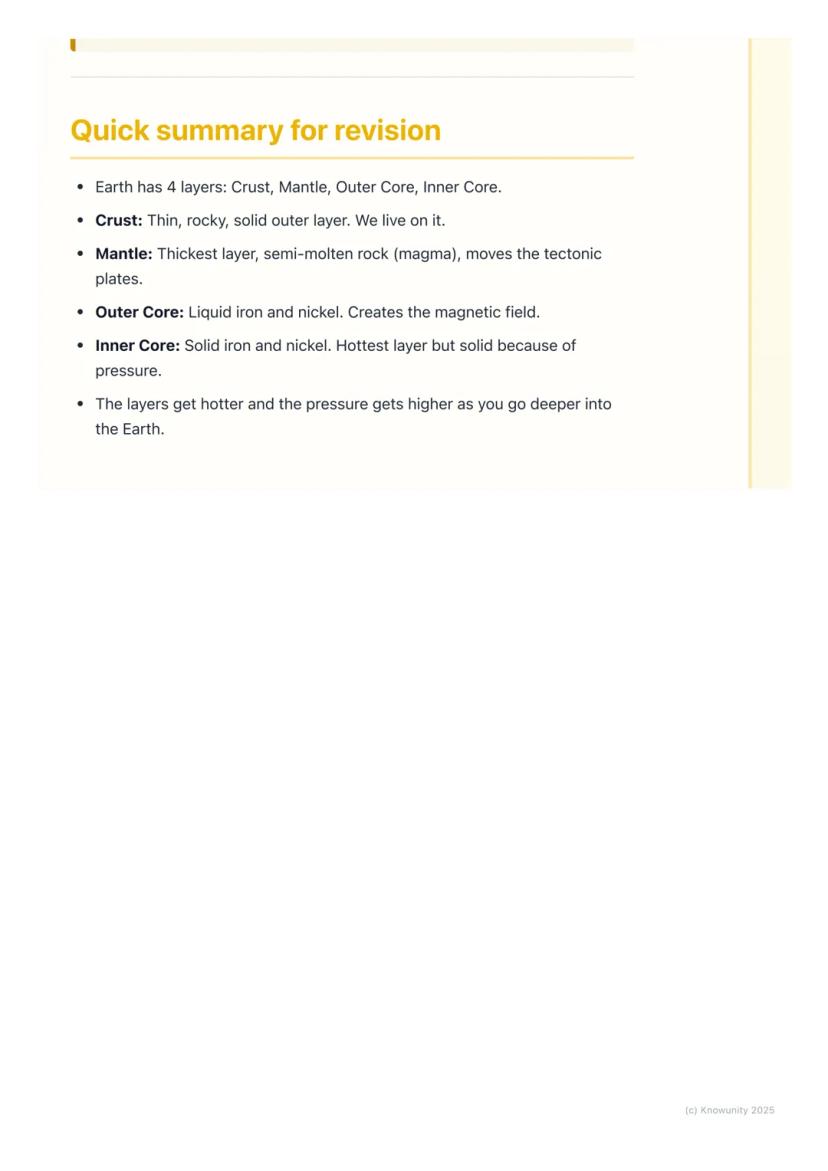
The key things to remember: crust (thin and rocky), mantle (thick and moving), outer core (liquid and magnetic), inner core (solid despite extreme heat). Each layer gets hotter and more pressurised as you go deeper.
Understanding Earth's layers helps explain so many things around us - from why Ireland doesn't have active volcanoes (we're in a stable part of a tectonic plate) to why we can navigate using compasses (thanks to that magnetic outer core).
Test Success Tip: Remember that pressure increases with depth - that's why the hottest layer (inner core) is solid while the slightly cooler outer core is liquid. Get this concept right and you'll nail the tricky questions!
Myśleliśmy, że nigdy nie zapytasz...
Czym jest Towarzysz AI z Knowunity?
Nasz asystent AI jest specjalnie dostosowany do potrzeb uczniów. W oparciu o miliony treści, które mamy na platformie, możemy udzielać uczniom naprawdę znaczących i trafnych odpowiedzi. Ale nie chodzi tylko o odpowiedzi, towarzysz prowadzi również uczniów przez codzienne wyzwania związane z nauką, ze spersonalizowanymi planami nauki, quizami lub treściami na czacie i 100% personalizacją opartą na umiejętnościach i rozwoju uczniów.
Gdzie mogę pobrać aplikację Knowunity?
Aplikację możesz pobrać z Google Play i Apple Store.
Czy aplikacja Knowunity naprawdę jest darmowa?
Tak, masz całkowicie darmowy dostęp do wszystkich notatek w aplikacji, możesz w każdej chwili rozmawiać z Ekspertami lub ich obserwować. Możesz użyć punktów, aby odblokować pewne funkcje w aplikacji, które również możesz otrzymać za darmo. Dodatkowo oferujemy usługę Knowunity Premium, która pozwala na odblokowanie większej liczby funkcji.
Najpopularniejsze notatki z Geography
9Najpopularniejsze notatki
9Nie ma nic odpowiedniego? Sprawdź inne przedmioty.
Zobacz, co mówią o nas nasi użytkownicy. Pokochali nas — pokochasz też i Ty.
4.6/5App Store
4.7/5Google Play
Aplikacja jest bardzo prosta i dobrze przemyślana. Do tej pory znalazłem wszystko, czego szukałem i mogłem się wiele nauczyć z innych notatek! Na pewno wykorzystam aplikację do pomocy przy robieniu prac domowych! No i oczywiście bardzo pomaga też jako inspiracja do robienia swoich notatek.
Stefan Sużytkownik iOS
Ta aplikacja jest naprawdę świetna. Jest tak wiele notatek i pomocnych informacji [...]. Moim problematycznym przedmiotem jest język niemiecki, a w aplikacji jest w czym wybierać. Dzięki tej aplikacji poprawiłam swój niemiecki. Polecam ją każdemu.
Samantha Klichużytkownik Androida
Wow, jestem w szoku. Właśnie wypróbowałam aplikację, ponieważ widziałam ją kilka razy reklamowaną na TikToku jestem absolutnie w szoku. Ta aplikacja jest POMOCĄ, której potrzebujesz w szkole i przede wszystkim oferuje tak wiele rzeczy jak notatki czy streszczenia, które są BARDZO pomocne w moim przypadku.
Annaużytkownik iOS
Geography5 wyświetleń·Zaktualizowano May 29, 2026·5 stronyThe Earth's Layers Explained
Ever wondered what's actually beneath your feet? The Earth isn't just solid rock all the way down - it's made up of four distinct layers, each with its own unique properties. Understanding these layers helps explain everything from why volcanoes... Pokaż więcej
1
of 5Zarejestruj się, aby zobaczyć notatkę. To nic nie kosztuje!
- Dostęp do wszystkich materiałów
- Popraw swoje oceny
- Dołącz do milionów studentów
What's Under Our Feet?
Think of the Earth like a giant jawbreaker sweet - it has different layers that get more intense as you go deeper. The ground feels solid, but there's actually a lot of action happening beneath us that affects our daily lives.
The Earth's structure is made up of four main layers: the crust, mantle, outer core, and inner core. Each layer has different temperatures, pressures, and materials. What's really cool is that Ireland sits on something called the Eurasian Plate, which is basically a massive piece of the Earth's outer shell.
Understanding these layers isn't just academic stuff - it explains why we have the Giant's Causeway in Northern Ireland and why earthquakes happen around the world.
Quick Tip: Remember the layers from outside to inside as "Crust Meets Outer Inner" - this simple phrase will help you ace any test question about Earth's structure!
2
of 5Zarejestruj się, aby zobaczyć notatkę. To nic nie kosztuje!
- Dostęp do wszystkich materiałów
- Popraw swoje oceny
- Dołącz do milionów studentów
The Crust - Our Home Layer
The crust is literally the ground beneath your feet, and it's surprisingly thin compared to the other layers. Imagine the Earth as an apple - the crust would be thinner than the apple's skin!
This rocky outer layer varies in thickness from just 5km under the oceans to 70km under mountain ranges. There are two types: continental crust (the thicker stuff that makes up Ireland and other landmasses) and oceanic crust (the thinner layer under the sea).
Here's what makes the crust special - it's not one solid piece. It's broken up into huge slabs called tectonic plates that float around on the layer beneath. These plates are constantly moving, which is why we get earthquakes and volcanoes.
Did You Know? Ireland sits on the Eurasian Plate, which is slowly drifting eastward at about 2cm per year - roughly the same speed your fingernails grow!
3
of 5Zarejestruj się, aby zobaczyć notatkę. To nic nie kosztuje!
- Dostęp do wszystkich materiałów
- Popraw swoje oceny
- Dołącz do milionów studentów
The Mantle - The Engine Room
The mantle is absolutely massive - it makes up about 84% of Earth's total volume. Think of it as the engine that powers everything happening on the surface.
This layer is mostly solid rock, but the extreme heat (between 1000°C and 3700°C) makes parts of it behave like thick, hot treacle. This semi-molten rock is called magma, and it's constantly moving in slow circles called convection currents.
These convection currents are crucial because they're what moves the tectonic plates around on the surface. When the mantle moves, it drags the crust along with it, causing earthquakes, mountain formation, and volcanic activity.
Key Point: The mantle's movement is the reason we have volcanoes in places like Iceland and earthquakes around the world - it's all connected to this underground circulation system!
4
of 5Zarejestruj się, aby zobaczyć notatkę. To nic nie kosztuje!
- Dostęp do wszystkich materiałów
- Popraw swoje oceny
- Dołącz do milionów studentów
The Core - Earth's Powerhouse
The Earth's core is split into two parts, and both are incredibly important for life on our planet. The outer core is a liquid layer made of iron and nickel, spinning around at temperatures between 4000°C and 5000°C.
This liquid metal movement creates Earth's magnetic field, which acts like an invisible shield protecting us from harmful solar radiation. Without it, compasses wouldn't work and life on Earth would be impossible.
The inner core is even more extreme - it's over 5000°C (as hot as the sun's surface!) but it's actually solid. This seems impossible, but the immense pressure from all the layers above squeezes the atoms so tightly that they can't move around as a liquid.
Mind-Blowing Fact: Scientists can't drill to the Earth's centre, so they study earthquake waves to learn about these deep layers - it's like using the Earth as a giant X-ray machine!
5
of 5Zarejestruj się, aby zobaczyć notatkę. To nic nie kosztuje!
- Dostęp do wszystkich materiałów
- Popraw swoje oceny
- Dołącz do milionów studentów
Putting It All Together
Now you can see how everything connects! When magma from the mantle finds weak spots in the crust, it erupts as lava, creating volcanoes. The Giant's Causeway in Northern Ireland was formed exactly this way from ancient lava flows.
The key things to remember: crust (thin and rocky), mantle (thick and moving), outer core (liquid and magnetic), inner core (solid despite extreme heat). Each layer gets hotter and more pressurised as you go deeper.
Understanding Earth's layers helps explain so many things around us - from why Ireland doesn't have active volcanoes (we're in a stable part of a tectonic plate) to why we can navigate using compasses (thanks to that magnetic outer core).
Test Success Tip: Remember that pressure increases with depth - that's why the hottest layer (inner core) is solid while the slightly cooler outer core is liquid. Get this concept right and you'll nail the tricky questions!
Myśleliśmy, że nigdy nie zapytasz...
Czym jest Towarzysz AI z Knowunity?
Nasz asystent AI jest specjalnie dostosowany do potrzeb uczniów. W oparciu o miliony treści, które mamy na platformie, możemy udzielać uczniom naprawdę znaczących i trafnych odpowiedzi. Ale nie chodzi tylko o odpowiedzi, towarzysz prowadzi również uczniów przez codzienne wyzwania związane z nauką, ze spersonalizowanymi planami nauki, quizami lub treściami na czacie i 100% personalizacją opartą na umiejętnościach i rozwoju uczniów.
Gdzie mogę pobrać aplikację Knowunity?
Aplikację możesz pobrać z Google Play i Apple Store.
Czy aplikacja Knowunity naprawdę jest darmowa?
Tak, masz całkowicie darmowy dostęp do wszystkich notatek w aplikacji, możesz w każdej chwili rozmawiać z Ekspertami lub ich obserwować. Możesz użyć punktów, aby odblokować pewne funkcje w aplikacji, które również możesz otrzymać za darmo. Dodatkowo oferujemy usługę Knowunity Premium, która pozwala na odblokowanie większej liczby funkcji.
Najpopularniejsze notatki z Geography
9Najpopularniejsze notatki
9Nie ma nic odpowiedniego? Sprawdź inne przedmioty.
Zobacz, co mówią o nas nasi użytkownicy. Pokochali nas — pokochasz też i Ty.
4.6/5App Store
4.7/5Google Play
Aplikacja jest bardzo prosta i dobrze przemyślana. Do tej pory znalazłem wszystko, czego szukałem i mogłem się wiele nauczyć z innych notatek! Na pewno wykorzystam aplikację do pomocy przy robieniu prac domowych! No i oczywiście bardzo pomaga też jako inspiracja do robienia swoich notatek.
Stefan Sużytkownik iOS
Ta aplikacja jest naprawdę świetna. Jest tak wiele notatek i pomocnych informacji [...]. Moim problematycznym przedmiotem jest język niemiecki, a w aplikacji jest w czym wybierać. Dzięki tej aplikacji poprawiłam swój niemiecki. Polecam ją każdemu.
Samantha Klichużytkownik Androida
Wow, jestem w szoku. Właśnie wypróbowałam aplikację, ponieważ widziałam ją kilka razy reklamowaną na TikToku jestem absolutnie w szoku. Ta aplikacja jest POMOCĄ, której potrzebujesz w szkole i przede wszystkim oferuje tak wiele rzeczy jak notatki czy streszczenia, które są BARDZO pomocne w moim przypadku.
Annaużytkownik iOS