
Urbanisation is the process where more and more people move...
 Geography3 wyświetleń·Zaktualizowano Jun 7, 2026·6 strony
Understanding Urban Growth and Challenges
1 / 6
1
of 6
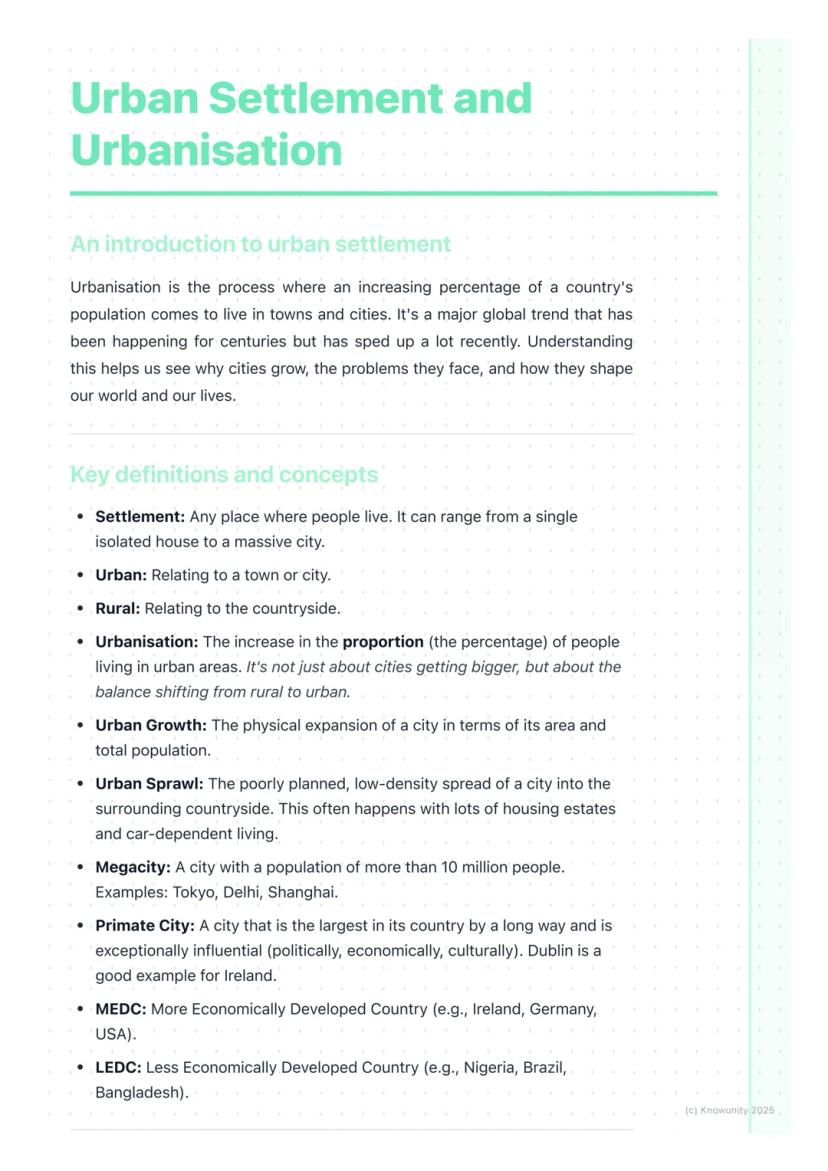
Urban Settlement Basics
When studying settlements, we need to understand some key differences. A settlement is any place where people live, from isolated houses to massive cities. Urban areas are towns and cities, while rural refers to the countryside.
Urbanisation specifically means the increasing percentage of people living in urban areas. It's not just about cities getting bigger, but about the population balance shifting from rural to urban. Urban growth refers to the physical expansion of a city's area and total population.
Cities develop in different ways. Urban sprawl is the poorly planned spread of a city into surrounding countryside, often through housing estates and car-dependent living. Megacities have populations over 10 million (like Tokyo), while primate cities dominate their countries economically and politically (Dublin is Ireland's primate city).
Did you know? The world is becoming increasingly urban. In 1950, only 30% of people lived in cities, but today it's over 55%, and by 2050 it could reach 68%!
2
of 6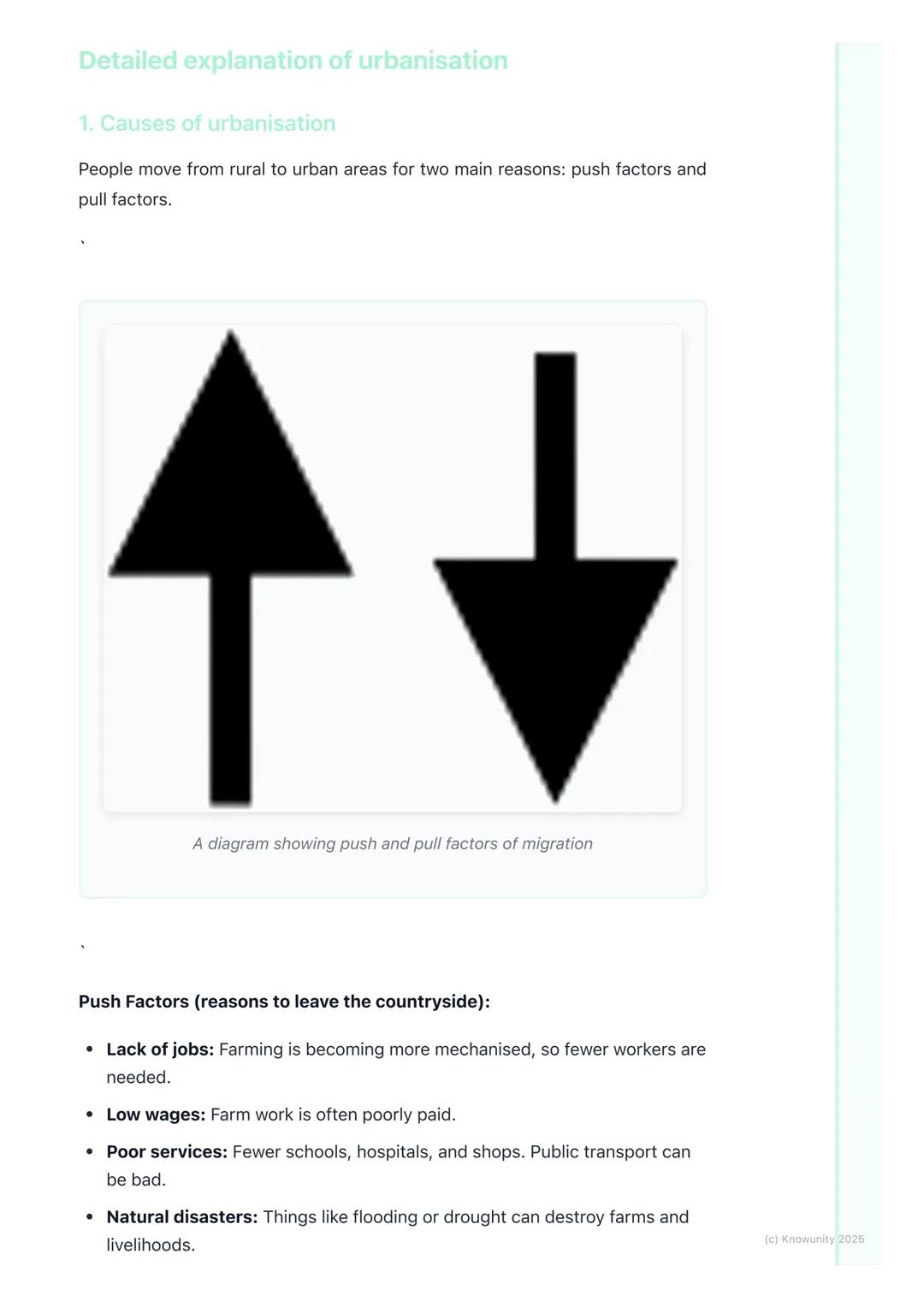
Why People Move to Cities
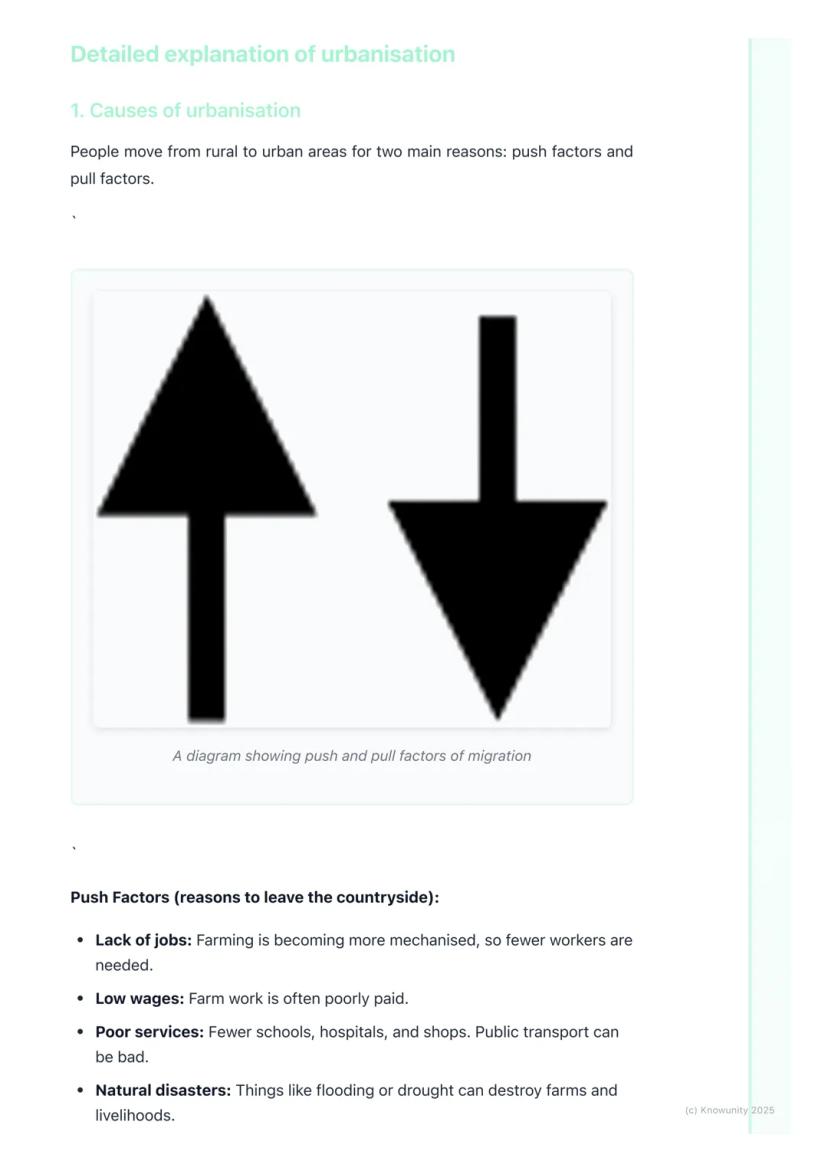
People migrate to cities because of both push factors (reasons to leave rural areas) and pull factors (attractions of urban areas). These work together to drive urbanisation.
Push factors include the lack of rural jobs as farming becomes more mechanised. Low wages in agriculture compared to city jobs push people away, as do poor services like limited schools and healthcare in rural areas. Natural disasters like floods or droughts can destroy farms and force people to relocate, while isolation from opportunities and social networks can make rural living less appealing.
Pull factors drawing people to cities include greater job opportunities in factories, offices, and service industries. The promise of higher wages is a major attraction, along with better services like education, healthcare, and entertainment. Many people perceive a better quality of life in cities, with more excitement and modern amenities.
Remember this: For your exams, always pair push and pull factors together - they're two sides of the same migration coin!
3
of 6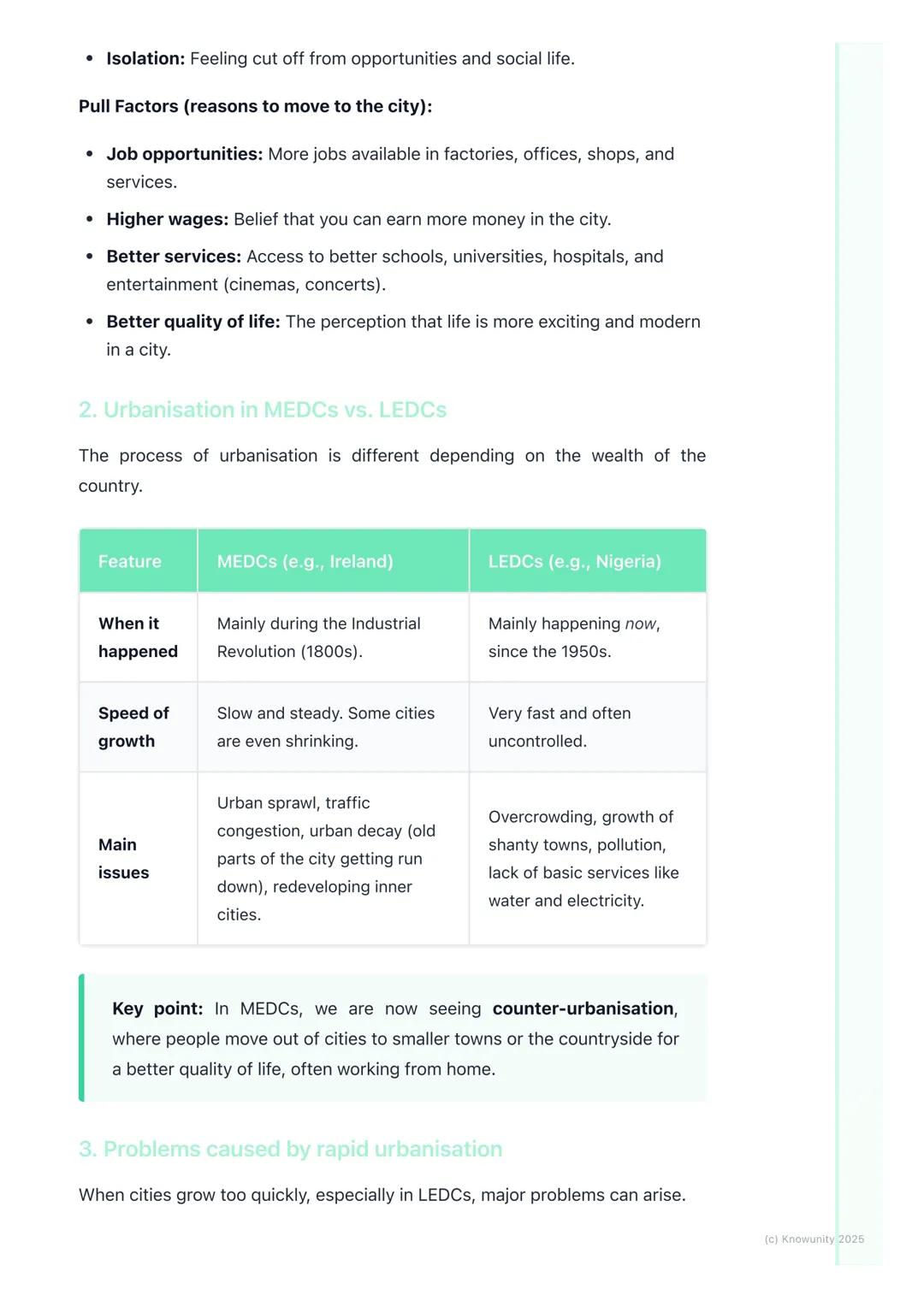
Urbanisation: Rich vs. Developing Countries
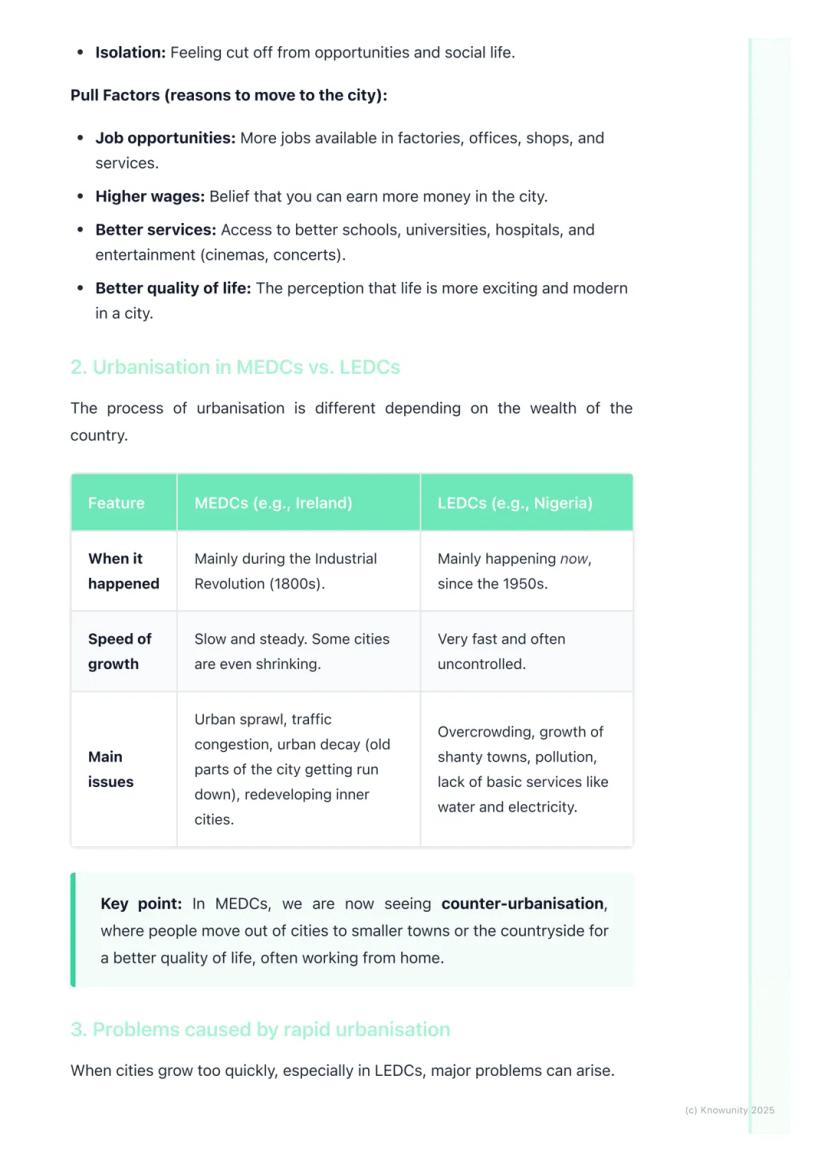
Urbanisation looks quite different depending on a country's wealth and development stage. In MEDCs (More Economically Developed Countries) like Ireland, urbanisation happened mainly during the Industrial Revolution in the 1800s. Growth was slow and steady, with some cities now even shrinking.
By contrast, in LEDCs (Less Economically Developed Countries) like Nigeria, urbanisation is happening now at a very fast, often uncontrolled pace. This speed creates different challenges - while MEDCs struggle with urban sprawl, traffic congestion and urban decay, LEDCs face overwhelming problems with overcrowding, shanty towns, and lack of basic services.
Interestingly, many MEDCs are now experiencing counter-urbanisation, where people move out of cities to smaller towns or rural areas for a better quality of life. This trend has been accelerated by remote working opportunities, allowing people to enjoy rural living while keeping urban jobs.
Exam tip: Make sure you can explain specific differences between urbanisation in MEDCs and LEDCs - examiners love comparing these patterns!
4
of 6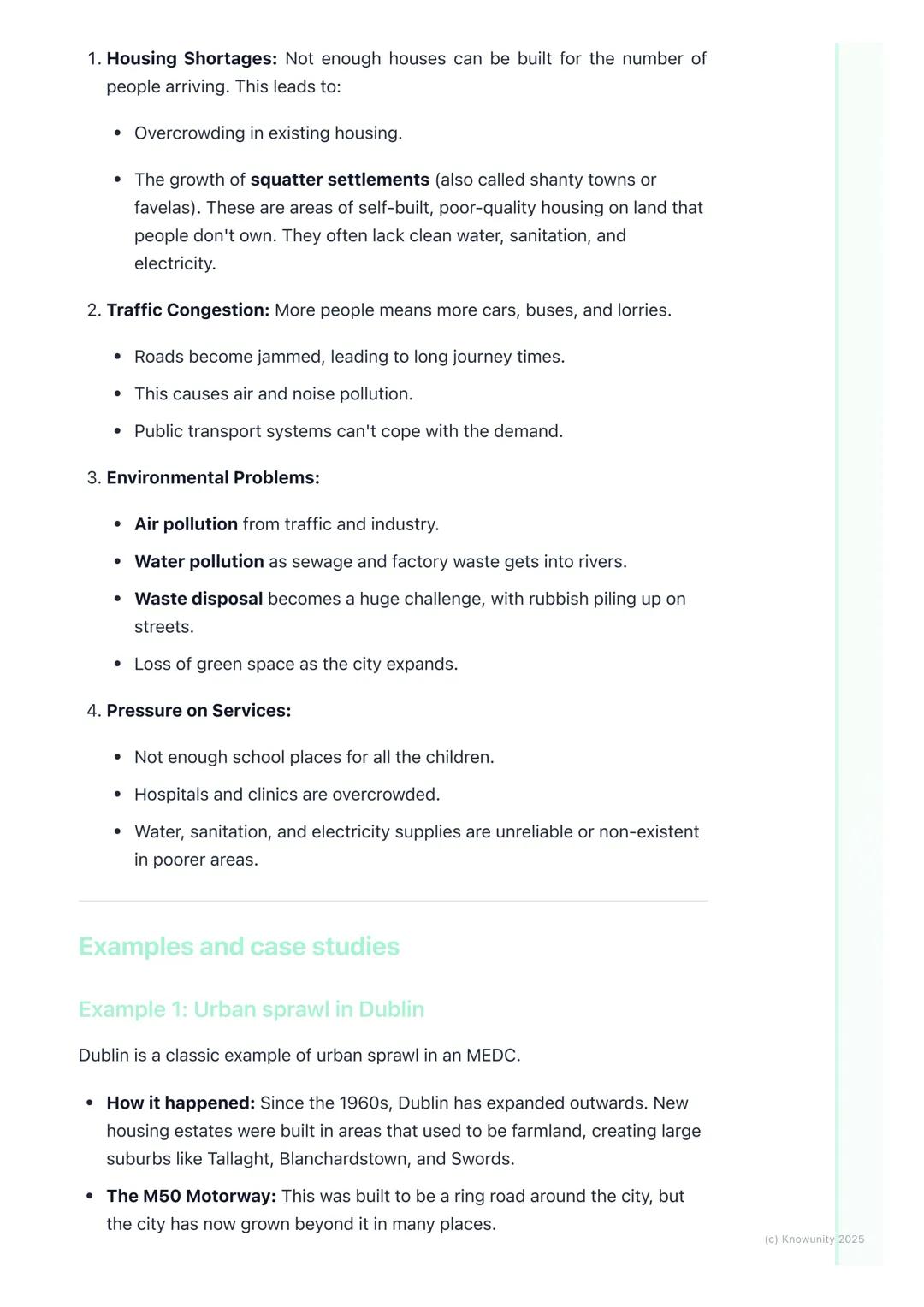
Problems of Rapid Urbanisation
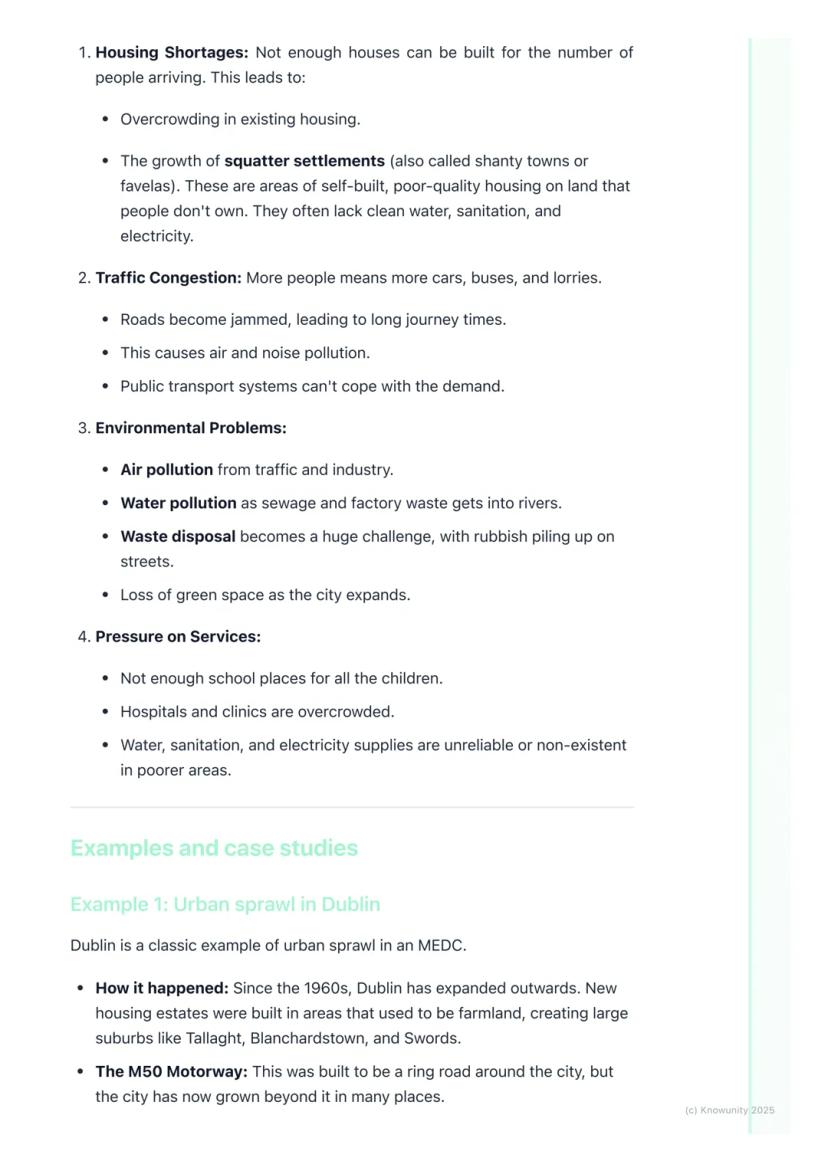
When cities grow too quickly, especially in developing countries, they face serious challenges. Housing shortages occur when construction can't keep pace with migration, leading to overcrowding and the growth of squatter settlements (also called shanty towns or favelas) - areas with poor-quality self-built housing lacking basic services.
Traffic congestion becomes a major headache as roads become jammed with vehicles. This not only wastes time but creates air and noise pollution. Public transport systems struggle to meet the increasing demand, making the problem worse.
Environmental problems multiply in rapidly growing cities. Air pollution from traffic and industry can reach dangerous levels, while water pollution occurs when sewage and factory waste contaminate rivers. Waste disposal becomes a massive challenge, and green spaces disappear as cities expand.
The pressure on public services becomes intense. Schools can't provide enough places, hospitals become overcrowded, and utilities like water and electricity become unreliable or completely unavailable in poorer areas.
Think about this: Many of the problems of urbanisation are interconnected. For example, traffic congestion leads to air pollution, which causes health problems, putting more pressure on hospitals!
5
of 6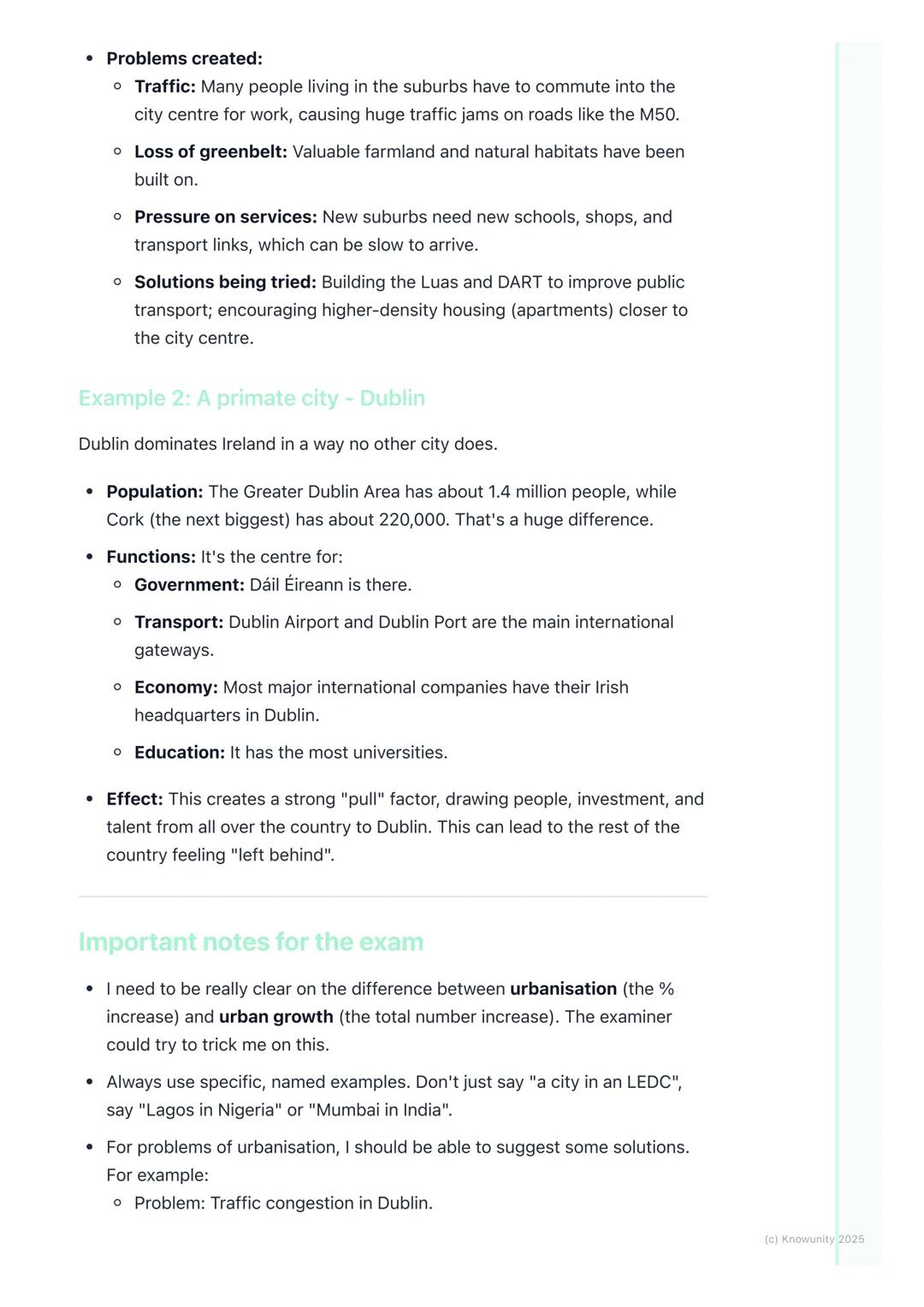
Case Study: Dublin's Urban Challenges
Dublin provides excellent examples of urban issues in an MEDC. Since the 1960s, urban sprawl has transformed Dublin as it expanded outwards. New housing estates were built on former farmland, creating large suburbs like Tallaght and Blanchardstown. Even the M50 motorway, originally designed as a ring road around the city, has been engulfed as the city expanded beyond it.
This sprawl has created significant problems. Traffic congestion is severe as suburbanites commute into the city centre. Valuable farmland and natural habitats have been lost to development. New suburbs often lack adequate services initially, putting pressure on existing infrastructure. Solutions being implemented include expanding the Luas and DART systems and encouraging higher-density housing closer to the city centre.
Dublin is also a classic primate city, dominating Ireland demographically, economically and politically. With about 1.4 million people in the Greater Dublin Area (compared to Cork's 220,000), it serves as the centre for government, transport, economy, and education. This creates a strong "pull" effect, drawing people and investment from all over Ireland, sometimes leaving other regions feeling neglected.
For your exam: Be able to explain how Dublin exemplifies both urban sprawl and the primate city concept - these are perfect examples from right here in Ireland!
6
of 6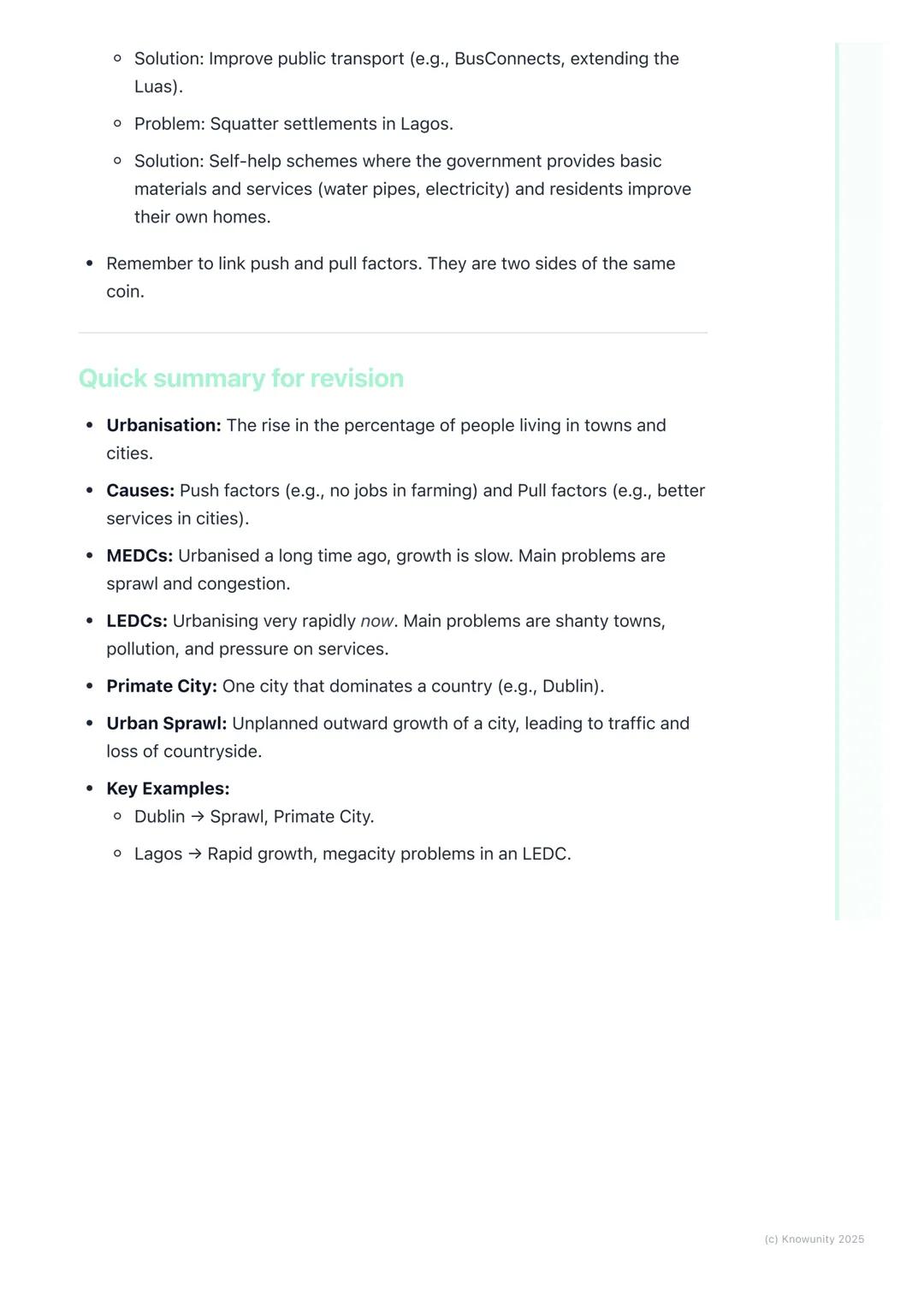
Exam Preparation Tips
When preparing for exams on urbanisation, focus on clarity and specificity. Be very clear about the difference between urbanisation (the percentage increase of urban population) and urban growth (the total population increase) - examiners often test this distinction.
Always use specific, named examples rather than general statements. Instead of "a city in an LEDC," say "Lagos in Nigeria" or "Mumbai in India." This shows deeper understanding and application of concepts.
For problems of urbanisation, be ready to suggest solutions. For traffic congestion in Dublin, mention improving public transport through BusConnects or Luas extensions. For squatter settlements in Lagos, discuss self-help schemes where governments provide basic materials and services while residents improve their homes.
Remember these key concepts: urbanisation is driven by push and pull factors; MEDCs urbanised long ago while LEDCs are urbanising rapidly now; urban sprawl creates traffic problems and loss of countryside; and primate cities dominate their countries economically and politically. Key examples to know include Dublin (sprawl, primate city) and Lagos (rapid growth, megacity problems).
Confidence booster: Urbanisation might seem complex, but by breaking it down into causes, effects and examples, you'll master this topic and be ready to tackle any exam question!
Myśleliśmy, że nigdy nie zapytasz...
Czym jest Towarzysz AI z Knowunity?
Nasz asystent AI jest specjalnie dostosowany do potrzeb uczniów. W oparciu o miliony treści, które mamy na platformie, możemy udzielać uczniom naprawdę znaczących i trafnych odpowiedzi. Ale nie chodzi tylko o odpowiedzi, towarzysz prowadzi również uczniów przez codzienne wyzwania związane z nauką, ze spersonalizowanymi planami nauki, quizami lub treściami na czacie i 100% personalizacją opartą na umiejętnościach i rozwoju uczniów.
Gdzie mogę pobrać aplikację Knowunity?
Aplikację możesz pobrać z Google Play i Apple Store.
Czy aplikacja Knowunity naprawdę jest darmowa?
Tak, masz całkowicie darmowy dostęp do wszystkich notatek w aplikacji, możesz w każdej chwili rozmawiać z Ekspertami lub ich obserwować. Możesz użyć punktów, aby odblokować pewne funkcje w aplikacji, które również możesz otrzymać za darmo. Dodatkowo oferujemy usługę Knowunity Premium, która pozwala na odblokowanie większej liczby funkcji.
Najpopularniejsze notatki z Geography
9GeographyGeography notes on rocks
Includes types of rocks,uses of rocks, case studies
1st Year341
GeographyEarthquakes revision notes
Notes on earthquakes with diagrams
1st Year110
GeographyPopulation Change and Migration
This covers factors that cause populations to grow or shrink, including birth rates, death rates, and the reasons people migrate.
2nd Year90
GeographyRock notes geography
Geography
5th Year250
GeographyThe sea
Jc Geography
1st Year230
GeographyGeography notes On the sea
Includes costal erosion, sea cliffs, longshore drift etc.
1st Year160
GeographyInside the Earth
Students will learn about the basic layers of the Earth: the crust, mantle, and core, understanding that our planet is made up of different parts.
1st Year51
GeographyGeography notes on glaciation
Includes diagrams, erosion, deposition, transportation
1st Year210
GeographyGeography notes on weather
Includes instruments, diagrams, how to read weather
1st Year120
Najpopularniejsze notatki
9 Irish
IrishIrish oral questions and answers
Questions and answers for the leaving cert oral
5th Year4264
 English
Key Quotes : Sive
Key Quotes and explanations: Sive
6th Year2842
IrishIrish oral questions
Outline of oral questions
5th Year2055
IrishIníon- le hÁine Durkin
Aine Durkin’s poem, Iníon: Themes & summary
5th Year850
IrishIrish poetry 2027
Iníon + Dínit an Bhróin
5th Year1133
IrishLC HL notes- Iníon (poem)
Includes poem in English and Irish, theme, key words & phrases
5th Year2284
EnglishCultural Context : Shawshank Redemption : Sive : Small Things Like These
Comparative Study : Cultural Context : Shawshank Redemption, Sive and Small Things Like These
6th Year1430
IrishMo Ghrá-sa (Idir Lúibíní)
Notes on mo ghrá-sa
5th Year380
IrishAn Gaeilge Aiste
Irish Language essay
6th Year1320
Nie ma nic odpowiedniego? Sprawdź inne przedmioty.
Zobacz, co mówią o nas nasi użytkownicy. Pokochali nas — pokochasz też i Ty.
4.6/5App Store
4.7/5Google Play
Aplikacja jest bardzo prosta i dobrze przemyślana. Do tej pory znalazłem wszystko, czego szukałem i mogłem się wiele nauczyć z innych notatek! Na pewno wykorzystam aplikację do pomocy przy robieniu prac domowych! No i oczywiście bardzo pomaga też jako inspiracja do robienia swoich notatek.
Stefan Sużytkownik iOS
Ta aplikacja jest naprawdę świetna. Jest tak wiele notatek i pomocnych informacji [...]. Moim problematycznym przedmiotem jest język niemiecki, a w aplikacji jest w czym wybierać. Dzięki tej aplikacji poprawiłam swój niemiecki. Polecam ją każdemu.
Samantha Klichużytkownik Androida
Wow, jestem w szoku. Właśnie wypróbowałam aplikację, ponieważ widziałam ją kilka razy reklamowaną na TikToku jestem absolutnie w szoku. Ta aplikacja jest POMOCĄ, której potrzebujesz w szkole i przede wszystkim oferuje tak wiele rzeczy jak notatki czy streszczenia, które są BARDZO pomocne w moim przypadku.
Annaużytkownik iOS
Geography3 wyświetleń·Zaktualizowano Jun 7, 2026·6 stronyUnderstanding Urban Growth and Challenges
Urbanisation is the process where more and more people move from rural areas to live in towns and cities. This global trend has accelerated in recent decades, reshaping our landscapes and societies. Understanding urbanisation helps us grasp why cities grow,...
1
of 6
Zarejestruj się, aby zobaczyć notatkę. To nic nie kosztuje!
- Dostęp do wszystkich materiałów
- Popraw swoje oceny
- Dołącz do milionów studentów
Urban Settlement Basics
When studying settlements, we need to understand some key differences. A settlement is any place where people live, from isolated houses to massive cities. Urban areas are towns and cities, while rural refers to the countryside.
Urbanisation specifically means the increasing percentage of people living in urban areas. It's not just about cities getting bigger, but about the population balance shifting from rural to urban. Urban growth refers to the physical expansion of a city's area and total population.
Cities develop in different ways. Urban sprawl is the poorly planned spread of a city into surrounding countryside, often through housing estates and car-dependent living. Megacities have populations over 10 million (like Tokyo), while primate cities dominate their countries economically and politically (Dublin is Ireland's primate city).
Did you know? The world is becoming increasingly urban. In 1950, only 30% of people lived in cities, but today it's over 55%, and by 2050 it could reach 68%!
2
of 6Zarejestruj się, aby zobaczyć notatkę. To nic nie kosztuje!
- Dostęp do wszystkich materiałów
- Popraw swoje oceny
- Dołącz do milionów studentów
Why People Move to Cities
People migrate to cities because of both push factors (reasons to leave rural areas) and pull factors (attractions of urban areas). These work together to drive urbanisation.
Push factors include the lack of rural jobs as farming becomes more mechanised. Low wages in agriculture compared to city jobs push people away, as do poor services like limited schools and healthcare in rural areas. Natural disasters like floods or droughts can destroy farms and force people to relocate, while isolation from opportunities and social networks can make rural living less appealing.
Pull factors drawing people to cities include greater job opportunities in factories, offices, and service industries. The promise of higher wages is a major attraction, along with better services like education, healthcare, and entertainment. Many people perceive a better quality of life in cities, with more excitement and modern amenities.
Remember this: For your exams, always pair push and pull factors together - they're two sides of the same migration coin!
3
of 6Zarejestruj się, aby zobaczyć notatkę. To nic nie kosztuje!
- Dostęp do wszystkich materiałów
- Popraw swoje oceny
- Dołącz do milionów studentów
Urbanisation: Rich vs. Developing Countries
Urbanisation looks quite different depending on a country's wealth and development stage. In MEDCs (More Economically Developed Countries) like Ireland, urbanisation happened mainly during the Industrial Revolution in the 1800s. Growth was slow and steady, with some cities now even shrinking.
By contrast, in LEDCs (Less Economically Developed Countries) like Nigeria, urbanisation is happening now at a very fast, often uncontrolled pace. This speed creates different challenges - while MEDCs struggle with urban sprawl, traffic congestion and urban decay, LEDCs face overwhelming problems with overcrowding, shanty towns, and lack of basic services.
Interestingly, many MEDCs are now experiencing counter-urbanisation, where people move out of cities to smaller towns or rural areas for a better quality of life. This trend has been accelerated by remote working opportunities, allowing people to enjoy rural living while keeping urban jobs.
Exam tip: Make sure you can explain specific differences between urbanisation in MEDCs and LEDCs - examiners love comparing these patterns!
4
of 6Zarejestruj się, aby zobaczyć notatkę. To nic nie kosztuje!
- Dostęp do wszystkich materiałów
- Popraw swoje oceny
- Dołącz do milionów studentów
Problems of Rapid Urbanisation
When cities grow too quickly, especially in developing countries, they face serious challenges. Housing shortages occur when construction can't keep pace with migration, leading to overcrowding and the growth of squatter settlements (also called shanty towns or favelas) - areas with poor-quality self-built housing lacking basic services.
Traffic congestion becomes a major headache as roads become jammed with vehicles. This not only wastes time but creates air and noise pollution. Public transport systems struggle to meet the increasing demand, making the problem worse.
Environmental problems multiply in rapidly growing cities. Air pollution from traffic and industry can reach dangerous levels, while water pollution occurs when sewage and factory waste contaminate rivers. Waste disposal becomes a massive challenge, and green spaces disappear as cities expand.
The pressure on public services becomes intense. Schools can't provide enough places, hospitals become overcrowded, and utilities like water and electricity become unreliable or completely unavailable in poorer areas.
Think about this: Many of the problems of urbanisation are interconnected. For example, traffic congestion leads to air pollution, which causes health problems, putting more pressure on hospitals!
5
of 6Zarejestruj się, aby zobaczyć notatkę. To nic nie kosztuje!
- Dostęp do wszystkich materiałów
- Popraw swoje oceny
- Dołącz do milionów studentów
Case Study: Dublin's Urban Challenges
Dublin provides excellent examples of urban issues in an MEDC. Since the 1960s, urban sprawl has transformed Dublin as it expanded outwards. New housing estates were built on former farmland, creating large suburbs like Tallaght and Blanchardstown. Even the M50 motorway, originally designed as a ring road around the city, has been engulfed as the city expanded beyond it.
This sprawl has created significant problems. Traffic congestion is severe as suburbanites commute into the city centre. Valuable farmland and natural habitats have been lost to development. New suburbs often lack adequate services initially, putting pressure on existing infrastructure. Solutions being implemented include expanding the Luas and DART systems and encouraging higher-density housing closer to the city centre.
Dublin is also a classic primate city, dominating Ireland demographically, economically and politically. With about 1.4 million people in the Greater Dublin Area (compared to Cork's 220,000), it serves as the centre for government, transport, economy, and education. This creates a strong "pull" effect, drawing people and investment from all over Ireland, sometimes leaving other regions feeling neglected.
For your exam: Be able to explain how Dublin exemplifies both urban sprawl and the primate city concept - these are perfect examples from right here in Ireland!
6
of 6Zarejestruj się, aby zobaczyć notatkę. To nic nie kosztuje!
- Dostęp do wszystkich materiałów
- Popraw swoje oceny
- Dołącz do milionów studentów
Exam Preparation Tips
When preparing for exams on urbanisation, focus on clarity and specificity. Be very clear about the difference between urbanisation (the percentage increase of urban population) and urban growth (the total population increase) - examiners often test this distinction.
Always use specific, named examples rather than general statements. Instead of "a city in an LEDC," say "Lagos in Nigeria" or "Mumbai in India." This shows deeper understanding and application of concepts.
For problems of urbanisation, be ready to suggest solutions. For traffic congestion in Dublin, mention improving public transport through BusConnects or Luas extensions. For squatter settlements in Lagos, discuss self-help schemes where governments provide basic materials and services while residents improve their homes.
Remember these key concepts: urbanisation is driven by push and pull factors; MEDCs urbanised long ago while LEDCs are urbanising rapidly now; urban sprawl creates traffic problems and loss of countryside; and primate cities dominate their countries economically and politically. Key examples to know include Dublin (sprawl, primate city) and Lagos (rapid growth, megacity problems).
Confidence booster: Urbanisation might seem complex, but by breaking it down into causes, effects and examples, you'll master this topic and be ready to tackle any exam question!
Myśleliśmy, że nigdy nie zapytasz...
Czym jest Towarzysz AI z Knowunity?
Nasz asystent AI jest specjalnie dostosowany do potrzeb uczniów. W oparciu o miliony treści, które mamy na platformie, możemy udzielać uczniom naprawdę znaczących i trafnych odpowiedzi. Ale nie chodzi tylko o odpowiedzi, towarzysz prowadzi również uczniów przez codzienne wyzwania związane z nauką, ze spersonalizowanymi planami nauki, quizami lub treściami na czacie i 100% personalizacją opartą na umiejętnościach i rozwoju uczniów.
Gdzie mogę pobrać aplikację Knowunity?
Aplikację możesz pobrać z Google Play i Apple Store.
Czy aplikacja Knowunity naprawdę jest darmowa?
Tak, masz całkowicie darmowy dostęp do wszystkich notatek w aplikacji, możesz w każdej chwili rozmawiać z Ekspertami lub ich obserwować. Możesz użyć punktów, aby odblokować pewne funkcje w aplikacji, które również możesz otrzymać za darmo. Dodatkowo oferujemy usługę Knowunity Premium, która pozwala na odblokowanie większej liczby funkcji.
Najpopularniejsze notatki z Geography
9GeographyGeography notes on rocks
Includes types of rocks,uses of rocks, case studies
1st Year341
GeographyEarthquakes revision notes
Notes on earthquakes with diagrams
1st Year110
GeographyPopulation Change and Migration
This covers factors that cause populations to grow or shrink, including birth rates, death rates, and the reasons people migrate.
2nd Year90
GeographyRock notes geography
Geography
5th Year250
GeographyThe sea
Jc Geography
1st Year230
GeographyGeography notes On the sea
Includes costal erosion, sea cliffs, longshore drift etc.
1st Year160
GeographyInside the Earth
Students will learn about the basic layers of the Earth: the crust, mantle, and core, understanding that our planet is made up of different parts.
1st Year51
GeographyGeography notes on glaciation
Includes diagrams, erosion, deposition, transportation
1st Year210
GeographyGeography notes on weather
Includes instruments, diagrams, how to read weather
1st Year120
Najpopularniejsze notatki
9IrishIrish oral questions and answers
Questions and answers for the leaving cert oral
5th Year4264
EnglishKey Quotes : Sive
Key Quotes and explanations: Sive
6th Year2842
IrishIrish oral questions
Outline of oral questions
5th Year2055
IrishIníon- le hÁine Durkin
Aine Durkin’s poem, Iníon: Themes & summary
5th Year850
IrishIrish poetry 2027
Iníon + Dínit an Bhróin
5th Year1133
IrishLC HL notes- Iníon (poem)
Includes poem in English and Irish, theme, key words & phrases
5th Year2284
EnglishCultural Context : Shawshank Redemption : Sive : Small Things Like These
Comparative Study : Cultural Context : Shawshank Redemption, Sive and Small Things Like These
6th Year1430
IrishMo Ghrá-sa (Idir Lúibíní)
Notes on mo ghrá-sa
5th Year380
IrishAn Gaeilge Aiste
Irish Language essay
6th Year1320
Nie ma nic odpowiedniego? Sprawdź inne przedmioty.
Zobacz, co mówią o nas nasi użytkownicy. Pokochali nas — pokochasz też i Ty.
4.6/5App Store
4.7/5Google Play
Aplikacja jest bardzo prosta i dobrze przemyślana. Do tej pory znalazłem wszystko, czego szukałem i mogłem się wiele nauczyć z innych notatek! Na pewno wykorzystam aplikację do pomocy przy robieniu prac domowych! No i oczywiście bardzo pomaga też jako inspiracja do robienia swoich notatek.
Stefan Sużytkownik iOS
Ta aplikacja jest naprawdę świetna. Jest tak wiele notatek i pomocnych informacji [...]. Moim problematycznym przedmiotem jest język niemiecki, a w aplikacji jest w czym wybierać. Dzięki tej aplikacji poprawiłam swój niemiecki. Polecam ją każdemu.
Samantha Klichużytkownik Androida
Wow, jestem w szoku. Właśnie wypróbowałam aplikację, ponieważ widziałam ją kilka razy reklamowaną na TikToku jestem absolutnie w szoku. Ta aplikacja jest POMOCĄ, której potrzebujesz w szkole i przede wszystkim oferuje tak wiele rzeczy jak notatki czy streszczenia, które są BARDZO pomocne w moim przypadku.
Annaużytkownik iOS