
World War II was the deadliest conflict in human history,...
 History15 wyświetleń·Zaktualizowano Jun 10, 2026·6 strony
The Causes and Effects of World War II
1 / 6
1
of 6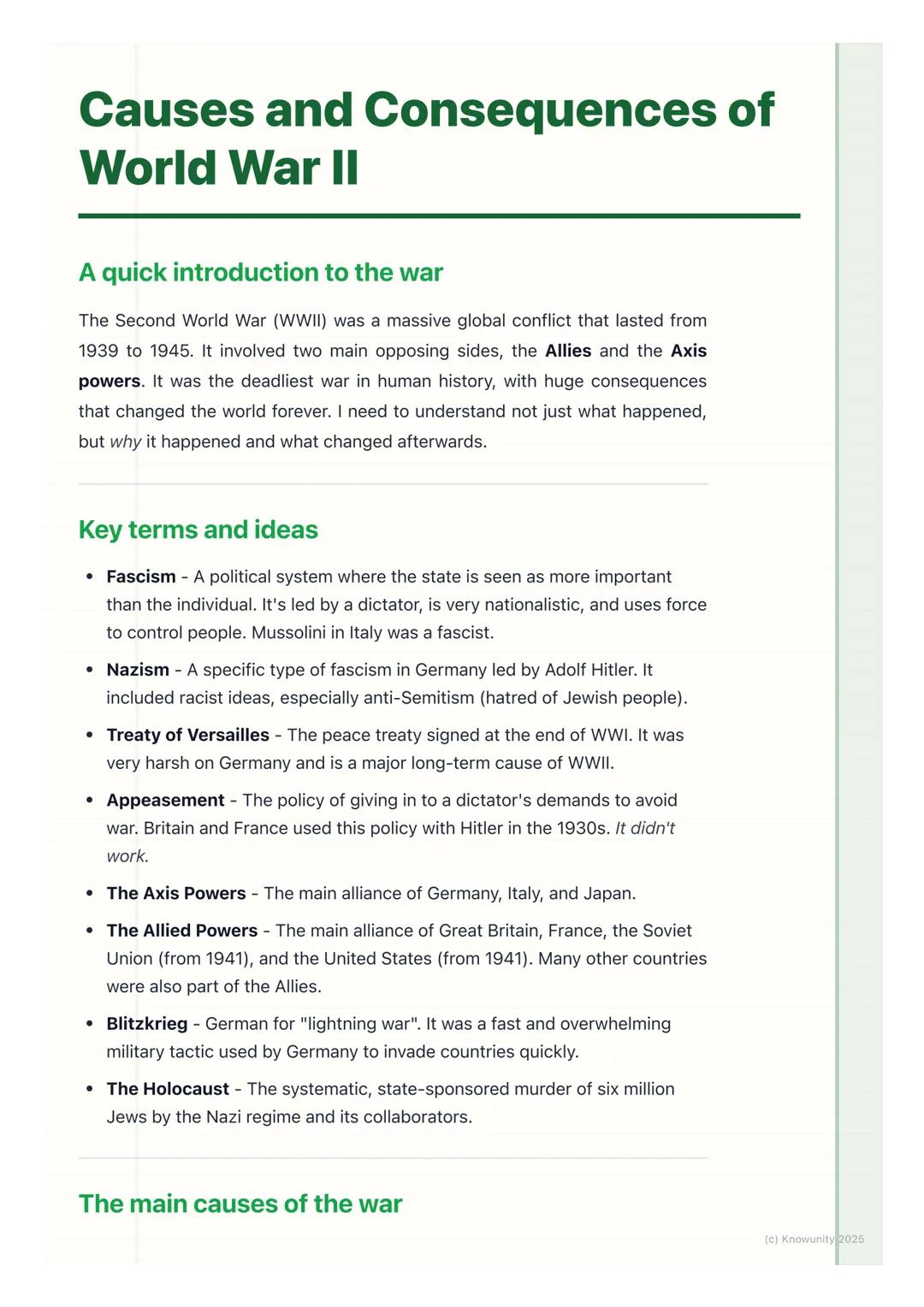
Introduction and Key Concepts
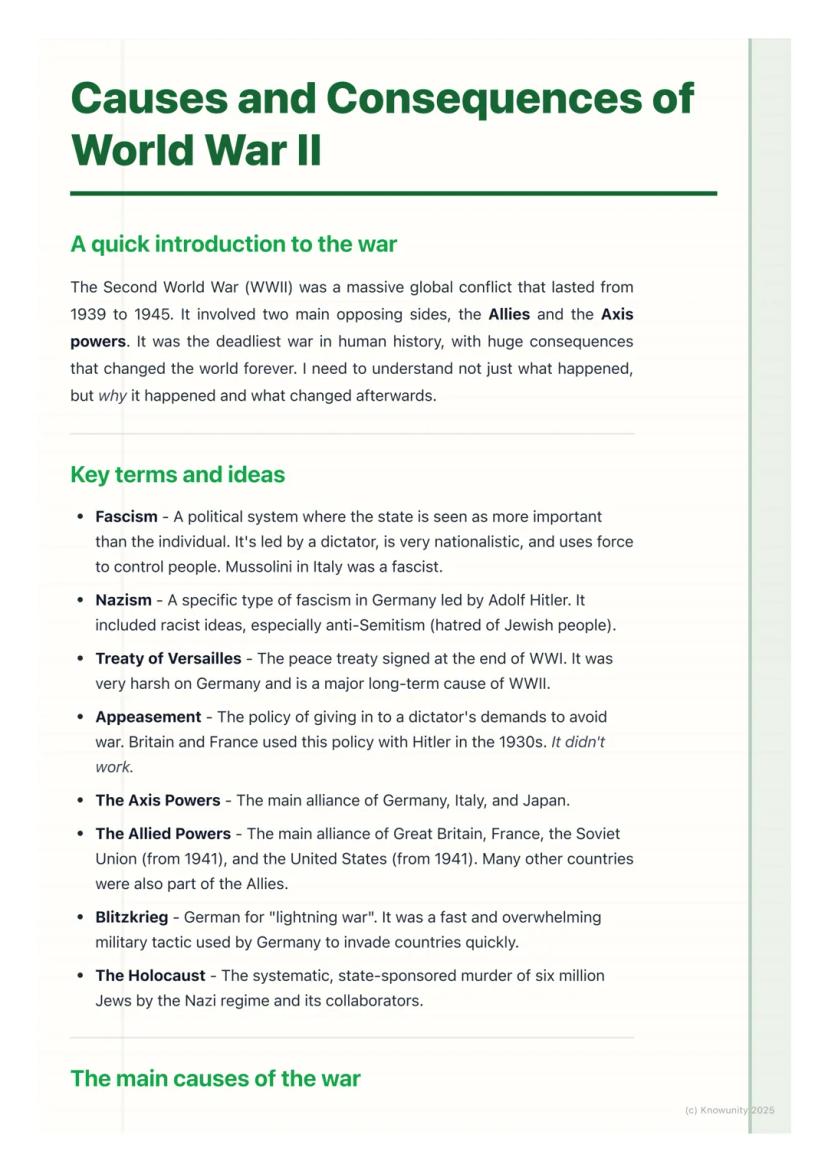
You've probably heard of WWII, but understanding why it happened makes all the difference in your exams. This massive global conflict split the world into two sides: the Allies (mainly Britain, France, USSR, and USA) versus the Axis powers (Germany, Italy, and Japan).
The most important concept to grasp is fascism – a political system where dictators control everything and the state matters more than individual people. Hitler's version, called Nazism, added horrific racist ideas that led to the Holocaust.
Two other key terms will come up constantly: appeasement (when Britain and France tried to avoid war by giving Hitler what he wanted) and blitzkrieg . The Treaty of Versailles from 1919 is also crucial – it was meant to keep peace after WWI but actually helped cause WWII.
Remember: Don't just memorise dates – focus on understanding the connections between causes and consequences.
2
of 6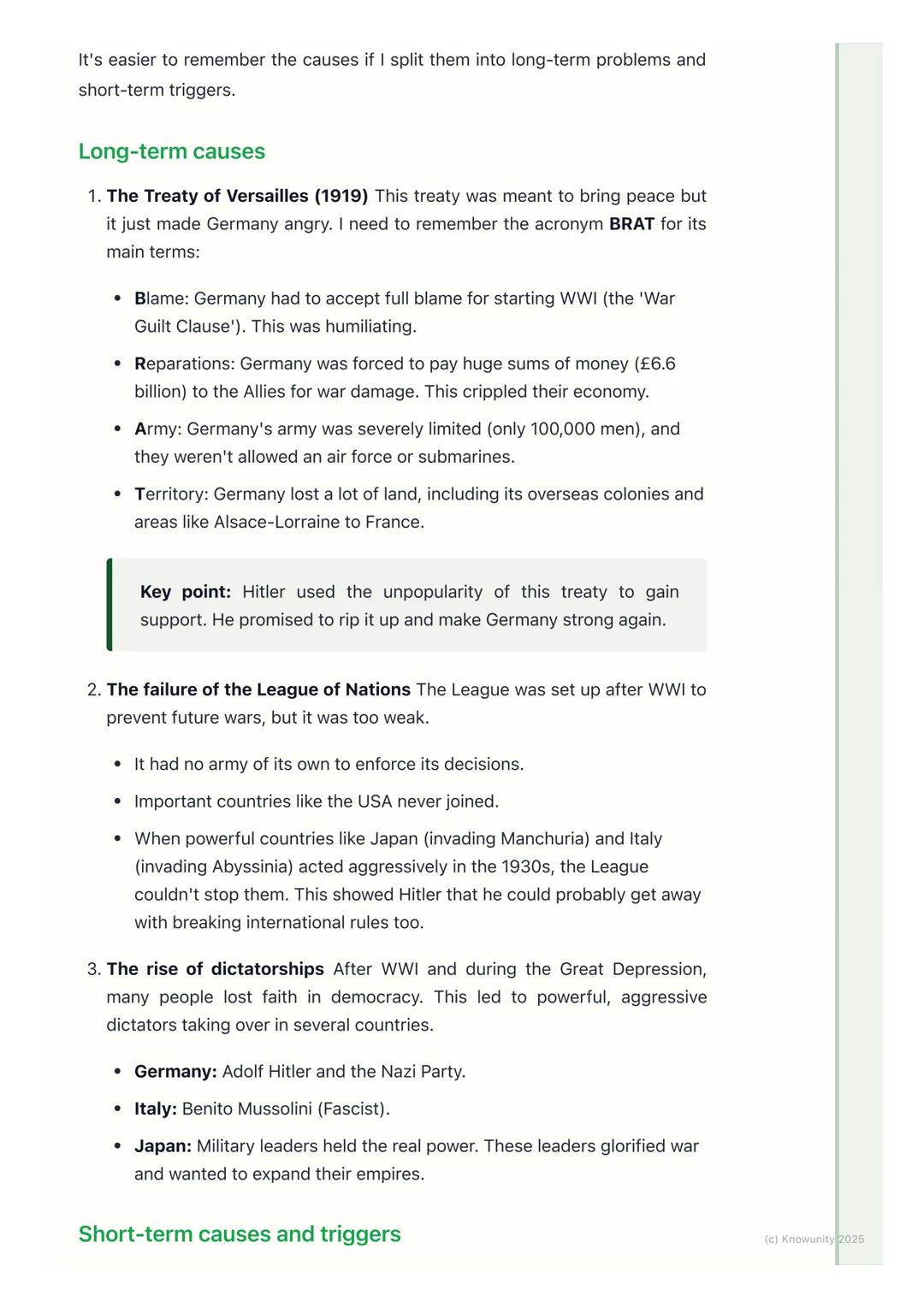
Long-term Causes
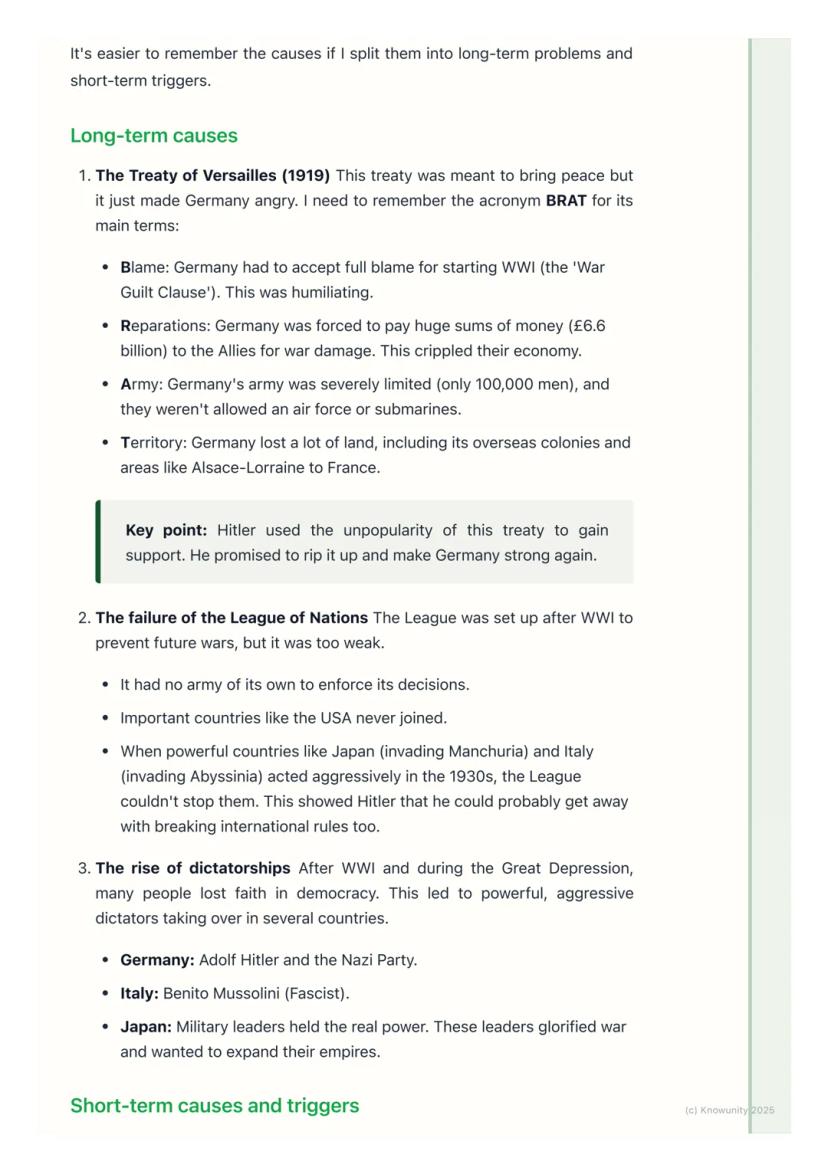
The Treaty of Versailles was basically a recipe for disaster. Use the acronym BRAT to remember its harsh terms: Blame (Germany had to accept full responsibility for WWI), Reparations (£6.6 billion in payments that crippled Germany's economy), Army (limited to just 100,000 men), and Territory (Germany lost loads of land).
Hitler used Germans' anger about this treaty to gain support. People were desperate after economic crisis and national humiliation, so his promises to tear up the treaty and make Germany great again sounded brilliant.
The League of Nations was supposed to prevent future wars but was completely useless. It had no army and couldn't stop aggressive countries like Japan or Italy from invading other nations. This showed Hitler he could probably get away with breaking international rules too.
Meanwhile, dictatorships were popping up everywhere as people lost faith in democracy during the Great Depression. These leaders – Hitler in Germany, Mussolini in Italy, and military leaders in Japan – all glorified war and wanted to expand their empires.
Exam tip: Long-term causes are just as important as the immediate trigger – make sure you can explain both!
3
of 6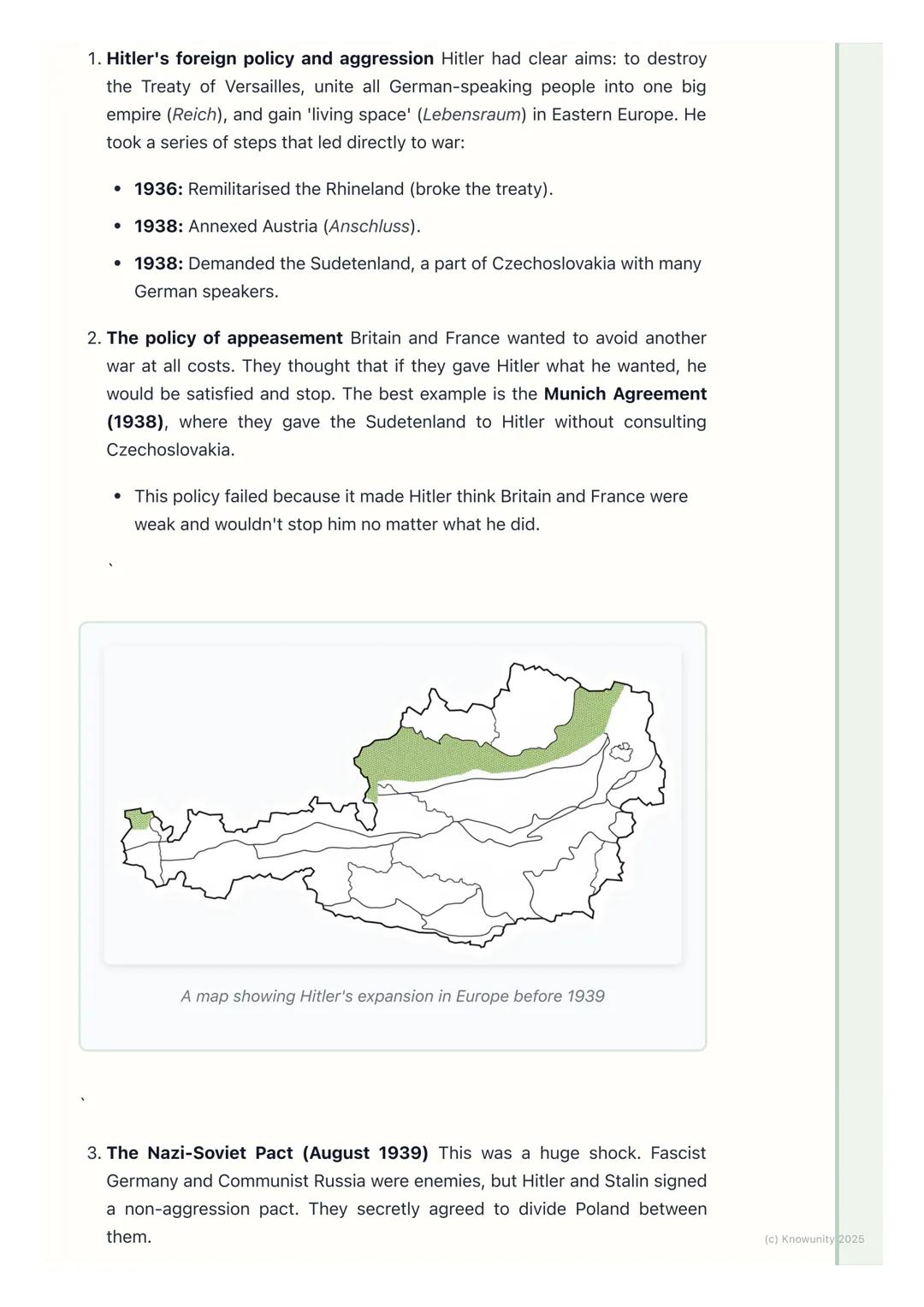
Short-term Causes and Triggers
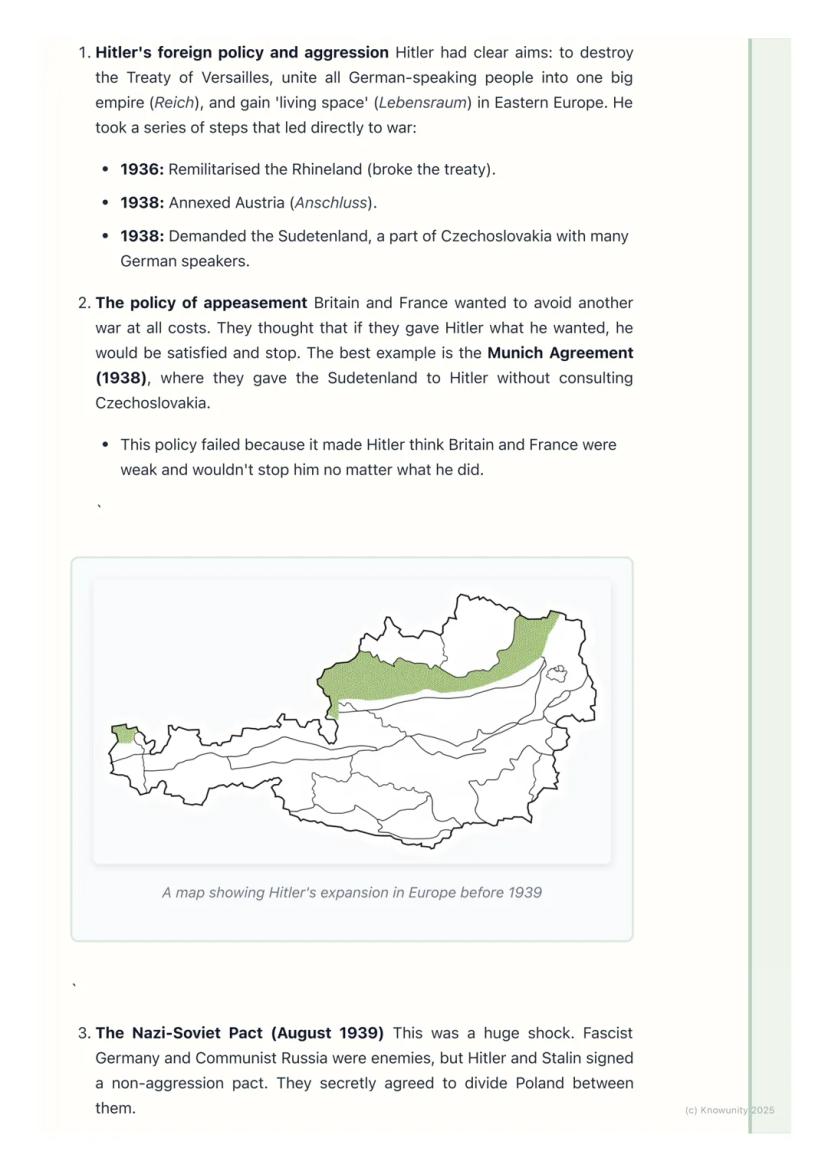
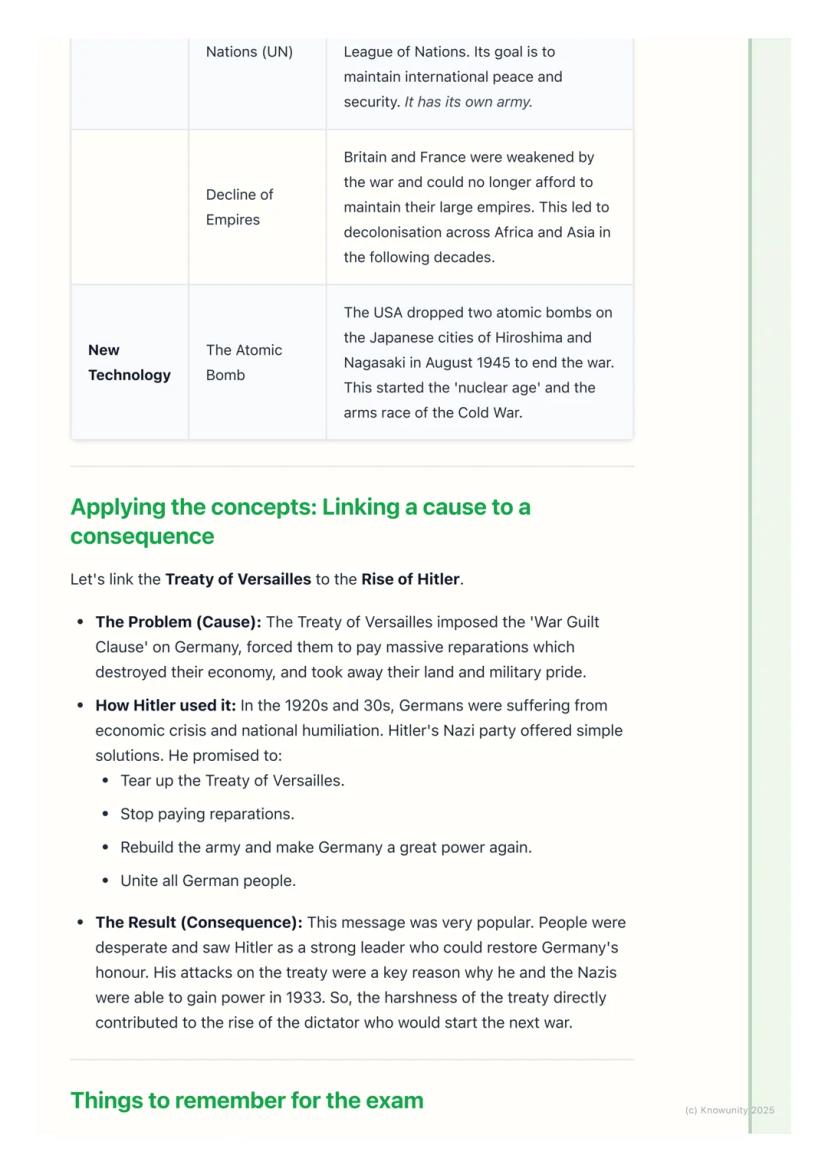
Hitler had clear goals: destroy the Treaty of Versailles, unite all German speakers, and grab 'living space' (Lebensraum) in Eastern Europe. He tested the waters by remilitarising the Rhineland in 1936, then annexed Austria in 1938, then demanded the Sudetenland from Czechoslovakia.
This is where appeasement comes in. Britain and France were so desperate to avoid another war that they kept giving Hitler what he wanted. The Munich Agreement in 1938 handed over the Sudetenland without even asking Czechoslovakia – basically throwing them under the bus.
Appeasement completely backfired because it made Hitler think Britain and France were weak and wouldn't stop him no matter what he did. He was getting bolder with each success.
The Nazi-Soviet Pact in August 1939 was a massive shock – fascist Germany and communist Russia agreeing not to fight each other and secretly planning to carve up Poland between them. This meant Hitler didn't have to worry about fighting on two fronts, giving him the green light for invasion.
Key point: Appeasement wasn't cowardice – leaders genuinely thought they were preventing war, but it actually encouraged Hitler's aggression.
4
of 6
The Final Trigger and Human Consequences
On 1 September 1939, Hitler invaded Poland. Britain and France had promised to protect Poland, so they gave Hitler an ultimatum to withdraw. When he ignored it, they declared war on 3 September 1939. World War II had officially begun.
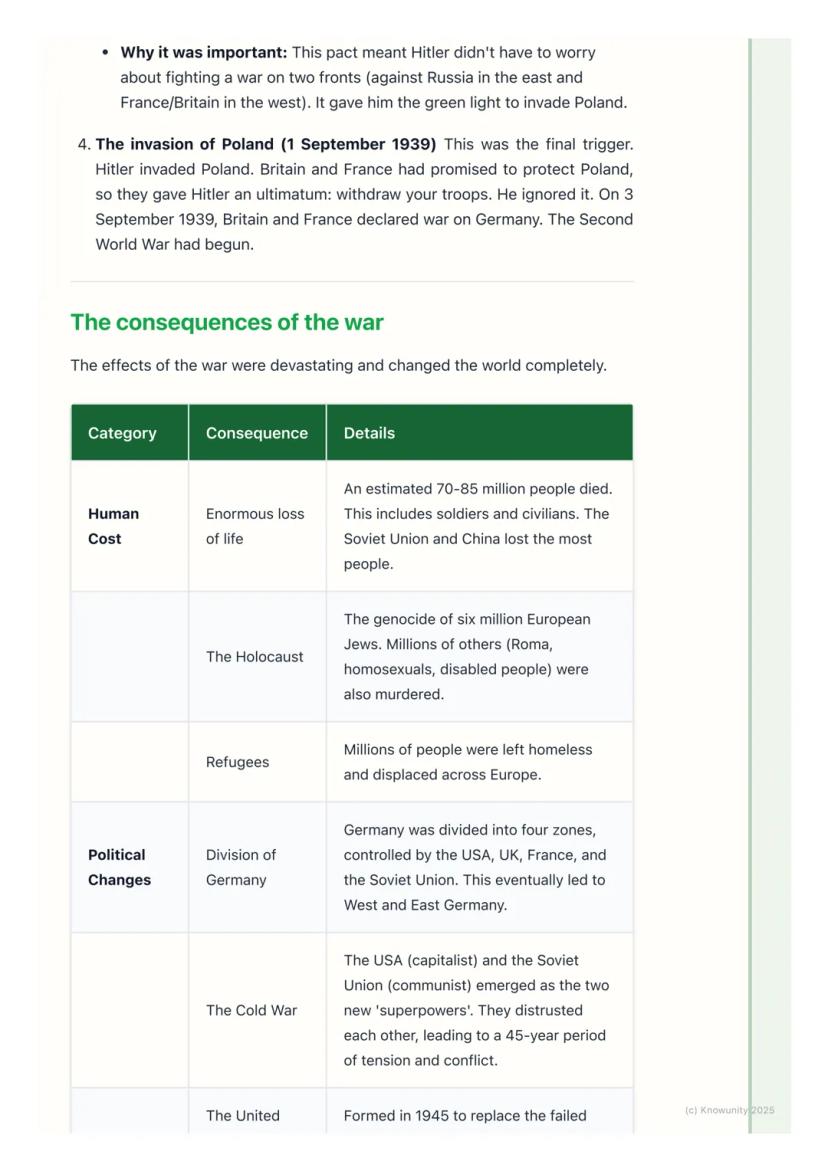
The human cost was absolutely staggering. An estimated 70-85 million people died – that's more than the entire population of Britain today. The Holocaust saw six million Jews systematically murdered, along with millions of others including Roma people, homosexuals, and disabled individuals.
Millions more became refugees, left homeless and displaced across Europe. The Soviet Union and China lost the most people, with some estimates putting Soviet deaths alone at 27 million. These weren't just numbers – they were real people with families, dreams, and lives cut short.
The war also saw the first use of atomic weapons when the USA dropped bombs on Hiroshima and Nagasaki in August 1945. This wasn't just about ending the war – it ushered in the nuclear age and changed warfare forever.
Remember: The scale of suffering was unprecedented – understanding this helps explain why the world was so determined to create international organisations like the UN afterwards.
5
of 6
Political and Global Consequences
The war's aftermath completely reshaped the world map and power structure. Germany was divided into four zones controlled by the USA, UK, France, and Soviet Union, eventually becoming West and East Germany. This division symbolised the broader split that was coming.
The Cold War emerged as the USA and Soviet Union became the world's new superpowers. Despite being wartime allies, their opposing ideologies (capitalism vs communism) created 45 years of tension, proxy wars, and the constant threat of nuclear conflict.
The United Nations was founded in 1945 to replace the failed League of Nations. Unlike its predecessor, the UN had more power and backing from major world powers, though it still struggles with enforcement today.
European empires crumbled as Britain and France, weakened by the war, could no longer afford to maintain their colonies. This triggered decolonisation across Africa and Asia in the following decades, creating many of the countries we know today.
Think about it: Many of today's global conflicts and political tensions can be traced back to these post-WWII changes – the war's consequences are still with us.
6
of 6
Exam Success Tips
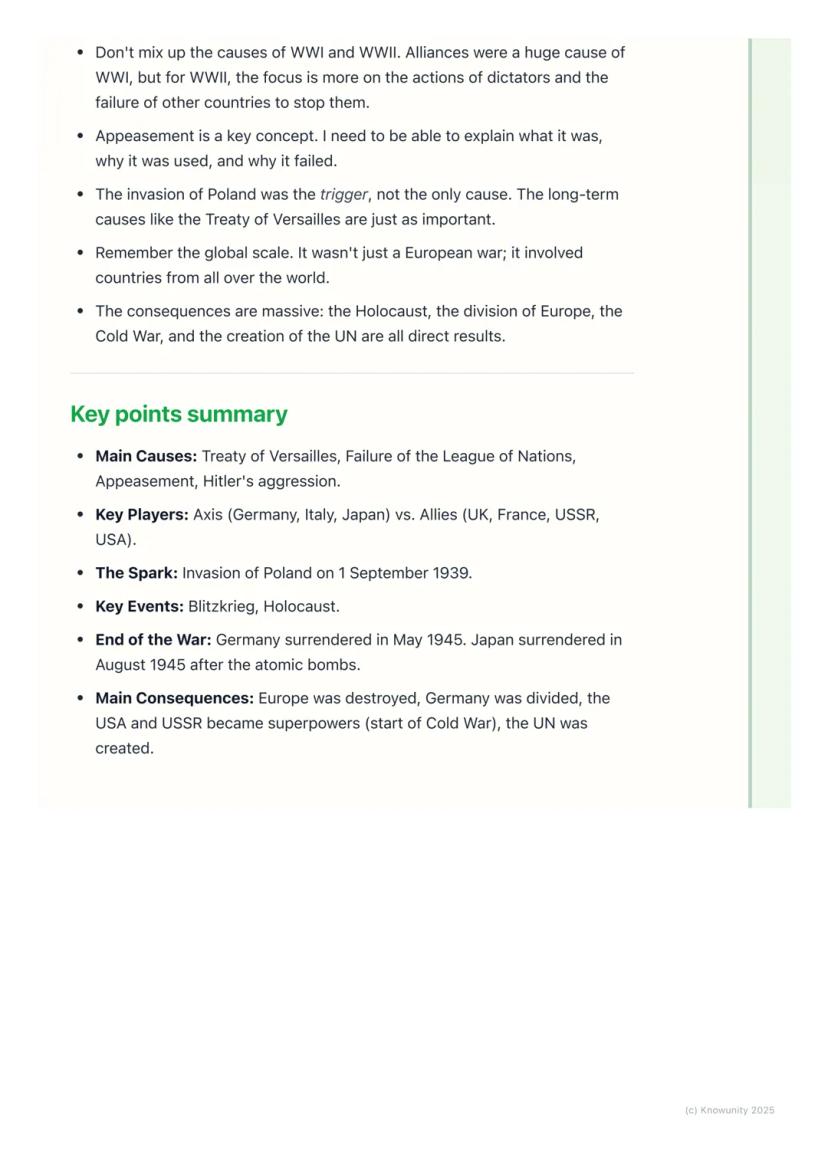
Don't confuse WWI and WWII causes – alliances were crucial for the first war, but WWII was more about dictators' actions and other countries' failure to stop them early. Make sure you can explain the difference clearly.
Appeasement is absolutely vital to understand. Know what it was (giving dictators what they want to avoid war), why leaders used it (desperate to prevent another devastating conflict), and why it failed (encouraged Hitler's aggression).
The invasion of Poland was just the trigger, not the whole story. Your essays need to show you understand the long-term causes like the Treaty of Versailles were equally important in creating the conditions for war.
Remember the global scale – this wasn't just Europeans fighting each other. Countries from every continent were involved, and the consequences affected the entire world. The Holocaust, the Cold War division of Europe, and the creation of the UN all stemmed directly from this conflict.
Exam strategy: Always link causes to consequences in your answers – show how the harsh Treaty of Versailles helped Hitler rise to power, or how appeasement encouraged his aggression.
Myśleliśmy, że nigdy nie zapytasz...
Czym jest Towarzysz AI z Knowunity?
Nasz asystent AI jest specjalnie dostosowany do potrzeb uczniów. W oparciu o miliony treści, które mamy na platformie, możemy udzielać uczniom naprawdę znaczących i trafnych odpowiedzi. Ale nie chodzi tylko o odpowiedzi, towarzysz prowadzi również uczniów przez codzienne wyzwania związane z nauką, ze spersonalizowanymi planami nauki, quizami lub treściami na czacie i 100% personalizacją opartą na umiejętnościach i rozwoju uczniów.
Gdzie mogę pobrać aplikację Knowunity?
Aplikację możesz pobrać z Google Play i Apple Store.
Czy aplikacja Knowunity naprawdę jest darmowa?
Tak, masz całkowicie darmowy dostęp do wszystkich notatek w aplikacji, możesz w każdej chwili rozmawiać z Ekspertami lub ich obserwować. Możesz użyć punktów, aby odblokować pewne funkcje w aplikacji, które również możesz otrzymać za darmo. Dodatkowo oferujemy usługę Knowunity Premium, która pozwala na odblokowanie większej liczby funkcji.
Najpopularniejsze notatki z History
9HistoryThe Great Famine (An Gorta Mór)
Students will learn about the causes, devastating impact, and long-term consequences of the potato famine on Irish population and society.
2nd Year282
HistoryThe renaissance
junior cert renaissance summary
1st Year361
HistoryAmerican revolution
junior cert american revolution summary
1st Year442
HistoryThe 1798 Rebellion in Ireland
Learning about the causes, events, and aftermath of the United Irishmen's rebellion against British rule, inspired by revolutionary ideals.
3rd Year211
HistoryThe Great Famine (An Gorta Mór)
This critical subtopic examines the causes, devastating impact, and long-term consequences of the potato famine on Irish society, population, and emigration.
3rd Year140
HistoryThe Renaissance
Students will learn about a time of 'rebirth' in Europe, where new ideas in art, science, and literature flourished.
1st Year140
History1916 Rising Revison Sheet
revision sheet
3rd Year211
HistoryThe American Revolution
Exploring the causes and consequences of the American colonies' fight for independence from British rule and its global significance.
3rd Year180
HistoryHome Rule Crisis and World War I
Exploring the political tensions surrounding Home Rule, the rise of paramilitary groups like the UVF and Irish Volunteers, and Ireland's involvement in the First World War.
3rd Year110
Najpopularniejsze notatki
9 English
Key Quotes : Sive
Key Quotes and explanations: Sive
6th Year2842
 Irish
IrishIrish oral questions and answers
Questions and answers for the leaving cert oral
5th Year4264
 Physics
Balanced and Unbalanced Forces
Students will explore how balanced forces result in no change in motion, while unbalanced forces cause an object to accelerate or change direction.
2nd Year562
IrishIníon- le hÁine Durkin
Aine Durkin’s poem, Iníon: Themes & summary
5th Year890
EnglishCultural Context : Shawshank Redemption : Sive : Small Things Like These
Comparative Study : Cultural Context : Shawshank Redemption, Sive and Small Things Like These
6th Year1430
IrishLC HL notes- Iníon (poem)
Includes poem in English and Irish, theme, key words & phrases
5th Year2314
IrishIrish oral questions
Outline of oral questions
5th Year2055
IrishMo Ghrá-sa (Idir Lúibíní)
Notes on mo ghrá-sa
5th Year380
IrishAn Gaeilge Aiste
Irish Language essay
6th Year1320
Nie ma nic odpowiedniego? Sprawdź inne przedmioty.
Zobacz, co mówią o nas nasi użytkownicy. Pokochali nas — pokochasz też i Ty.
4.6/5App Store
4.7/5Google Play
Aplikacja jest bardzo prosta i dobrze przemyślana. Do tej pory znalazłem wszystko, czego szukałem i mogłem się wiele nauczyć z innych notatek! Na pewno wykorzystam aplikację do pomocy przy robieniu prac domowych! No i oczywiście bardzo pomaga też jako inspiracja do robienia swoich notatek.
Stefan Sużytkownik iOS
Ta aplikacja jest naprawdę świetna. Jest tak wiele notatek i pomocnych informacji [...]. Moim problematycznym przedmiotem jest język niemiecki, a w aplikacji jest w czym wybierać. Dzięki tej aplikacji poprawiłam swój niemiecki. Polecam ją każdemu.
Samantha Klichużytkownik Androida
Wow, jestem w szoku. Właśnie wypróbowałam aplikację, ponieważ widziałam ją kilka razy reklamowaną na TikToku jestem absolutnie w szoku. Ta aplikacja jest POMOCĄ, której potrzebujesz w szkole i przede wszystkim oferuje tak wiele rzeczy jak notatki czy streszczenia, które są BARDZO pomocne w moim przypadku.
Annaużytkownik iOS
History15 wyświetleń·Zaktualizowano Jun 10, 2026·6 stronyThe Causes and Effects of World War II
World War II was the deadliest conflict in human history, lasting from 1939 to 1945 and changing the world forever. Understanding why it started and what happened afterwards is crucial for grasping how our modern world was shaped. This wasn't...
1
of 6
Zarejestruj się, aby zobaczyć notatkę. To nic nie kosztuje!
- Dostęp do wszystkich materiałów
- Popraw swoje oceny
- Dołącz do milionów studentów
Introduction and Key Concepts
You've probably heard of WWII, but understanding why it happened makes all the difference in your exams. This massive global conflict split the world into two sides: the Allies (mainly Britain, France, USSR, and USA) versus the Axis powers (Germany, Italy, and Japan).
The most important concept to grasp is fascism – a political system where dictators control everything and the state matters more than individual people. Hitler's version, called Nazism, added horrific racist ideas that led to the Holocaust.
Two other key terms will come up constantly: appeasement (when Britain and France tried to avoid war by giving Hitler what he wanted) and blitzkrieg . The Treaty of Versailles from 1919 is also crucial – it was meant to keep peace after WWI but actually helped cause WWII.
Remember: Don't just memorise dates – focus on understanding the connections between causes and consequences.
2
of 6Zarejestruj się, aby zobaczyć notatkę. To nic nie kosztuje!
- Dostęp do wszystkich materiałów
- Popraw swoje oceny
- Dołącz do milionów studentów
Long-term Causes
The Treaty of Versailles was basically a recipe for disaster. Use the acronym BRAT to remember its harsh terms: Blame (Germany had to accept full responsibility for WWI), Reparations (£6.6 billion in payments that crippled Germany's economy), Army (limited to just 100,000 men), and Territory (Germany lost loads of land).
Hitler used Germans' anger about this treaty to gain support. People were desperate after economic crisis and national humiliation, so his promises to tear up the treaty and make Germany great again sounded brilliant.
The League of Nations was supposed to prevent future wars but was completely useless. It had no army and couldn't stop aggressive countries like Japan or Italy from invading other nations. This showed Hitler he could probably get away with breaking international rules too.
Meanwhile, dictatorships were popping up everywhere as people lost faith in democracy during the Great Depression. These leaders – Hitler in Germany, Mussolini in Italy, and military leaders in Japan – all glorified war and wanted to expand their empires.
Exam tip: Long-term causes are just as important as the immediate trigger – make sure you can explain both!
3
of 6Zarejestruj się, aby zobaczyć notatkę. To nic nie kosztuje!
- Dostęp do wszystkich materiałów
- Popraw swoje oceny
- Dołącz do milionów studentów
Short-term Causes and Triggers
Hitler had clear goals: destroy the Treaty of Versailles, unite all German speakers, and grab 'living space' (Lebensraum) in Eastern Europe. He tested the waters by remilitarising the Rhineland in 1936, then annexed Austria in 1938, then demanded the Sudetenland from Czechoslovakia.
This is where appeasement comes in. Britain and France were so desperate to avoid another war that they kept giving Hitler what he wanted. The Munich Agreement in 1938 handed over the Sudetenland without even asking Czechoslovakia – basically throwing them under the bus.
Appeasement completely backfired because it made Hitler think Britain and France were weak and wouldn't stop him no matter what he did. He was getting bolder with each success.
The Nazi-Soviet Pact in August 1939 was a massive shock – fascist Germany and communist Russia agreeing not to fight each other and secretly planning to carve up Poland between them. This meant Hitler didn't have to worry about fighting on two fronts, giving him the green light for invasion.
Key point: Appeasement wasn't cowardice – leaders genuinely thought they were preventing war, but it actually encouraged Hitler's aggression.
4
of 6Zarejestruj się, aby zobaczyć notatkę. To nic nie kosztuje!
- Dostęp do wszystkich materiałów
- Popraw swoje oceny
- Dołącz do milionów studentów
The Final Trigger and Human Consequences
On 1 September 1939, Hitler invaded Poland. Britain and France had promised to protect Poland, so they gave Hitler an ultimatum to withdraw. When he ignored it, they declared war on 3 September 1939. World War II had officially begun.
The human cost was absolutely staggering. An estimated 70-85 million people died – that's more than the entire population of Britain today. The Holocaust saw six million Jews systematically murdered, along with millions of others including Roma people, homosexuals, and disabled individuals.
Millions more became refugees, left homeless and displaced across Europe. The Soviet Union and China lost the most people, with some estimates putting Soviet deaths alone at 27 million. These weren't just numbers – they were real people with families, dreams, and lives cut short.
The war also saw the first use of atomic weapons when the USA dropped bombs on Hiroshima and Nagasaki in August 1945. This wasn't just about ending the war – it ushered in the nuclear age and changed warfare forever.
Remember: The scale of suffering was unprecedented – understanding this helps explain why the world was so determined to create international organisations like the UN afterwards.
5
of 6Zarejestruj się, aby zobaczyć notatkę. To nic nie kosztuje!
- Dostęp do wszystkich materiałów
- Popraw swoje oceny
- Dołącz do milionów studentów
Political and Global Consequences
The war's aftermath completely reshaped the world map and power structure. Germany was divided into four zones controlled by the USA, UK, France, and Soviet Union, eventually becoming West and East Germany. This division symbolised the broader split that was coming.
The Cold War emerged as the USA and Soviet Union became the world's new superpowers. Despite being wartime allies, their opposing ideologies (capitalism vs communism) created 45 years of tension, proxy wars, and the constant threat of nuclear conflict.
The United Nations was founded in 1945 to replace the failed League of Nations. Unlike its predecessor, the UN had more power and backing from major world powers, though it still struggles with enforcement today.
European empires crumbled as Britain and France, weakened by the war, could no longer afford to maintain their colonies. This triggered decolonisation across Africa and Asia in the following decades, creating many of the countries we know today.
Think about it: Many of today's global conflicts and political tensions can be traced back to these post-WWII changes – the war's consequences are still with us.
6
of 6Zarejestruj się, aby zobaczyć notatkę. To nic nie kosztuje!
- Dostęp do wszystkich materiałów
- Popraw swoje oceny
- Dołącz do milionów studentów
Exam Success Tips
Don't confuse WWI and WWII causes – alliances were crucial for the first war, but WWII was more about dictators' actions and other countries' failure to stop them early. Make sure you can explain the difference clearly.
Appeasement is absolutely vital to understand. Know what it was (giving dictators what they want to avoid war), why leaders used it (desperate to prevent another devastating conflict), and why it failed (encouraged Hitler's aggression).
The invasion of Poland was just the trigger, not the whole story. Your essays need to show you understand the long-term causes like the Treaty of Versailles were equally important in creating the conditions for war.
Remember the global scale – this wasn't just Europeans fighting each other. Countries from every continent were involved, and the consequences affected the entire world. The Holocaust, the Cold War division of Europe, and the creation of the UN all stemmed directly from this conflict.
Exam strategy: Always link causes to consequences in your answers – show how the harsh Treaty of Versailles helped Hitler rise to power, or how appeasement encouraged his aggression.
Myśleliśmy, że nigdy nie zapytasz...
Czym jest Towarzysz AI z Knowunity?
Nasz asystent AI jest specjalnie dostosowany do potrzeb uczniów. W oparciu o miliony treści, które mamy na platformie, możemy udzielać uczniom naprawdę znaczących i trafnych odpowiedzi. Ale nie chodzi tylko o odpowiedzi, towarzysz prowadzi również uczniów przez codzienne wyzwania związane z nauką, ze spersonalizowanymi planami nauki, quizami lub treściami na czacie i 100% personalizacją opartą na umiejętnościach i rozwoju uczniów.
Gdzie mogę pobrać aplikację Knowunity?
Aplikację możesz pobrać z Google Play i Apple Store.
Czy aplikacja Knowunity naprawdę jest darmowa?
Tak, masz całkowicie darmowy dostęp do wszystkich notatek w aplikacji, możesz w każdej chwili rozmawiać z Ekspertami lub ich obserwować. Możesz użyć punktów, aby odblokować pewne funkcje w aplikacji, które również możesz otrzymać za darmo. Dodatkowo oferujemy usługę Knowunity Premium, która pozwala na odblokowanie większej liczby funkcji.
Najpopularniejsze notatki z History
9HistoryThe Great Famine (An Gorta Mór)
Students will learn about the causes, devastating impact, and long-term consequences of the potato famine on Irish population and society.
2nd Year282
HistoryThe renaissance
junior cert renaissance summary
1st Year361
HistoryAmerican revolution
junior cert american revolution summary
1st Year442
HistoryThe 1798 Rebellion in Ireland
Learning about the causes, events, and aftermath of the United Irishmen's rebellion against British rule, inspired by revolutionary ideals.
3rd Year211
HistoryThe Great Famine (An Gorta Mór)
This critical subtopic examines the causes, devastating impact, and long-term consequences of the potato famine on Irish society, population, and emigration.
3rd Year140
HistoryThe Renaissance
Students will learn about a time of 'rebirth' in Europe, where new ideas in art, science, and literature flourished.
1st Year140
History1916 Rising Revison Sheet
revision sheet
3rd Year211
HistoryThe American Revolution
Exploring the causes and consequences of the American colonies' fight for independence from British rule and its global significance.
3rd Year180
HistoryHome Rule Crisis and World War I
Exploring the political tensions surrounding Home Rule, the rise of paramilitary groups like the UVF and Irish Volunteers, and Ireland's involvement in the First World War.
3rd Year110
Najpopularniejsze notatki
9EnglishKey Quotes : Sive
Key Quotes and explanations: Sive
6th Year2842
IrishIrish oral questions and answers
Questions and answers for the leaving cert oral
5th Year4264
PhysicsBalanced and Unbalanced Forces
Students will explore how balanced forces result in no change in motion, while unbalanced forces cause an object to accelerate or change direction.
2nd Year562
IrishIníon- le hÁine Durkin
Aine Durkin’s poem, Iníon: Themes & summary
5th Year890
EnglishCultural Context : Shawshank Redemption : Sive : Small Things Like These
Comparative Study : Cultural Context : Shawshank Redemption, Sive and Small Things Like These
6th Year1430
IrishLC HL notes- Iníon (poem)
Includes poem in English and Irish, theme, key words & phrases
5th Year2314
IrishIrish oral questions
Outline of oral questions
5th Year2055
IrishMo Ghrá-sa (Idir Lúibíní)
Notes on mo ghrá-sa
5th Year380
IrishAn Gaeilge Aiste
Irish Language essay
6th Year1320
Nie ma nic odpowiedniego? Sprawdź inne przedmioty.
Zobacz, co mówią o nas nasi użytkownicy. Pokochali nas — pokochasz też i Ty.
4.6/5App Store
4.7/5Google Play
Aplikacja jest bardzo prosta i dobrze przemyślana. Do tej pory znalazłem wszystko, czego szukałem i mogłem się wiele nauczyć z innych notatek! Na pewno wykorzystam aplikację do pomocy przy robieniu prac domowych! No i oczywiście bardzo pomaga też jako inspiracja do robienia swoich notatek.
Stefan Sużytkownik iOS
Ta aplikacja jest naprawdę świetna. Jest tak wiele notatek i pomocnych informacji [...]. Moim problematycznym przedmiotem jest język niemiecki, a w aplikacji jest w czym wybierać. Dzięki tej aplikacji poprawiłam swój niemiecki. Polecam ją każdemu.
Samantha Klichużytkownik Androida
Wow, jestem w szoku. Właśnie wypróbowałam aplikację, ponieważ widziałam ją kilka razy reklamowaną na TikToku jestem absolutnie w szoku. Ta aplikacja jest POMOCĄ, której potrzebujesz w szkole i przede wszystkim oferuje tak wiele rzeczy jak notatki czy streszczenia, które są BARDZO pomocne w moim przypadku.
Annaużytkownik iOS