
The Cold War was one of the most important periods... Pokaż więcej
 History22 wyświetleń·Zaktualizowano May 22, 2026·6 strony
Understanding the Cold War Era
1 / 6
1
of 6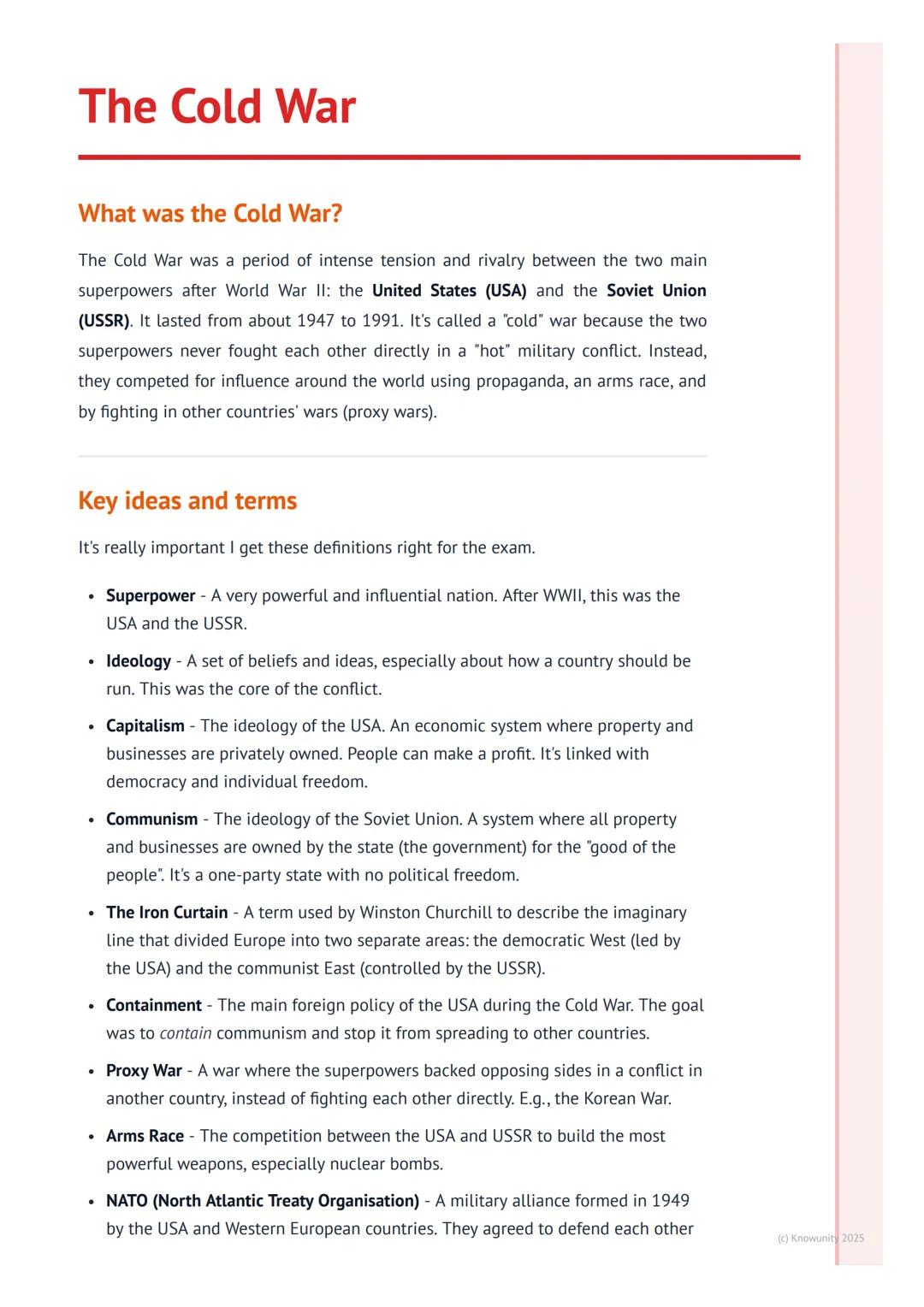
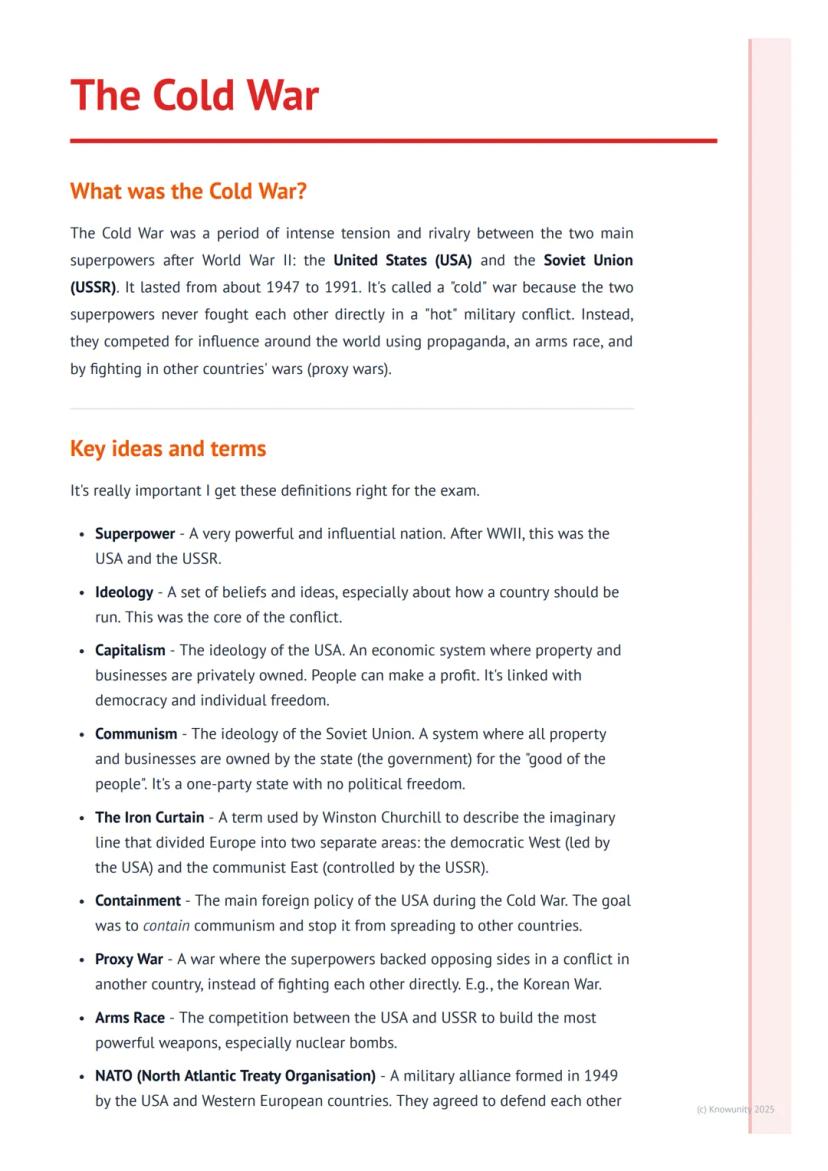
What Was the Cold War?
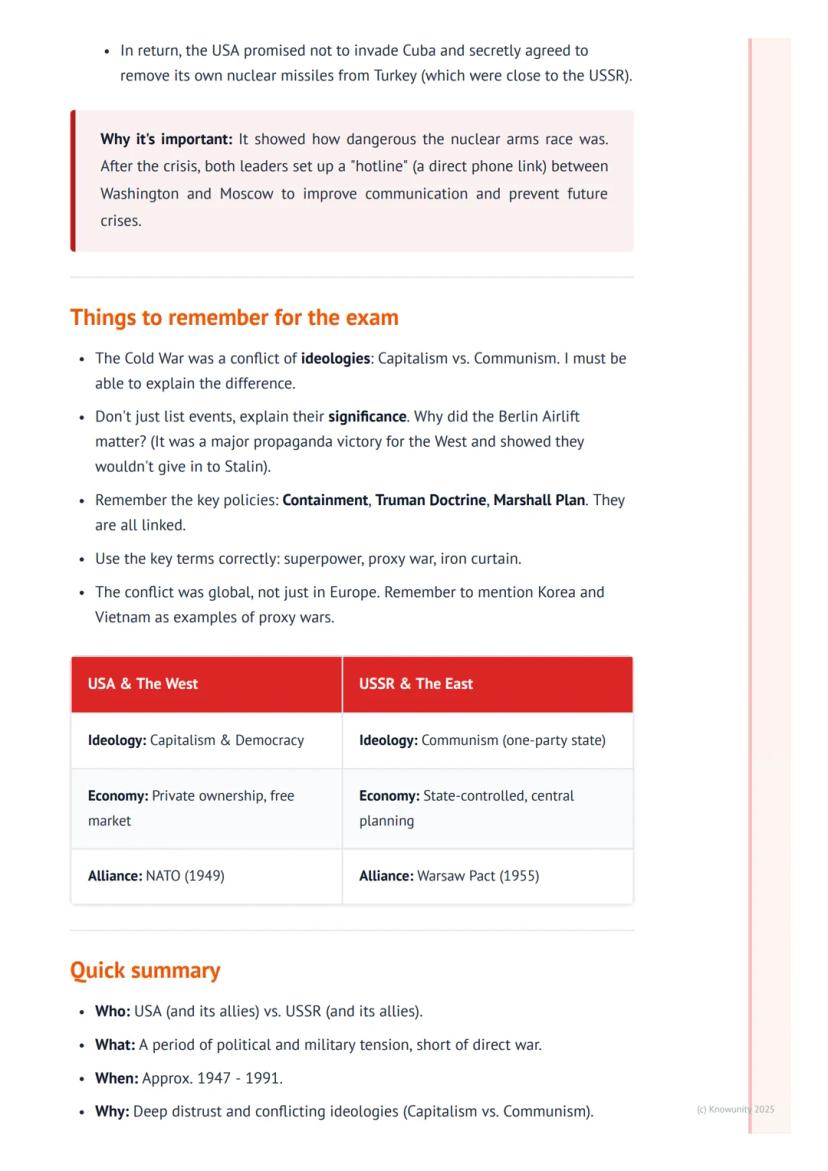
Ever wondered why it's called a "cold" war when tensions were so heated? The Cold War was the period of intense rivalry between the USA and USSR after World War II, but they never actually fought each other directly in battle.
Instead of tanks and soldiers clashing, these two superpowers competed through propaganda, spying, and backing opposite sides in other countries' conflicts. Think of it like two football rivals who never play each other but constantly try to prove who's better by beating everyone else.
The real fight was about ideology - completely different ideas about how countries should be run. The USA championed capitalism (private ownership, free markets, democracy), whilst the USSR promoted communism . These opposing beliefs would drive nearly half a century of global tension.
Key Point: The Cold War wasn't just about politics - it affected everything from space exploration to sports, dividing the entire world into two opposing camps.
2
of 6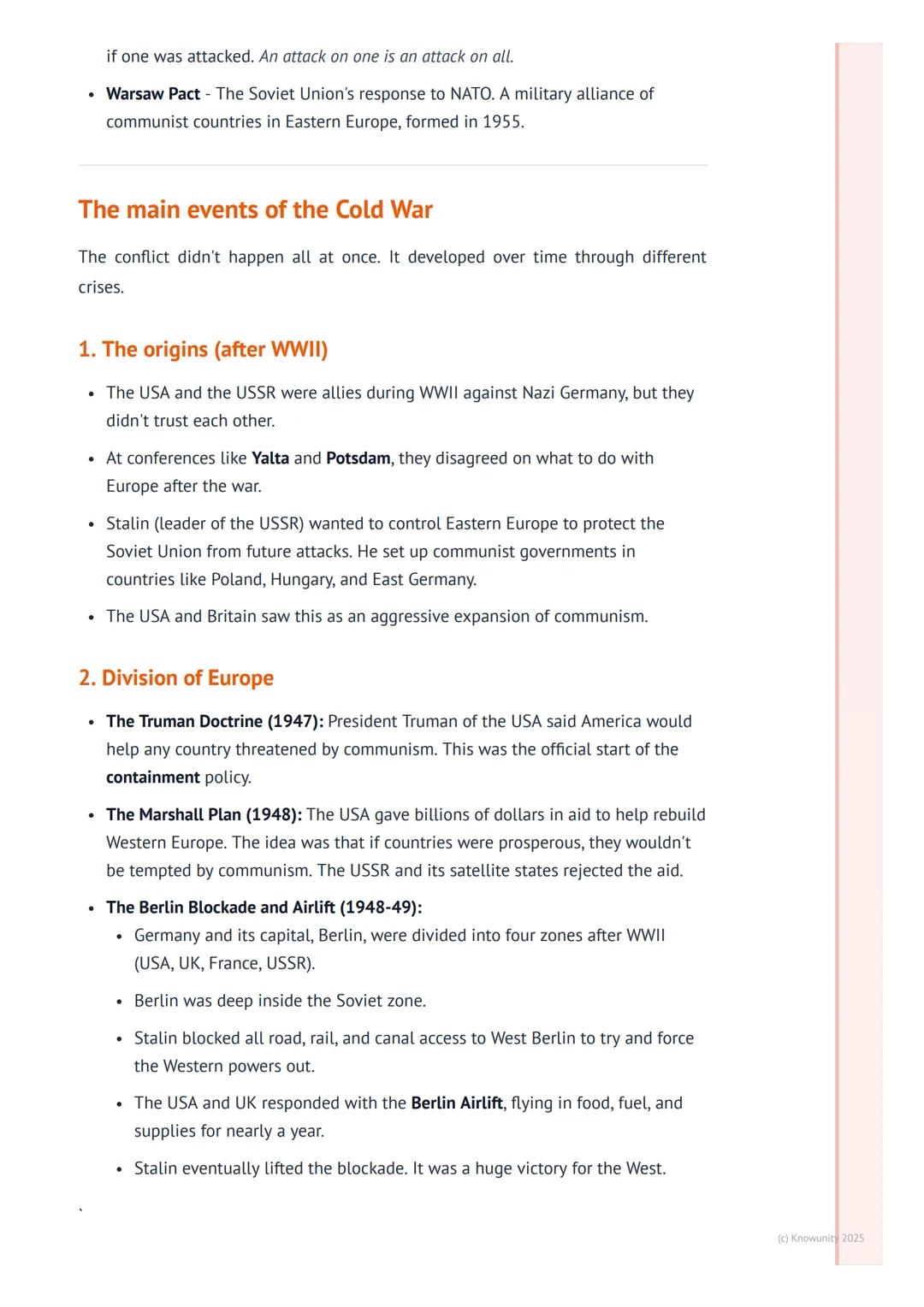
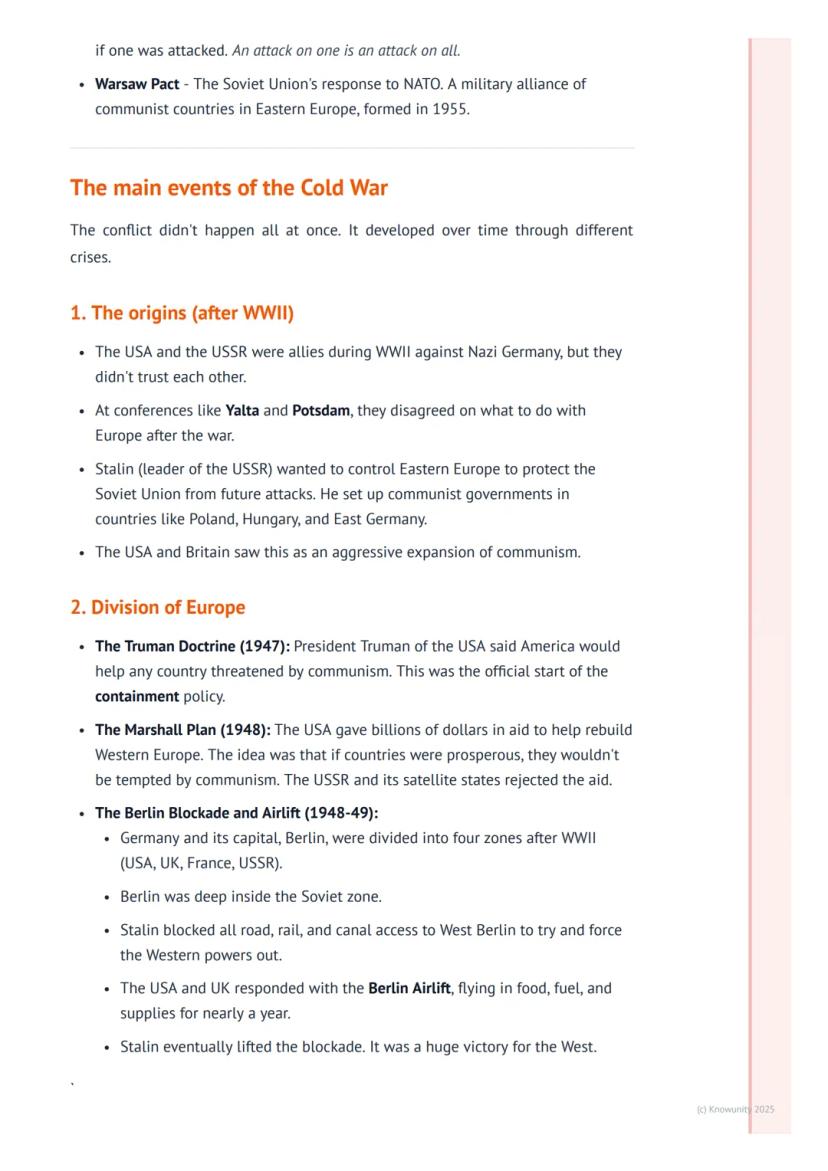
The World Splits in Two
Right after WWII ended, former allies became bitter enemies. Stalin wanted to control Eastern Europe to protect Russia from future attacks, so he installed communist governments across countries like Poland and Hungary.
The West saw this as aggressive expansion. Winston Churchill famously described an "Iron Curtain" falling across Europe, separating the democratic West from the communist East. This wasn't an actual wall - it was an invisible line that divided families, friends, and entire nations.
America responded with the Truman Doctrine in 1947, promising to help any country threatened by communism. This containment policy became America's main strategy throughout the Cold War. The Marshall Plan followed, pumping billions of dollars into rebuilding Western Europe - because prosperous countries were less likely to turn communist.
The first major showdown came with the Berlin Blockade (1948-49). Stalin cut off all access to West Berlin, but America and Britain responded with a massive airlift, flying in supplies for nearly a year until Stalin backed down.
Remember This: The Truman Doctrine and Marshall Plan weren't just generous gestures - they were strategic moves to stop communism spreading westward.
3
of 6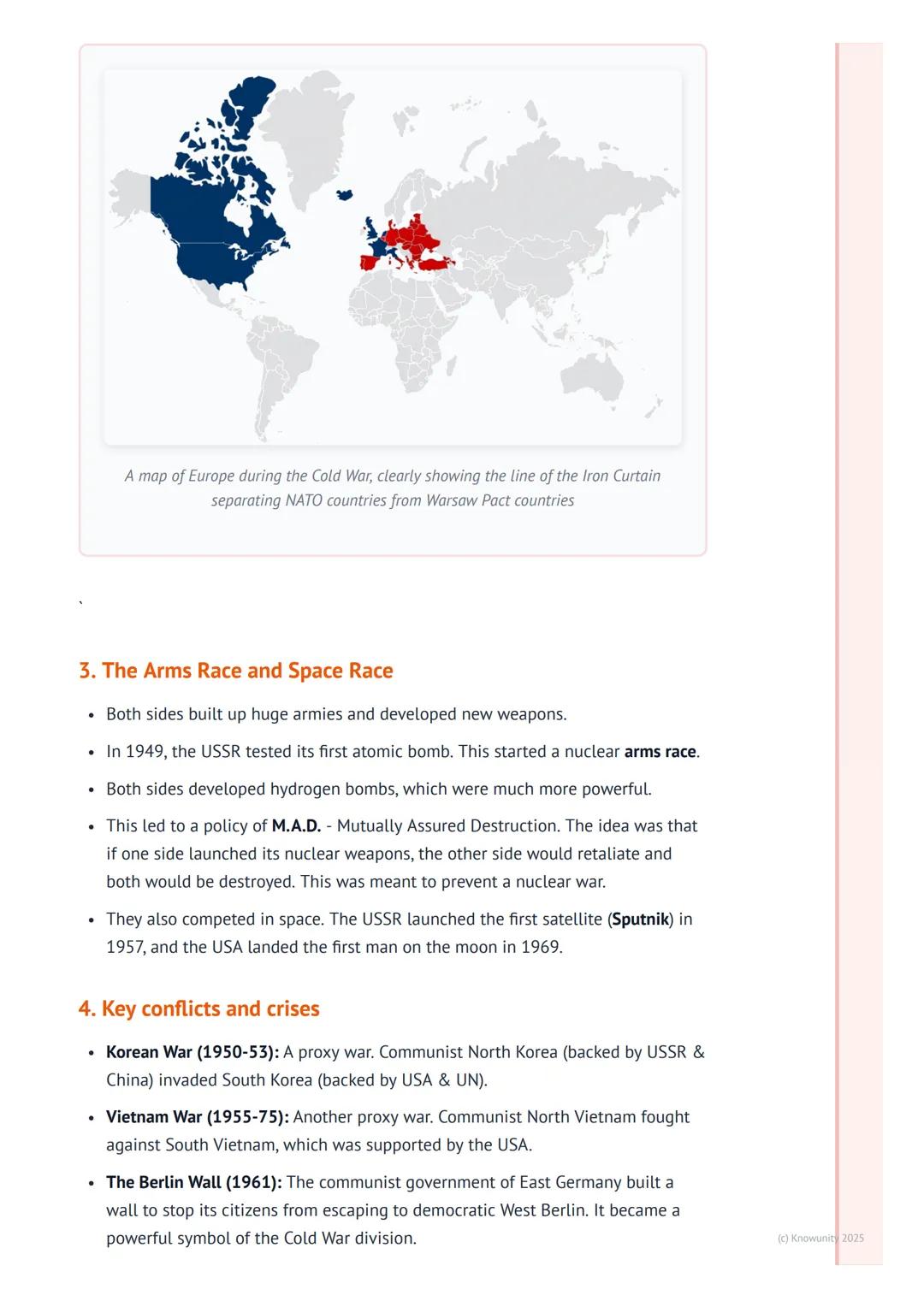
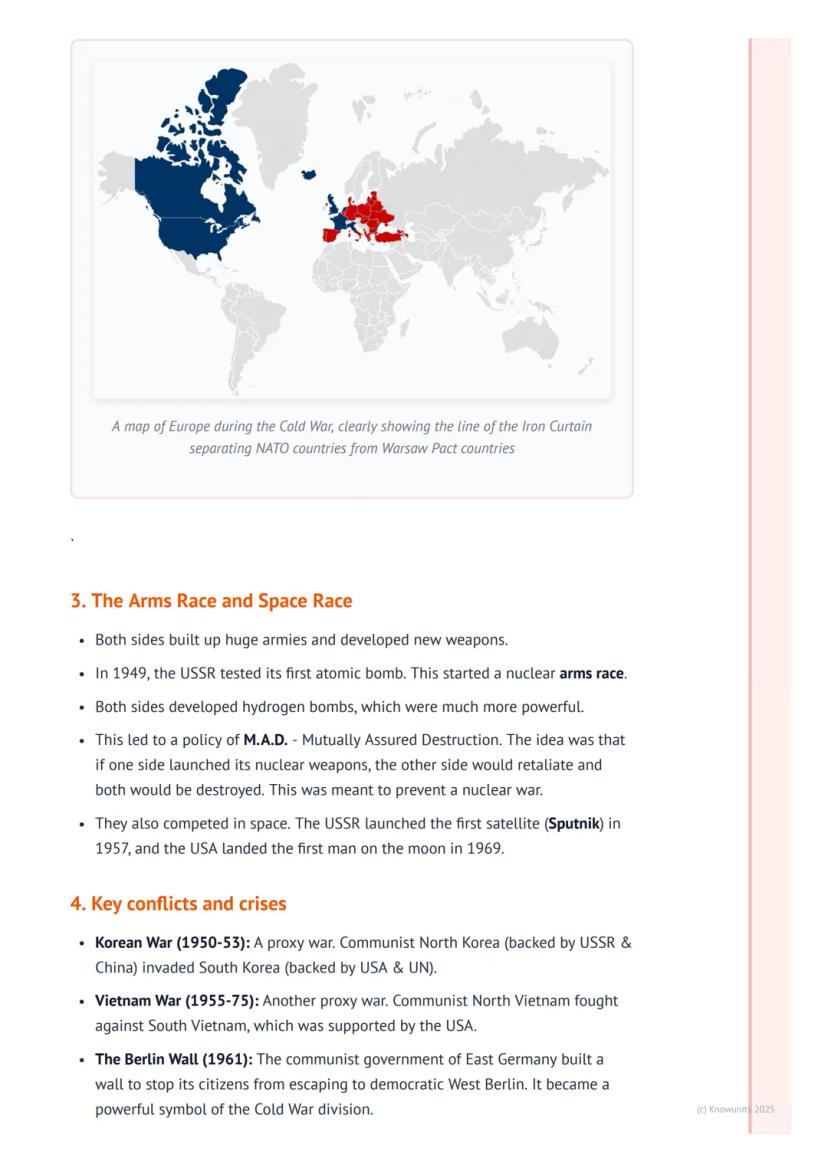
The Arms Race and Major Conflicts
The 1950s and 60s saw an terrifying nuclear arms race. When the USSR tested its first atomic bomb in 1949, both sides began building increasingly powerful weapons. This led to M.A.D. - Mutually Assured Destruction - the terrifying logic that neither side would start a nuclear war because both would be completely destroyed.
The superpowers also fought proxy wars - backing opposing sides in conflicts around the world rather than fighting directly. The Korean War (1950-53) saw communist North Korea battle American-backed South Korea. The Vietnam War dragged on even longer, becoming America's longest and most controversial conflict of the era.
Meanwhile, the Berlin Wall went up in 1961, physically dividing East and West Berlin. Families were separated overnight, and the wall became the most powerful symbol of Cold War division. East German guards shot anyone trying to escape to the West.
The Cuban Missile Crisis in 1962 brought the world closest to nuclear war. For 13 terrifying days, American and Soviet leaders played a deadly game of brinkmanship over Soviet missiles in Cuba, just 90 miles from Florida.
Exam Tip: Don't just memorise dates - understand why these events mattered and how they increased or decreased tensions between the superpowers.
4
of 6
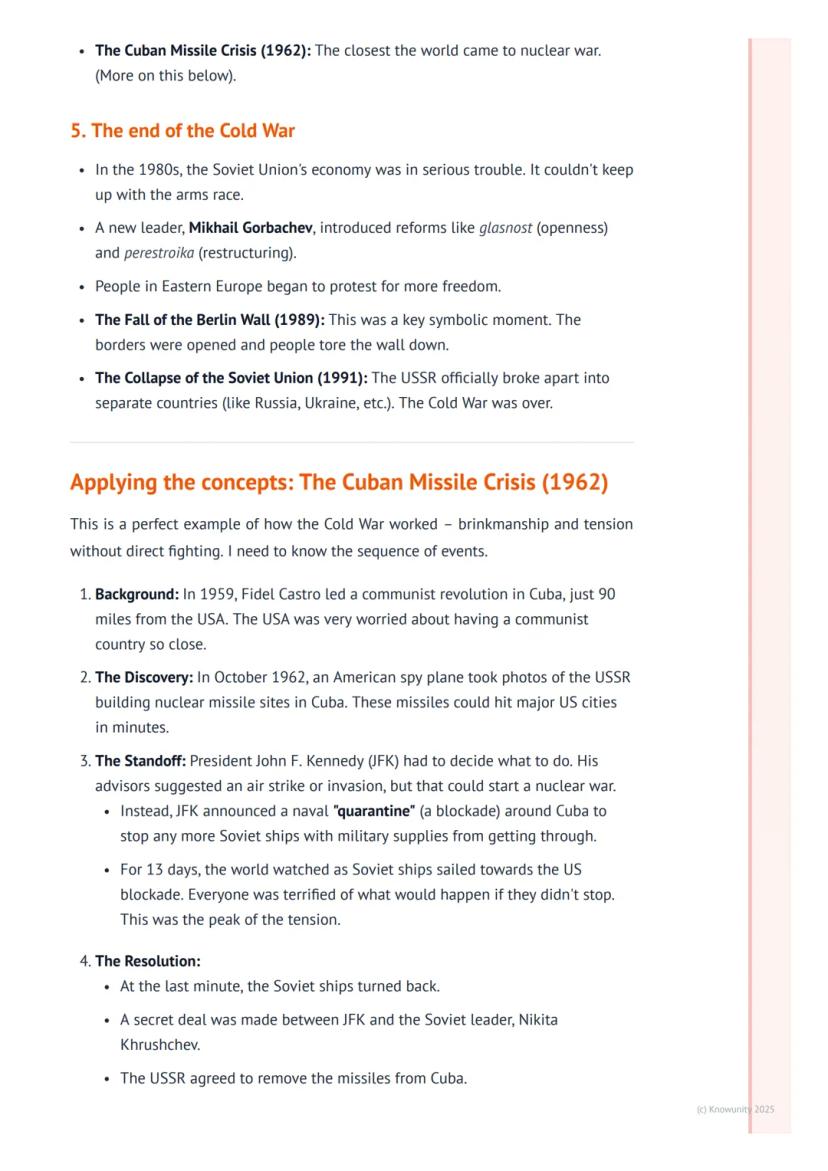
The Cuban Missile Crisis - 13 Days That Nearly Ended the World
October 1962 was the most dangerous moment in human history. American spy planes discovered Soviet nuclear missiles being installed in Cuba, capable of hitting major US cities within minutes of launch.
President John F. Kennedy faced an impossible choice. Military advisors wanted to bomb the sites or invade Cuba, but that could trigger World War III. Instead, JFK announced a naval blockade around Cuba, stopping Soviet ships from delivering more weapons.
For 13 days, the world held its breath as Soviet ships approached the American blockade. Would they stop or force their way through? Nuclear submarines lurked beneath the waves, and both sides' militaries were on highest alert.
Finally, Soviet leader Khrushchev blinked first. The ships turned back, and a secret deal was struck: Russia would remove missiles from Cuba, America would promise not to invade Cuba, and secretly remove its own missiles from Turkey. The crisis established a "hotline" between Washington and Moscow to prevent future misunderstandings.
Why It Matters: The Cuban Missile Crisis showed how quickly the Cold War could turn hot - and how important communication was in preventing nuclear disaster.
5
of 6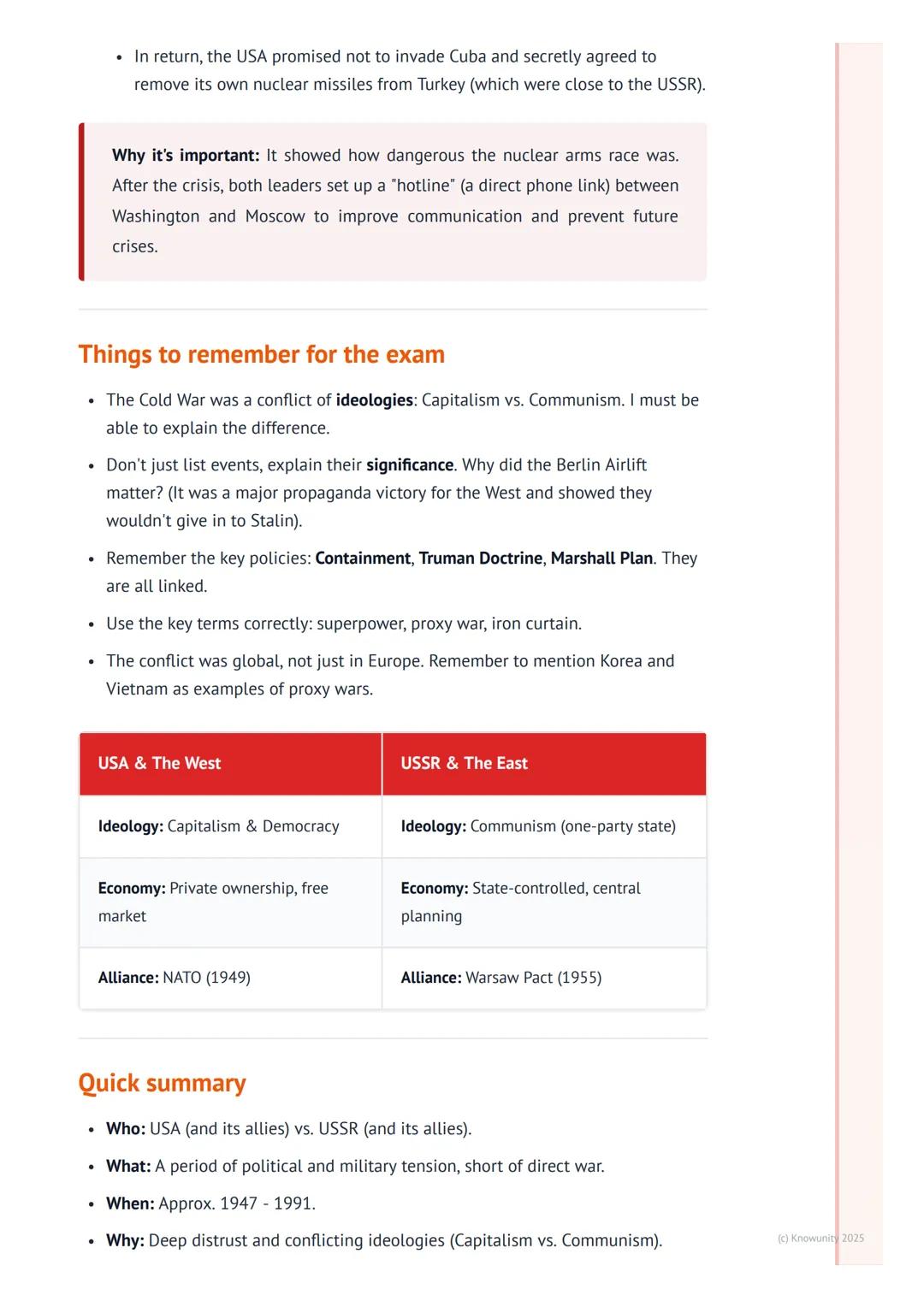
Military Alliances and the Space Race
Both sides built military alliances to strengthen their positions. NATO (North Atlantic Treaty Organisation) formed in 1949, uniting America with Western European countries under the principle that an attack on one was an attack on all. The Soviets responded with the Warsaw Pact in 1955, binding Eastern European communist countries together.
The competition extended beyond Earth into space. The USSR shocked the world by launching Sputnik, the first satellite, in 1957. This space race became another front in the Cold War, with each side trying to prove their technological superiority.
America eventually won this particular contest by landing the first humans on the moon in 1969, but the space race pushed both nations to incredible technological achievements that benefit us today.
Throughout this period, both sides used propaganda, spying, and economic pressure to gain advantages. The KGB and CIA became household names as secret agents operated across the globe, gathering intelligence and supporting friendly governments.
Think About It: Many technologies we use daily - from GPS to the internet - originated from Cold War military research and the space race.
6
of 6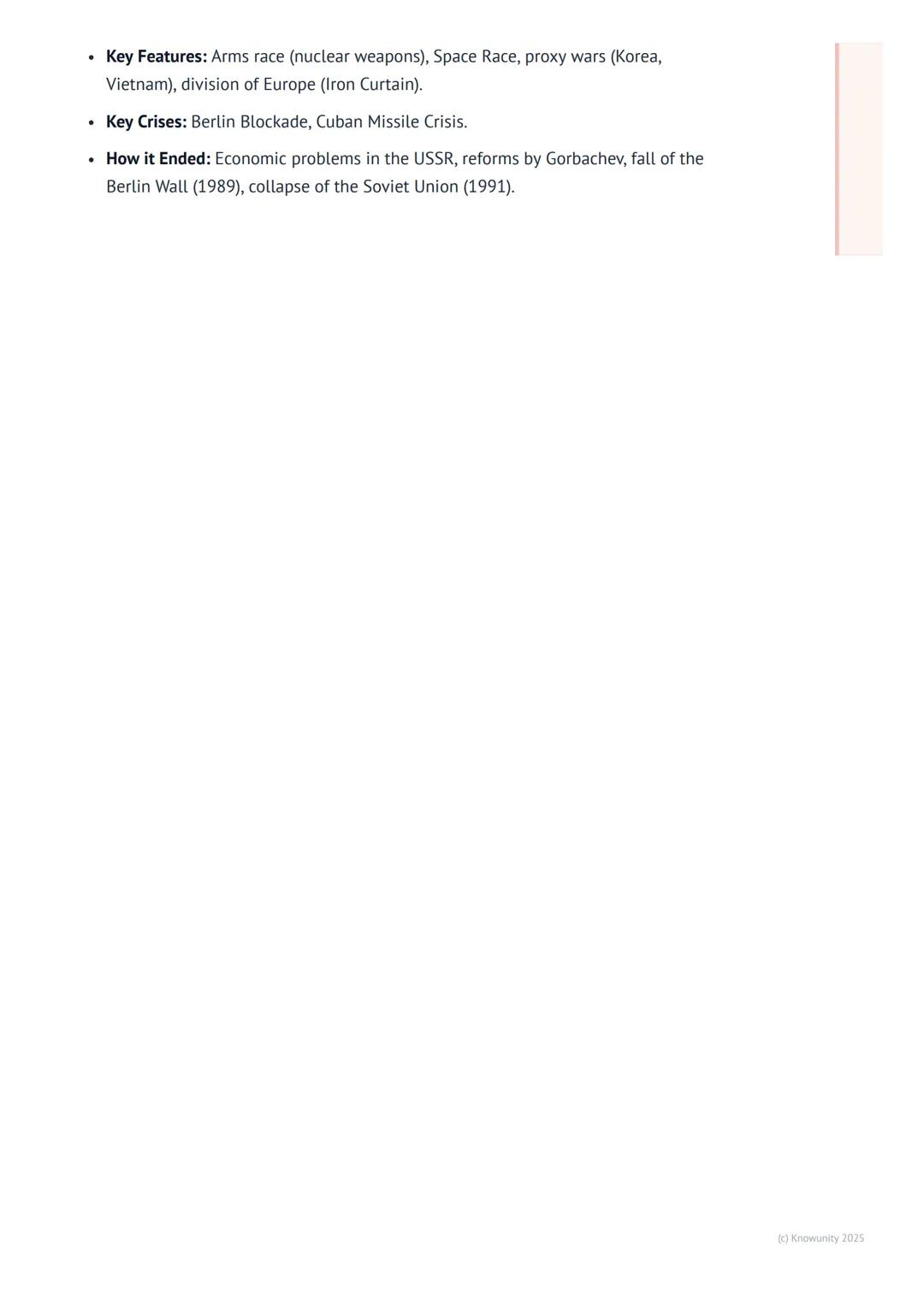
The End of an Era
By the 1980s, the Soviet Union was cracking under pressure. The arms race had drained their economy, and their outdated system couldn't compete with Western prosperity. When Mikhail Gorbachev became Soviet leader, he introduced glasnost (openness) and perestroika (restructuring) to save the system.
Instead, these reforms unleashed forces that destroyed Soviet control. People across Eastern Europe demanded freedom, and communist governments began toppling like dominoes. The most symbolic moment came in 1989 when the Berlin Wall fell, with ordinary citizens taking sledgehammers to the concrete barrier that had divided their city for 28 years.
The Soviet Union officially collapsed in 1991, splitting into separate countries like Russia, Ukraine, and the Baltic states. The Cold War was finally over, leaving America as the world's only superpower.
The Cold War's end didn't solve all global problems, but it removed the constant threat of nuclear annihilation that had haunted two generations. Understanding this period helps explain many current world issues, from NATO expansion to tensions with Russia.
For Your Exams: Focus on key turning points, understand the difference between capitalism and communism, and be able to explain how specific events like the Berlin Airlift showed the broader conflict between the superpowers.
Myśleliśmy, że nigdy nie zapytasz...
Czym jest Towarzysz AI z Knowunity?
Nasz asystent AI jest specjalnie dostosowany do potrzeb uczniów. W oparciu o miliony treści, które mamy na platformie, możemy udzielać uczniom naprawdę znaczących i trafnych odpowiedzi. Ale nie chodzi tylko o odpowiedzi, towarzysz prowadzi również uczniów przez codzienne wyzwania związane z nauką, ze spersonalizowanymi planami nauki, quizami lub treściami na czacie i 100% personalizacją opartą na umiejętnościach i rozwoju uczniów.
Gdzie mogę pobrać aplikację Knowunity?
Aplikację możesz pobrać z Google Play i Apple Store.
Czy aplikacja Knowunity naprawdę jest darmowa?
Tak, masz całkowicie darmowy dostęp do wszystkich notatek w aplikacji, możesz w każdej chwili rozmawiać z Ekspertami lub ich obserwować. Możesz użyć punktów, aby odblokować pewne funkcje w aplikacji, które również możesz otrzymać za darmo. Dodatkowo oferujemy usługę Knowunity Premium, która pozwala na odblokowanie większej liczby funkcji.
Najpopularniejsze notatki z History
9Najpopularniejsze notatki
9Nie ma nic odpowiedniego? Sprawdź inne przedmioty.
Zobacz, co mówią o nas nasi użytkownicy. Pokochali nas — pokochasz też i Ty.
4.6/5App Store
4.7/5Google Play
Aplikacja jest bardzo prosta i dobrze przemyślana. Do tej pory znalazłem wszystko, czego szukałem i mogłem się wiele nauczyć z innych notatek! Na pewno wykorzystam aplikację do pomocy przy robieniu prac domowych! No i oczywiście bardzo pomaga też jako inspiracja do robienia swoich notatek.
Stefan Sużytkownik iOS
Ta aplikacja jest naprawdę świetna. Jest tak wiele notatek i pomocnych informacji [...]. Moim problematycznym przedmiotem jest język niemiecki, a w aplikacji jest w czym wybierać. Dzięki tej aplikacji poprawiłam swój niemiecki. Polecam ją każdemu.
Samantha Klichużytkownik Androida
Wow, jestem w szoku. Właśnie wypróbowałam aplikację, ponieważ widziałam ją kilka razy reklamowaną na TikToku jestem absolutnie w szoku. Ta aplikacja jest POMOCĄ, której potrzebujesz w szkole i przede wszystkim oferuje tak wiele rzeczy jak notatki czy streszczenia, które są BARDZO pomocne w moim przypadku.
Annaużytkownik iOS
History22 wyświetleń·Zaktualizowano May 22, 2026·6 stronyUnderstanding the Cold War Era
The Cold War was one of the most important periods in modern history, shaping the world we live in today. From 1947 to 1991, two superpowers - the USA and USSR - faced off in a tense rivalry that nearly... Pokaż więcej
1
of 6Zarejestruj się, aby zobaczyć notatkę. To nic nie kosztuje!
- Dostęp do wszystkich materiałów
- Popraw swoje oceny
- Dołącz do milionów studentów
What Was the Cold War?
Ever wondered why it's called a "cold" war when tensions were so heated? The Cold War was the period of intense rivalry between the USA and USSR after World War II, but they never actually fought each other directly in battle.
Instead of tanks and soldiers clashing, these two superpowers competed through propaganda, spying, and backing opposite sides in other countries' conflicts. Think of it like two football rivals who never play each other but constantly try to prove who's better by beating everyone else.
The real fight was about ideology - completely different ideas about how countries should be run. The USA championed capitalism (private ownership, free markets, democracy), whilst the USSR promoted communism . These opposing beliefs would drive nearly half a century of global tension.
Key Point: The Cold War wasn't just about politics - it affected everything from space exploration to sports, dividing the entire world into two opposing camps.
2
of 6Zarejestruj się, aby zobaczyć notatkę. To nic nie kosztuje!
- Dostęp do wszystkich materiałów
- Popraw swoje oceny
- Dołącz do milionów studentów
The World Splits in Two
Right after WWII ended, former allies became bitter enemies. Stalin wanted to control Eastern Europe to protect Russia from future attacks, so he installed communist governments across countries like Poland and Hungary.
The West saw this as aggressive expansion. Winston Churchill famously described an "Iron Curtain" falling across Europe, separating the democratic West from the communist East. This wasn't an actual wall - it was an invisible line that divided families, friends, and entire nations.
America responded with the Truman Doctrine in 1947, promising to help any country threatened by communism. This containment policy became America's main strategy throughout the Cold War. The Marshall Plan followed, pumping billions of dollars into rebuilding Western Europe - because prosperous countries were less likely to turn communist.
The first major showdown came with the Berlin Blockade (1948-49). Stalin cut off all access to West Berlin, but America and Britain responded with a massive airlift, flying in supplies for nearly a year until Stalin backed down.
Remember This: The Truman Doctrine and Marshall Plan weren't just generous gestures - they were strategic moves to stop communism spreading westward.
3
of 6Zarejestruj się, aby zobaczyć notatkę. To nic nie kosztuje!
- Dostęp do wszystkich materiałów
- Popraw swoje oceny
- Dołącz do milionów studentów
The Arms Race and Major Conflicts
The 1950s and 60s saw an terrifying nuclear arms race. When the USSR tested its first atomic bomb in 1949, both sides began building increasingly powerful weapons. This led to M.A.D. - Mutually Assured Destruction - the terrifying logic that neither side would start a nuclear war because both would be completely destroyed.
The superpowers also fought proxy wars - backing opposing sides in conflicts around the world rather than fighting directly. The Korean War (1950-53) saw communist North Korea battle American-backed South Korea. The Vietnam War dragged on even longer, becoming America's longest and most controversial conflict of the era.
Meanwhile, the Berlin Wall went up in 1961, physically dividing East and West Berlin. Families were separated overnight, and the wall became the most powerful symbol of Cold War division. East German guards shot anyone trying to escape to the West.
The Cuban Missile Crisis in 1962 brought the world closest to nuclear war. For 13 terrifying days, American and Soviet leaders played a deadly game of brinkmanship over Soviet missiles in Cuba, just 90 miles from Florida.
Exam Tip: Don't just memorise dates - understand why these events mattered and how they increased or decreased tensions between the superpowers.
4
of 6Zarejestruj się, aby zobaczyć notatkę. To nic nie kosztuje!
- Dostęp do wszystkich materiałów
- Popraw swoje oceny
- Dołącz do milionów studentów
The Cuban Missile Crisis - 13 Days That Nearly Ended the World
October 1962 was the most dangerous moment in human history. American spy planes discovered Soviet nuclear missiles being installed in Cuba, capable of hitting major US cities within minutes of launch.
President John F. Kennedy faced an impossible choice. Military advisors wanted to bomb the sites or invade Cuba, but that could trigger World War III. Instead, JFK announced a naval blockade around Cuba, stopping Soviet ships from delivering more weapons.
For 13 days, the world held its breath as Soviet ships approached the American blockade. Would they stop or force their way through? Nuclear submarines lurked beneath the waves, and both sides' militaries were on highest alert.
Finally, Soviet leader Khrushchev blinked first. The ships turned back, and a secret deal was struck: Russia would remove missiles from Cuba, America would promise not to invade Cuba, and secretly remove its own missiles from Turkey. The crisis established a "hotline" between Washington and Moscow to prevent future misunderstandings.
Why It Matters: The Cuban Missile Crisis showed how quickly the Cold War could turn hot - and how important communication was in preventing nuclear disaster.
5
of 6Zarejestruj się, aby zobaczyć notatkę. To nic nie kosztuje!
- Dostęp do wszystkich materiałów
- Popraw swoje oceny
- Dołącz do milionów studentów
Military Alliances and the Space Race
Both sides built military alliances to strengthen their positions. NATO (North Atlantic Treaty Organisation) formed in 1949, uniting America with Western European countries under the principle that an attack on one was an attack on all. The Soviets responded with the Warsaw Pact in 1955, binding Eastern European communist countries together.
The competition extended beyond Earth into space. The USSR shocked the world by launching Sputnik, the first satellite, in 1957. This space race became another front in the Cold War, with each side trying to prove their technological superiority.
America eventually won this particular contest by landing the first humans on the moon in 1969, but the space race pushed both nations to incredible technological achievements that benefit us today.
Throughout this period, both sides used propaganda, spying, and economic pressure to gain advantages. The KGB and CIA became household names as secret agents operated across the globe, gathering intelligence and supporting friendly governments.
Think About It: Many technologies we use daily - from GPS to the internet - originated from Cold War military research and the space race.
6
of 6Zarejestruj się, aby zobaczyć notatkę. To nic nie kosztuje!
- Dostęp do wszystkich materiałów
- Popraw swoje oceny
- Dołącz do milionów studentów
The End of an Era
By the 1980s, the Soviet Union was cracking under pressure. The arms race had drained their economy, and their outdated system couldn't compete with Western prosperity. When Mikhail Gorbachev became Soviet leader, he introduced glasnost (openness) and perestroika (restructuring) to save the system.
Instead, these reforms unleashed forces that destroyed Soviet control. People across Eastern Europe demanded freedom, and communist governments began toppling like dominoes. The most symbolic moment came in 1989 when the Berlin Wall fell, with ordinary citizens taking sledgehammers to the concrete barrier that had divided their city for 28 years.
The Soviet Union officially collapsed in 1991, splitting into separate countries like Russia, Ukraine, and the Baltic states. The Cold War was finally over, leaving America as the world's only superpower.
The Cold War's end didn't solve all global problems, but it removed the constant threat of nuclear annihilation that had haunted two generations. Understanding this period helps explain many current world issues, from NATO expansion to tensions with Russia.
For Your Exams: Focus on key turning points, understand the difference between capitalism and communism, and be able to explain how specific events like the Berlin Airlift showed the broader conflict between the superpowers.
Myśleliśmy, że nigdy nie zapytasz...
Czym jest Towarzysz AI z Knowunity?
Nasz asystent AI jest specjalnie dostosowany do potrzeb uczniów. W oparciu o miliony treści, które mamy na platformie, możemy udzielać uczniom naprawdę znaczących i trafnych odpowiedzi. Ale nie chodzi tylko o odpowiedzi, towarzysz prowadzi również uczniów przez codzienne wyzwania związane z nauką, ze spersonalizowanymi planami nauki, quizami lub treściami na czacie i 100% personalizacją opartą na umiejętnościach i rozwoju uczniów.
Gdzie mogę pobrać aplikację Knowunity?
Aplikację możesz pobrać z Google Play i Apple Store.
Czy aplikacja Knowunity naprawdę jest darmowa?
Tak, masz całkowicie darmowy dostęp do wszystkich notatek w aplikacji, możesz w każdej chwili rozmawiać z Ekspertami lub ich obserwować. Możesz użyć punktów, aby odblokować pewne funkcje w aplikacji, które również możesz otrzymać za darmo. Dodatkowo oferujemy usługę Knowunity Premium, która pozwala na odblokowanie większej liczby funkcji.
Najpopularniejsze notatki z History
9Najpopularniejsze notatki
9Nie ma nic odpowiedniego? Sprawdź inne przedmioty.
Zobacz, co mówią o nas nasi użytkownicy. Pokochali nas — pokochasz też i Ty.
4.6/5App Store
4.7/5Google Play
Aplikacja jest bardzo prosta i dobrze przemyślana. Do tej pory znalazłem wszystko, czego szukałem i mogłem się wiele nauczyć z innych notatek! Na pewno wykorzystam aplikację do pomocy przy robieniu prac domowych! No i oczywiście bardzo pomaga też jako inspiracja do robienia swoich notatek.
Stefan Sużytkownik iOS
Ta aplikacja jest naprawdę świetna. Jest tak wiele notatek i pomocnych informacji [...]. Moim problematycznym przedmiotem jest język niemiecki, a w aplikacji jest w czym wybierać. Dzięki tej aplikacji poprawiłam swój niemiecki. Polecam ją każdemu.
Samantha Klichużytkownik Androida
Wow, jestem w szoku. Właśnie wypróbowałam aplikację, ponieważ widziałam ją kilka razy reklamowaną na TikToku jestem absolutnie w szoku. Ta aplikacja jest POMOCĄ, której potrzebujesz w szkole i przede wszystkim oferuje tak wiele rzeczy jak notatki czy streszczenia, które są BARDZO pomocne w moim przypadku.
Annaużytkownik iOS