
Ever wondered why Ireland and Britain had such a complicated...
 History4 wyświetleń·Zaktualizowano Jun 15, 2026·5 strony
The Irish Home Rule Movement Explained: Challenges and Goals
1 / 5
1
of 5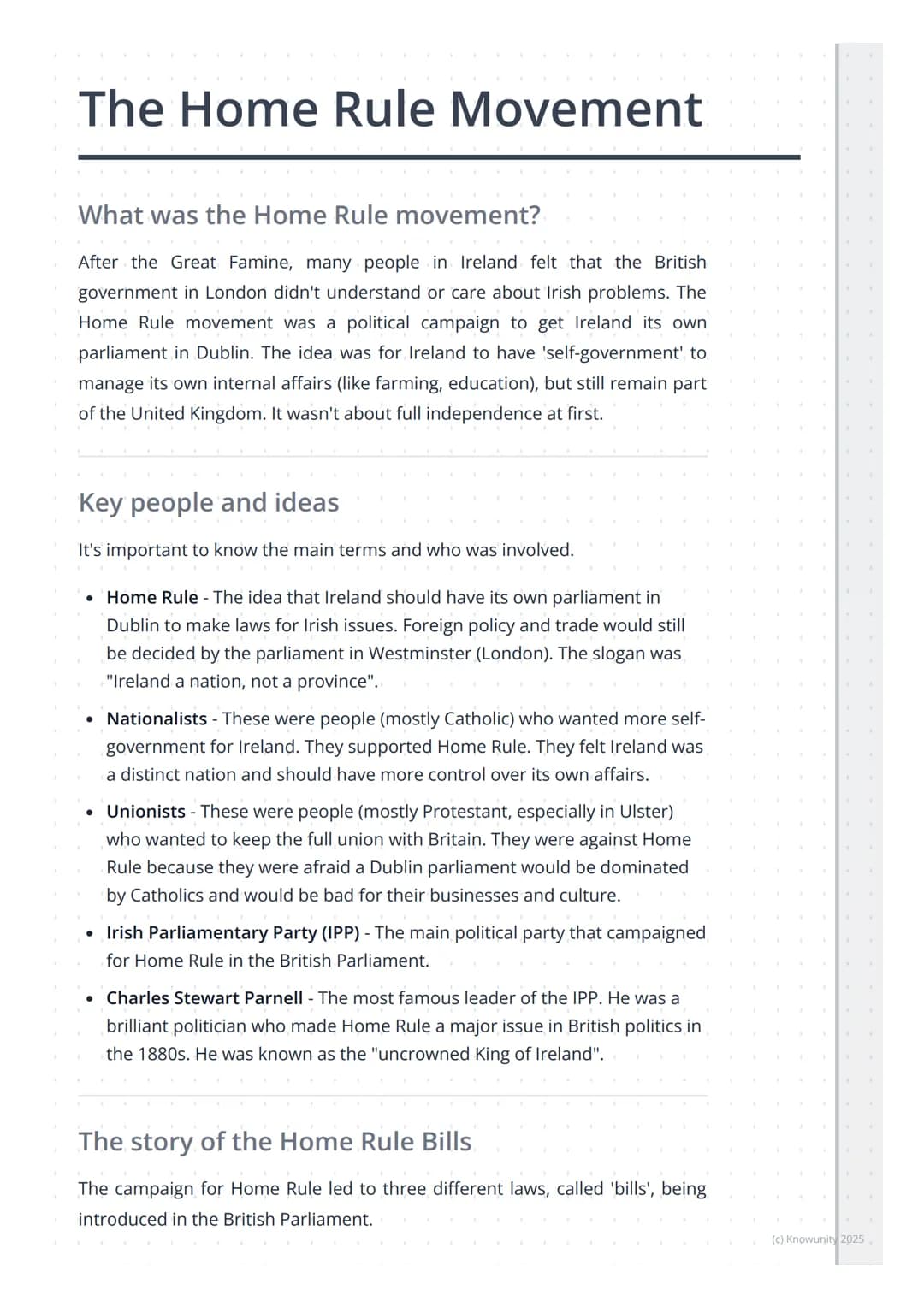
What Was Home Rule All About?
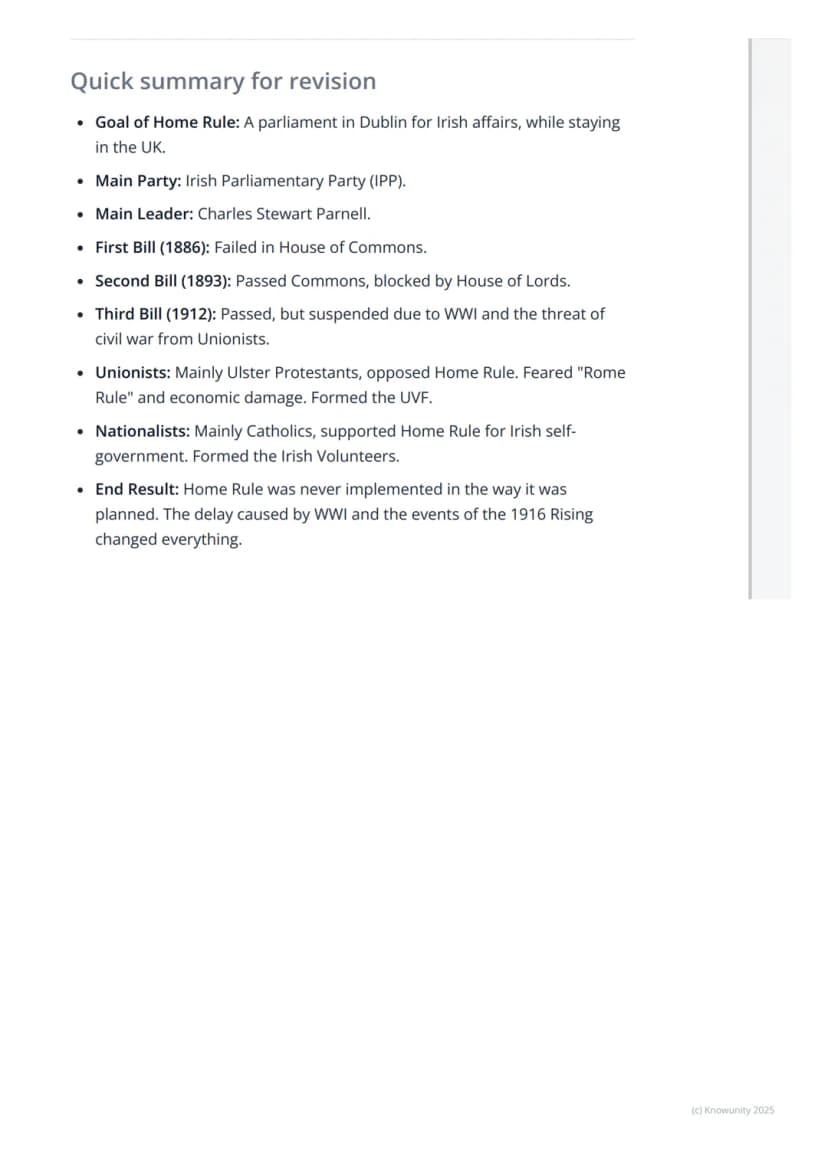
After the devastating Great Famine, loads of Irish people felt the British government just didn't get their problems. Home Rule was basically Ireland's way of saying "let us sort out our own mess" - they wanted a parliament in Dublin to handle things like farming and education, but foreign policy would still be London's job.
The key slogan was "Ireland a nation, not a province", which sums up perfectly what they were after. This wasn't about complete independence at first - just enough freedom to make decisions that actually made sense for Irish people.
Nationalists (mostly Catholics) were dead keen on this idea because they saw Ireland as a proper nation that deserved control over its own affairs. On the flip side, Unionists (mainly Ulster Protestants) were absolutely terrified of Home Rule because they reckoned a Dublin parliament would be stuffed full of Catholics who'd wreck their businesses and culture.
Quick Tip: Remember that Home Rule wasn't about leaving the UK completely - that came later after 1916!
2
of 5
The Three Home Rule Bills - A Tale of Failure
The campaign for Home Rule led to three attempts at getting a law passed, and each one had its own dramatic ending.
The First Home Rule Bill (1886) was introduced by Prime Minister William Gladstone, but it crashed and burned in the House of Commons when his own party members voted against it. They were petrified it would be the first domino to fall in breaking up the British Empire.
The Second Home Rule Bill (1893) made it through the Commons this time, but the House of Lords - packed with wealthy Unionist landowners - shot it down completely. This was a massive kick in the teeth for Irish Nationalists who thought they were finally getting somewhere.
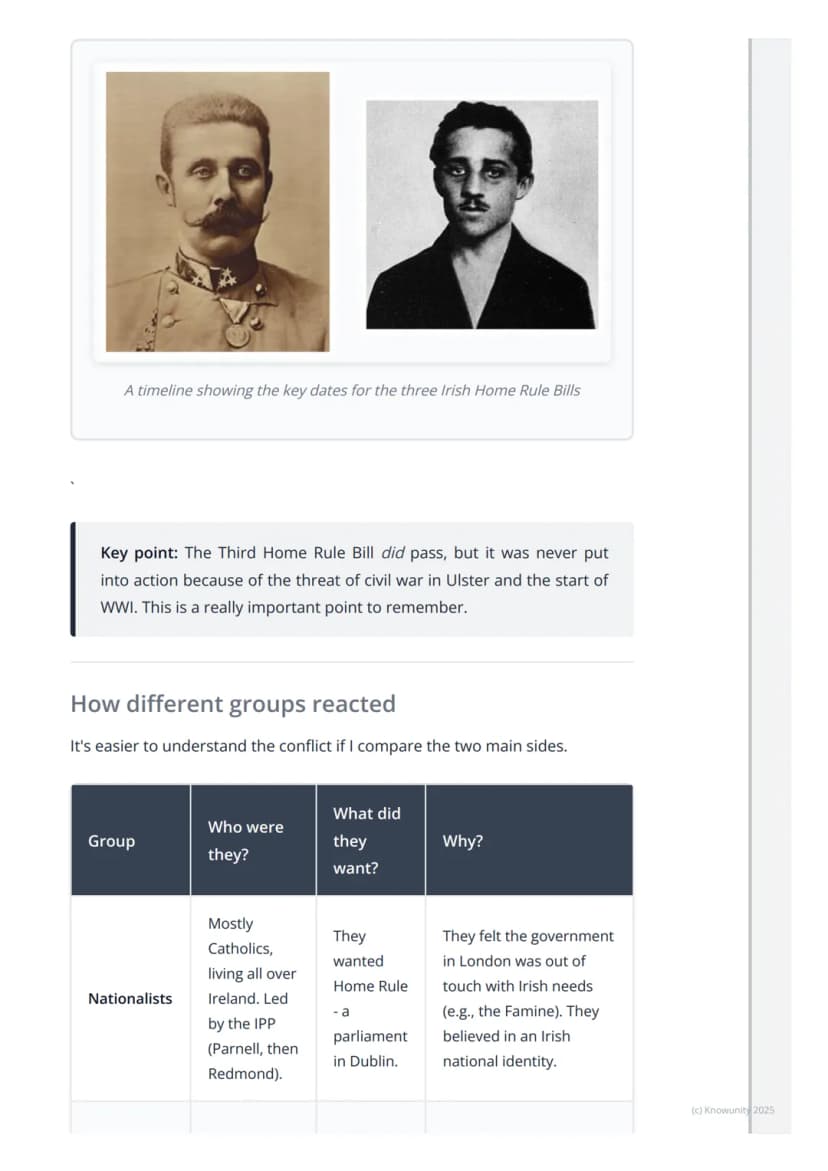
The Third Home Rule Bill (1912-1914) was where things got properly mental. The Irish Parliamentary Party, led by John Redmond, held the balance of power in Parliament, so they could basically blackmail the government into promising Home Rule. Plus, the Parliament Act 1911 meant the House of Lords could only delay bills for two years, not block them forever.
Did You Know: The third bill actually passed in 1914, but World War I broke out just as Ireland was about to explode into civil war!
3
of 5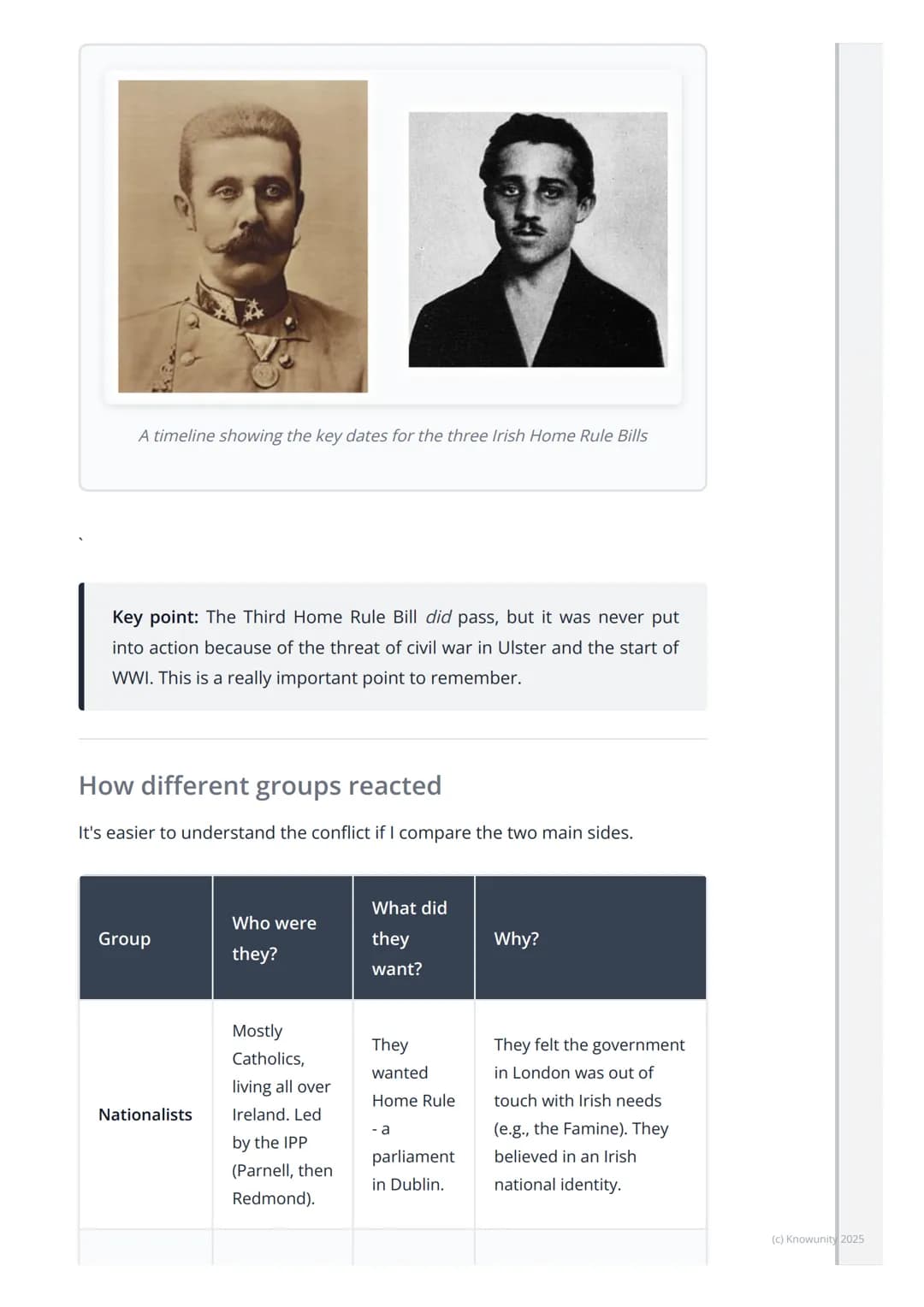
When Ireland Nearly Went to War With Itself
By 1914, Ireland was a powder keg ready to blow. The Third Home Rule Bill had passed, but Unionists in Ulster were absolutely raging about it.
Edward Carson led the Ulster Unionists, and they weren't messing about - they formed the Ulster Volunteer Force (UVF), which was basically a private army ready to fight rather than accept Home Rule. Over 230,000 men signed the Solemn League and Covenant in 1912, some literally in their own blood, promising to use "all means necessary" to stop Home Rule.
Nationalists weren't going to be pushed around either. When they saw the UVF forming up, they created their own group called the Irish Volunteers in 1913 to make sure Home Rule actually happened. Both sides were armed and ready for a scrap.
Just when it looked like Ireland was about to tear itself apart, World War I kicked off in August 1914. The British government basically said "right, we'll deal with this Home Rule business after we've sorted out the Germans" and put the whole thing on ice.
Key Point: The Home Rule Act was law by 1914 but was never actually put into action - this delay changed everything!
4
of 5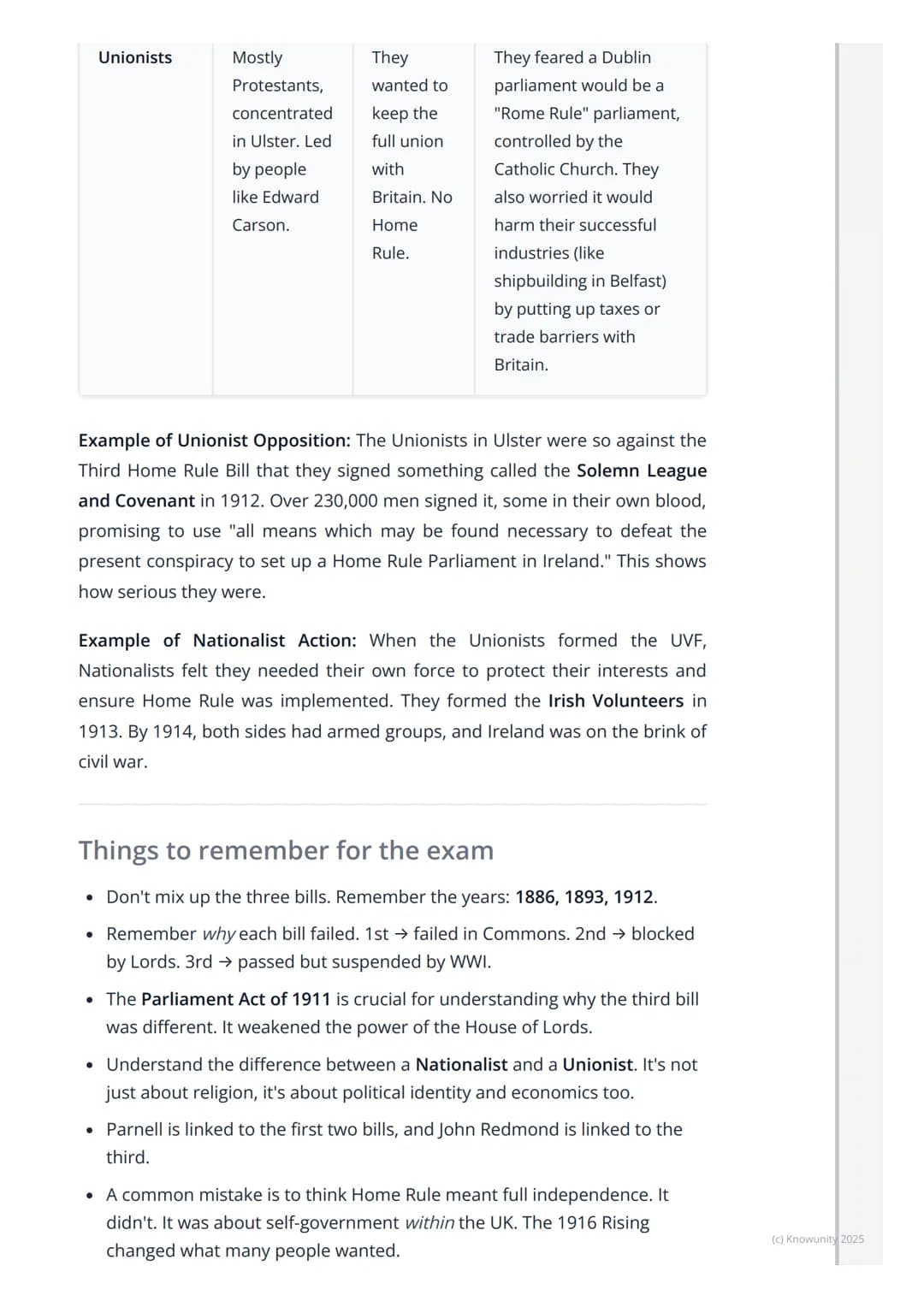
The Two Sides: Why They Couldn't Agree
Understanding the Home Rule conflict is way easier when you compare what each side actually wanted and feared.
Unionists were mostly Protestants concentrated in Ulster who wanted to keep the full union with Britain. They were terrified that a Dublin parliament would be "Rome Rule" - basically controlled by the Catholic Church. They also had proper successful industries like shipbuilding in Belfast and worried that Home Rule would mean higher taxes or trade barriers that would wreck their businesses.
Nationalists were mainly Catholics who felt Ireland was a distinct nation that deserved to run its own affairs. They supported the Irish Parliamentary Party and leaders like Charles Stewart Parnell, who was known as the "uncrowned King of Ireland" because he was such a brilliant politician.
The economic fears were massive too. Unionists had built up thriving businesses trading with Britain and the Empire, whilst many Nationalists were still struggling with the aftermath of the Famine and felt British rule had failed them completely.
Remember: This wasn't just about religion - it was about completely different ideas of what Ireland should be!
5
of 5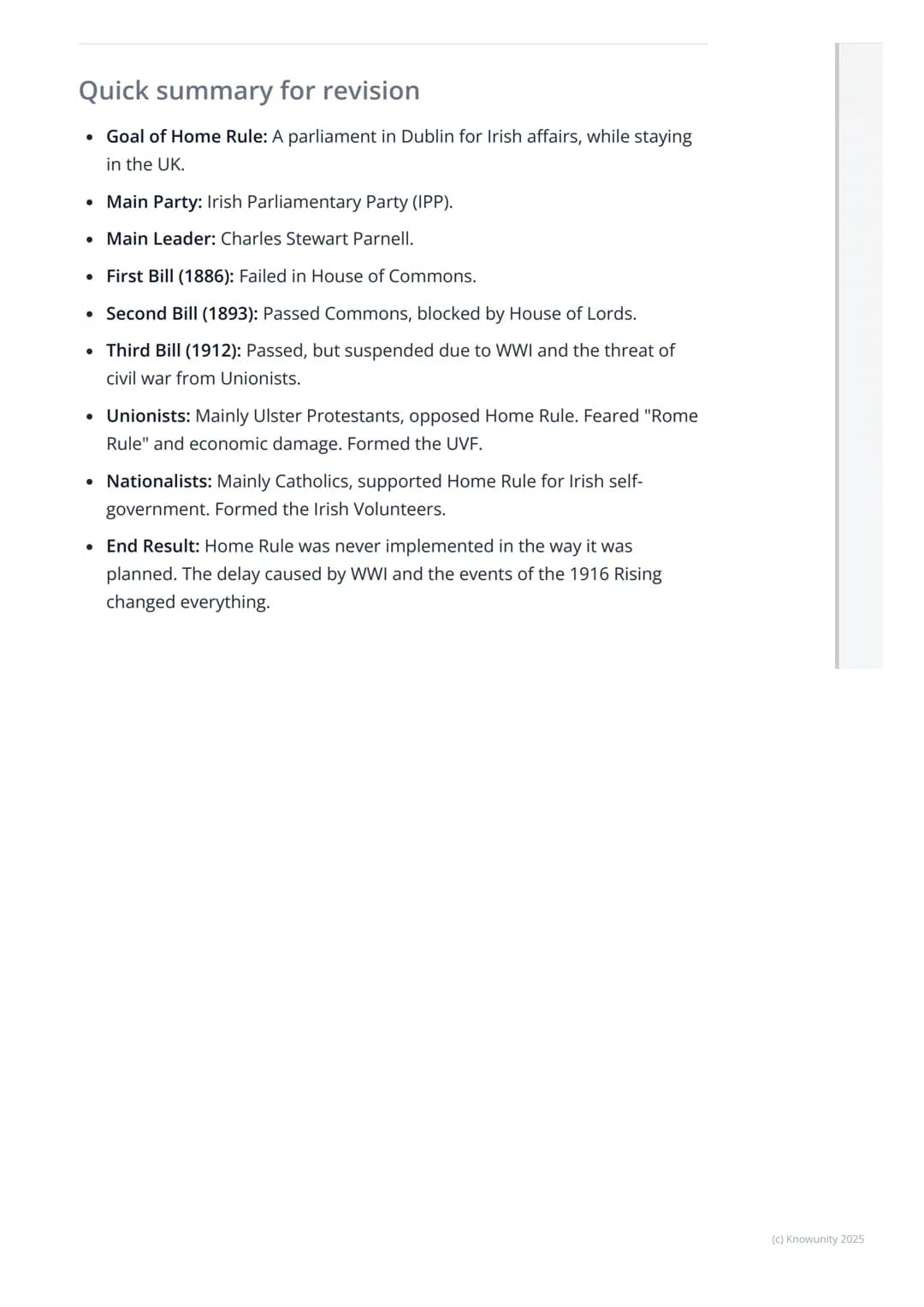
Key Points for Your Exams
Don't get the three bills mixed up - remember the dates: 1886, 1893, 1912. Each failed for different reasons: the first crashed in the Commons, the second was blocked by the Lords, and the third passed but got suspended because of WWI.
The Parliament Act 1911 is crucial for understanding why the third bill was different - it basically neutered the House of Lords' power to block bills permanently. Parnell is your man for the first two bills, whilst John Redmond led the charge for the third.
A dead common mistake is thinking Home Rule meant full independence - it absolutely didn't. Ireland would still be part of the UK, just with its own parliament for local issues. The 1916 Rising completely changed what many Irish people wanted.
The big irony is that Home Rule actually became law in 1914 but was never implemented. The delay caused by World War I and the dramatic events that followed meant Ireland's future took a completely different path.
Exam Tip: Always explain WHY each bill failed - examiners love seeing you understand the different obstacles Home Rule faced!
Myśleliśmy, że nigdy nie zapytasz...
Czym jest Towarzysz AI z Knowunity?
Nasz asystent AI jest specjalnie dostosowany do potrzeb uczniów. W oparciu o miliony treści, które mamy na platformie, możemy udzielać uczniom naprawdę znaczących i trafnych odpowiedzi. Ale nie chodzi tylko o odpowiedzi, towarzysz prowadzi również uczniów przez codzienne wyzwania związane z nauką, ze spersonalizowanymi planami nauki, quizami lub treściami na czacie i 100% personalizacją opartą na umiejętnościach i rozwoju uczniów.
Gdzie mogę pobrać aplikację Knowunity?
Aplikację możesz pobrać z Google Play i Apple Store.
Czy aplikacja Knowunity naprawdę jest darmowa?
Tak, masz całkowicie darmowy dostęp do wszystkich notatek w aplikacji, możesz w każdej chwili rozmawiać z Ekspertami lub ich obserwować. Możesz użyć punktów, aby odblokować pewne funkcje w aplikacji, które również możesz otrzymać za darmo. Dodatkowo oferujemy usługę Knowunity Premium, która pozwala na odblokowanie większej liczby funkcji.
Najpopularniejsze notatki z History
9HistoryThe Great Famine (An Gorta Mór)
Students will learn about the causes, devastating impact, and long-term consequences of the potato famine on Irish population and society.
2nd Year282
HistoryThe renaissance
junior cert renaissance summary
1st Year361
HistoryCauses and Consequences of World War II
This subtopic covers the origins of the Second World War, its global scale, and its devastating human and political consequences, including the atomic bomb.
3rd Year152
HistoryThe 1798 Rebellion in Ireland
Learning about the causes, events, and aftermath of the United Irishmen's rebellion against British rule, inspired by revolutionary ideals.
3rd Year211
HistoryAmerican revolution
junior cert american revolution summary
1st Year442
HistoryThe Great Famine (An Gorta Mór)
This critical subtopic examines the causes, devastating impact, and long-term consequences of the potato famine on Irish society, population, and emigration.
3rd Year140
HistoryThe Renaissance
Students will learn about a time of 'rebirth' in Europe, where new ideas in art, science, and literature flourished.
1st Year140
History1916 Rising Revison Sheet
revision sheet
3rd Year211
HistoryThe Reformation in Europe
Students will learn about the causes and key figures of the Protestant Reformation and its impact on European society and politics.
3rd Year110
Najpopularniejsze notatki
9 Irish
IrishIrish oral questions and answers
Questions and answers for the leaving cert oral
5th Year4264
 English
Key Quotes : Sive
Key Quotes and explanations: Sive
6th Year2842
IrishIrish oral questions
Outline of oral questions
5th Year2055
IrishIníon- le hÁine Durkin
Aine Durkin’s poem, Iníon: Themes & summary
5th Year850
IrishIrish poetry 2027
Iníon + Dínit an Bhróin
5th Year1133
IrishLC HL notes- Iníon (poem)
Includes poem in English and Irish, theme, key words & phrases
5th Year2284
EnglishCultural Context : Shawshank Redemption : Sive : Small Things Like These
Comparative Study : Cultural Context : Shawshank Redemption, Sive and Small Things Like These
6th Year1430
IrishMo Ghrá-sa (Idir Lúibíní)
Notes on mo ghrá-sa
5th Year380
IrishAn Gaeilge Aiste
Irish Language essay
6th Year1320
Nie ma nic odpowiedniego? Sprawdź inne przedmioty.
Zobacz, co mówią o nas nasi użytkownicy. Pokochali nas — pokochasz też i Ty.
4.6/5App Store
4.7/5Google Play
Aplikacja jest bardzo prosta i dobrze przemyślana. Do tej pory znalazłem wszystko, czego szukałem i mogłem się wiele nauczyć z innych notatek! Na pewno wykorzystam aplikację do pomocy przy robieniu prac domowych! No i oczywiście bardzo pomaga też jako inspiracja do robienia swoich notatek.
Stefan Sużytkownik iOS
Ta aplikacja jest naprawdę świetna. Jest tak wiele notatek i pomocnych informacji [...]. Moim problematycznym przedmiotem jest język niemiecki, a w aplikacji jest w czym wybierać. Dzięki tej aplikacji poprawiłam swój niemiecki. Polecam ją każdemu.
Samantha Klichużytkownik Androida
Wow, jestem w szoku. Właśnie wypróbowałam aplikację, ponieważ widziałam ją kilka razy reklamowaną na TikToku jestem absolutnie w szoku. Ta aplikacja jest POMOCĄ, której potrzebujesz w szkole i przede wszystkim oferuje tak wiele rzeczy jak notatki czy streszczenia, które są BARDZO pomocne w moim przypadku.
Annaużytkownik iOS
History4 wyświetleń·Zaktualizowano Jun 15, 2026·5 stronyThe Irish Home Rule Movement Explained: Challenges and Goals
Ever wondered why Ireland and Britain had such a complicated relationship? The Home Rule movement was Ireland's big push for self-government in the late 1800s and early 1900s. Instead of being ruled entirely from London, Irish politicians wanted their own...
1
of 5
Zarejestruj się, aby zobaczyć notatkę. To nic nie kosztuje!
- Dostęp do wszystkich materiałów
- Popraw swoje oceny
- Dołącz do milionów studentów
What Was Home Rule All About?
After the devastating Great Famine, loads of Irish people felt the British government just didn't get their problems. Home Rule was basically Ireland's way of saying "let us sort out our own mess" - they wanted a parliament in Dublin to handle things like farming and education, but foreign policy would still be London's job.
The key slogan was "Ireland a nation, not a province", which sums up perfectly what they were after. This wasn't about complete independence at first - just enough freedom to make decisions that actually made sense for Irish people.
Nationalists (mostly Catholics) were dead keen on this idea because they saw Ireland as a proper nation that deserved control over its own affairs. On the flip side, Unionists (mainly Ulster Protestants) were absolutely terrified of Home Rule because they reckoned a Dublin parliament would be stuffed full of Catholics who'd wreck their businesses and culture.
Quick Tip: Remember that Home Rule wasn't about leaving the UK completely - that came later after 1916!
2
of 5Zarejestruj się, aby zobaczyć notatkę. To nic nie kosztuje!
- Dostęp do wszystkich materiałów
- Popraw swoje oceny
- Dołącz do milionów studentów
The Three Home Rule Bills - A Tale of Failure
The campaign for Home Rule led to three attempts at getting a law passed, and each one had its own dramatic ending.
The First Home Rule Bill (1886) was introduced by Prime Minister William Gladstone, but it crashed and burned in the House of Commons when his own party members voted against it. They were petrified it would be the first domino to fall in breaking up the British Empire.
The Second Home Rule Bill (1893) made it through the Commons this time, but the House of Lords - packed with wealthy Unionist landowners - shot it down completely. This was a massive kick in the teeth for Irish Nationalists who thought they were finally getting somewhere.
The Third Home Rule Bill (1912-1914) was where things got properly mental. The Irish Parliamentary Party, led by John Redmond, held the balance of power in Parliament, so they could basically blackmail the government into promising Home Rule. Plus, the Parliament Act 1911 meant the House of Lords could only delay bills for two years, not block them forever.
Did You Know: The third bill actually passed in 1914, but World War I broke out just as Ireland was about to explode into civil war!
3
of 5Zarejestruj się, aby zobaczyć notatkę. To nic nie kosztuje!
- Dostęp do wszystkich materiałów
- Popraw swoje oceny
- Dołącz do milionów studentów
When Ireland Nearly Went to War With Itself
By 1914, Ireland was a powder keg ready to blow. The Third Home Rule Bill had passed, but Unionists in Ulster were absolutely raging about it.
Edward Carson led the Ulster Unionists, and they weren't messing about - they formed the Ulster Volunteer Force (UVF), which was basically a private army ready to fight rather than accept Home Rule. Over 230,000 men signed the Solemn League and Covenant in 1912, some literally in their own blood, promising to use "all means necessary" to stop Home Rule.
Nationalists weren't going to be pushed around either. When they saw the UVF forming up, they created their own group called the Irish Volunteers in 1913 to make sure Home Rule actually happened. Both sides were armed and ready for a scrap.
Just when it looked like Ireland was about to tear itself apart, World War I kicked off in August 1914. The British government basically said "right, we'll deal with this Home Rule business after we've sorted out the Germans" and put the whole thing on ice.
Key Point: The Home Rule Act was law by 1914 but was never actually put into action - this delay changed everything!
4
of 5Zarejestruj się, aby zobaczyć notatkę. To nic nie kosztuje!
- Dostęp do wszystkich materiałów
- Popraw swoje oceny
- Dołącz do milionów studentów
The Two Sides: Why They Couldn't Agree
Understanding the Home Rule conflict is way easier when you compare what each side actually wanted and feared.
Unionists were mostly Protestants concentrated in Ulster who wanted to keep the full union with Britain. They were terrified that a Dublin parliament would be "Rome Rule" - basically controlled by the Catholic Church. They also had proper successful industries like shipbuilding in Belfast and worried that Home Rule would mean higher taxes or trade barriers that would wreck their businesses.
Nationalists were mainly Catholics who felt Ireland was a distinct nation that deserved to run its own affairs. They supported the Irish Parliamentary Party and leaders like Charles Stewart Parnell, who was known as the "uncrowned King of Ireland" because he was such a brilliant politician.
The economic fears were massive too. Unionists had built up thriving businesses trading with Britain and the Empire, whilst many Nationalists were still struggling with the aftermath of the Famine and felt British rule had failed them completely.
Remember: This wasn't just about religion - it was about completely different ideas of what Ireland should be!
5
of 5Zarejestruj się, aby zobaczyć notatkę. To nic nie kosztuje!
- Dostęp do wszystkich materiałów
- Popraw swoje oceny
- Dołącz do milionów studentów
Key Points for Your Exams
Don't get the three bills mixed up - remember the dates: 1886, 1893, 1912. Each failed for different reasons: the first crashed in the Commons, the second was blocked by the Lords, and the third passed but got suspended because of WWI.
The Parliament Act 1911 is crucial for understanding why the third bill was different - it basically neutered the House of Lords' power to block bills permanently. Parnell is your man for the first two bills, whilst John Redmond led the charge for the third.
A dead common mistake is thinking Home Rule meant full independence - it absolutely didn't. Ireland would still be part of the UK, just with its own parliament for local issues. The 1916 Rising completely changed what many Irish people wanted.
The big irony is that Home Rule actually became law in 1914 but was never implemented. The delay caused by World War I and the dramatic events that followed meant Ireland's future took a completely different path.
Exam Tip: Always explain WHY each bill failed - examiners love seeing you understand the different obstacles Home Rule faced!
Myśleliśmy, że nigdy nie zapytasz...
Czym jest Towarzysz AI z Knowunity?
Nasz asystent AI jest specjalnie dostosowany do potrzeb uczniów. W oparciu o miliony treści, które mamy na platformie, możemy udzielać uczniom naprawdę znaczących i trafnych odpowiedzi. Ale nie chodzi tylko o odpowiedzi, towarzysz prowadzi również uczniów przez codzienne wyzwania związane z nauką, ze spersonalizowanymi planami nauki, quizami lub treściami na czacie i 100% personalizacją opartą na umiejętnościach i rozwoju uczniów.
Gdzie mogę pobrać aplikację Knowunity?
Aplikację możesz pobrać z Google Play i Apple Store.
Czy aplikacja Knowunity naprawdę jest darmowa?
Tak, masz całkowicie darmowy dostęp do wszystkich notatek w aplikacji, możesz w każdej chwili rozmawiać z Ekspertami lub ich obserwować. Możesz użyć punktów, aby odblokować pewne funkcje w aplikacji, które również możesz otrzymać za darmo. Dodatkowo oferujemy usługę Knowunity Premium, która pozwala na odblokowanie większej liczby funkcji.
Najpopularniejsze notatki z History
9HistoryThe Great Famine (An Gorta Mór)
Students will learn about the causes, devastating impact, and long-term consequences of the potato famine on Irish population and society.
2nd Year282
HistoryThe renaissance
junior cert renaissance summary
1st Year361
HistoryCauses and Consequences of World War II
This subtopic covers the origins of the Second World War, its global scale, and its devastating human and political consequences, including the atomic bomb.
3rd Year152
HistoryThe 1798 Rebellion in Ireland
Learning about the causes, events, and aftermath of the United Irishmen's rebellion against British rule, inspired by revolutionary ideals.
3rd Year211
HistoryAmerican revolution
junior cert american revolution summary
1st Year442
HistoryThe Great Famine (An Gorta Mór)
This critical subtopic examines the causes, devastating impact, and long-term consequences of the potato famine on Irish society, population, and emigration.
3rd Year140
HistoryThe Renaissance
Students will learn about a time of 'rebirth' in Europe, where new ideas in art, science, and literature flourished.
1st Year140
History1916 Rising Revison Sheet
revision sheet
3rd Year211
HistoryThe Reformation in Europe
Students will learn about the causes and key figures of the Protestant Reformation and its impact on European society and politics.
3rd Year110
Najpopularniejsze notatki
9IrishIrish oral questions and answers
Questions and answers for the leaving cert oral
5th Year4264
EnglishKey Quotes : Sive
Key Quotes and explanations: Sive
6th Year2842
IrishIrish oral questions
Outline of oral questions
5th Year2055
IrishIníon- le hÁine Durkin
Aine Durkin’s poem, Iníon: Themes & summary
5th Year850
IrishIrish poetry 2027
Iníon + Dínit an Bhróin
5th Year1133
IrishLC HL notes- Iníon (poem)
Includes poem in English and Irish, theme, key words & phrases
5th Year2284
EnglishCultural Context : Shawshank Redemption : Sive : Small Things Like These
Comparative Study : Cultural Context : Shawshank Redemption, Sive and Small Things Like These
6th Year1430
IrishMo Ghrá-sa (Idir Lúibíní)
Notes on mo ghrá-sa
5th Year380
IrishAn Gaeilge Aiste
Irish Language essay
6th Year1320
Nie ma nic odpowiedniego? Sprawdź inne przedmioty.
Zobacz, co mówią o nas nasi użytkownicy. Pokochali nas — pokochasz też i Ty.
4.6/5App Store
4.7/5Google Play
Aplikacja jest bardzo prosta i dobrze przemyślana. Do tej pory znalazłem wszystko, czego szukałem i mogłem się wiele nauczyć z innych notatek! Na pewno wykorzystam aplikację do pomocy przy robieniu prac domowych! No i oczywiście bardzo pomaga też jako inspiracja do robienia swoich notatek.
Stefan Sużytkownik iOS
Ta aplikacja jest naprawdę świetna. Jest tak wiele notatek i pomocnych informacji [...]. Moim problematycznym przedmiotem jest język niemiecki, a w aplikacji jest w czym wybierać. Dzięki tej aplikacji poprawiłam swój niemiecki. Polecam ją każdemu.
Samantha Klichużytkownik Androida
Wow, jestem w szoku. Właśnie wypróbowałam aplikację, ponieważ widziałam ją kilka razy reklamowaną na TikToku jestem absolutnie w szoku. Ta aplikacja jest POMOCĄ, której potrzebujesz w szkole i przede wszystkim oferuje tak wiele rzeczy jak notatki czy streszczenia, które są BARDZO pomocne w moim przypadku.
Annaużytkownik iOS