
Ever wondered who the Irish people were before Christianity arrived?... Pokaż więcej
 History1 wyświetleń·Zaktualizowano Jun 8, 2026·7 strony
The Celts and Their Iron Age Legacy in Ireland

1 / 7
1
of 7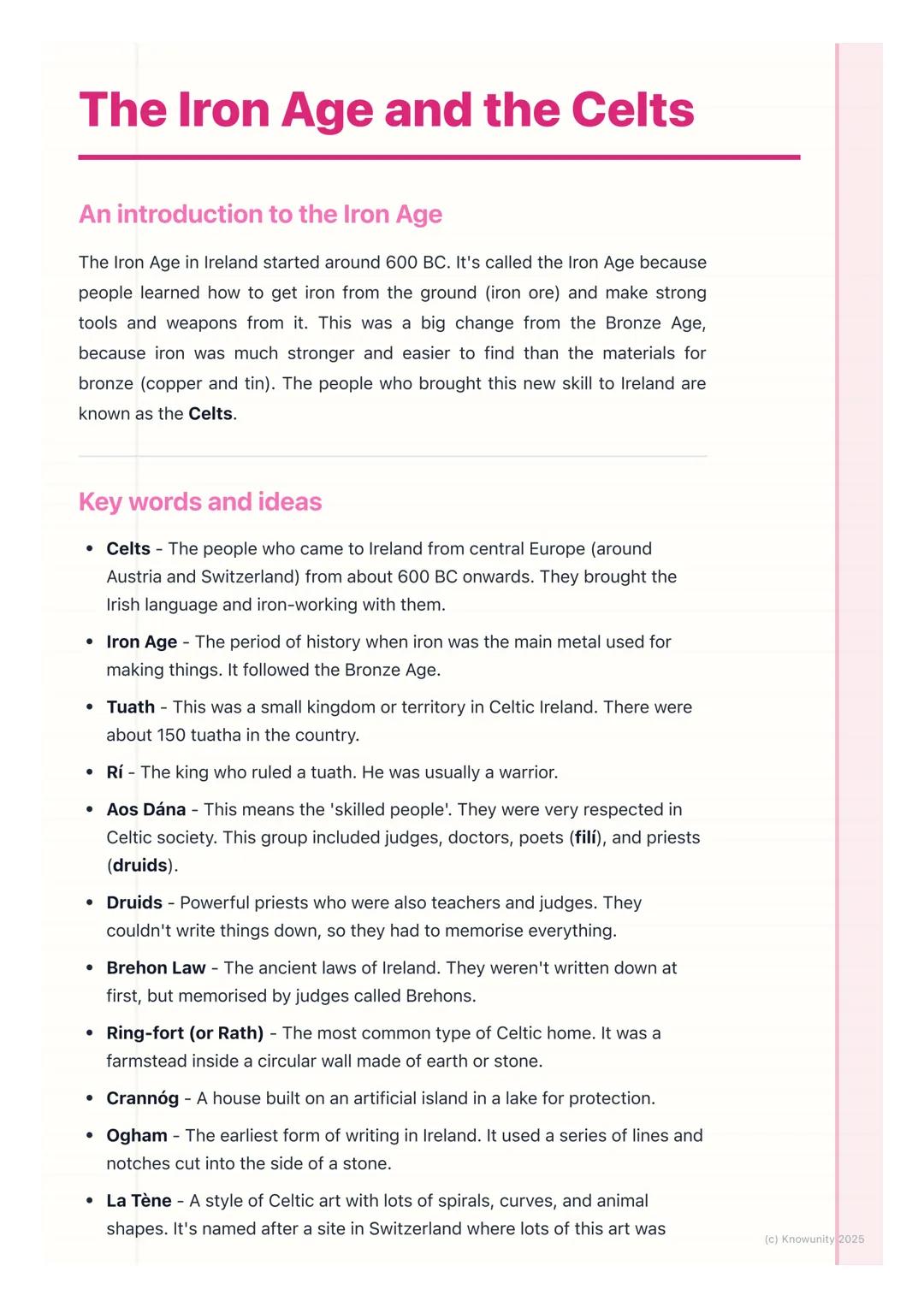
The Iron Age Arrives in Ireland
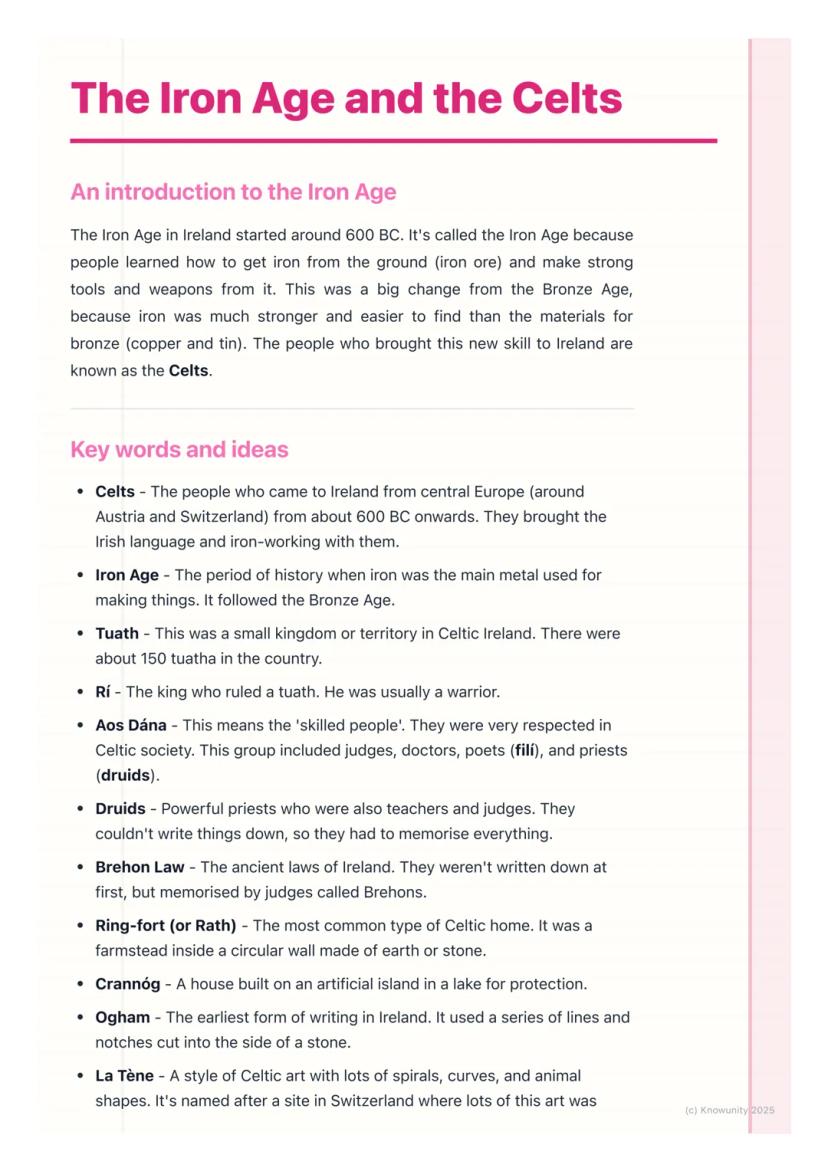
Picture Ireland around 600 BC - everything's about to change! The Celts arrived from central Europe (think Austria and Switzerland) bringing something revolutionary: the ability to make tools and weapons from iron ore. This was massive because iron was way stronger than bronze and much easier to find.
The Iron Age wasn't just about better metal - the Celts brought the Irish language, incredible art, and a whole new way of organizing society. They divided Ireland into about 150 small kingdoms called tuatha , each ruled by a warrior king called a Rí.
The Aos Dána were the celebrities of Celtic society - these "skilled people" included powerful druids (priests who memorized everything because they couldn't write), poets called filí, doctors, and judges. They were so respected that even kings had to listen to them!
Did you know? Druids had to memorize 20 years' worth of laws, stories, and religious knowledge because writing was forbidden in their training!
2
of 7
Celtic Society: All About the Pyramid
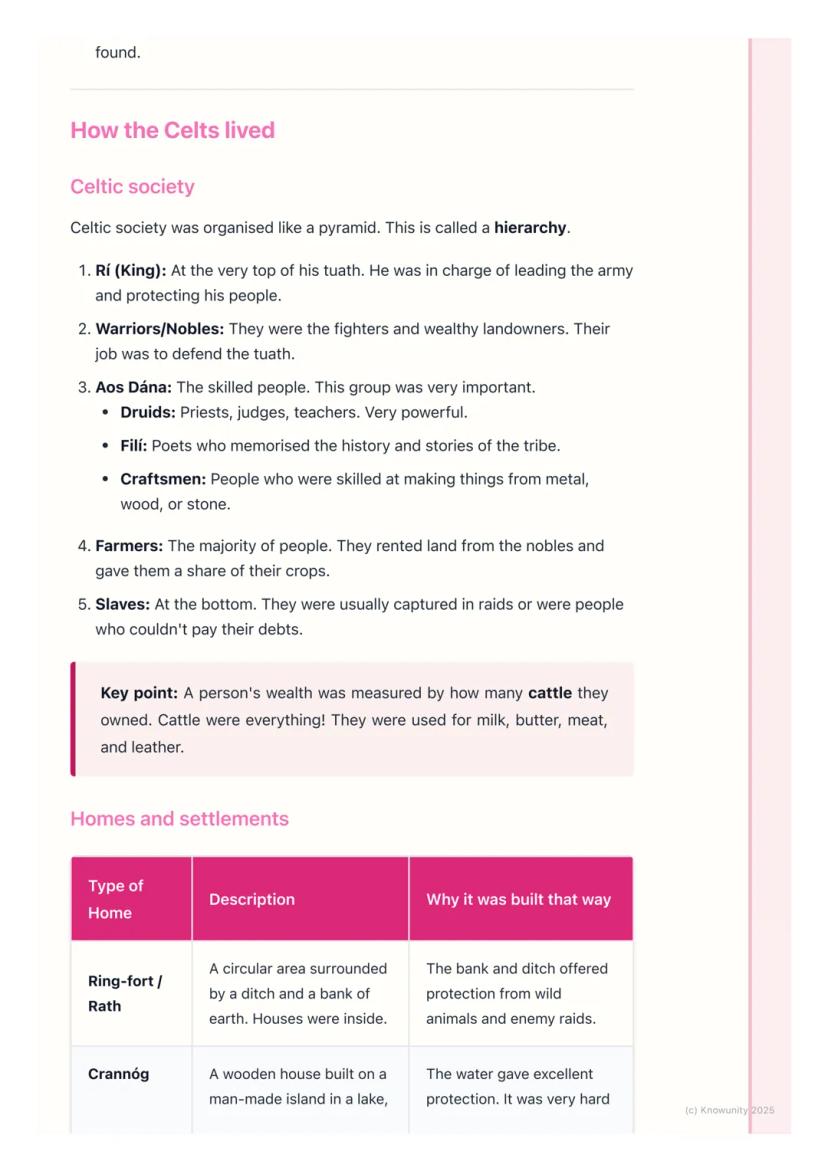
Think of Celtic society like a pyramid with the Rí (king) at the top of each tuath. Below him were warriors and nobles who owned land and fought battles. The Aos Dána came next - these skilled people were incredibly important even though they weren't necessarily warriors.
Most people were farmers who rented land from nobles and paid them with crops. At the bottom were slaves - usually people captured in raids or those who couldn't pay their debts. Here's the key thing: wealth was measured in cattle. No joke - cows were literally money! They provided milk, butter, meat, and leather.
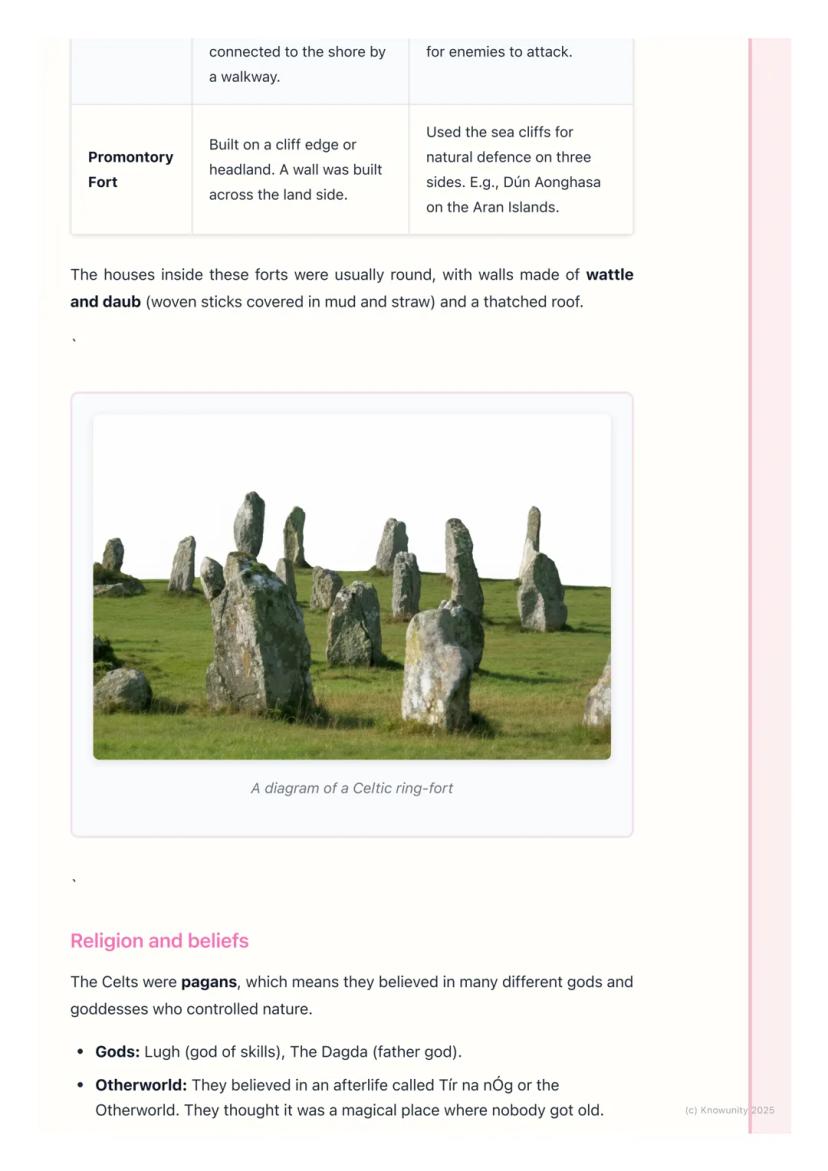
Celtic homes were built for protection. Ring-forts (or raths) were circular farmsteads surrounded by earth banks and ditches to keep out wild animals and raiders. For extra security, some families built crannógs - houses on artificial islands in lakes connected to shore by hidden walkways.
Remember this: In any exam answer about Celtic society, always mention that cattle = wealth. It's the golden rule!
3
of 7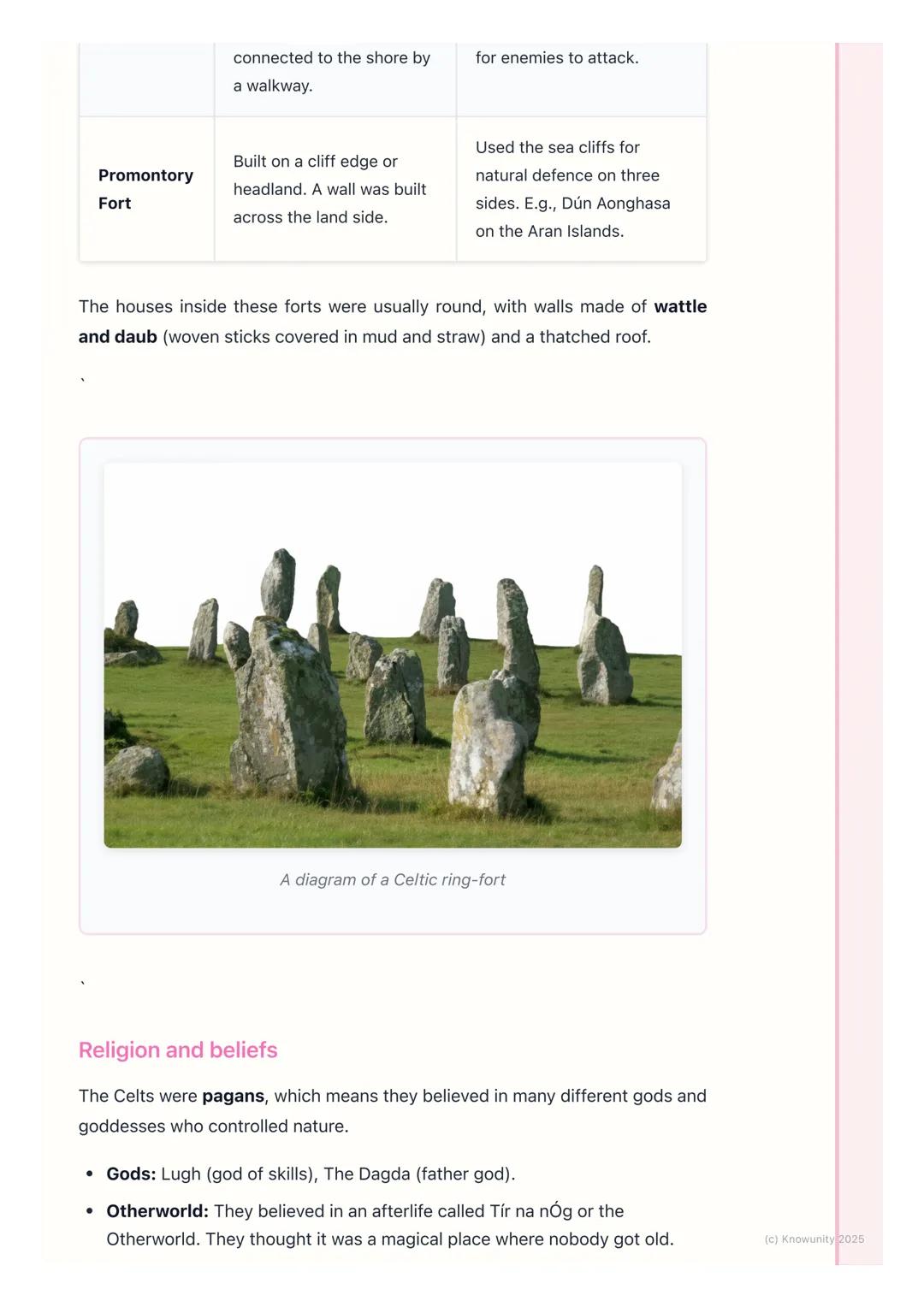
Daily Life and Beliefs
The Celts loved a good party! They celebrated four major festivals that matched the seasons: Samhain (Halloween's ancestor), Imbolc (spring's start), Bealtaine (summer begins), and Lughnasa (harvest time). These weren't just parties - they were serious religious events.
Celtic religion was all about nature gods and the Otherworld - their version of the afterlife. When important people died, they were buried with grave goods like swords, shields, and jewelry because they'd need them in the next life. The druids ran religious ceremonies and acted as judges using Brehon Law - ancient Irish laws they memorized word for word.
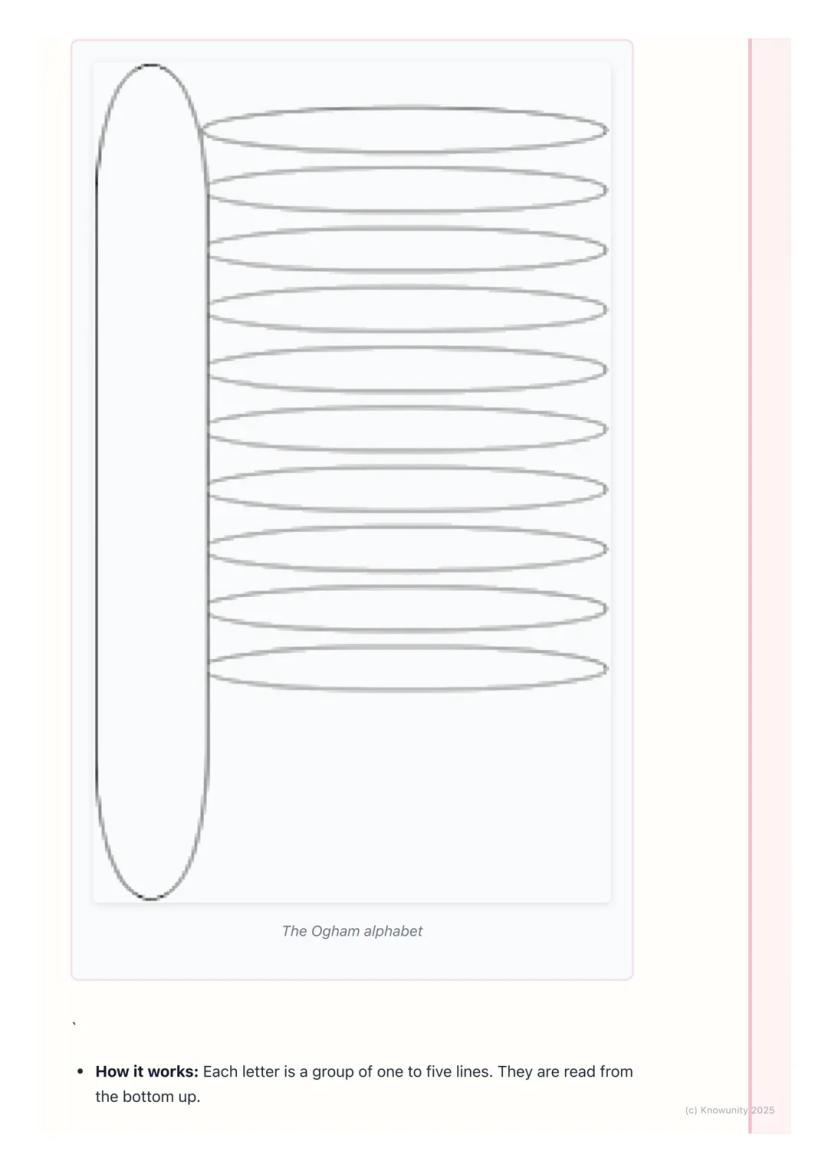
The Celts created the first writing system in Ireland called Ogham. These were lines and notches carved into stone edges, read from bottom to top. Most Ogham stones just marked graves or boundaries with simple messages like "this belonged to so-and-so."
Cool fact: The tiny gold boat in the Broighter Hoard might have been thrown into water as an offering to sea gods - showing how seriously Celts took their religion!
4
of 7
Evidence and Legacy
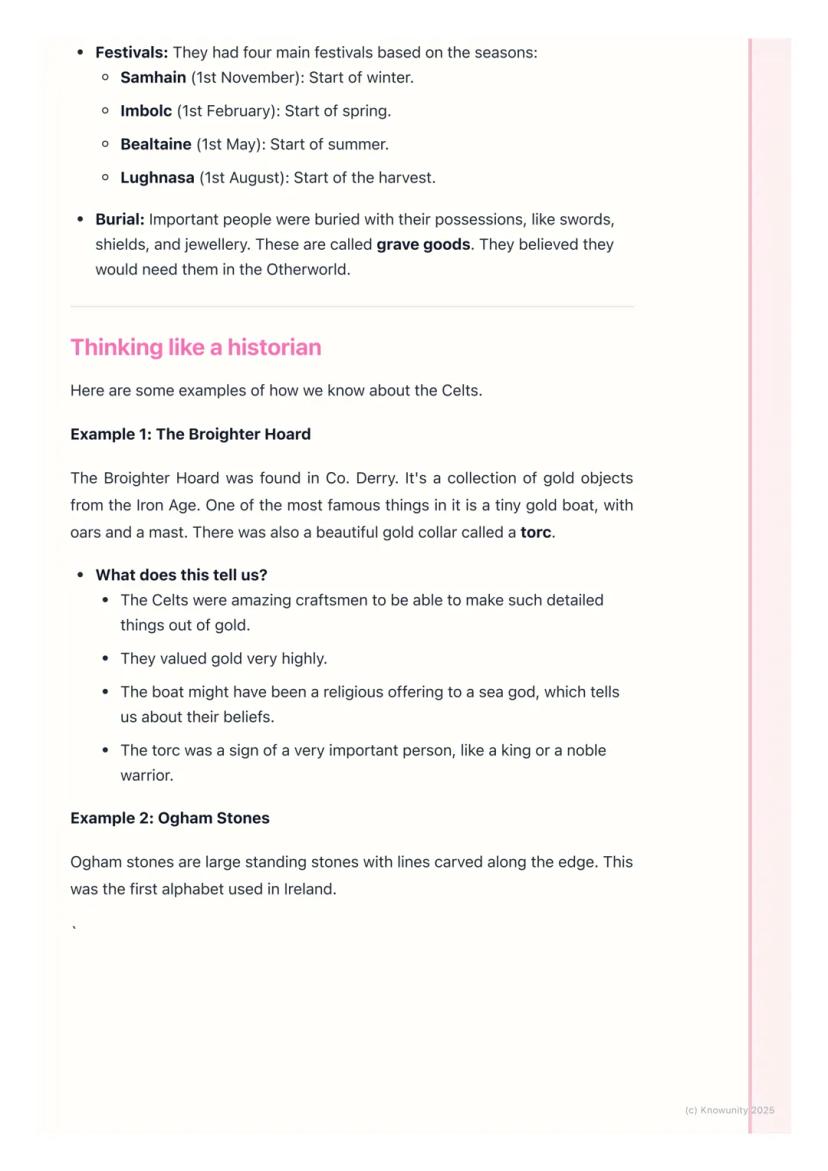
How do we know all this stuff about people from over 2,000 years ago? Archaeologists are like detectives! The Broighter Hoard found in County Derry shows us incredible Celtic craftsmanship - especially a tiny gold boat with working oars and mast, plus a gorgeous gold collar called a torc that screamed "I'm important!"
La Tène art was the Celtic style - think swirls, spirals, and animal patterns that flow together beautifully. You can see this on artifacts like the Turoe Stone. This art style proves the Celts weren't just tough warriors - they were seriously talented artists too.
The Ogham stones scattered around Ireland are like ancient text messages. Each letter was made of one to five lines carved along the stone's edge. Though most just say someone's name, they mark the beginning of written history in Ireland - pretty amazing for people whose priests weren't allowed to write!
Exam tip: Don't mix up Bronze Age and Iron Age! The big difference is the metal used - iron was much stronger and more available than bronze.
5
of 7
6
of 7
7
of 7
Myśleliśmy, że nigdy nie zapytasz...
Czym jest Towarzysz AI z Knowunity?
Nasz asystent AI jest specjalnie dostosowany do potrzeb uczniów. W oparciu o miliony treści, które mamy na platformie, możemy udzielać uczniom naprawdę znaczących i trafnych odpowiedzi. Ale nie chodzi tylko o odpowiedzi, towarzysz prowadzi również uczniów przez codzienne wyzwania związane z nauką, ze spersonalizowanymi planami nauki, quizami lub treściami na czacie i 100% personalizacją opartą na umiejętnościach i rozwoju uczniów.
Gdzie mogę pobrać aplikację Knowunity?
Aplikację możesz pobrać z Google Play i Apple Store.
Czy aplikacja Knowunity naprawdę jest darmowa?
Tak, masz całkowicie darmowy dostęp do wszystkich notatek w aplikacji, możesz w każdej chwili rozmawiać z Ekspertami lub ich obserwować. Możesz użyć punktów, aby odblokować pewne funkcje w aplikacji, które również możesz otrzymać za darmo. Dodatkowo oferujemy usługę Knowunity Premium, która pozwala na odblokowanie większej liczby funkcji.
Najpopularniejsze notatki z History
9Najpopularniejsze notatki
9Nie ma nic odpowiedniego? Sprawdź inne przedmioty.
Zobacz, co mówią o nas nasi użytkownicy. Pokochali nas — pokochasz też i Ty.
4.6/5App Store
4.7/5Google Play
Aplikacja jest bardzo prosta i dobrze przemyślana. Do tej pory znalazłem wszystko, czego szukałem i mogłem się wiele nauczyć z innych notatek! Na pewno wykorzystam aplikację do pomocy przy robieniu prac domowych! No i oczywiście bardzo pomaga też jako inspiracja do robienia swoich notatek.
Stefan Sużytkownik iOS
Ta aplikacja jest naprawdę świetna. Jest tak wiele notatek i pomocnych informacji [...]. Moim problematycznym przedmiotem jest język niemiecki, a w aplikacji jest w czym wybierać. Dzięki tej aplikacji poprawiłam swój niemiecki. Polecam ją każdemu.
Samantha Klichużytkownik Androida
Wow, jestem w szoku. Właśnie wypróbowałam aplikację, ponieważ widziałam ją kilka razy reklamowaną na TikToku jestem absolutnie w szoku. Ta aplikacja jest POMOCĄ, której potrzebujesz w szkole i przede wszystkim oferuje tak wiele rzeczy jak notatki czy streszczenia, które są BARDZO pomocne w moim przypadku.
Annaużytkownik iOS
History1 wyświetleń·Zaktualizowano Jun 8, 2026·7 stronyThe Celts and Their Iron Age Legacy in Ireland
Ever wondered who the Irish people were before Christianity arrived? Meet the Celts- the warriors, craftspeople, and storytellers who shaped Ireland from around 600 BC. They brought iron tools, the Irish language, and amazing art that you can still... Pokaż więcej
1
of 7Zarejestruj się, aby zobaczyć notatkę. To nic nie kosztuje!
- Dostęp do wszystkich materiałów
- Popraw swoje oceny
- Dołącz do milionów studentów
The Iron Age Arrives in Ireland
Picture Ireland around 600 BC - everything's about to change! The Celts arrived from central Europe (think Austria and Switzerland) bringing something revolutionary: the ability to make tools and weapons from iron ore. This was massive because iron was way stronger than bronze and much easier to find.
The Iron Age wasn't just about better metal - the Celts brought the Irish language, incredible art, and a whole new way of organizing society. They divided Ireland into about 150 small kingdoms called tuatha , each ruled by a warrior king called a Rí.
The Aos Dána were the celebrities of Celtic society - these "skilled people" included powerful druids (priests who memorized everything because they couldn't write), poets called filí, doctors, and judges. They were so respected that even kings had to listen to them!
Did you know? Druids had to memorize 20 years' worth of laws, stories, and religious knowledge because writing was forbidden in their training!
2
of 7Zarejestruj się, aby zobaczyć notatkę. To nic nie kosztuje!
- Dostęp do wszystkich materiałów
- Popraw swoje oceny
- Dołącz do milionów studentów
Celtic Society: All About the Pyramid
Think of Celtic society like a pyramid with the Rí (king) at the top of each tuath. Below him were warriors and nobles who owned land and fought battles. The Aos Dána came next - these skilled people were incredibly important even though they weren't necessarily warriors.
Most people were farmers who rented land from nobles and paid them with crops. At the bottom were slaves - usually people captured in raids or those who couldn't pay their debts. Here's the key thing: wealth was measured in cattle. No joke - cows were literally money! They provided milk, butter, meat, and leather.
Celtic homes were built for protection. Ring-forts (or raths) were circular farmsteads surrounded by earth banks and ditches to keep out wild animals and raiders. For extra security, some families built crannógs - houses on artificial islands in lakes connected to shore by hidden walkways.
Remember this: In any exam answer about Celtic society, always mention that cattle = wealth. It's the golden rule!
3
of 7Zarejestruj się, aby zobaczyć notatkę. To nic nie kosztuje!
- Dostęp do wszystkich materiałów
- Popraw swoje oceny
- Dołącz do milionów studentów
Daily Life and Beliefs
The Celts loved a good party! They celebrated four major festivals that matched the seasons: Samhain (Halloween's ancestor), Imbolc (spring's start), Bealtaine (summer begins), and Lughnasa (harvest time). These weren't just parties - they were serious religious events.
Celtic religion was all about nature gods and the Otherworld - their version of the afterlife. When important people died, they were buried with grave goods like swords, shields, and jewelry because they'd need them in the next life. The druids ran religious ceremonies and acted as judges using Brehon Law - ancient Irish laws they memorized word for word.
The Celts created the first writing system in Ireland called Ogham. These were lines and notches carved into stone edges, read from bottom to top. Most Ogham stones just marked graves or boundaries with simple messages like "this belonged to so-and-so."
Cool fact: The tiny gold boat in the Broighter Hoard might have been thrown into water as an offering to sea gods - showing how seriously Celts took their religion!
4
of 7Zarejestruj się, aby zobaczyć notatkę. To nic nie kosztuje!
- Dostęp do wszystkich materiałów
- Popraw swoje oceny
- Dołącz do milionów studentów
Evidence and Legacy
How do we know all this stuff about people from over 2,000 years ago? Archaeologists are like detectives! The Broighter Hoard found in County Derry shows us incredible Celtic craftsmanship - especially a tiny gold boat with working oars and mast, plus a gorgeous gold collar called a torc that screamed "I'm important!"
La Tène art was the Celtic style - think swirls, spirals, and animal patterns that flow together beautifully. You can see this on artifacts like the Turoe Stone. This art style proves the Celts weren't just tough warriors - they were seriously talented artists too.
The Ogham stones scattered around Ireland are like ancient text messages. Each letter was made of one to five lines carved along the stone's edge. Though most just say someone's name, they mark the beginning of written history in Ireland - pretty amazing for people whose priests weren't allowed to write!
Exam tip: Don't mix up Bronze Age and Iron Age! The big difference is the metal used - iron was much stronger and more available than bronze.
5
of 7Zarejestruj się, aby zobaczyć notatkę. To nic nie kosztuje!
- Dostęp do wszystkich materiałów
- Popraw swoje oceny
- Dołącz do milionów studentów
6
of 7Zarejestruj się, aby zobaczyć notatkę. To nic nie kosztuje!
- Dostęp do wszystkich materiałów
- Popraw swoje oceny
- Dołącz do milionów studentów
7
of 7Zarejestruj się, aby zobaczyć notatkę. To nic nie kosztuje!
- Dostęp do wszystkich materiałów
- Popraw swoje oceny
- Dołącz do milionów studentów
Myśleliśmy, że nigdy nie zapytasz...
Czym jest Towarzysz AI z Knowunity?
Nasz asystent AI jest specjalnie dostosowany do potrzeb uczniów. W oparciu o miliony treści, które mamy na platformie, możemy udzielać uczniom naprawdę znaczących i trafnych odpowiedzi. Ale nie chodzi tylko o odpowiedzi, towarzysz prowadzi również uczniów przez codzienne wyzwania związane z nauką, ze spersonalizowanymi planami nauki, quizami lub treściami na czacie i 100% personalizacją opartą na umiejętnościach i rozwoju uczniów.
Gdzie mogę pobrać aplikację Knowunity?
Aplikację możesz pobrać z Google Play i Apple Store.
Czy aplikacja Knowunity naprawdę jest darmowa?
Tak, masz całkowicie darmowy dostęp do wszystkich notatek w aplikacji, możesz w każdej chwili rozmawiać z Ekspertami lub ich obserwować. Możesz użyć punktów, aby odblokować pewne funkcje w aplikacji, które również możesz otrzymać za darmo. Dodatkowo oferujemy usługę Knowunity Premium, która pozwala na odblokowanie większej liczby funkcji.
Najpopularniejsze notatki z History
9Najpopularniejsze notatki
9Nie ma nic odpowiedniego? Sprawdź inne przedmioty.
Zobacz, co mówią o nas nasi użytkownicy. Pokochali nas — pokochasz też i Ty.
4.6/5App Store
4.7/5Google Play
Aplikacja jest bardzo prosta i dobrze przemyślana. Do tej pory znalazłem wszystko, czego szukałem i mogłem się wiele nauczyć z innych notatek! Na pewno wykorzystam aplikację do pomocy przy robieniu prac domowych! No i oczywiście bardzo pomaga też jako inspiracja do robienia swoich notatek.
Stefan Sużytkownik iOS
Ta aplikacja jest naprawdę świetna. Jest tak wiele notatek i pomocnych informacji [...]. Moim problematycznym przedmiotem jest język niemiecki, a w aplikacji jest w czym wybierać. Dzięki tej aplikacji poprawiłam swój niemiecki. Polecam ją każdemu.
Samantha Klichużytkownik Androida
Wow, jestem w szoku. Właśnie wypróbowałam aplikację, ponieważ widziałam ją kilka razy reklamowaną na TikToku jestem absolutnie w szoku. Ta aplikacja jest POMOCĄ, której potrzebujesz w szkole i przede wszystkim oferuje tak wiele rzeczy jak notatki czy streszczenia, które są BARDZO pomocne w moim przypadku.
Annaużytkownik iOS