
Ever wonder how some of history's most dangerous leaders gained...
 History11 wyświetleń·Zaktualizowano Jun 6, 2026·6 strony
Understanding the Rise of Totalitarian Dictatorships
1 / 6
1
of 6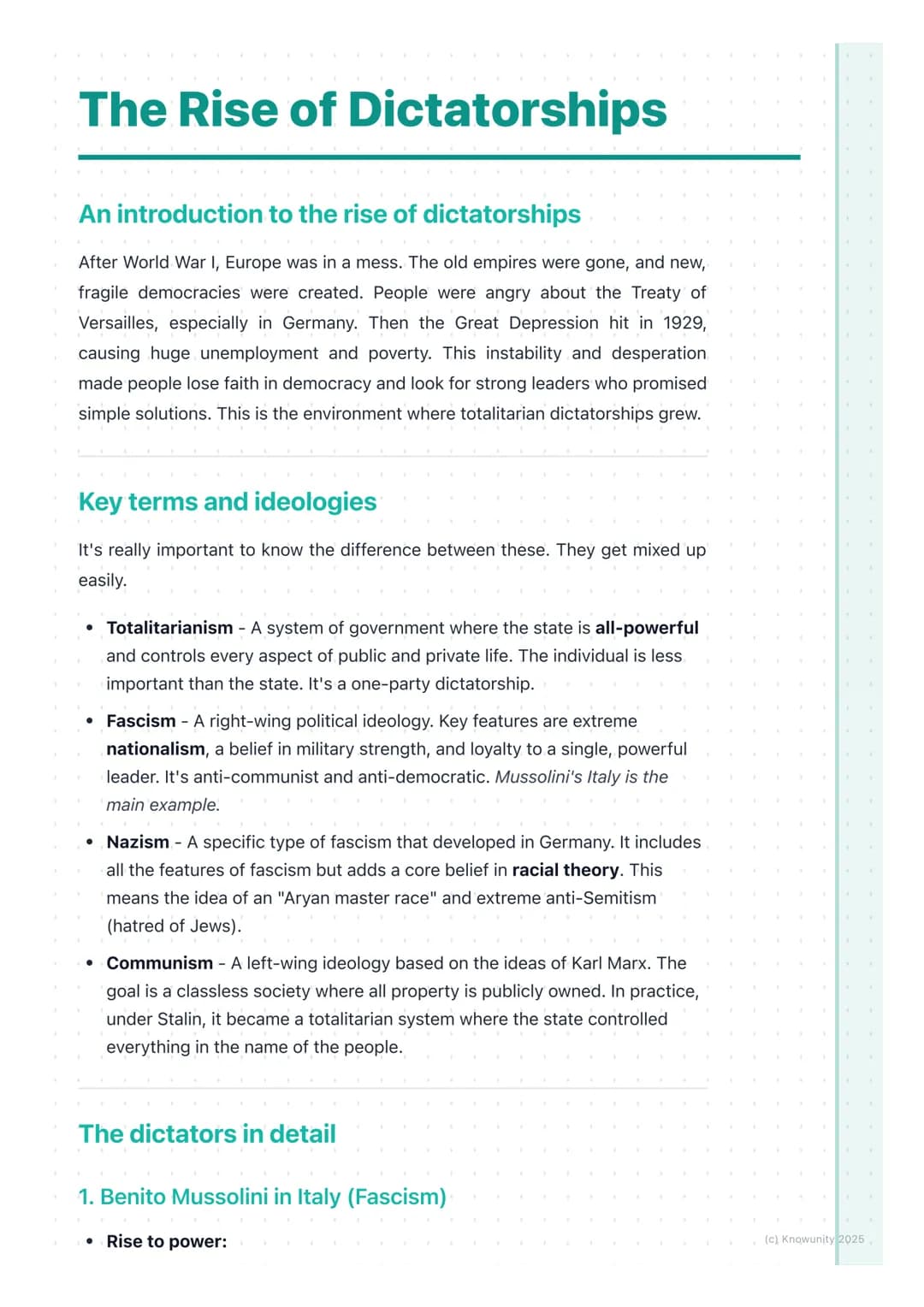
The Perfect Storm for Dictators
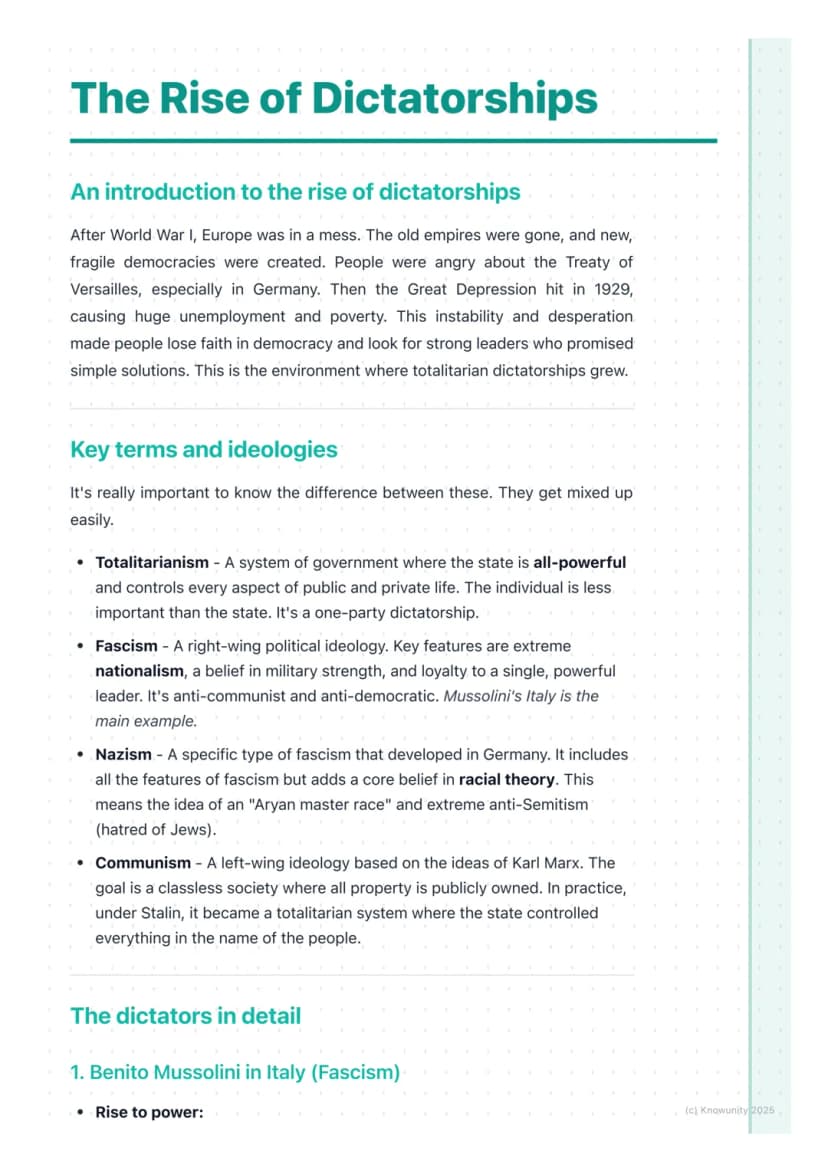
The chaos after World War I set the stage for some of history's most brutal regimes. Old empires had collapsed, leaving fragile new democracies that nobody really trusted. Germans were furious about the harsh Treaty of Versailles, which blamed them for the entire war.
Then 1929 hit like a sledgehammer. The Great Depression destroyed jobs, wiped out savings, and left millions desperate. When democracy feels like it's failing you, suddenly a strong leader promising easy answers starts looking pretty appealing.
Totalitarianism became the new nightmare - governments that controlled literally everything about your life. But don't get confused between the different types: Fascism , Nazism (fascism plus deadly racism, like Hitler's Germany), and Communism .
💡 Key Insight: These weren't random evil people - they were responding to real problems that people were facing. Understanding why people supported them initially is crucial for your essays.
2
of 6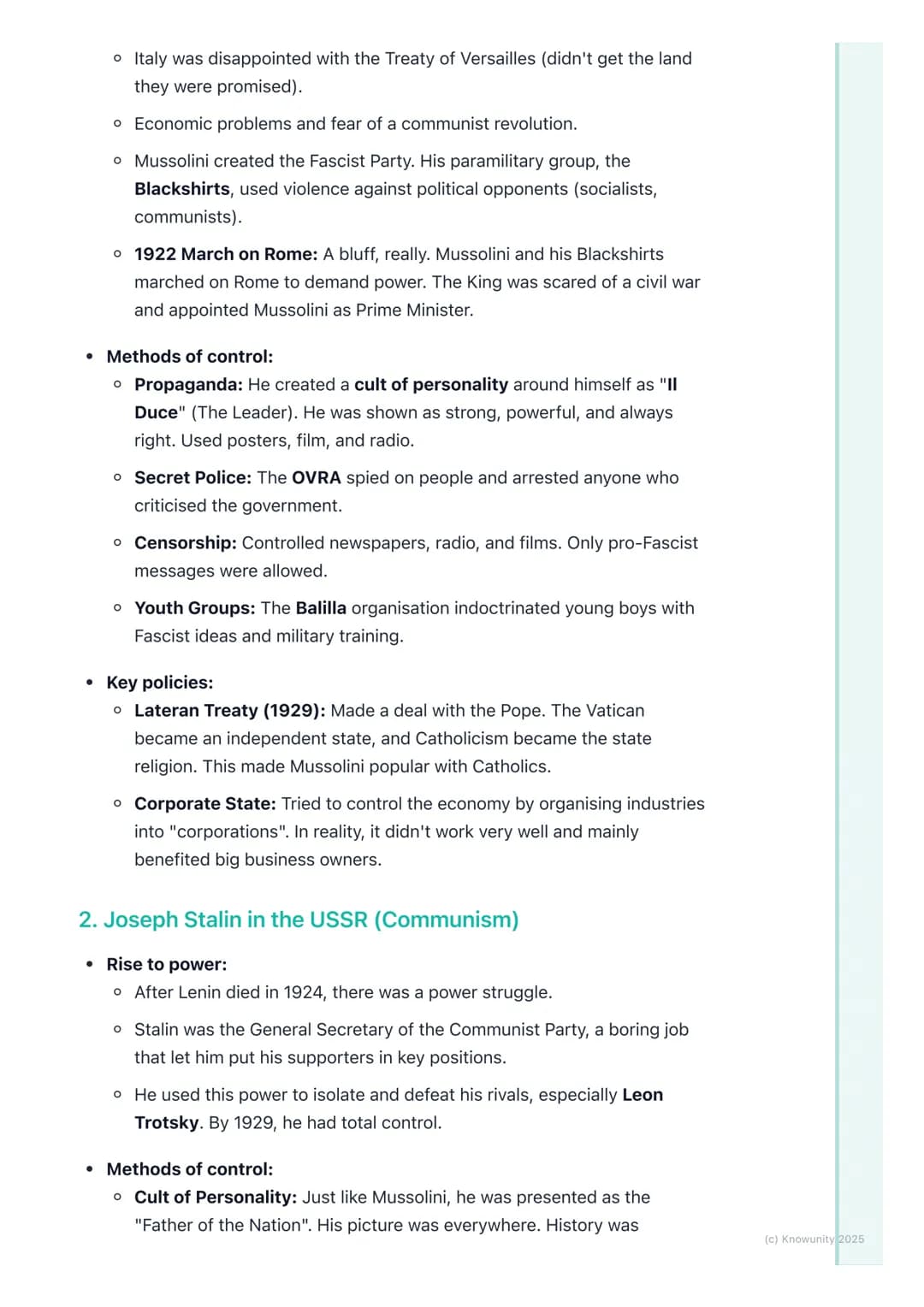
Mussolini's Italy: The First Fascist State
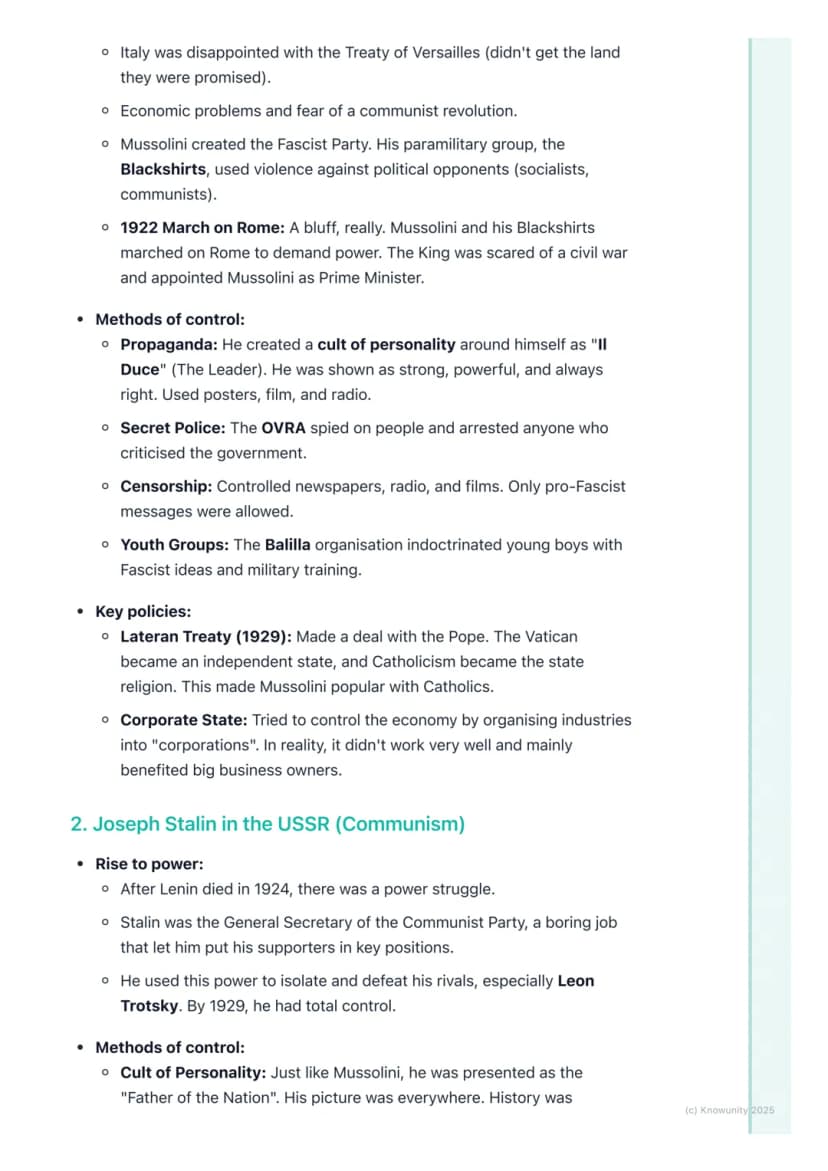
Italy felt cheated after WWI - they'd been promised land they never got, and their economy was falling apart. Enter Benito Mussolini with his black-shirted thugs who beat up anyone who disagreed with them.
His March on Rome in 1922 was basically a massive bluff. Mussolini and his Blackshirts marched on the capital demanding power, and the King panicked and just... gave it to him. Sometimes the biggest gambles pay off.
Once in power, Il Duce (The Leader) perfected the art of looking powerful. Massive propaganda campaigns painted him as Italy's saviour. His secret police, the OVRA, made sure critics stayed quiet. The Lateran Treaty with the Pope was genius politics - suddenly all the Catholics were on his side.
His Corporate State was supposed to revolutionise the economy by organising everything into state-controlled corporations. Spoiler alert: it mainly just helped rich business owners get richer whilst ordinary people struggled.
💡 Remember: Mussolini essentially created the fascist playbook that other dictators would copy and improve upon.
3
of 6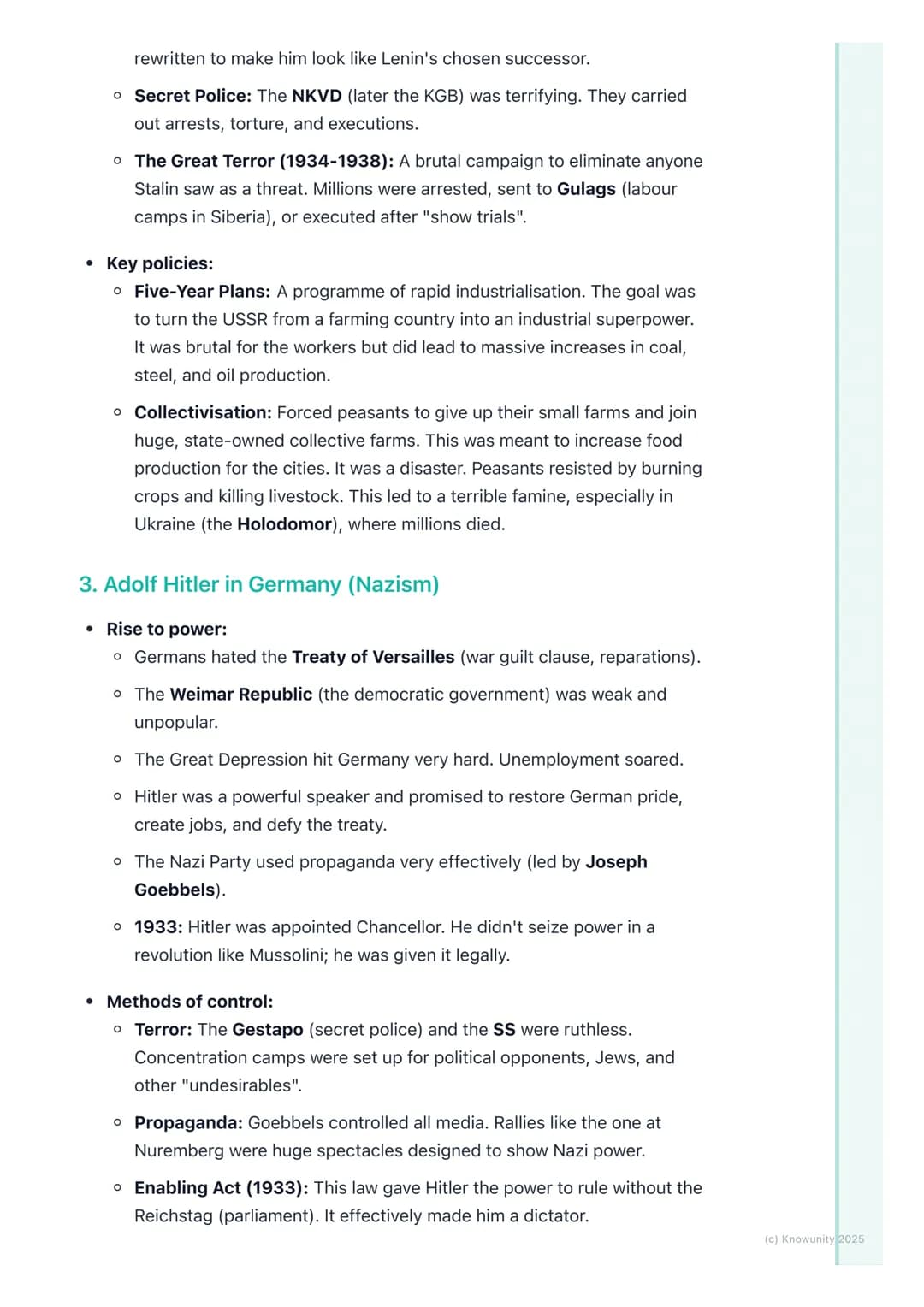
Stalin's Soviet Union: Communism Turned Deadly
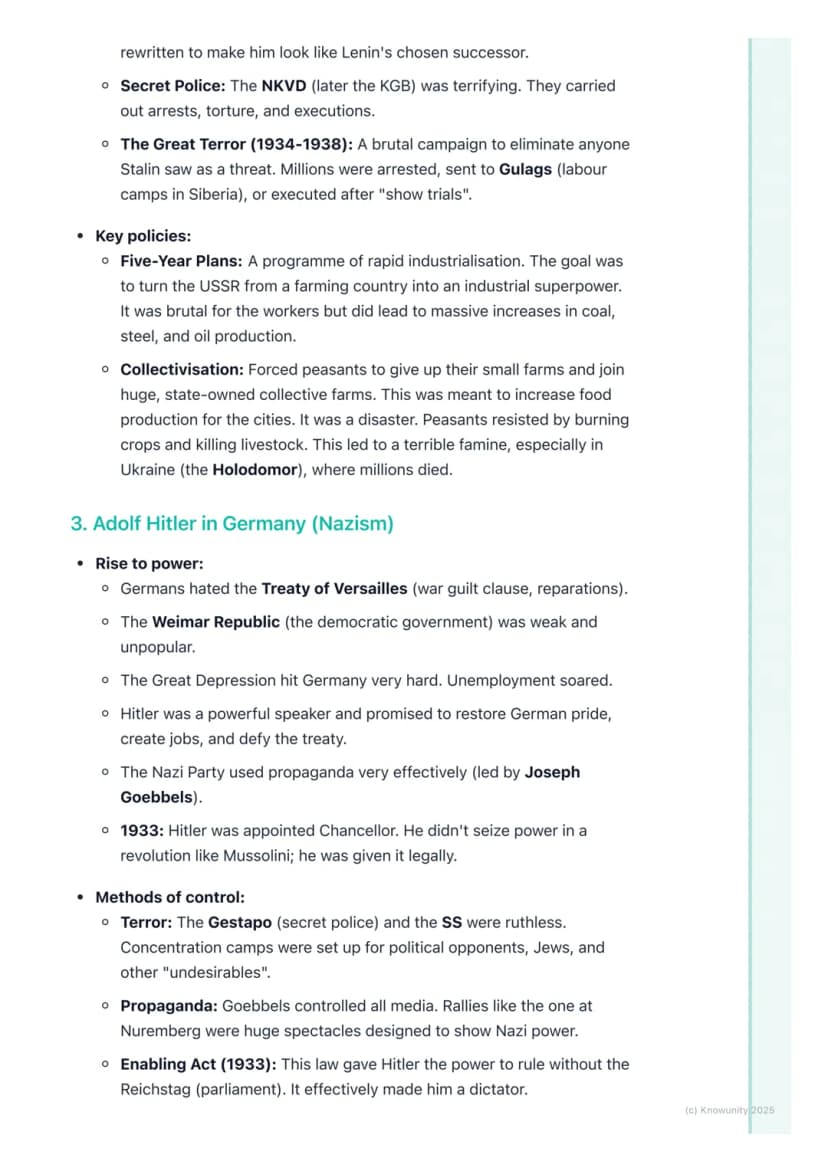
When Lenin died in 1924, Joseph Stalin seemed like the boring bureaucrat who'd never amount to much. Big mistake. As General Secretary, he quietly placed his supporters in key positions whilst his rivals fought each other publicly.
By 1929, Stalin had outmaneuvered everyone, including the brilliant Leon Trotsky. He then transformed himself into the "Father of the Nation" through relentless propaganda. Every success was his doing, every failure was sabotage by enemies.
The Great Terror (1934-1938) was when Stalin's paranoia went completely mental. Millions were arrested by the terrifying NKVD secret police, sent to Gulags in Siberia, or executed after fake trials. Even top Communist Party members weren't safe.
His economic policies were brutal but effective in some ways. The Five-Year Plans turned the USSR into an industrial powerhouse, but at enormous human cost. Collectivisation was meant to modernise farming but caused mass starvation, especially the Holodomor famine in Ukraine where millions died.
💡 Essay Tip: Stalin shows how communist ideals about equality can be twisted into something just as totalitarian as fascism.
4
of 6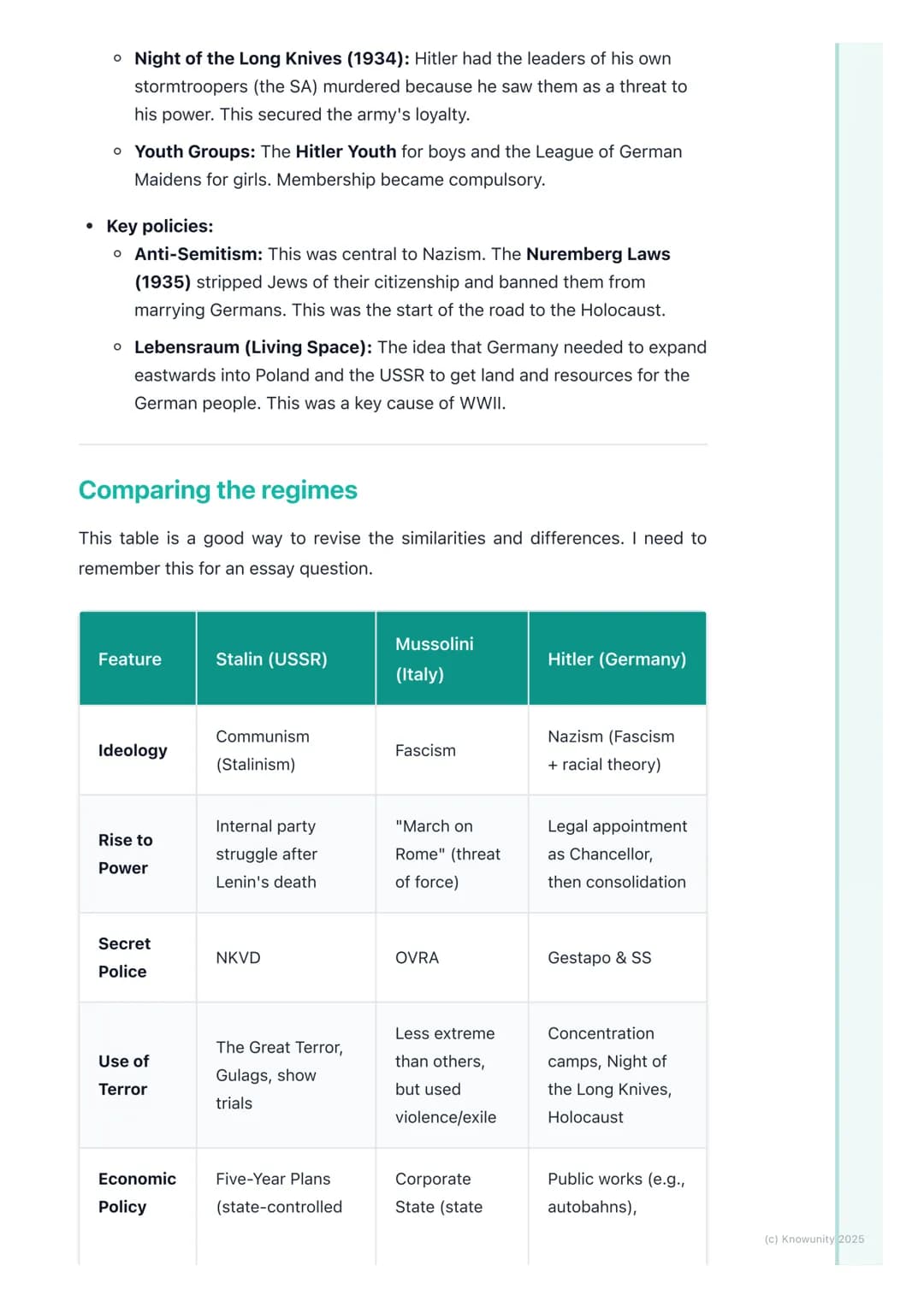
Hitler's Germany: Nazism Takes Hold
Adolf Hitler didn't seize power - he was handed it legally in 1933. Germans were still furious about Versailles, the Weimar Republic seemed useless, and the Great Depression had destroyed their economy. Hitler's promises to restore German pride struck a chord.
The Nazi Party's propaganda machine, led by Joseph Goebbels, was incredibly sophisticated. They understood that people respond to emotion more than facts. Hitler was a mesmerising speaker who told Germans exactly what they wanted to hear.
Once in power as Chancellor, Hitler moved fast. The Enabling Act gave him power to rule without parliament. The Night of the Long Knives saw him murder his own supporters who were getting too powerful. The army was impressed by this ruthlessness and pledged loyalty.
The Nuremberg Laws in 1935 were the legal start of the Holocaust, stripping Jews of citizenship and basic rights. Hitler's concept of Lebensraum (living space) meant Germany needed to expand eastward, setting up the conditions for World War II.
💡 Critical Point: Hitler's anti-Semitism wasn't just prejudice - it was a core part of Nazi ideology that would lead to genocide.
5
of 6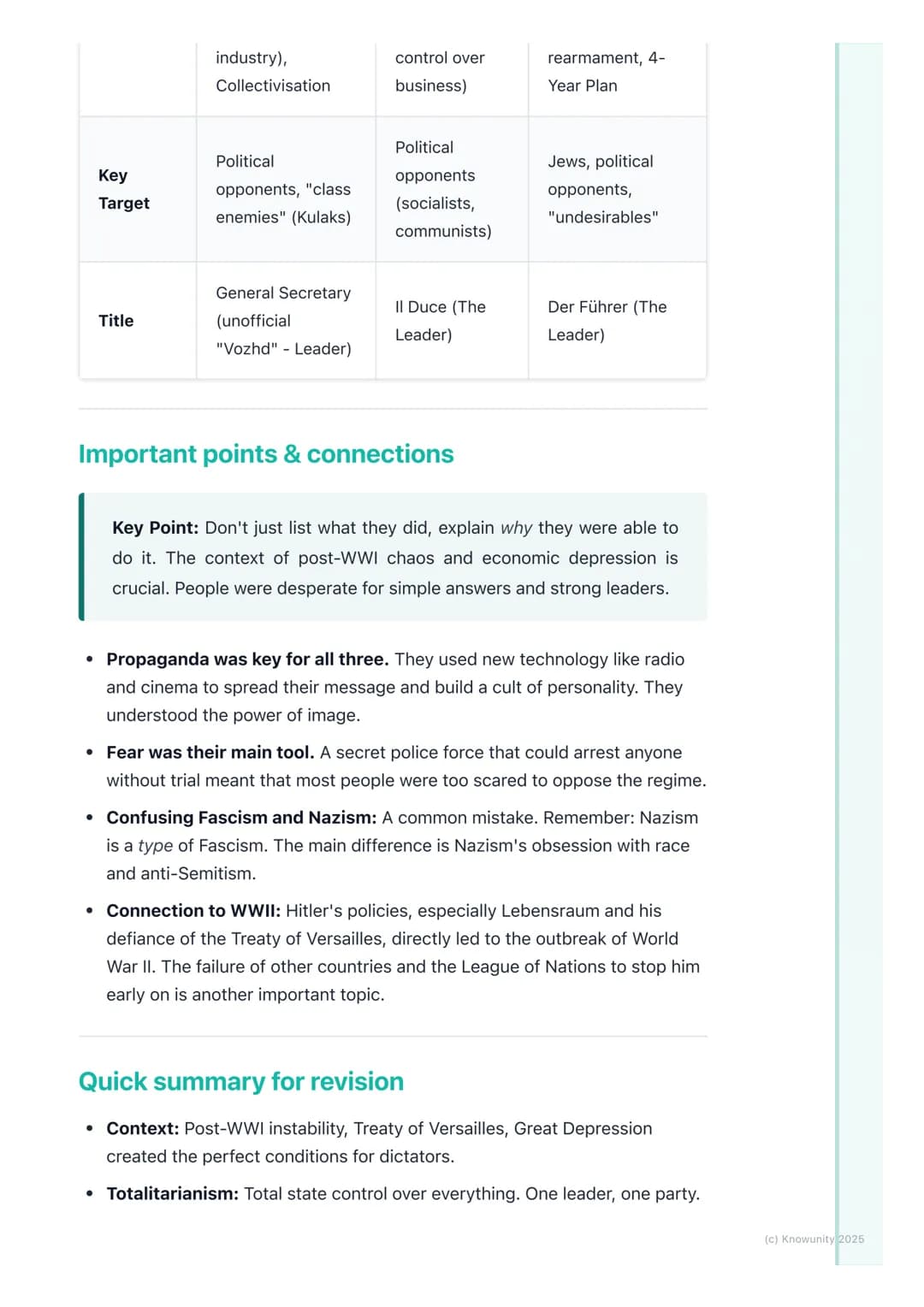
How These Dictators Controlled People
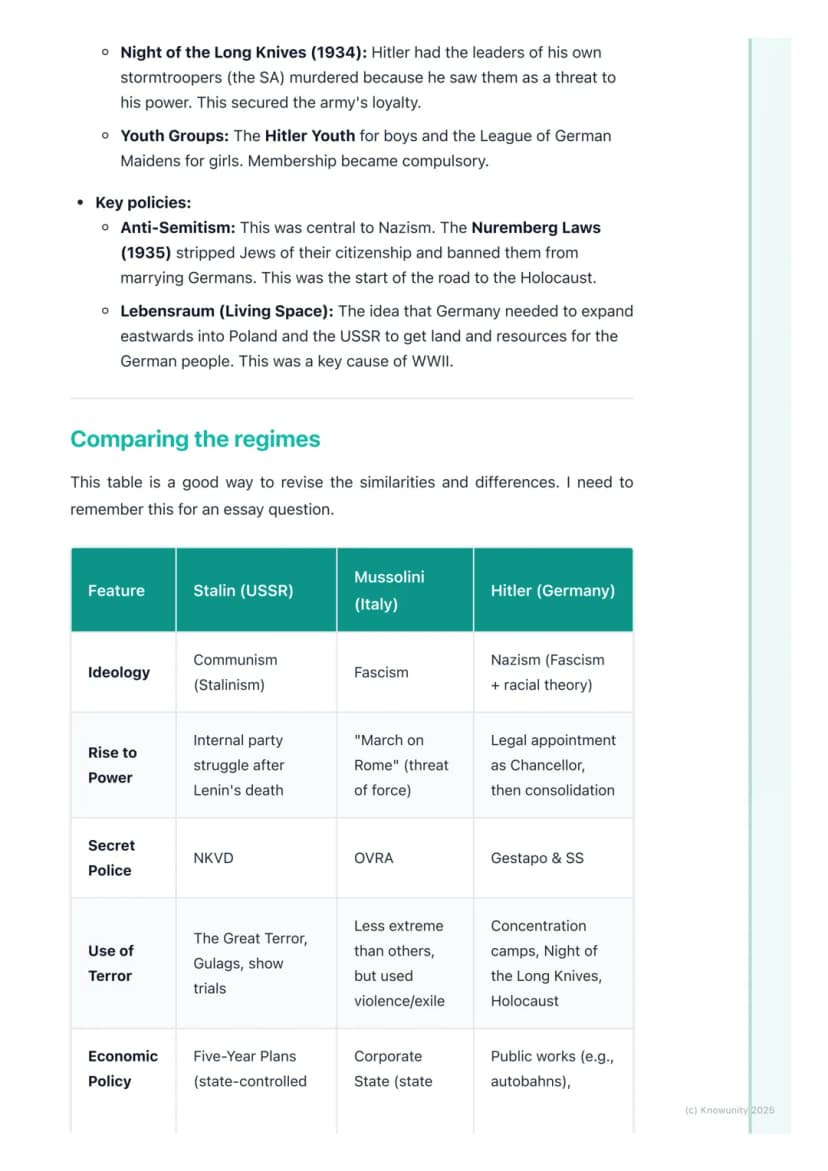
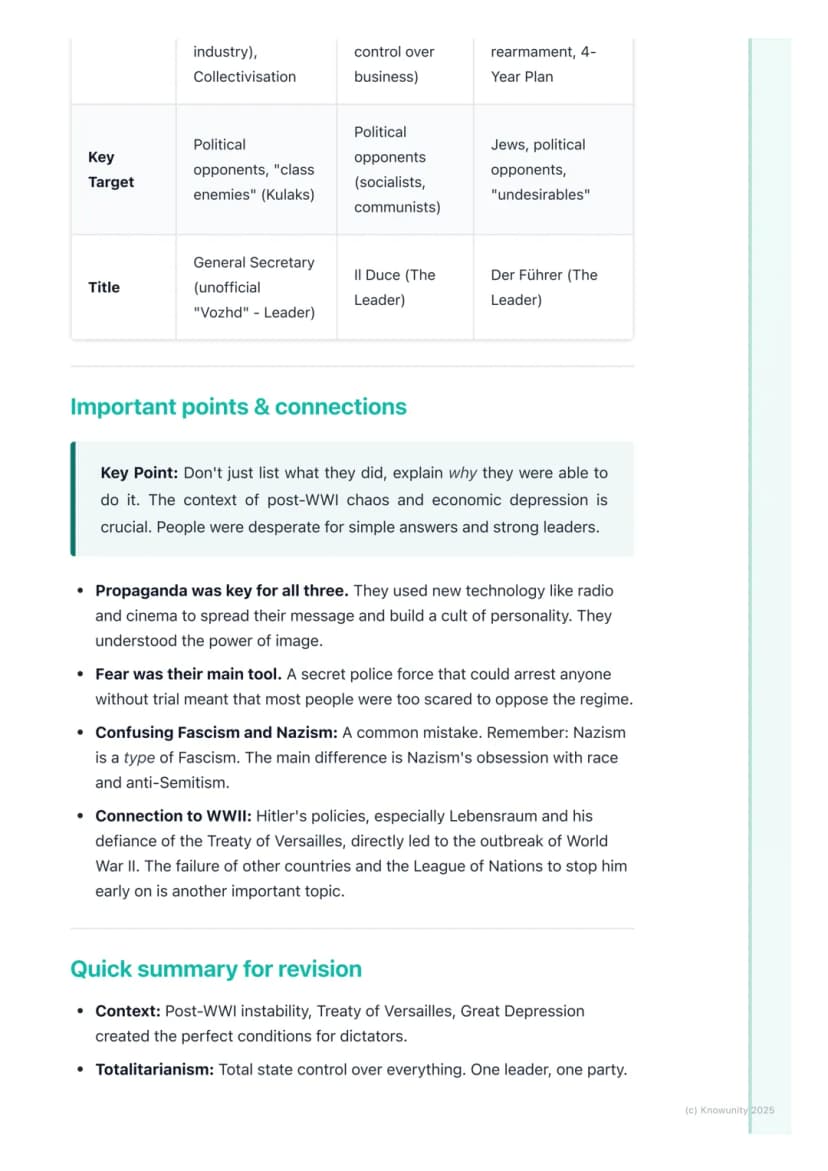
All three used remarkably similar methods to maintain power. Propaganda was their most powerful weapon - constant messages through radio, film, and massive rallies that made their leadership seem inevitable and their enemies look pathetic.
Secret police forces (NKVD, OVRA, Gestapo) created climates of fear where anyone could disappear for saying the wrong thing. Your neighbour might report you, your colleague might be a spy. This paranoia kept most people in line.
Youth organisations were crucial for long-term control. The Hitler Youth, Stalin's Young Pioneers, and Mussolini's Balilla all indoctrinated children with regime ideology. Catch them young, and you control the future.
The cult of personality around each leader was carefully constructed. They weren't just politicians - they were saviours, fathers of the nation, men of destiny. Questioning them wasn't just political opposition; it was almost blasphemy.
💡 For Exams: Don't just list their methods - explain why they worked. People were scared, desperate, and bombarded with propaganda from childhood.
6
of 6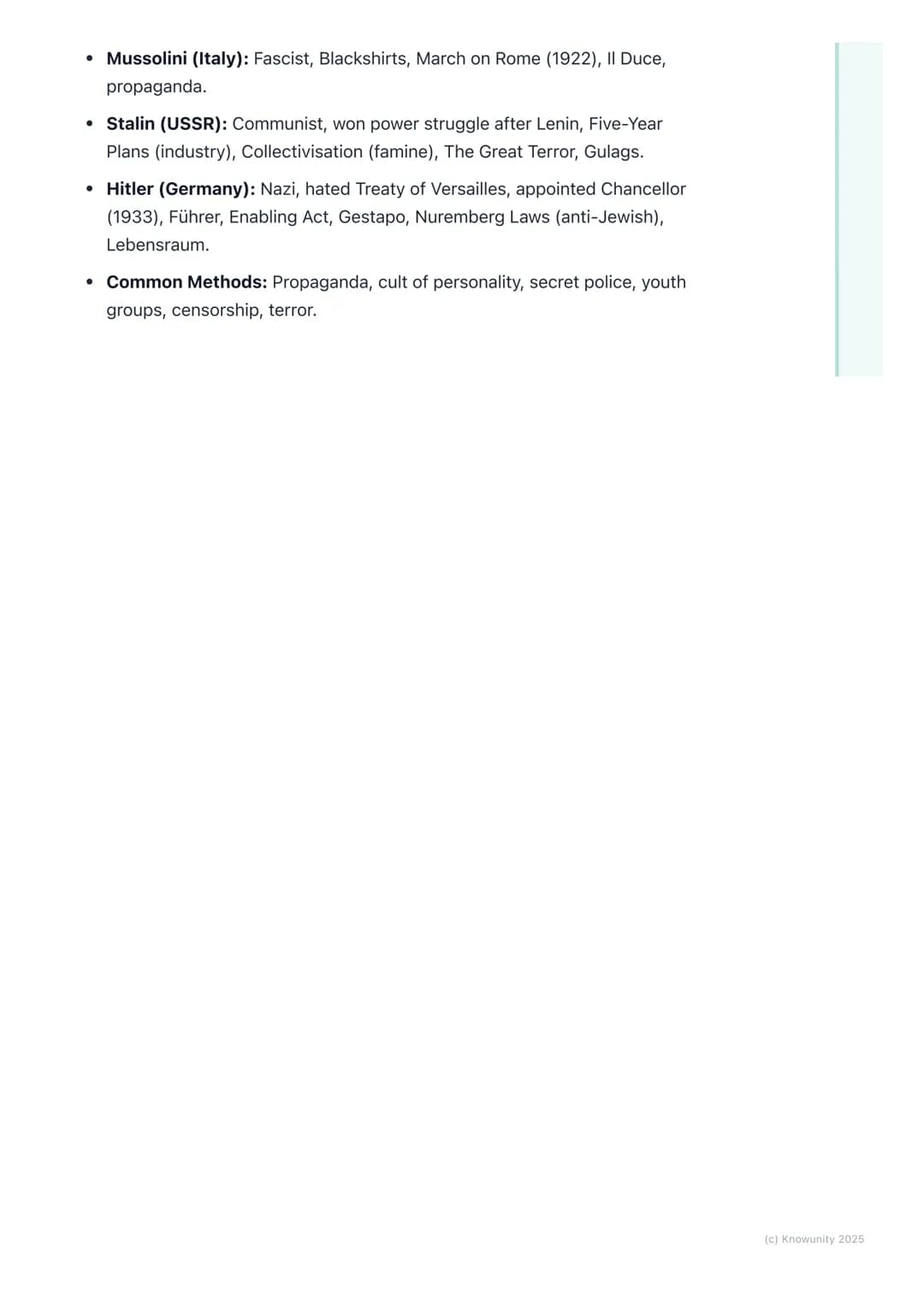
Why This Still Matters Today
Understanding these totalitarian regimes isn't just about memorising dates and names for your Leaving Cert. These dictators succeeded because they exploited real problems - economic hardship, national humiliation, social chaos - and offered simple solutions to complex problems.
The connection to World War II is direct. Hitler's Lebensraum policy and defiance of international treaties led straight to the deadliest conflict in human history. The failure of democratic nations to stop him early shows how quickly things can spiral out of control.
Key exam strategy: Focus on the context that allowed these men to rise. The post-WWI chaos, the Great Depression, and the failure of democratic governments to solve people's problems created the perfect conditions for extremism.
Remember the differences: Mussolini's fascism was about national glory, Stalin's communism became state control in the name of the people, and Hitler's Nazism added deadly racial theories to fascist nationalism. But all three used terror, propaganda, and the promise of simple solutions to complex problems.
💡 Final Tip: When writing essays, always explain the 'why' behind events. Examiners love students who can connect causes and effects rather than just listing facts.
Myśleliśmy, że nigdy nie zapytasz...
Czym jest Towarzysz AI z Knowunity?
Nasz asystent AI jest specjalnie dostosowany do potrzeb uczniów. W oparciu o miliony treści, które mamy na platformie, możemy udzielać uczniom naprawdę znaczących i trafnych odpowiedzi. Ale nie chodzi tylko o odpowiedzi, towarzysz prowadzi również uczniów przez codzienne wyzwania związane z nauką, ze spersonalizowanymi planami nauki, quizami lub treściami na czacie i 100% personalizacją opartą na umiejętnościach i rozwoju uczniów.
Gdzie mogę pobrać aplikację Knowunity?
Aplikację możesz pobrać z Google Play i Apple Store.
Czy aplikacja Knowunity naprawdę jest darmowa?
Tak, masz całkowicie darmowy dostęp do wszystkich notatek w aplikacji, możesz w każdej chwili rozmawiać z Ekspertami lub ich obserwować. Możesz użyć punktów, aby odblokować pewne funkcje w aplikacji, które również możesz otrzymać za darmo. Dodatkowo oferujemy usługę Knowunity Premium, która pozwala na odblokowanie większej liczby funkcji.
Najpopularniejsze notatki z History
9HistoryThe Great Famine (An Gorta Mór)
Students will learn about the causes, devastating impact, and long-term consequences of the potato famine on Irish population and society.
2nd Year282
HistoryThe renaissance
junior cert renaissance summary
1st Year361
HistoryCauses and Consequences of World War II
This subtopic covers the origins of the Second World War, its global scale, and its devastating human and political consequences, including the atomic bomb.
3rd Year152
HistoryThe 1798 Rebellion in Ireland
Learning about the causes, events, and aftermath of the United Irishmen's rebellion against British rule, inspired by revolutionary ideals.
3rd Year211
HistoryAmerican revolution
junior cert american revolution summary
1st Year442
HistoryThe Great Famine (An Gorta Mór)
This critical subtopic examines the causes, devastating impact, and long-term consequences of the potato famine on Irish society, population, and emigration.
3rd Year140
HistoryThe Renaissance
Students will learn about a time of 'rebirth' in Europe, where new ideas in art, science, and literature flourished.
1st Year140
History1916 Rising Revison Sheet
revision sheet
3rd Year211
HistoryThe Reformation in Europe
Students will learn about the causes and key figures of the Protestant Reformation and its impact on European society and politics.
3rd Year110
Najpopularniejsze notatki
9 Irish
IrishIrish oral questions and answers
Questions and answers for the leaving cert oral
5th Year4264
 English
Key Quotes : Sive
Key Quotes and explanations: Sive
6th Year2842
IrishIrish oral questions
Outline of oral questions
5th Year2055
IrishIníon- le hÁine Durkin
Aine Durkin’s poem, Iníon: Themes & summary
5th Year850
IrishIrish poetry 2027
Iníon + Dínit an Bhróin
5th Year1133
IrishLC HL notes- Iníon (poem)
Includes poem in English and Irish, theme, key words & phrases
5th Year2284
EnglishCultural Context : Shawshank Redemption : Sive : Small Things Like These
Comparative Study : Cultural Context : Shawshank Redemption, Sive and Small Things Like These
6th Year1430
IrishMo Ghrá-sa (Idir Lúibíní)
Notes on mo ghrá-sa
5th Year380
IrishAn Gaeilge Aiste
Irish Language essay
6th Year1320
Nie ma nic odpowiedniego? Sprawdź inne przedmioty.
Zobacz, co mówią o nas nasi użytkownicy. Pokochali nas — pokochasz też i Ty.
4.6/5App Store
4.7/5Google Play
Aplikacja jest bardzo prosta i dobrze przemyślana. Do tej pory znalazłem wszystko, czego szukałem i mogłem się wiele nauczyć z innych notatek! Na pewno wykorzystam aplikację do pomocy przy robieniu prac domowych! No i oczywiście bardzo pomaga też jako inspiracja do robienia swoich notatek.
Stefan Sużytkownik iOS
Ta aplikacja jest naprawdę świetna. Jest tak wiele notatek i pomocnych informacji [...]. Moim problematycznym przedmiotem jest język niemiecki, a w aplikacji jest w czym wybierać. Dzięki tej aplikacji poprawiłam swój niemiecki. Polecam ją każdemu.
Samantha Klichużytkownik Androida
Wow, jestem w szoku. Właśnie wypróbowałam aplikację, ponieważ widziałam ją kilka razy reklamowaną na TikToku jestem absolutnie w szoku. Ta aplikacja jest POMOCĄ, której potrzebujesz w szkole i przede wszystkim oferuje tak wiele rzeczy jak notatki czy streszczenia, które są BARDZO pomocne w moim przypadku.
Annaużytkownik iOS
History11 wyświetleń·Zaktualizowano Jun 6, 2026·6 stronyUnderstanding the Rise of Totalitarian Dictatorships
Ever wonder how some of history's most dangerous leaders gained absolute power? After World War I, Europe was a mess of broken empires, economic chaos, and desperate people looking for someone to blame. This created the perfect storm for dictators...
1
of 6
Zarejestruj się, aby zobaczyć notatkę. To nic nie kosztuje!
- Dostęp do wszystkich materiałów
- Popraw swoje oceny
- Dołącz do milionów studentów
The Perfect Storm for Dictators
The chaos after World War I set the stage for some of history's most brutal regimes. Old empires had collapsed, leaving fragile new democracies that nobody really trusted. Germans were furious about the harsh Treaty of Versailles, which blamed them for the entire war.
Then 1929 hit like a sledgehammer. The Great Depression destroyed jobs, wiped out savings, and left millions desperate. When democracy feels like it's failing you, suddenly a strong leader promising easy answers starts looking pretty appealing.
Totalitarianism became the new nightmare - governments that controlled literally everything about your life. But don't get confused between the different types: Fascism , Nazism (fascism plus deadly racism, like Hitler's Germany), and Communism .
💡 Key Insight: These weren't random evil people - they were responding to real problems that people were facing. Understanding why people supported them initially is crucial for your essays.
2
of 6Zarejestruj się, aby zobaczyć notatkę. To nic nie kosztuje!
- Dostęp do wszystkich materiałów
- Popraw swoje oceny
- Dołącz do milionów studentów
Mussolini's Italy: The First Fascist State
Italy felt cheated after WWI - they'd been promised land they never got, and their economy was falling apart. Enter Benito Mussolini with his black-shirted thugs who beat up anyone who disagreed with them.
His March on Rome in 1922 was basically a massive bluff. Mussolini and his Blackshirts marched on the capital demanding power, and the King panicked and just... gave it to him. Sometimes the biggest gambles pay off.
Once in power, Il Duce (The Leader) perfected the art of looking powerful. Massive propaganda campaigns painted him as Italy's saviour. His secret police, the OVRA, made sure critics stayed quiet. The Lateran Treaty with the Pope was genius politics - suddenly all the Catholics were on his side.
His Corporate State was supposed to revolutionise the economy by organising everything into state-controlled corporations. Spoiler alert: it mainly just helped rich business owners get richer whilst ordinary people struggled.
💡 Remember: Mussolini essentially created the fascist playbook that other dictators would copy and improve upon.
3
of 6Zarejestruj się, aby zobaczyć notatkę. To nic nie kosztuje!
- Dostęp do wszystkich materiałów
- Popraw swoje oceny
- Dołącz do milionów studentów
Stalin's Soviet Union: Communism Turned Deadly
When Lenin died in 1924, Joseph Stalin seemed like the boring bureaucrat who'd never amount to much. Big mistake. As General Secretary, he quietly placed his supporters in key positions whilst his rivals fought each other publicly.
By 1929, Stalin had outmaneuvered everyone, including the brilliant Leon Trotsky. He then transformed himself into the "Father of the Nation" through relentless propaganda. Every success was his doing, every failure was sabotage by enemies.
The Great Terror (1934-1938) was when Stalin's paranoia went completely mental. Millions were arrested by the terrifying NKVD secret police, sent to Gulags in Siberia, or executed after fake trials. Even top Communist Party members weren't safe.
His economic policies were brutal but effective in some ways. The Five-Year Plans turned the USSR into an industrial powerhouse, but at enormous human cost. Collectivisation was meant to modernise farming but caused mass starvation, especially the Holodomor famine in Ukraine where millions died.
💡 Essay Tip: Stalin shows how communist ideals about equality can be twisted into something just as totalitarian as fascism.
4
of 6Zarejestruj się, aby zobaczyć notatkę. To nic nie kosztuje!
- Dostęp do wszystkich materiałów
- Popraw swoje oceny
- Dołącz do milionów studentów
Hitler's Germany: Nazism Takes Hold
Adolf Hitler didn't seize power - he was handed it legally in 1933. Germans were still furious about Versailles, the Weimar Republic seemed useless, and the Great Depression had destroyed their economy. Hitler's promises to restore German pride struck a chord.
The Nazi Party's propaganda machine, led by Joseph Goebbels, was incredibly sophisticated. They understood that people respond to emotion more than facts. Hitler was a mesmerising speaker who told Germans exactly what they wanted to hear.
Once in power as Chancellor, Hitler moved fast. The Enabling Act gave him power to rule without parliament. The Night of the Long Knives saw him murder his own supporters who were getting too powerful. The army was impressed by this ruthlessness and pledged loyalty.
The Nuremberg Laws in 1935 were the legal start of the Holocaust, stripping Jews of citizenship and basic rights. Hitler's concept of Lebensraum (living space) meant Germany needed to expand eastward, setting up the conditions for World War II.
💡 Critical Point: Hitler's anti-Semitism wasn't just prejudice - it was a core part of Nazi ideology that would lead to genocide.
5
of 6Zarejestruj się, aby zobaczyć notatkę. To nic nie kosztuje!
- Dostęp do wszystkich materiałów
- Popraw swoje oceny
- Dołącz do milionów studentów
How These Dictators Controlled People
All three used remarkably similar methods to maintain power. Propaganda was their most powerful weapon - constant messages through radio, film, and massive rallies that made their leadership seem inevitable and their enemies look pathetic.
Secret police forces (NKVD, OVRA, Gestapo) created climates of fear where anyone could disappear for saying the wrong thing. Your neighbour might report you, your colleague might be a spy. This paranoia kept most people in line.
Youth organisations were crucial for long-term control. The Hitler Youth, Stalin's Young Pioneers, and Mussolini's Balilla all indoctrinated children with regime ideology. Catch them young, and you control the future.
The cult of personality around each leader was carefully constructed. They weren't just politicians - they were saviours, fathers of the nation, men of destiny. Questioning them wasn't just political opposition; it was almost blasphemy.
💡 For Exams: Don't just list their methods - explain why they worked. People were scared, desperate, and bombarded with propaganda from childhood.
6
of 6Zarejestruj się, aby zobaczyć notatkę. To nic nie kosztuje!
- Dostęp do wszystkich materiałów
- Popraw swoje oceny
- Dołącz do milionów studentów
Why This Still Matters Today
Understanding these totalitarian regimes isn't just about memorising dates and names for your Leaving Cert. These dictators succeeded because they exploited real problems - economic hardship, national humiliation, social chaos - and offered simple solutions to complex problems.
The connection to World War II is direct. Hitler's Lebensraum policy and defiance of international treaties led straight to the deadliest conflict in human history. The failure of democratic nations to stop him early shows how quickly things can spiral out of control.
Key exam strategy: Focus on the context that allowed these men to rise. The post-WWI chaos, the Great Depression, and the failure of democratic governments to solve people's problems created the perfect conditions for extremism.
Remember the differences: Mussolini's fascism was about national glory, Stalin's communism became state control in the name of the people, and Hitler's Nazism added deadly racial theories to fascist nationalism. But all three used terror, propaganda, and the promise of simple solutions to complex problems.
💡 Final Tip: When writing essays, always explain the 'why' behind events. Examiners love students who can connect causes and effects rather than just listing facts.
Myśleliśmy, że nigdy nie zapytasz...
Czym jest Towarzysz AI z Knowunity?
Nasz asystent AI jest specjalnie dostosowany do potrzeb uczniów. W oparciu o miliony treści, które mamy na platformie, możemy udzielać uczniom naprawdę znaczących i trafnych odpowiedzi. Ale nie chodzi tylko o odpowiedzi, towarzysz prowadzi również uczniów przez codzienne wyzwania związane z nauką, ze spersonalizowanymi planami nauki, quizami lub treściami na czacie i 100% personalizacją opartą na umiejętnościach i rozwoju uczniów.
Gdzie mogę pobrać aplikację Knowunity?
Aplikację możesz pobrać z Google Play i Apple Store.
Czy aplikacja Knowunity naprawdę jest darmowa?
Tak, masz całkowicie darmowy dostęp do wszystkich notatek w aplikacji, możesz w każdej chwili rozmawiać z Ekspertami lub ich obserwować. Możesz użyć punktów, aby odblokować pewne funkcje w aplikacji, które również możesz otrzymać za darmo. Dodatkowo oferujemy usługę Knowunity Premium, która pozwala na odblokowanie większej liczby funkcji.
Najpopularniejsze notatki z History
9HistoryThe Great Famine (An Gorta Mór)
Students will learn about the causes, devastating impact, and long-term consequences of the potato famine on Irish population and society.
2nd Year282
HistoryThe renaissance
junior cert renaissance summary
1st Year361
HistoryCauses and Consequences of World War II
This subtopic covers the origins of the Second World War, its global scale, and its devastating human and political consequences, including the atomic bomb.
3rd Year152
HistoryThe 1798 Rebellion in Ireland
Learning about the causes, events, and aftermath of the United Irishmen's rebellion against British rule, inspired by revolutionary ideals.
3rd Year211
HistoryAmerican revolution
junior cert american revolution summary
1st Year442
HistoryThe Great Famine (An Gorta Mór)
This critical subtopic examines the causes, devastating impact, and long-term consequences of the potato famine on Irish society, population, and emigration.
3rd Year140
HistoryThe Renaissance
Students will learn about a time of 'rebirth' in Europe, where new ideas in art, science, and literature flourished.
1st Year140
History1916 Rising Revison Sheet
revision sheet
3rd Year211
HistoryThe Reformation in Europe
Students will learn about the causes and key figures of the Protestant Reformation and its impact on European society and politics.
3rd Year110
Najpopularniejsze notatki
9IrishIrish oral questions and answers
Questions and answers for the leaving cert oral
5th Year4264
EnglishKey Quotes : Sive
Key Quotes and explanations: Sive
6th Year2842
IrishIrish oral questions
Outline of oral questions
5th Year2055
IrishIníon- le hÁine Durkin
Aine Durkin’s poem, Iníon: Themes & summary
5th Year850
IrishIrish poetry 2027
Iníon + Dínit an Bhróin
5th Year1133
IrishLC HL notes- Iníon (poem)
Includes poem in English and Irish, theme, key words & phrases
5th Year2284
EnglishCultural Context : Shawshank Redemption : Sive : Small Things Like These
Comparative Study : Cultural Context : Shawshank Redemption, Sive and Small Things Like These
6th Year1430
IrishMo Ghrá-sa (Idir Lúibíní)
Notes on mo ghrá-sa
5th Year380
IrishAn Gaeilge Aiste
Irish Language essay
6th Year1320
Nie ma nic odpowiedniego? Sprawdź inne przedmioty.
Zobacz, co mówią o nas nasi użytkownicy. Pokochali nas — pokochasz też i Ty.
4.6/5App Store
4.7/5Google Play
Aplikacja jest bardzo prosta i dobrze przemyślana. Do tej pory znalazłem wszystko, czego szukałem i mogłem się wiele nauczyć z innych notatek! Na pewno wykorzystam aplikację do pomocy przy robieniu prac domowych! No i oczywiście bardzo pomaga też jako inspiracja do robienia swoich notatek.
Stefan Sużytkownik iOS
Ta aplikacja jest naprawdę świetna. Jest tak wiele notatek i pomocnych informacji [...]. Moim problematycznym przedmiotem jest język niemiecki, a w aplikacji jest w czym wybierać. Dzięki tej aplikacji poprawiłam swój niemiecki. Polecam ją każdemu.
Samantha Klichużytkownik Androida
Wow, jestem w szoku. Właśnie wypróbowałam aplikację, ponieważ widziałam ją kilka razy reklamowaną na TikToku jestem absolutnie w szoku. Ta aplikacja jest POMOCĄ, której potrzebujesz w szkole i przede wszystkim oferuje tak wiele rzeczy jak notatki czy streszczenia, które są BARDZO pomocne w moim przypadku.
Annaużytkownik iOS