
Writing personal letters and emails in Irish is a key...
 Irish3 wyświetleń·Zaktualizowano Jun 3, 2026·6 strony
Conas Litreacha agus Ríomhphoist Phearsanta a Scríobh
1 / 6
1
of 6
Getting Started with Personal Letters and Emails
Ever wondered how to write to your mate in Irish without sounding like a robot? Personal letters and emails in Irish are called neamhfhoirmiúil (informal), and they're totally different from formal business letters.
The key is getting the structure right. Every litir phearsanta (personal letter) follows the same pattern, and once you nail this, you're sorted for the exam. Think of it like a template that you can adapt for any situation.
💡 Exam Tip: Learn the basic structure off by heart - it's easy marks waiting for you!
For emails, you can skip some parts like your address, but the friendly tone stays exactly the same. The examiners want to see that you can chat naturally in Irish whilst showing off your grammar skills.
2
of 6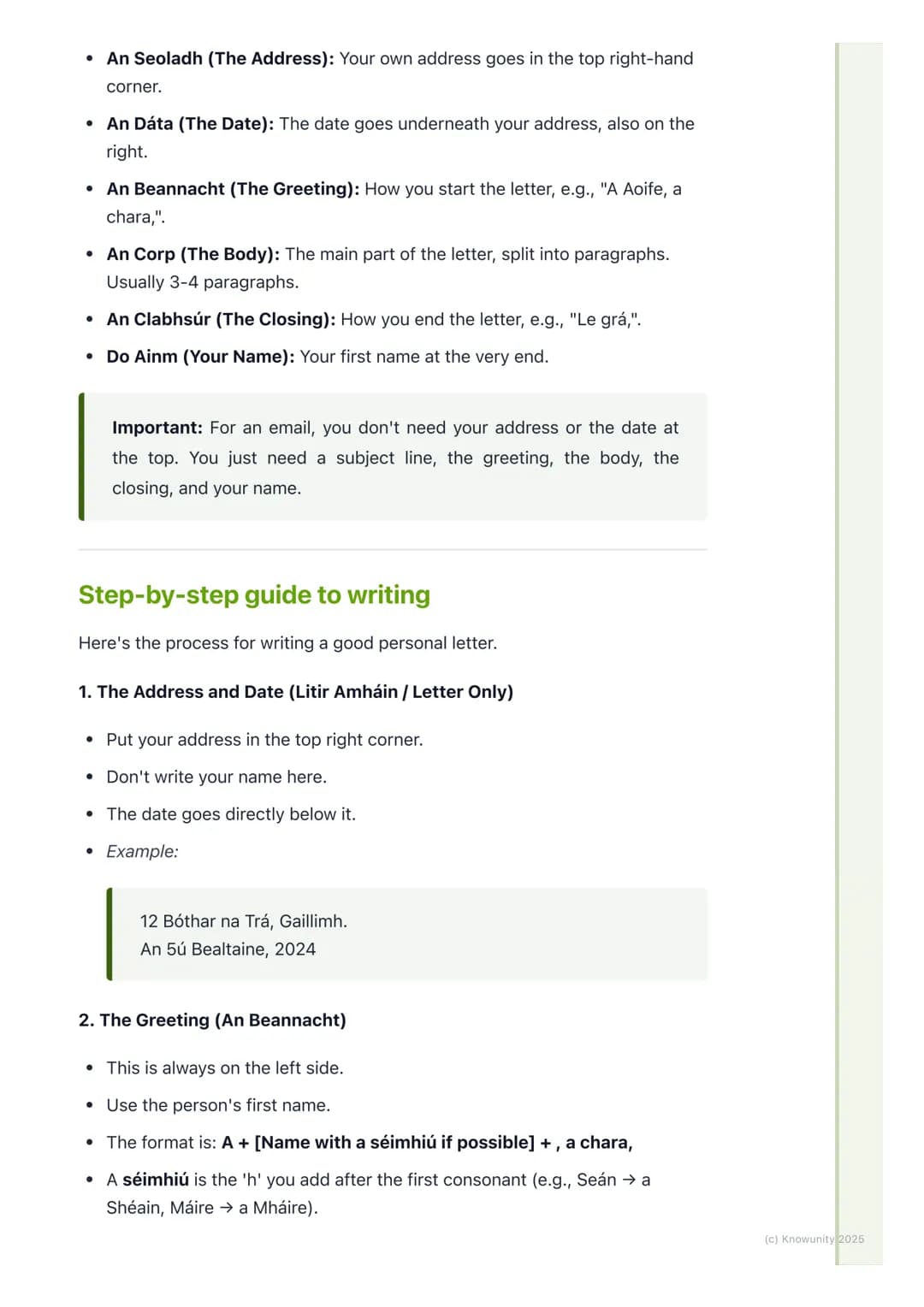
The Essential Structure You Need to Know
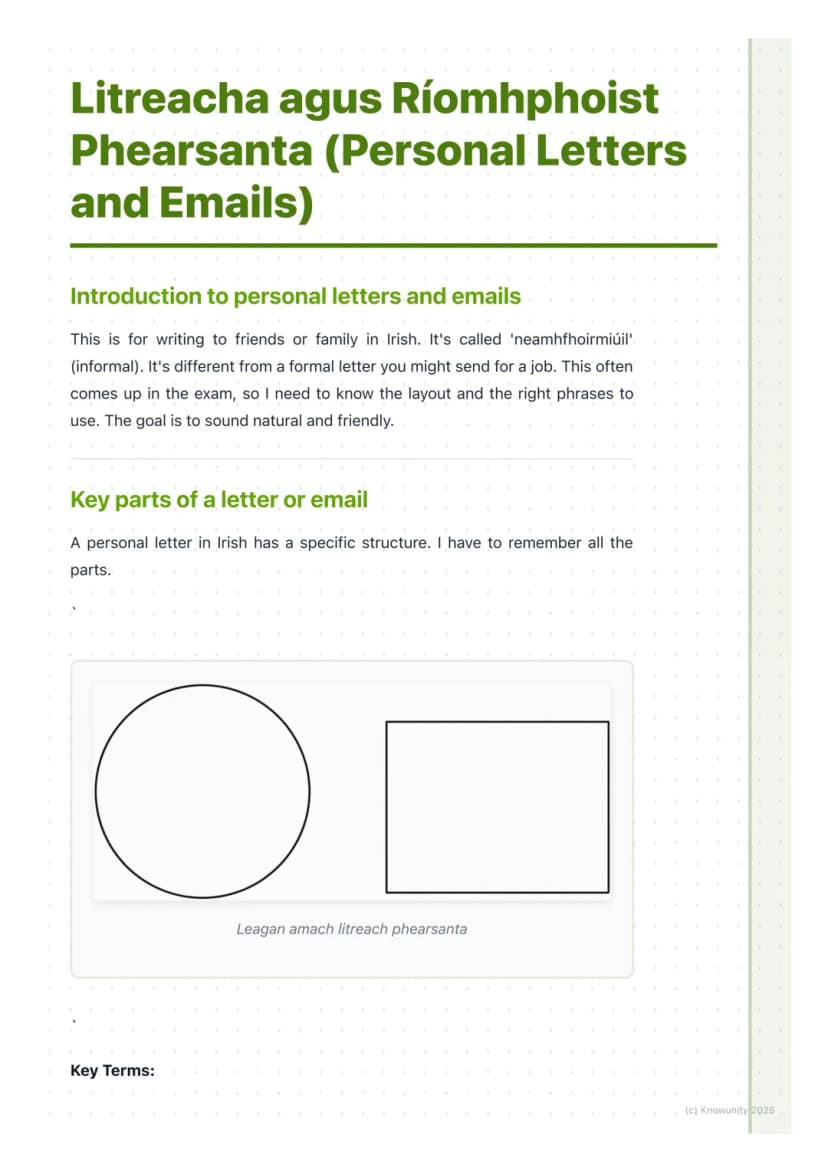
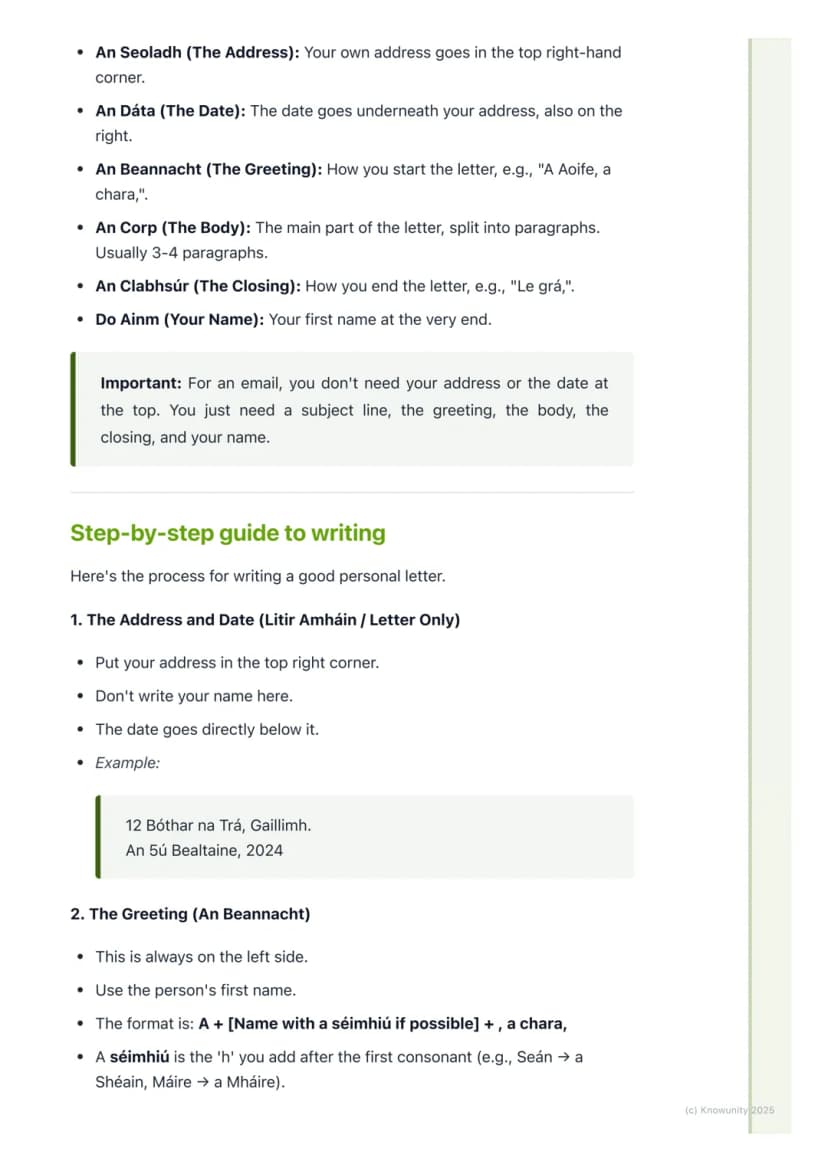
Your leagan amach litreach phearsanta (personal letter layout) has six main parts that never change. An seoladh (your address) goes top right, followed by an dáta (the date) just underneath it.
Then comes an beannacht (the greeting) on the left - this is where that tricky séimhiú comes in. You write "A" plus their name with an 'h' added: "A Shéain, a chara" or "A Mháire, a chara". If their name starts with a vowel or L, N, R, you don't add the 'h'.
An corp (the body) is your main content in 3-4 paragraphs. Finally, an clabhsúr (the closing) goes on the right with phrases like "Le grá," followed by do ainm (your first name).
💡 Quick Check: For emails, you only need a subject line, greeting, body, closing, and your name - much simpler!
Remember to put your address and date on the right, greeting on the left, and closing back on the right. This layout pattern is crucial for full marks.
3
of 6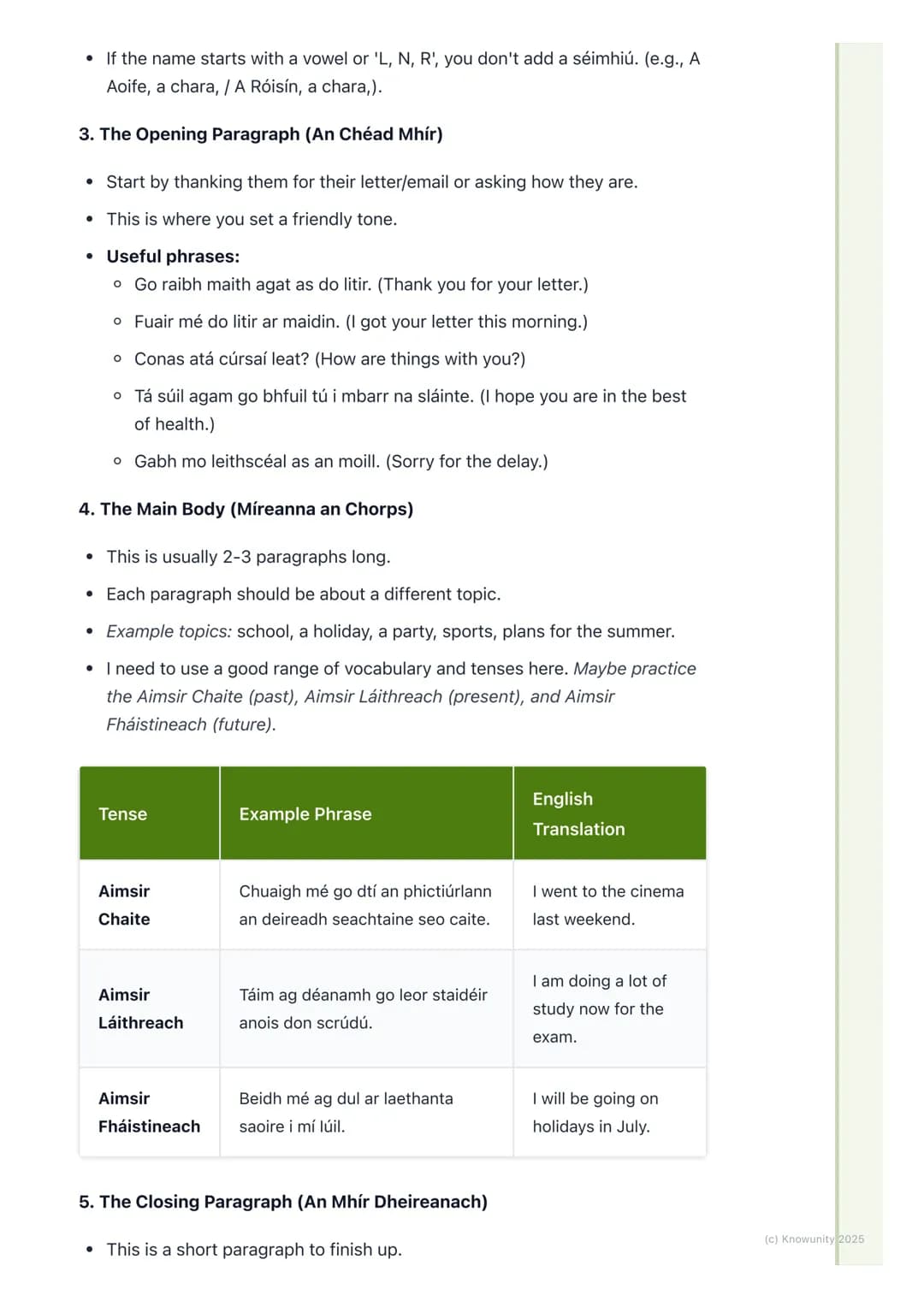
Writing Your Content Like a Pro
Start your opening paragraph by thanking them or asking how they are. Phrases like "Go raibh maith agat as do litir" (thanks for your letter) or "Conas atá cúrsaí leat?" (how are things?) work perfectly every time.
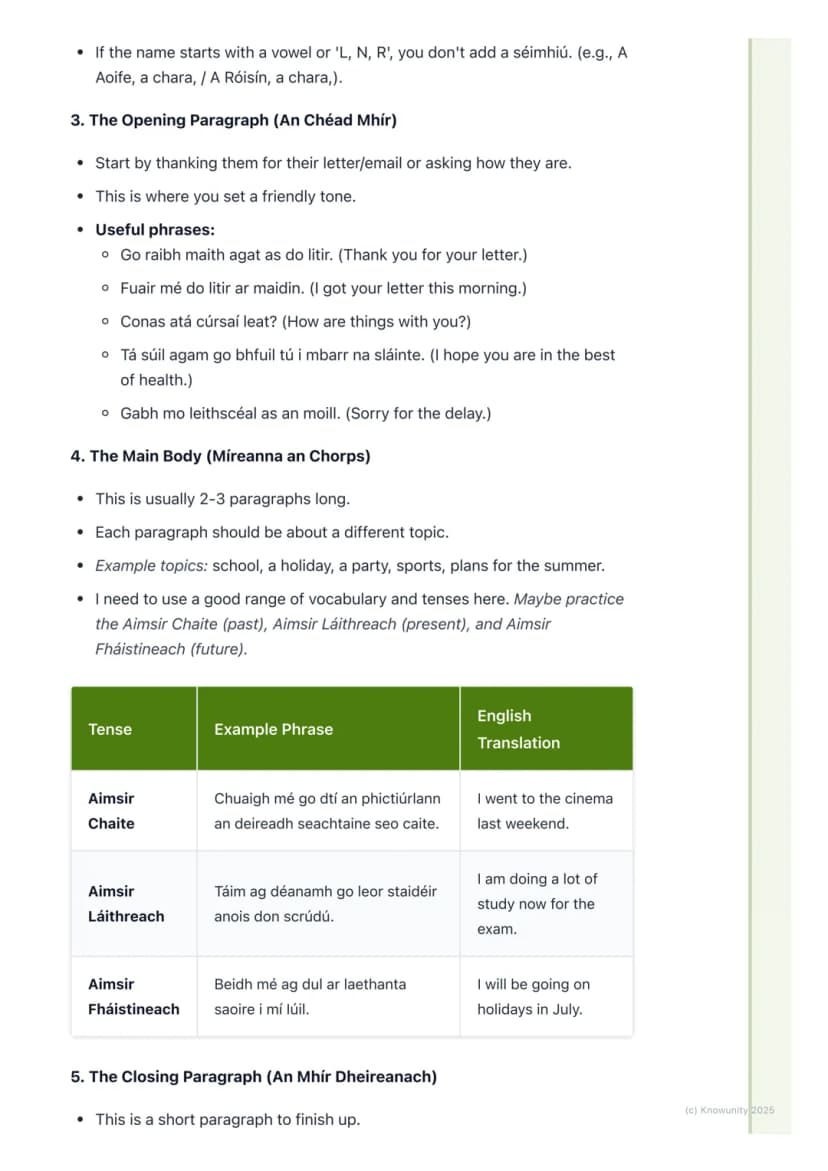
Your main body needs 2-3 paragraphs covering different topics - maybe school, holidays, or weekend plans. This is where you show off different tenses: Aimsir Chaite (past), Aimsir Láithreach (present), and Aimsir Fháistineach (future).
Mix up your sentences with examples like "Chuaigh mé go dtí an phictiúrlann" (I went to the cinema) for past, "Táim ag déanamh staidéir" (I'm studying) for present, and "Beidh mé ag dul ar laethanta saoire" (I'll be going on holidays) for future.
💡 Variety is Key: Using different tenses shows the examiners you're comfortable with Irish grammar!
End with a short closing paragraph asking them to write back: "Scríobh ar ais chugam go luath" (write back to me soon) keeps things friendly and natural.
4
of 6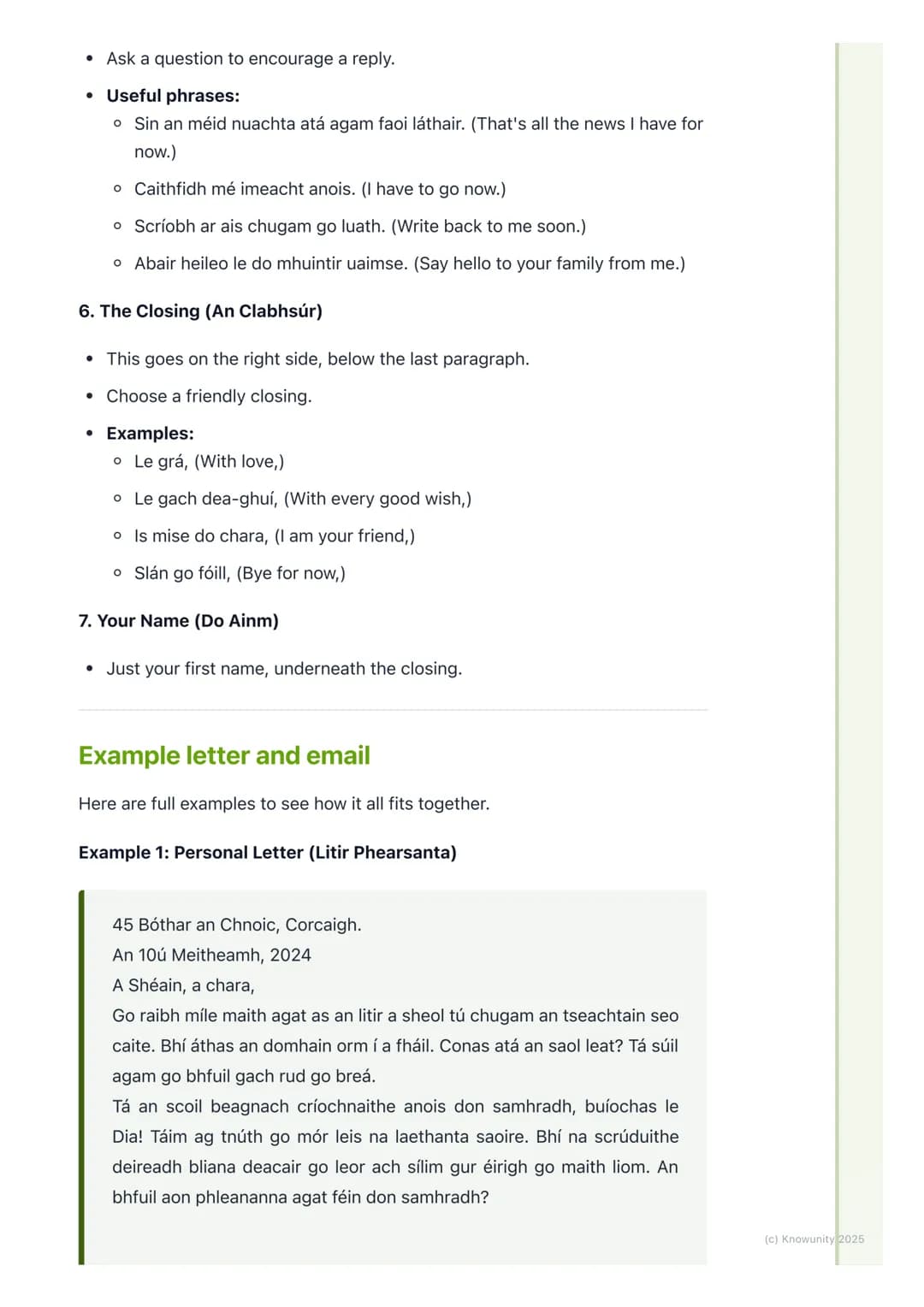
Real Examples That Actually Work
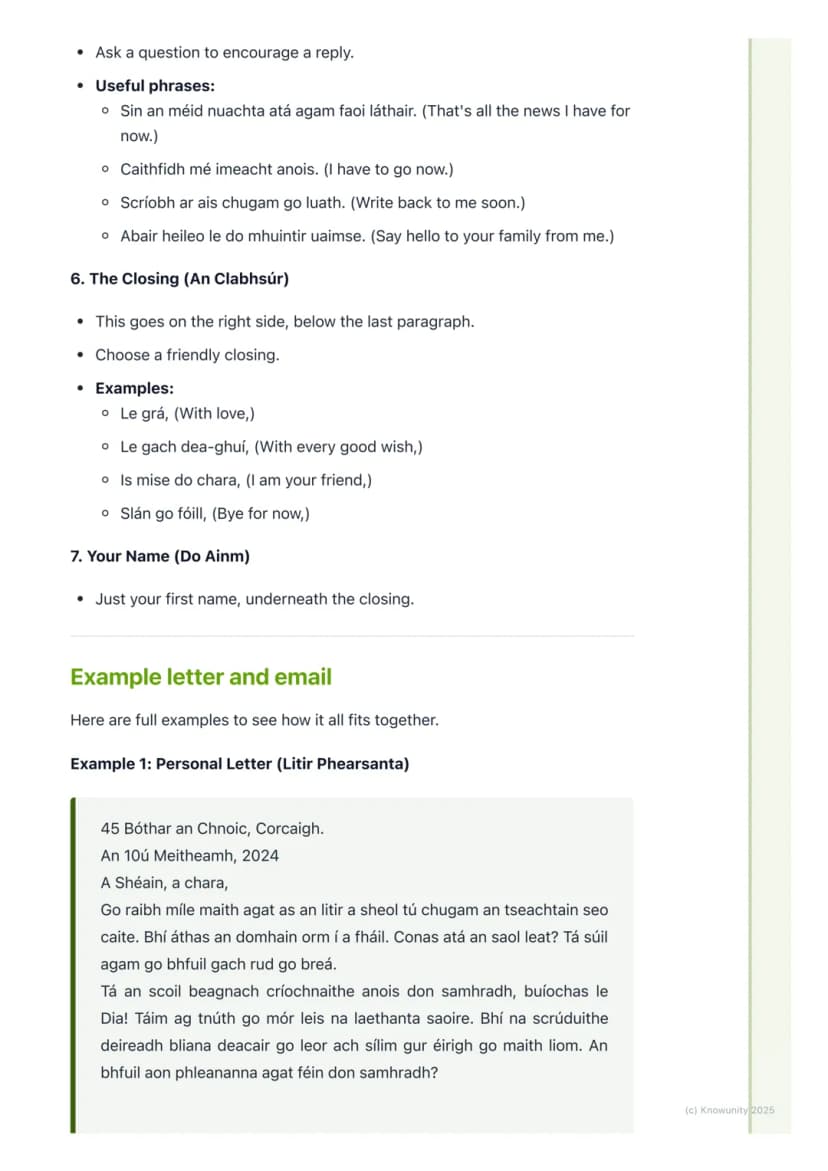
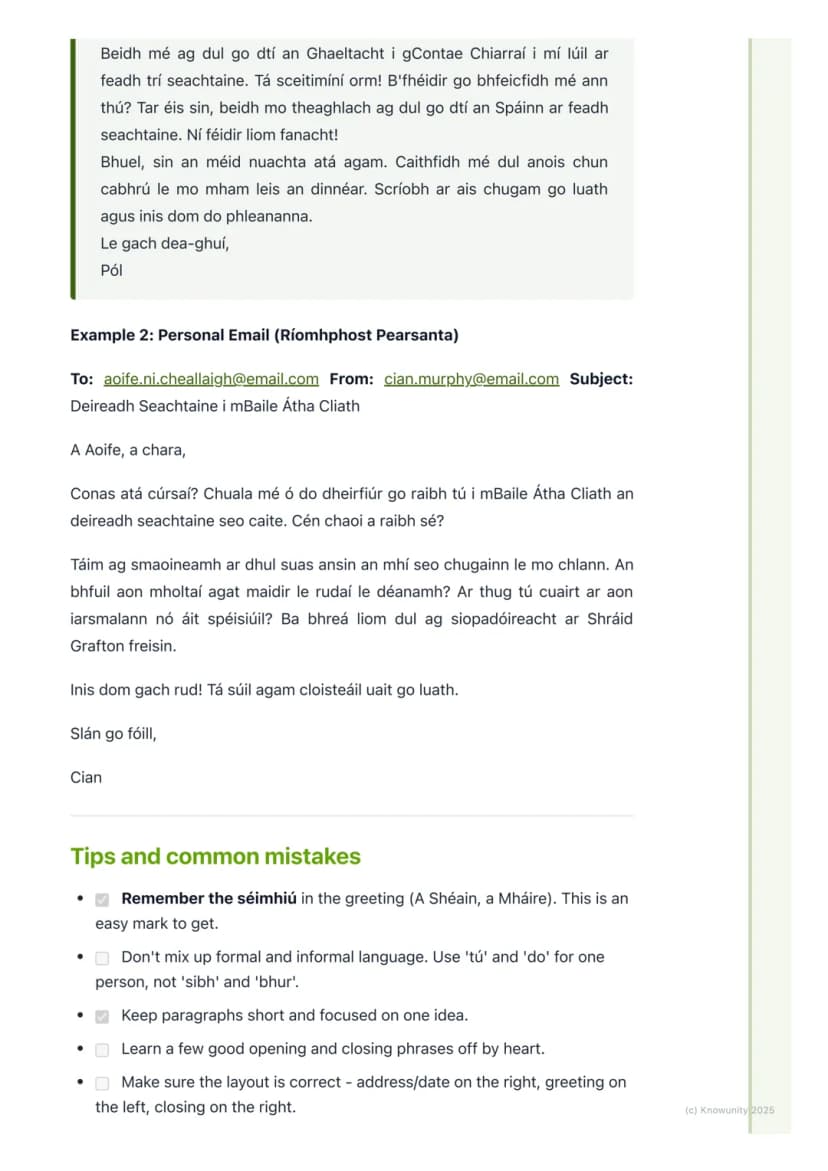
Here's how it looks in practice. Your litir phearsanta might start: "45 Bóthar an Chnoic, Corcaigh. An 10ú Meitheamh, 2024. A Shéain, a chara, Go raibh míle maith agat as an litir..."
For the main content, write about real stuff: "Tá an scoil beagnach críochnaithe anois don samhradh" (school's nearly finished for summer) or "Beidh mé ag dul go dtí an Ghaeltacht" (I'll be going to the Gaeltacht).
Ríomhphoist (emails) are even easier. Just add a subject line like "Deireadh Seachtaine i mBaile Átha Cliath" and jump straight into "A Aoife, a chara, Conas atá cúrsaí?"
💡 Sound Natural: Ask questions about their plans or experiences - it shows you understand the purpose of personal communication!
Close with friendly phrases like "Le gach dea-ghuí" (with every good wish) or "Slán go fóill" (bye for now) and you're done.
5
of 6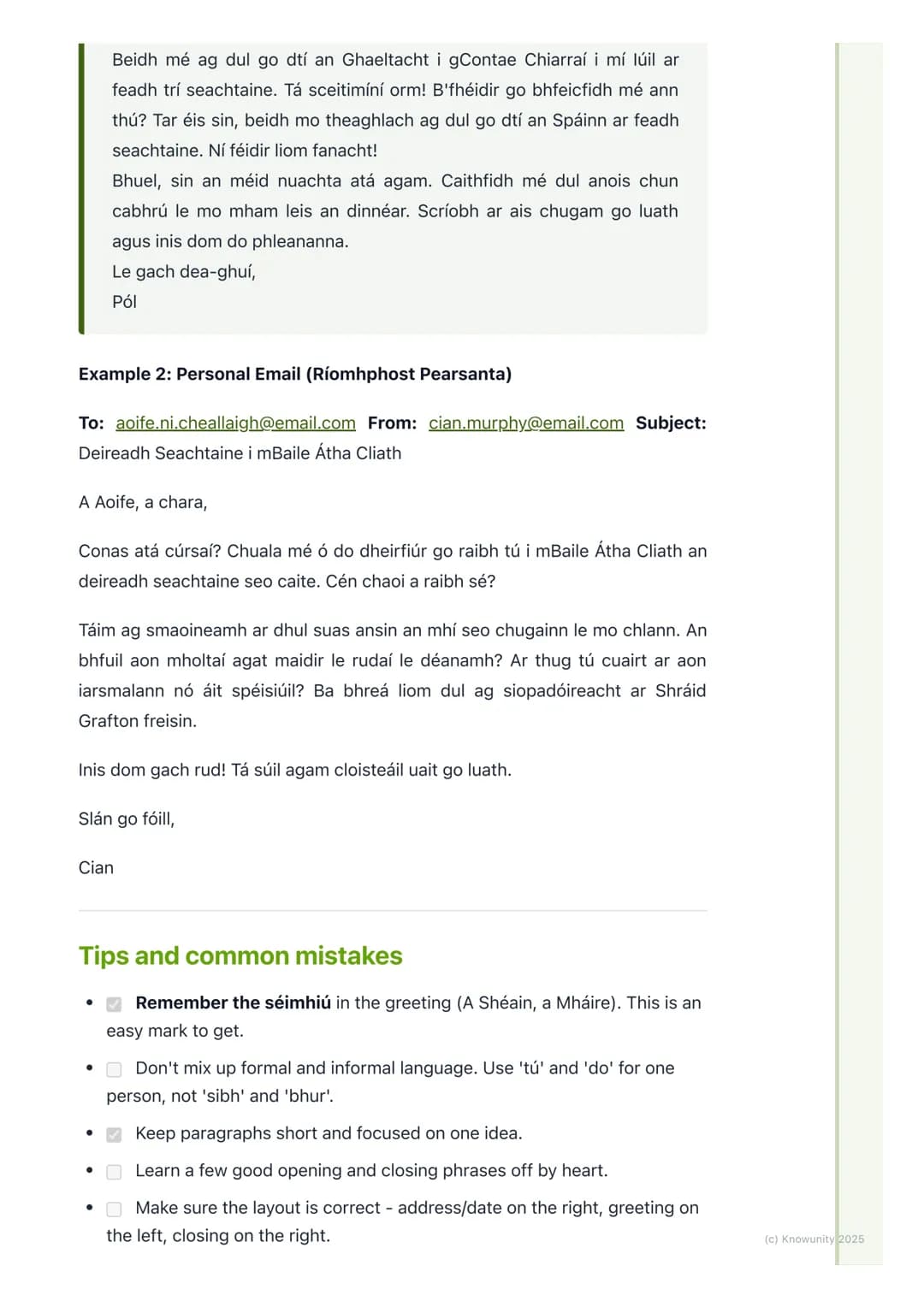
Avoiding the Most Common Mistakes
Don't mess up the séimhiú in your greeting - "A Shéain" not "A Seán". This tiny detail can cost you easy marks, so practice it until it's automatic.
Never mix formal and informal language. Stick to "tú" and "do" for one person, not "sibh" and "bhur" which are for groups or formal situations.
Keep your paragraphs short and focused. Each one should cover just one topic, whether that's school, sports, or weekend plans. Long, rambling paragraphs lose marks fast.
💡 Layout Matters: Get the positioning right - address/date on right, greeting on left, closing on right again!
For emails, make sure your ábhar (subject line) is short and in Irish. Something like "Pleananna an tSamhraidh" (summer plans) works perfectly and shows you're thinking in Irish from the start.
6
of 6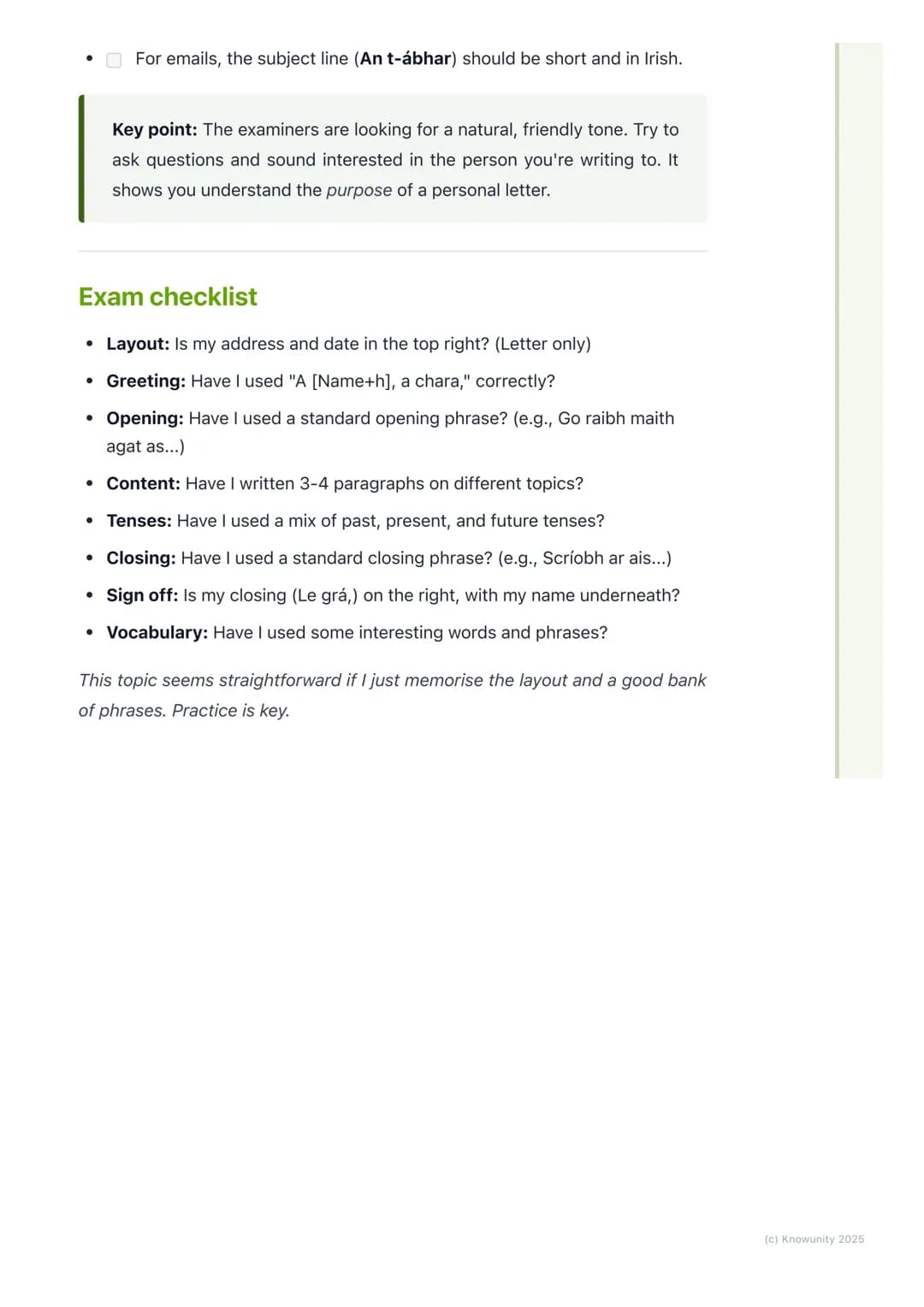
Your Exam Success Checklist
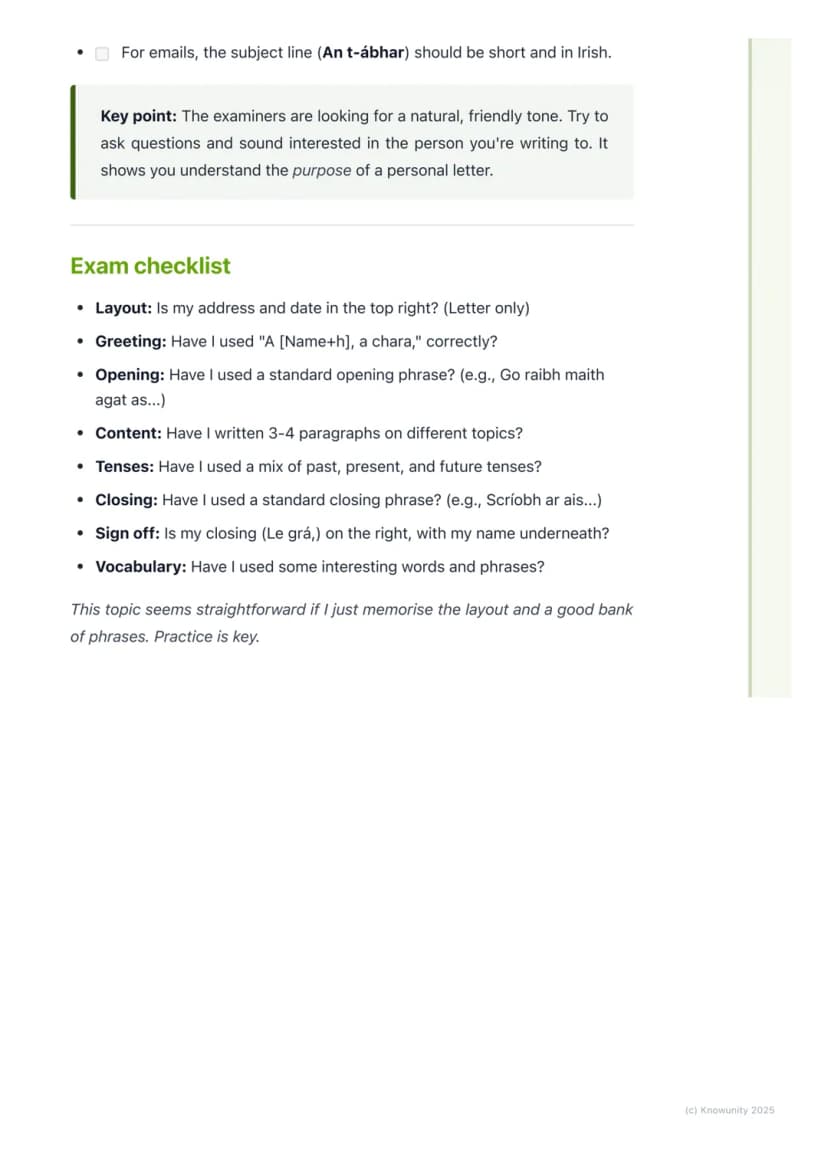
Before you hand in your paper, run through this quick checklist. Layout first: address and date top right (letters only), greeting with proper séimhiú on the left, and closing phrases positioned correctly on the right.
Content-wise, check you've used standard opening phrases, written 3-4 focused paragraphs, and mixed up your tenses properly. The examiners love seeing Aimsir Chaite, Aimsir Láithreach, and Aimsir Fháistineach all working together naturally.
Finally, make sure you sound genuinely friendly and interested. Ask questions, share news, and use phrases like "Tá súil agam go bhfuil tú i mbarr na sláinte" (I hope you're in great health) to show you understand Irish social conventions.
💡 Practice Makes Perfect: Learn a bank of useful phrases off by heart - they'll save you time and stress in the exam!
This topic is actually quite straightforward once you master the structure. The key is practising until the layout becomes second nature, then you can focus on showing off your vocabulary and grammar skills.
Myśleliśmy, że nigdy nie zapytasz...
Czym jest Towarzysz AI z Knowunity?
Nasz asystent AI jest specjalnie dostosowany do potrzeb uczniów. W oparciu o miliony treści, które mamy na platformie, możemy udzielać uczniom naprawdę znaczących i trafnych odpowiedzi. Ale nie chodzi tylko o odpowiedzi, towarzysz prowadzi również uczniów przez codzienne wyzwania związane z nauką, ze spersonalizowanymi planami nauki, quizami lub treściami na czacie i 100% personalizacją opartą na umiejętnościach i rozwoju uczniów.
Gdzie mogę pobrać aplikację Knowunity?
Aplikację możesz pobrać z Google Play i Apple Store.
Czy aplikacja Knowunity naprawdę jest darmowa?
Tak, masz całkowicie darmowy dostęp do wszystkich notatek w aplikacji, możesz w każdej chwili rozmawiać z Ekspertami lub ich obserwować. Możesz użyć punktów, aby odblokować pewne funkcje w aplikacji, które również możesz otrzymać za darmo. Dodatkowo oferujemy usługę Knowunity Premium, która pozwala na odblokowanie większej liczby funkcji.
Najpopularniejsze notatki z Irish
9IrishIrish oral questions and answers
Questions and answers for the leaving cert oral
5th Year4264
IrishIrish oral questions
Outline of oral questions
5th Year2055
IrishIrish poetry 2027
Iníon + Dínit an Bhróin
5th Year1133
IrishIníon- le hÁine Durkin
Aine Durkin’s poem, Iníon: Themes & summary
5th Year850
IrishLC HL notes- Iníon (poem)
Includes poem in English and Irish, theme, key words & phrases
5th Year2284
IrishMo Ghrá-sa (Idir Lúibíní)
Notes on mo ghrá-sa
5th Year380
IrishGaeilge Grammar Office
All the basics you need to know on Irish grammar.
6th Year1063
IrishAn Gaeilge Aiste
Irish Language essay
6th Year1320
IrishMé Féin & Mo Chlann (Myself & My Family)
Students will learn vocabulary to describe themselves, their family members, and daily routines. This helps in personal introductions and discussions.
TY291
Najpopularniejsze notatki
9IrishIrish oral questions and answers
Questions and answers for the leaving cert oral
5th Year4264
 English
Key Quotes : Sive
Key Quotes and explanations: Sive
6th Year2842
IrishIrish oral questions
Outline of oral questions
5th Year2055
IrishIníon- le hÁine Durkin
Aine Durkin’s poem, Iníon: Themes & summary
5th Year850
IrishIrish poetry 2027
Iníon + Dínit an Bhróin
5th Year1133
IrishLC HL notes- Iníon (poem)
Includes poem in English and Irish, theme, key words & phrases
5th Year2284
EnglishCultural Context : Shawshank Redemption : Sive : Small Things Like These
Comparative Study : Cultural Context : Shawshank Redemption, Sive and Small Things Like These
6th Year1430
IrishMo Ghrá-sa (Idir Lúibíní)
Notes on mo ghrá-sa
5th Year380
IrishAn Gaeilge Aiste
Irish Language essay
6th Year1320
Nie ma nic odpowiedniego? Sprawdź inne przedmioty.
Zobacz, co mówią o nas nasi użytkownicy. Pokochali nas — pokochasz też i Ty.
4.6/5App Store
4.7/5Google Play
Aplikacja jest bardzo prosta i dobrze przemyślana. Do tej pory znalazłem wszystko, czego szukałem i mogłem się wiele nauczyć z innych notatek! Na pewno wykorzystam aplikację do pomocy przy robieniu prac domowych! No i oczywiście bardzo pomaga też jako inspiracja do robienia swoich notatek.
Stefan Sużytkownik iOS
Ta aplikacja jest naprawdę świetna. Jest tak wiele notatek i pomocnych informacji [...]. Moim problematycznym przedmiotem jest język niemiecki, a w aplikacji jest w czym wybierać. Dzięki tej aplikacji poprawiłam swój niemiecki. Polecam ją każdemu.
Samantha Klichużytkownik Androida
Wow, jestem w szoku. Właśnie wypróbowałam aplikację, ponieważ widziałam ją kilka razy reklamowaną na TikToku jestem absolutnie w szoku. Ta aplikacja jest POMOCĄ, której potrzebujesz w szkole i przede wszystkim oferuje tak wiele rzeczy jak notatki czy streszczenia, które są BARDZO pomocne w moim przypadku.
Annaużytkownik iOS
Irish3 wyświetleń·Zaktualizowano Jun 3, 2026·6 stronyConas Litreacha agus Ríomhphoist Phearsanta a Scríobh
Writing personal letters and emails in Irish is a key skill that often shows up in your Leaving Cert exam. It's all about sounding natural and friendly whilst following the proper Irish structure and using the right phrases.
1
of 6
Zarejestruj się, aby zobaczyć notatkę. To nic nie kosztuje!
- Dostęp do wszystkich materiałów
- Popraw swoje oceny
- Dołącz do milionów studentów
Getting Started with Personal Letters and Emails
Ever wondered how to write to your mate in Irish without sounding like a robot? Personal letters and emails in Irish are called neamhfhoirmiúil (informal), and they're totally different from formal business letters.
The key is getting the structure right. Every litir phearsanta (personal letter) follows the same pattern, and once you nail this, you're sorted for the exam. Think of it like a template that you can adapt for any situation.
💡 Exam Tip: Learn the basic structure off by heart - it's easy marks waiting for you!
For emails, you can skip some parts like your address, but the friendly tone stays exactly the same. The examiners want to see that you can chat naturally in Irish whilst showing off your grammar skills.
2
of 6Zarejestruj się, aby zobaczyć notatkę. To nic nie kosztuje!
- Dostęp do wszystkich materiałów
- Popraw swoje oceny
- Dołącz do milionów studentów
The Essential Structure You Need to Know
Your leagan amach litreach phearsanta (personal letter layout) has six main parts that never change. An seoladh (your address) goes top right, followed by an dáta (the date) just underneath it.
Then comes an beannacht (the greeting) on the left - this is where that tricky séimhiú comes in. You write "A" plus their name with an 'h' added: "A Shéain, a chara" or "A Mháire, a chara". If their name starts with a vowel or L, N, R, you don't add the 'h'.
An corp (the body) is your main content in 3-4 paragraphs. Finally, an clabhsúr (the closing) goes on the right with phrases like "Le grá," followed by do ainm (your first name).
💡 Quick Check: For emails, you only need a subject line, greeting, body, closing, and your name - much simpler!
Remember to put your address and date on the right, greeting on the left, and closing back on the right. This layout pattern is crucial for full marks.
3
of 6Zarejestruj się, aby zobaczyć notatkę. To nic nie kosztuje!
- Dostęp do wszystkich materiałów
- Popraw swoje oceny
- Dołącz do milionów studentów
Writing Your Content Like a Pro
Start your opening paragraph by thanking them or asking how they are. Phrases like "Go raibh maith agat as do litir" (thanks for your letter) or "Conas atá cúrsaí leat?" (how are things?) work perfectly every time.
Your main body needs 2-3 paragraphs covering different topics - maybe school, holidays, or weekend plans. This is where you show off different tenses: Aimsir Chaite (past), Aimsir Láithreach (present), and Aimsir Fháistineach (future).
Mix up your sentences with examples like "Chuaigh mé go dtí an phictiúrlann" (I went to the cinema) for past, "Táim ag déanamh staidéir" (I'm studying) for present, and "Beidh mé ag dul ar laethanta saoire" (I'll be going on holidays) for future.
💡 Variety is Key: Using different tenses shows the examiners you're comfortable with Irish grammar!
End with a short closing paragraph asking them to write back: "Scríobh ar ais chugam go luath" (write back to me soon) keeps things friendly and natural.
4
of 6Zarejestruj się, aby zobaczyć notatkę. To nic nie kosztuje!
- Dostęp do wszystkich materiałów
- Popraw swoje oceny
- Dołącz do milionów studentów
Real Examples That Actually Work
Here's how it looks in practice. Your litir phearsanta might start: "45 Bóthar an Chnoic, Corcaigh. An 10ú Meitheamh, 2024. A Shéain, a chara, Go raibh míle maith agat as an litir..."
For the main content, write about real stuff: "Tá an scoil beagnach críochnaithe anois don samhradh" (school's nearly finished for summer) or "Beidh mé ag dul go dtí an Ghaeltacht" (I'll be going to the Gaeltacht).
Ríomhphoist (emails) are even easier. Just add a subject line like "Deireadh Seachtaine i mBaile Átha Cliath" and jump straight into "A Aoife, a chara, Conas atá cúrsaí?"
💡 Sound Natural: Ask questions about their plans or experiences - it shows you understand the purpose of personal communication!
Close with friendly phrases like "Le gach dea-ghuí" (with every good wish) or "Slán go fóill" (bye for now) and you're done.
5
of 6Zarejestruj się, aby zobaczyć notatkę. To nic nie kosztuje!
- Dostęp do wszystkich materiałów
- Popraw swoje oceny
- Dołącz do milionów studentów
Avoiding the Most Common Mistakes
Don't mess up the séimhiú in your greeting - "A Shéain" not "A Seán". This tiny detail can cost you easy marks, so practice it until it's automatic.
Never mix formal and informal language. Stick to "tú" and "do" for one person, not "sibh" and "bhur" which are for groups or formal situations.
Keep your paragraphs short and focused. Each one should cover just one topic, whether that's school, sports, or weekend plans. Long, rambling paragraphs lose marks fast.
💡 Layout Matters: Get the positioning right - address/date on right, greeting on left, closing on right again!
For emails, make sure your ábhar (subject line) is short and in Irish. Something like "Pleananna an tSamhraidh" (summer plans) works perfectly and shows you're thinking in Irish from the start.
6
of 6Zarejestruj się, aby zobaczyć notatkę. To nic nie kosztuje!
- Dostęp do wszystkich materiałów
- Popraw swoje oceny
- Dołącz do milionów studentów
Your Exam Success Checklist
Before you hand in your paper, run through this quick checklist. Layout first: address and date top right (letters only), greeting with proper séimhiú on the left, and closing phrases positioned correctly on the right.
Content-wise, check you've used standard opening phrases, written 3-4 focused paragraphs, and mixed up your tenses properly. The examiners love seeing Aimsir Chaite, Aimsir Láithreach, and Aimsir Fháistineach all working together naturally.
Finally, make sure you sound genuinely friendly and interested. Ask questions, share news, and use phrases like "Tá súil agam go bhfuil tú i mbarr na sláinte" (I hope you're in great health) to show you understand Irish social conventions.
💡 Practice Makes Perfect: Learn a bank of useful phrases off by heart - they'll save you time and stress in the exam!
This topic is actually quite straightforward once you master the structure. The key is practising until the layout becomes second nature, then you can focus on showing off your vocabulary and grammar skills.
Myśleliśmy, że nigdy nie zapytasz...
Czym jest Towarzysz AI z Knowunity?
Nasz asystent AI jest specjalnie dostosowany do potrzeb uczniów. W oparciu o miliony treści, które mamy na platformie, możemy udzielać uczniom naprawdę znaczących i trafnych odpowiedzi. Ale nie chodzi tylko o odpowiedzi, towarzysz prowadzi również uczniów przez codzienne wyzwania związane z nauką, ze spersonalizowanymi planami nauki, quizami lub treściami na czacie i 100% personalizacją opartą na umiejętnościach i rozwoju uczniów.
Gdzie mogę pobrać aplikację Knowunity?
Aplikację możesz pobrać z Google Play i Apple Store.
Czy aplikacja Knowunity naprawdę jest darmowa?
Tak, masz całkowicie darmowy dostęp do wszystkich notatek w aplikacji, możesz w każdej chwili rozmawiać z Ekspertami lub ich obserwować. Możesz użyć punktów, aby odblokować pewne funkcje w aplikacji, które również możesz otrzymać za darmo. Dodatkowo oferujemy usługę Knowunity Premium, która pozwala na odblokowanie większej liczby funkcji.
Najpopularniejsze notatki z Irish
9IrishIrish oral questions and answers
Questions and answers for the leaving cert oral
5th Year4264
IrishIrish oral questions
Outline of oral questions
5th Year2055
IrishIrish poetry 2027
Iníon + Dínit an Bhróin
5th Year1133
IrishIníon- le hÁine Durkin
Aine Durkin’s poem, Iníon: Themes & summary
5th Year850
IrishLC HL notes- Iníon (poem)
Includes poem in English and Irish, theme, key words & phrases
5th Year2284
IrishMo Ghrá-sa (Idir Lúibíní)
Notes on mo ghrá-sa
5th Year380
IrishGaeilge Grammar Office
All the basics you need to know on Irish grammar.
6th Year1063
IrishAn Gaeilge Aiste
Irish Language essay
6th Year1320
IrishMé Féin & Mo Chlann (Myself & My Family)
Students will learn vocabulary to describe themselves, their family members, and daily routines. This helps in personal introductions and discussions.
TY291
Najpopularniejsze notatki
9IrishIrish oral questions and answers
Questions and answers for the leaving cert oral
5th Year4264
EnglishKey Quotes : Sive
Key Quotes and explanations: Sive
6th Year2842
IrishIrish oral questions
Outline of oral questions
5th Year2055
IrishIníon- le hÁine Durkin
Aine Durkin’s poem, Iníon: Themes & summary
5th Year850
IrishIrish poetry 2027
Iníon + Dínit an Bhróin
5th Year1133
IrishLC HL notes- Iníon (poem)
Includes poem in English and Irish, theme, key words & phrases
5th Year2284
EnglishCultural Context : Shawshank Redemption : Sive : Small Things Like These
Comparative Study : Cultural Context : Shawshank Redemption, Sive and Small Things Like These
6th Year1430
IrishMo Ghrá-sa (Idir Lúibíní)
Notes on mo ghrá-sa
5th Year380
IrishAn Gaeilge Aiste
Irish Language essay
6th Year1320
Nie ma nic odpowiedniego? Sprawdź inne przedmioty.
Zobacz, co mówią o nas nasi użytkownicy. Pokochali nas — pokochasz też i Ty.
4.6/5App Store
4.7/5Google Play
Aplikacja jest bardzo prosta i dobrze przemyślana. Do tej pory znalazłem wszystko, czego szukałem i mogłem się wiele nauczyć z innych notatek! Na pewno wykorzystam aplikację do pomocy przy robieniu prac domowych! No i oczywiście bardzo pomaga też jako inspiracja do robienia swoich notatek.
Stefan Sużytkownik iOS
Ta aplikacja jest naprawdę świetna. Jest tak wiele notatek i pomocnych informacji [...]. Moim problematycznym przedmiotem jest język niemiecki, a w aplikacji jest w czym wybierać. Dzięki tej aplikacji poprawiłam swój niemiecki. Polecam ją każdemu.
Samantha Klichużytkownik Androida
Wow, jestem w szoku. Właśnie wypróbowałam aplikację, ponieważ widziałam ją kilka razy reklamowaną na TikToku jestem absolutnie w szoku. Ta aplikacja jest POMOCĄ, której potrzebujesz w szkole i przede wszystkim oferuje tak wiele rzeczy jak notatki czy streszczenia, które są BARDZO pomocne w moim przypadku.
Annaużytkownik iOS