
Learning how to talk about yourself and your family in... Pokaż więcej
 Irish29 wyświetleń·Zaktualizowano May 20, 2026·8 strony
Mé Féin & Mo Chlann: Ag Cur Síor Lé Chéile

1 / 8
1
of 8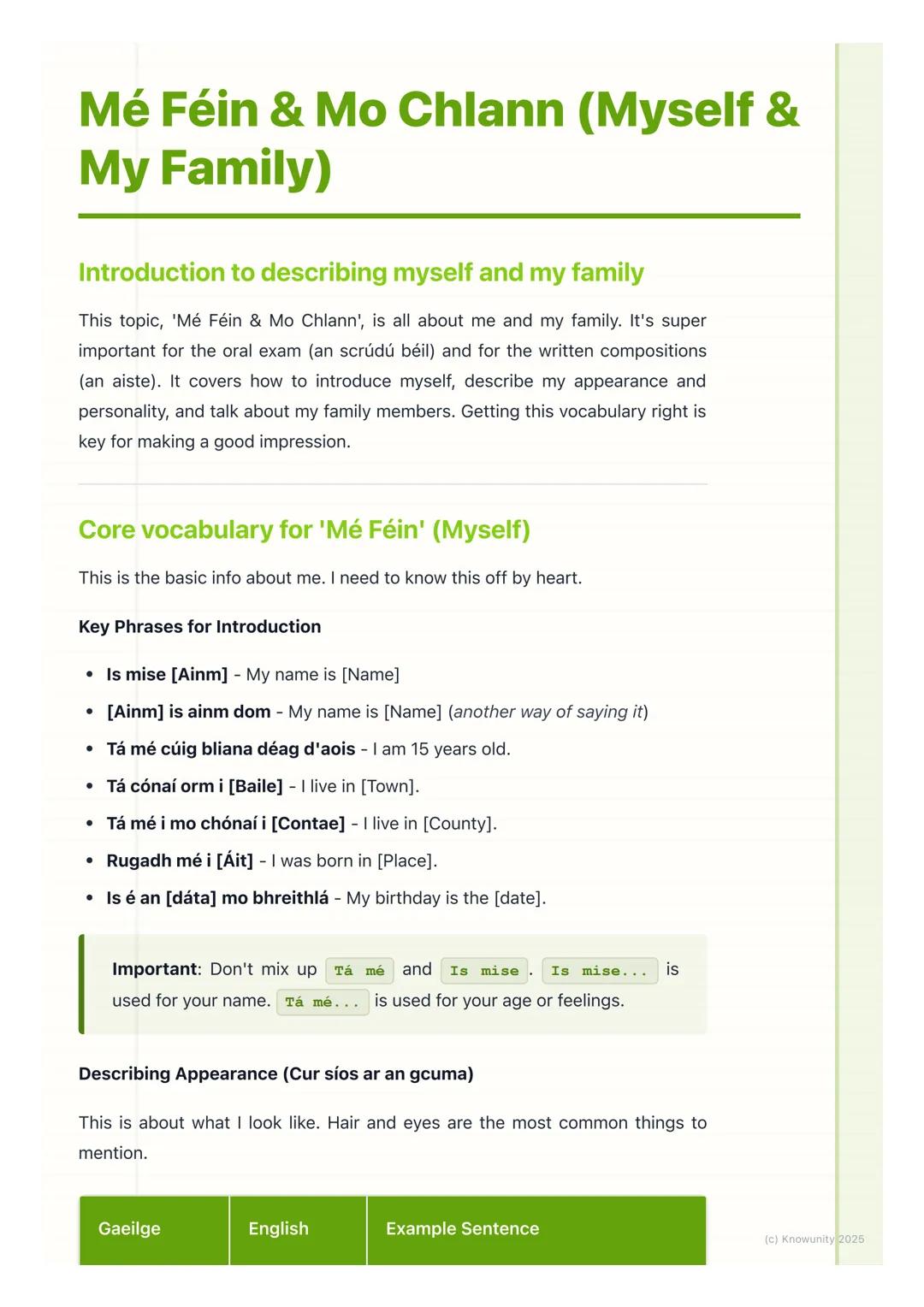
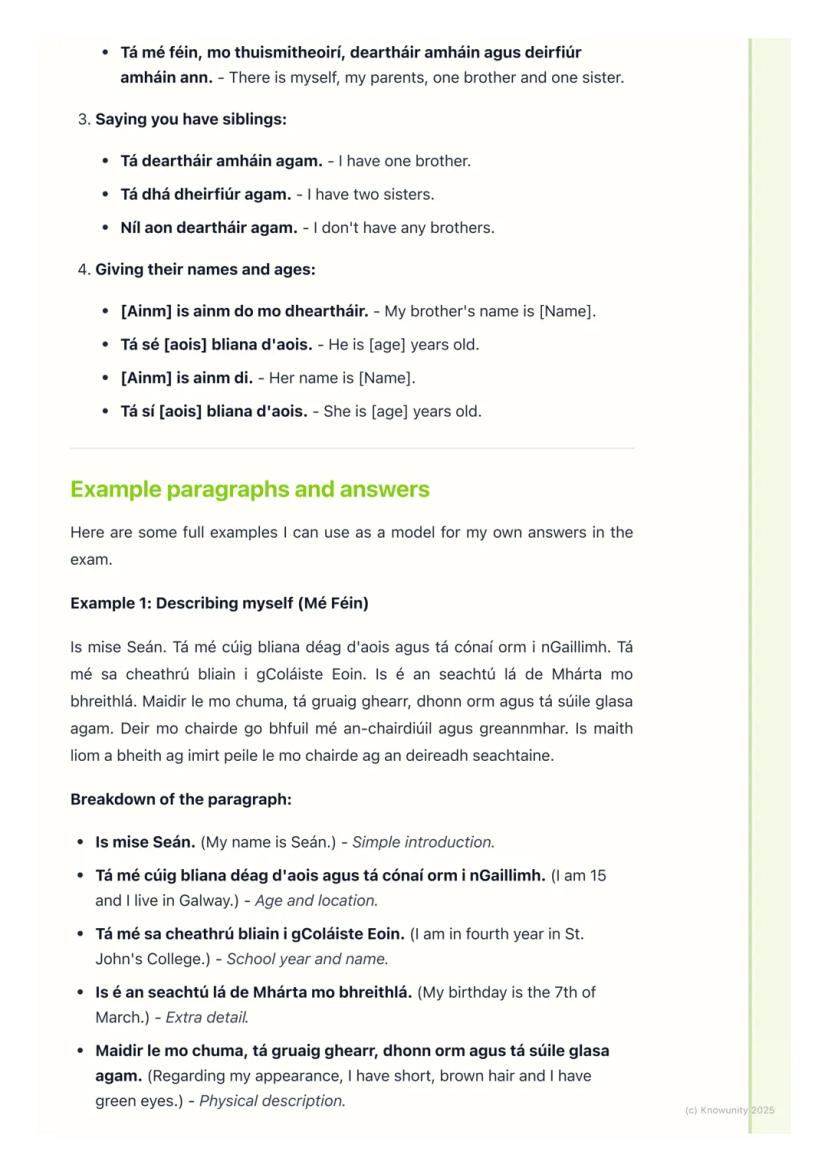
Introduction & Basic Self-Description
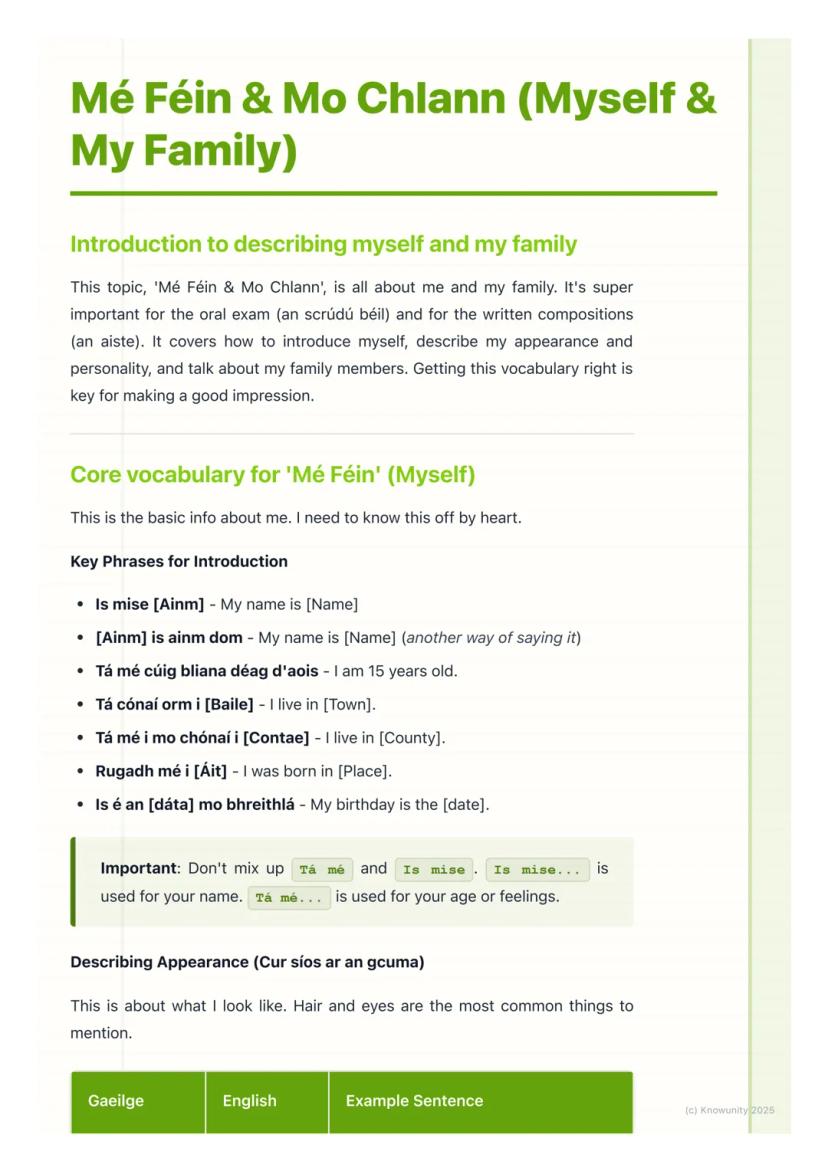
You'll use these phrases constantly in Irish exams, so they need to become second nature. The key is knowing exactly when to use Is mise versus Tá mé - it trips up loads of students but it's actually straightforward once you get it.
Is mise [Ainm] or [Ainm] is ainm dom both mean "My name is [Name]". Use these for introductions. For everything else about yourself, you'll use Tá mé - like Tá mé cúig bliana déag d'aois (I am 15 years old) and Tá cónaí orm i [Baile] (I live in [Town]).
Don't forget the birthday phrase Is é an [dáta] mo bhreithlá - it's a nice extra detail that shows you can handle more complex structures. Practice saying your actual age, town, and birthday until they roll off your tongue naturally.
Quick Tip: Master these basics first before moving on to descriptions - they're your safety net in any speaking situation!
2
of 8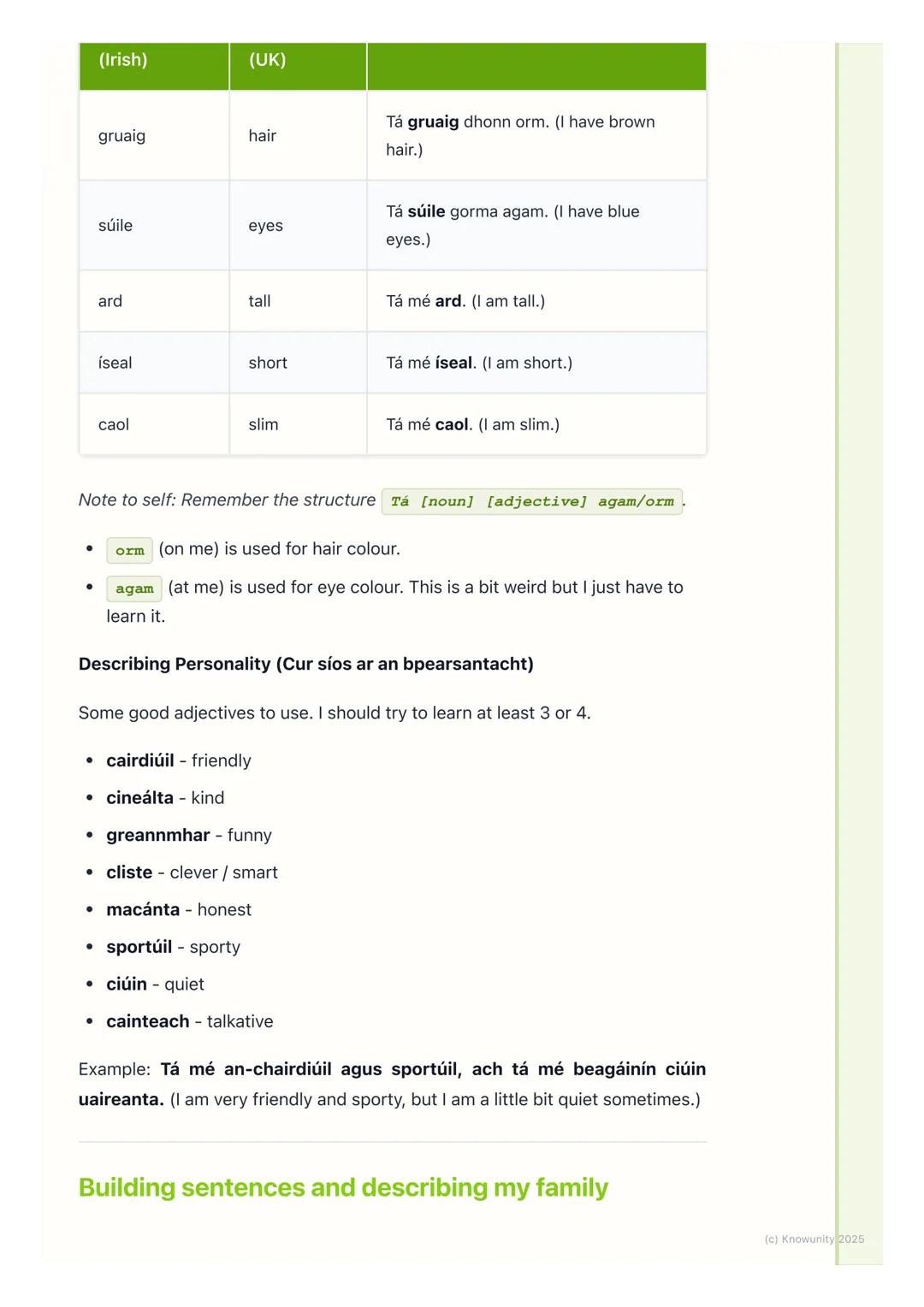
Describing Your Appearance
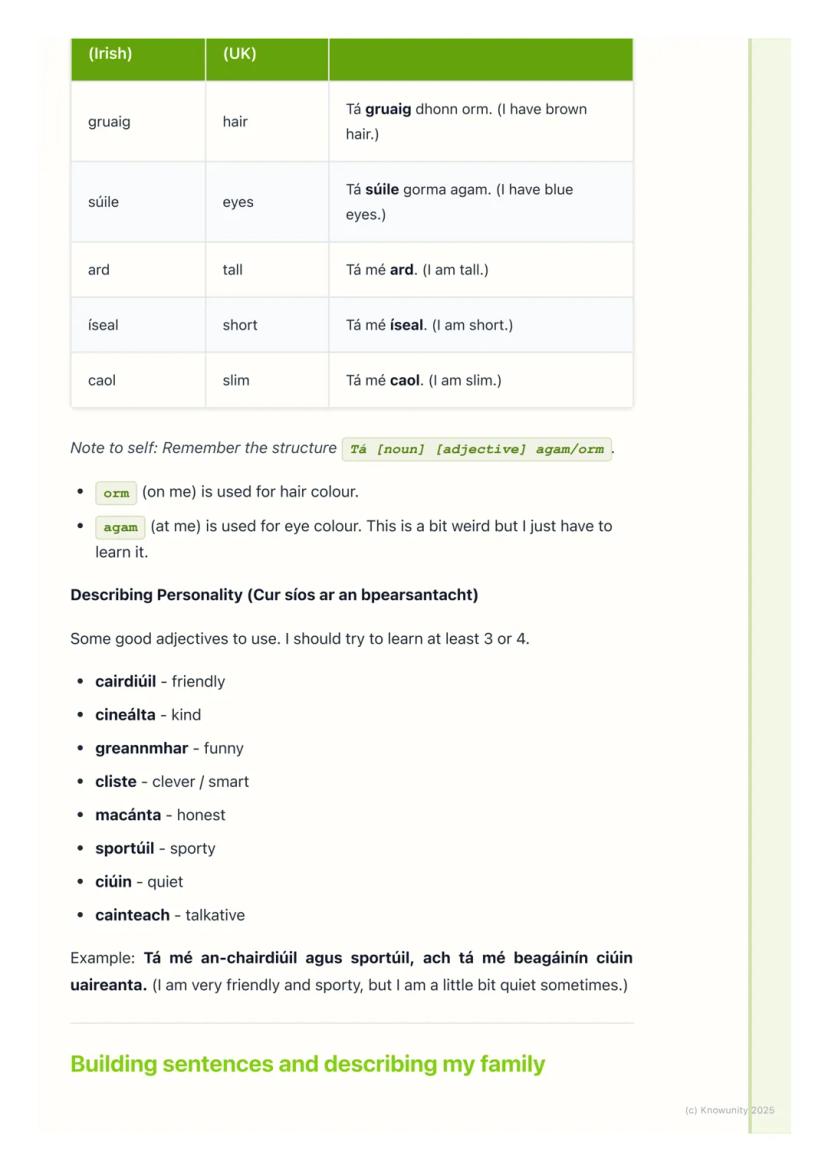
Physical descriptions in Irish follow specific patterns that you need to memorise. The trickiest bit is remembering whether to use orm (on me) or agam (at me) - and yes, it does seem backwards at first!
For hair, always use orm: Tá gruaig dhonn orm (I have brown hair). For eyes, it's always agam: Tá súile gorma agam (I have blue eyes). Height and build descriptions are simple - just Tá mé ard (I am tall) or Tá mé caol (I am slim).
The key vocabulary you absolutely need includes gruaig (hair), súile (eyes), ard (tall), íseal (short), and caol (slim). Learn at least three descriptions so you can give a proper picture of yourself.
Remember: Hair takes orm, eyes take agam - there's no logic to it, just memorise it!
3
of 8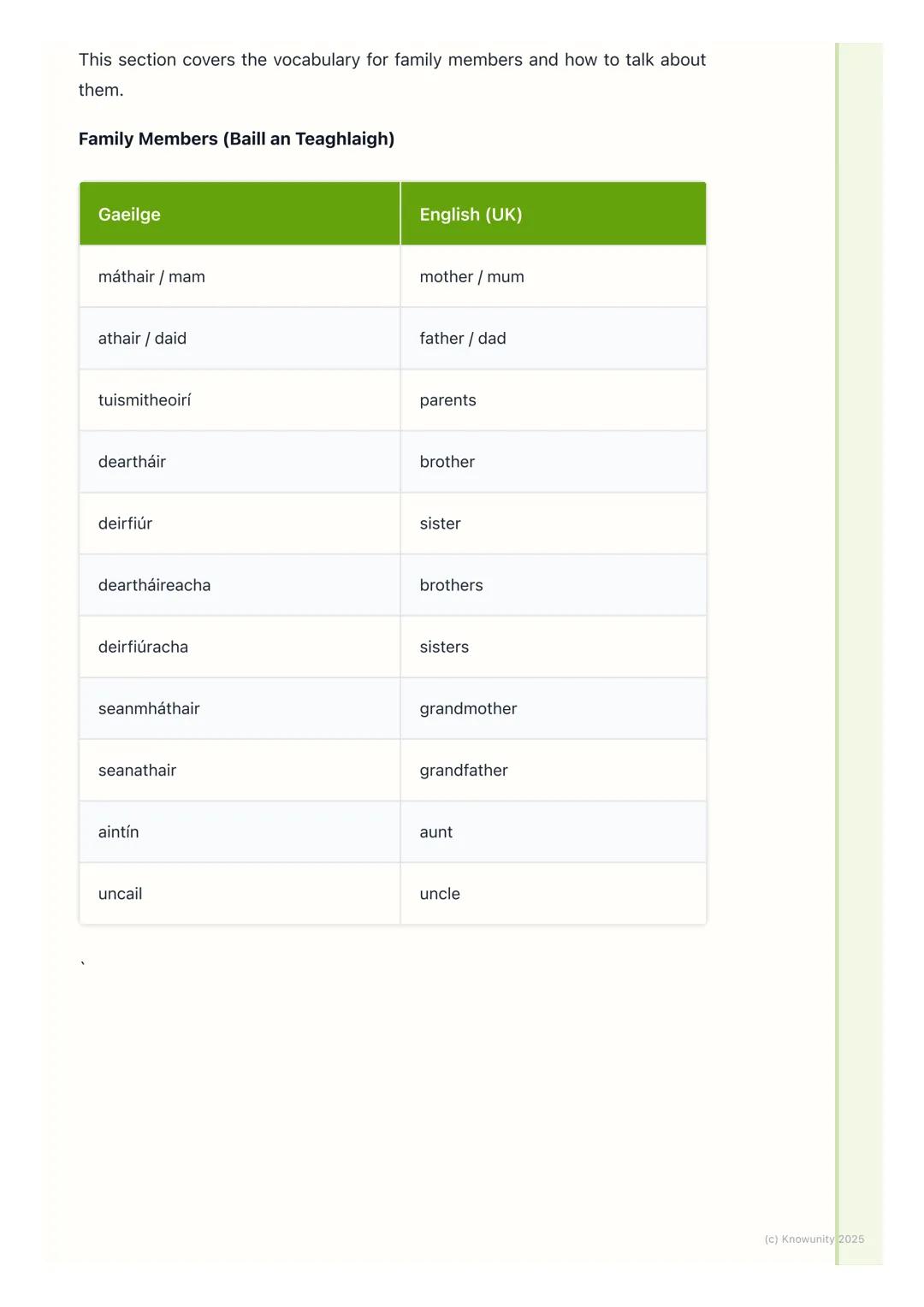
Personality Traits
Your personality description is where you can really shine and show off your Irish vocabulary. Learn at least four good adjectives so you can paint a full picture of who you are as a person.
The most useful personality words include cairdiúil (friendly), cineálta (kind), greannmhar (funny), cliste (clever), sportúil (sporty), and ciúin (quiet). Mix positive traits with one that shows you're realistic about yourself.
Try building sentences like Tá mé an-chairdiúil agus sportúil, ach tá mé beagáinín ciúin uaireanta (I am very friendly and sporty, but I am a little bit quiet sometimes). The word beagáinín (a little bit) is brilliant for softening statements.
Top Tip: Use Deir mo chairde go bhfuil mé... (My friends say that I am...) to add variety to your sentences!
4
of 8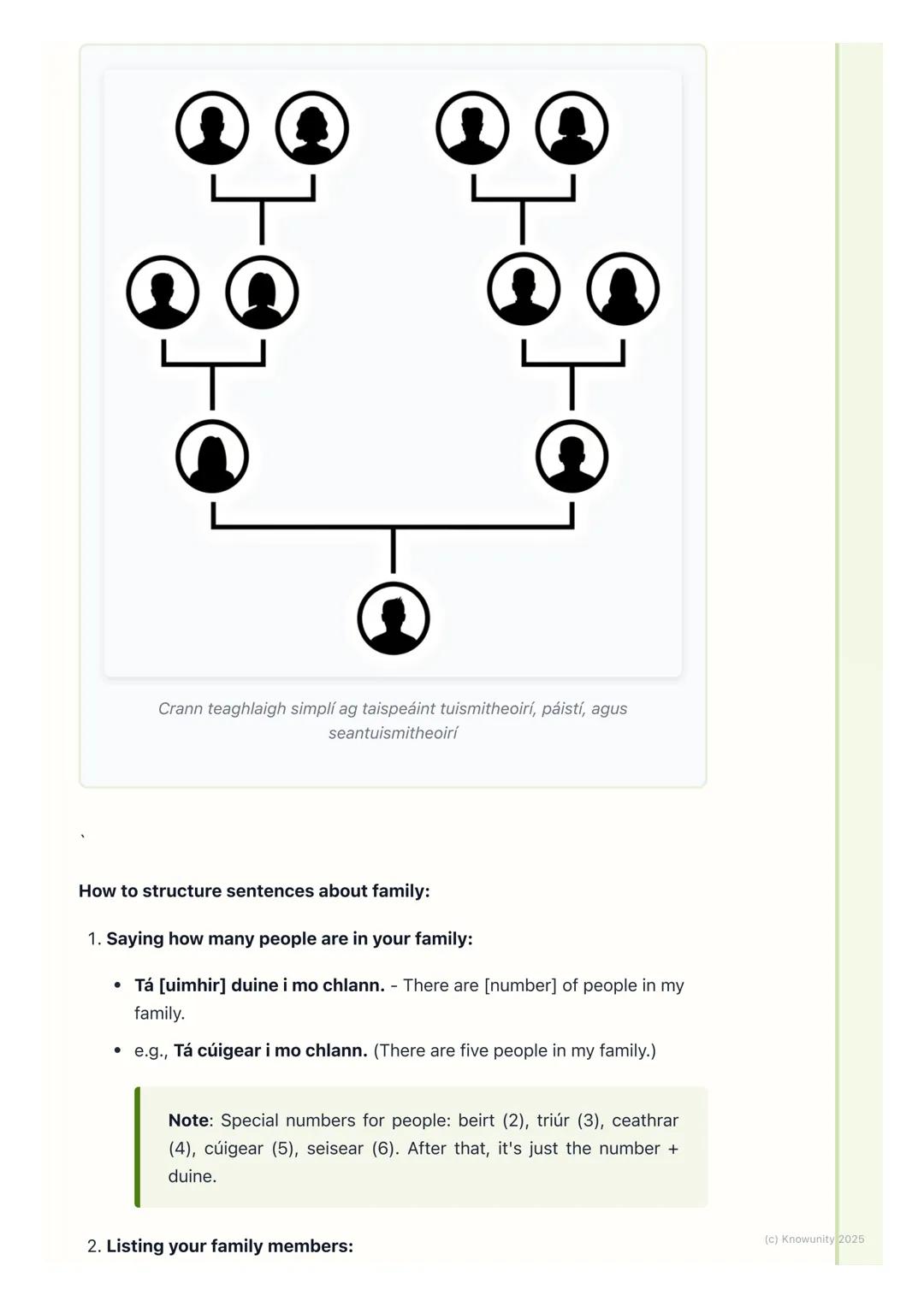
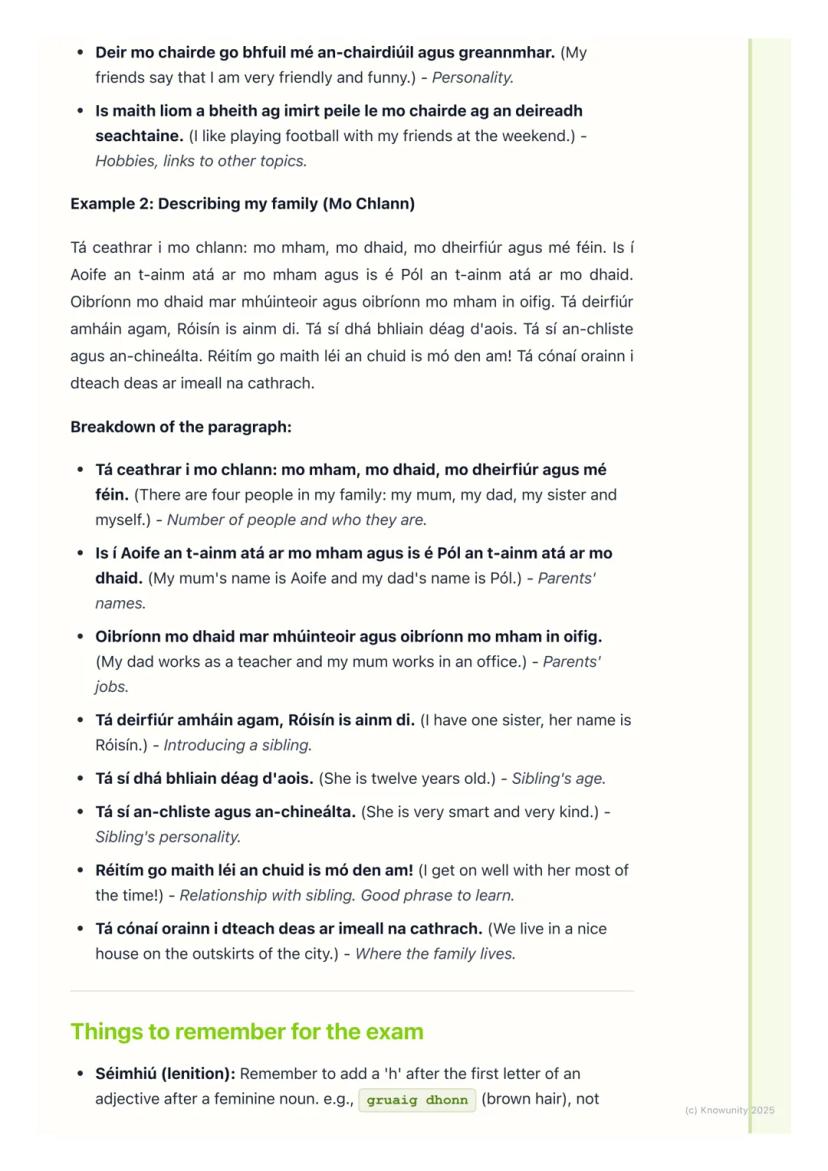
Family Members & Numbers
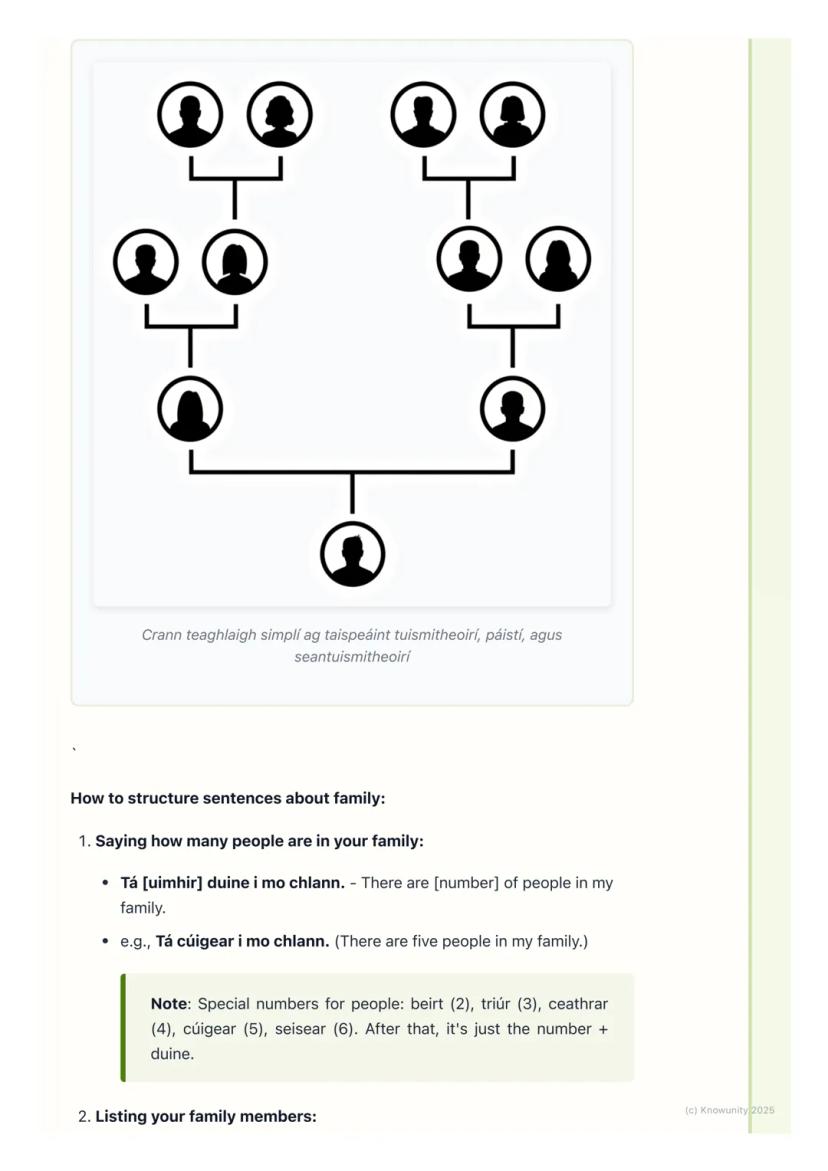
Talking about your family starts with knowing the special counting system Irish uses for people. Instead of regular numbers, you'll use beirt (2), triúr (3), ceathrar (4), cúigear (5), and seisear (6) people.
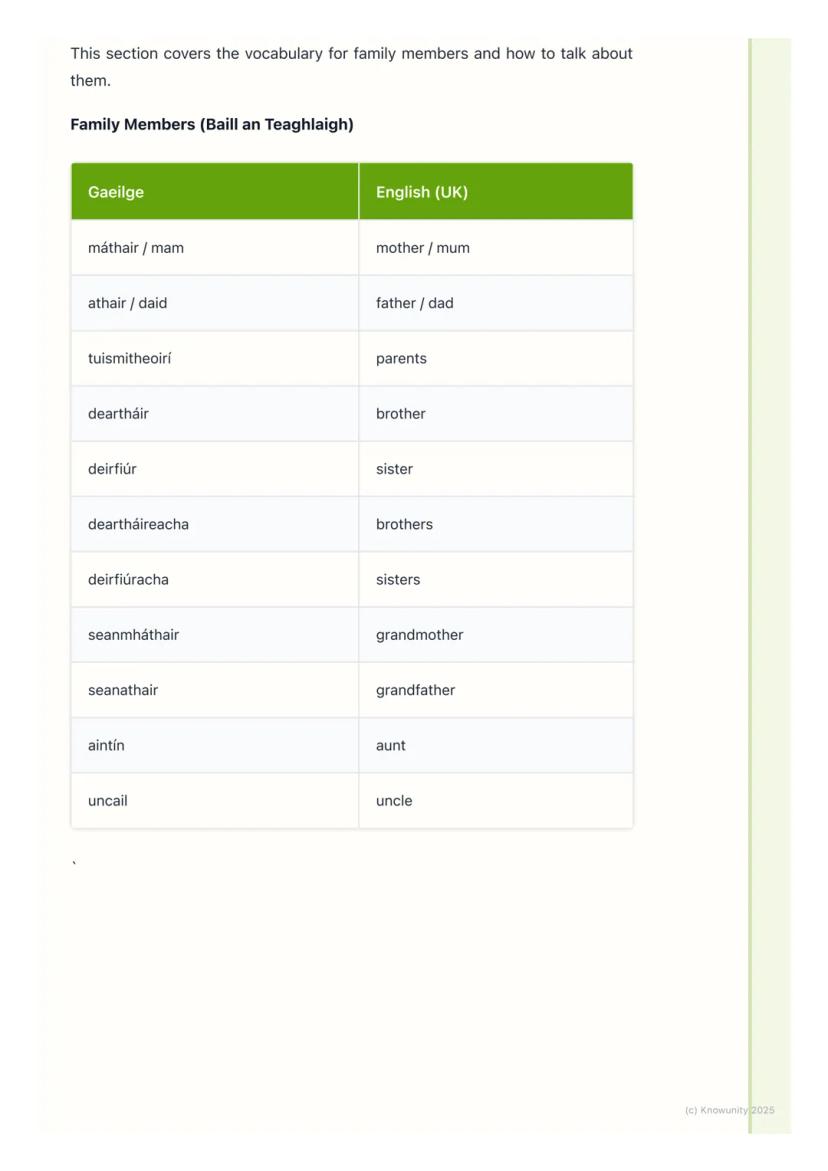
Essential family vocabulary includes máthair/mam , athair/daid , deartháir (brother), deirfiúr (sister), and tuismitheoirí (parents). The structure Tá ceathrar i mo chlann (There are four people in my family) is your starting point.
When listing family members, use phrases like Tá mé féin, mo thuismitheoirí agus deartháir amháin ann (There is myself, my parents and one brother). This shows you can handle more complex sentence structures confidently.
Quick Check: Practice counting your actual family members using the special people numbers - it's different from regular Irish counting!
5
of 8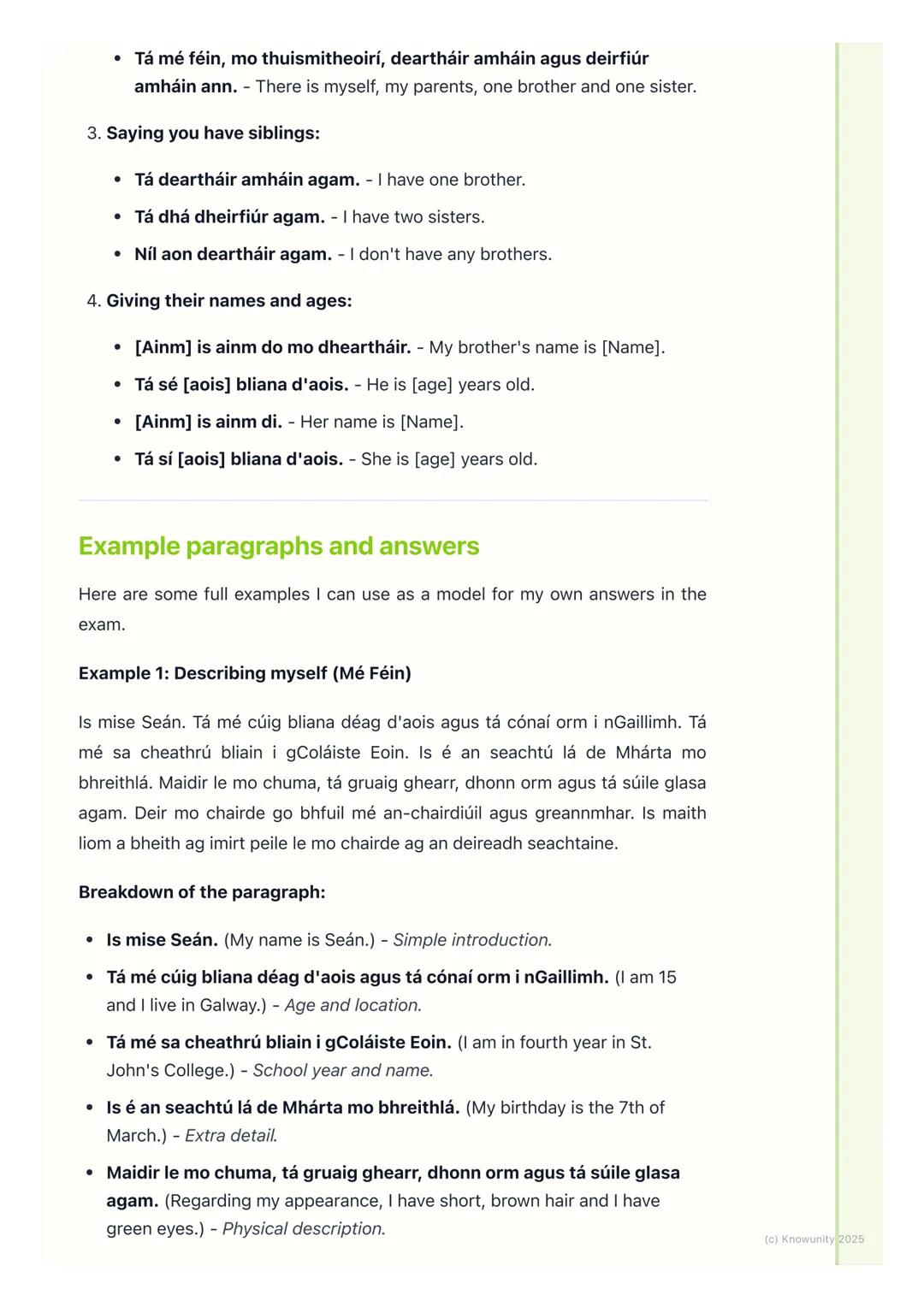
Describing Family Members
Once you've introduced your family, you need to give details about each person. Start with names using [Ainm] is ainm do mo dheartháir (My brother's name is [Name]) and ages with Tá sé [aois] bliana d'aois (He is [age] years old).
Don't just list facts - add personality traits and relationships. Tá sí an-chliste agus an-chineálta (She is very smart and very kind) brings your family to life. The phrase Réitím go maith léi (I get on well with her) is perfect for showing family dynamics.
For parents, mention their jobs if you know the Irish words: Oibríonn mo dhaid mar mhúinteoir (My dad works as a teacher). If you don't know specific job vocabulary, keep it simple with oibríonn sé/sí .
Smart Move: Learn to say whether you get on well with siblings - examiners love hearing about real relationships!
6
of 8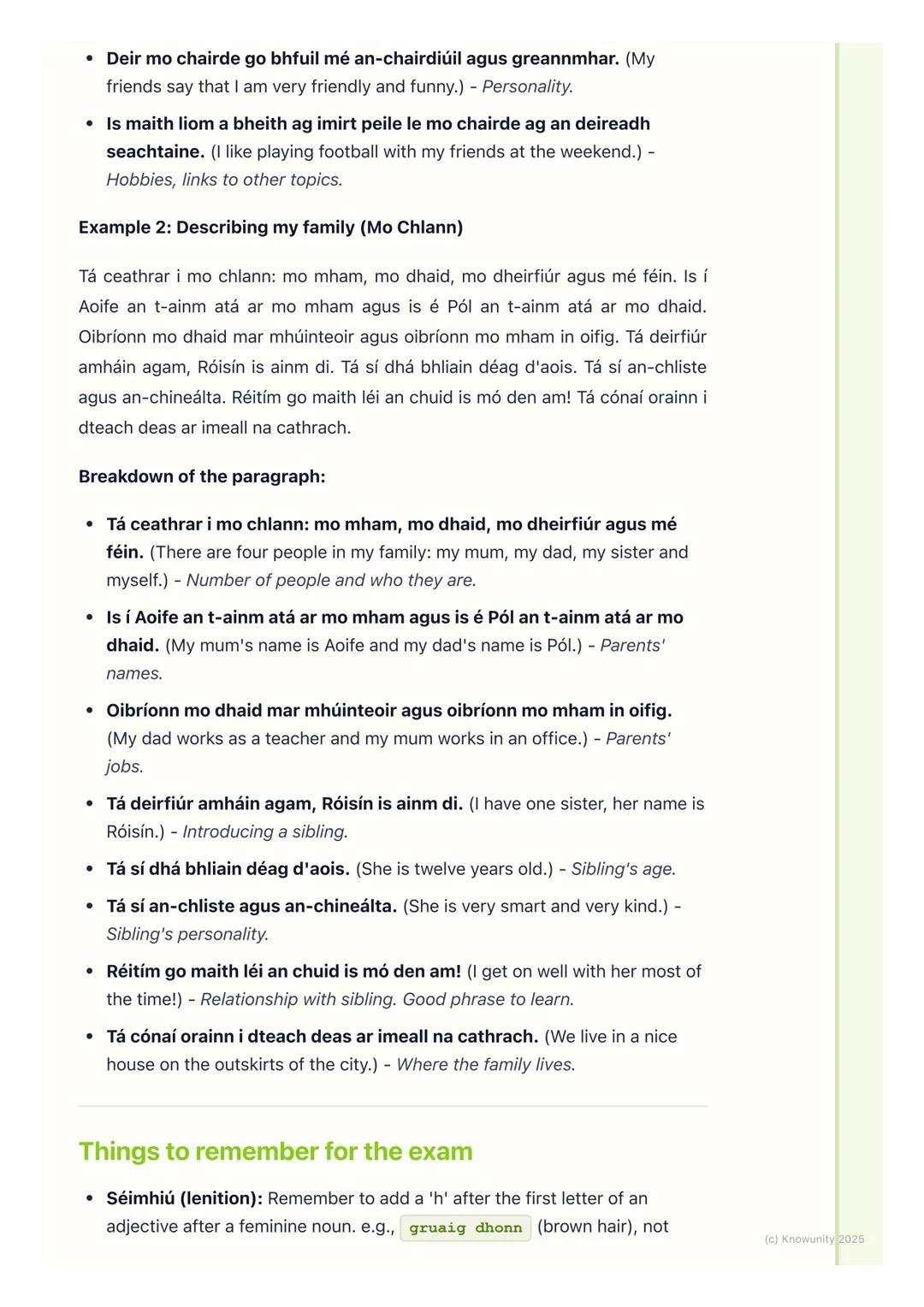
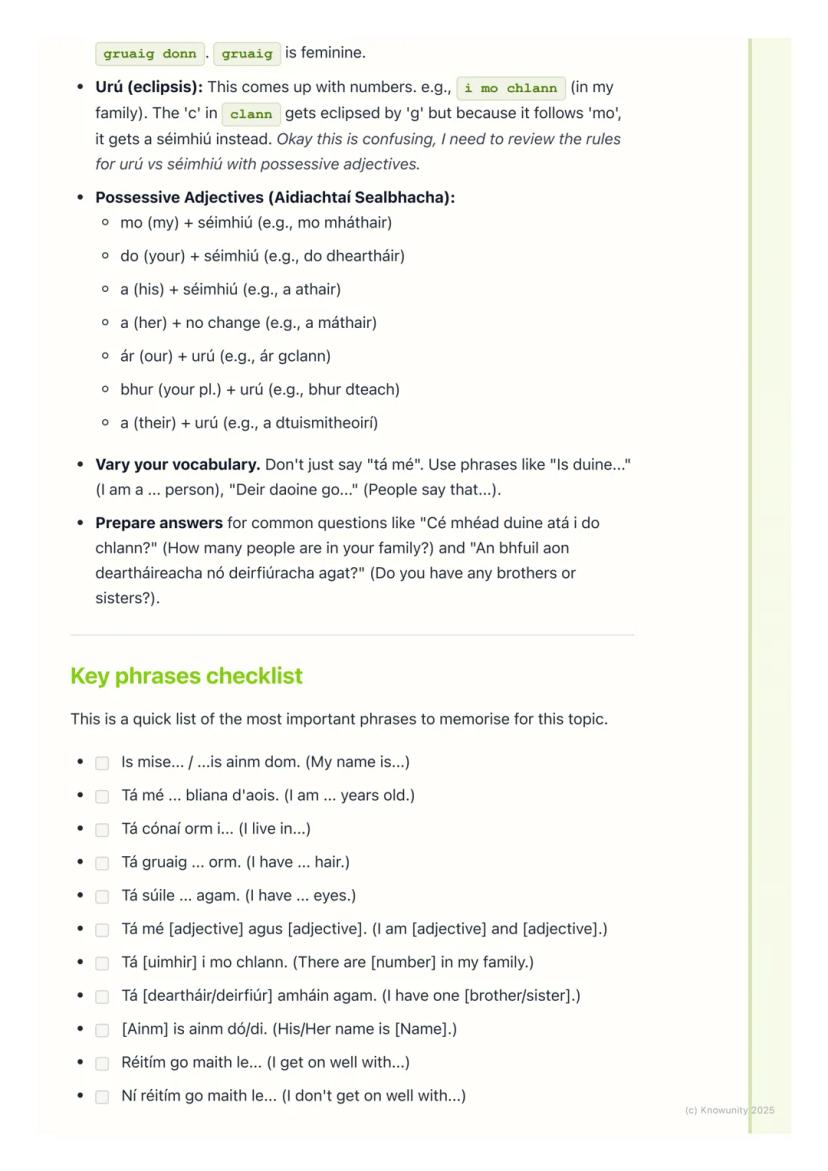
Grammar Essentials & Common Mistakes
Séimhiú (lenition) is crucial when describing appearance. Feminine nouns like gruaig cause the following adjective to get a 'h': gruaig dhonn (brown hair), not gruaig donn. This catches out loads of students in exams.
Possessive adjectives follow strict patterns: mo and do cause séimhiú (mo mháthair), while ár and bhur cause urú (ár gclann). The different forms of a are tricky - a athair (his father) gets séimhiú, but a máthair (her mother) stays unchanged.
Vary your sentence starters to avoid sounding repetitive. Instead of always using Tá mé, try Is duine cairdiúil mé (I am a friendly person) or Deir daoine go bhfuil mé... (People say that I am...). This shows real fluency.
Exam Saver: If you're unsure about grammar, stick to simple structures you know are correct - it's better than making mistakes with complex ones!
7
of 8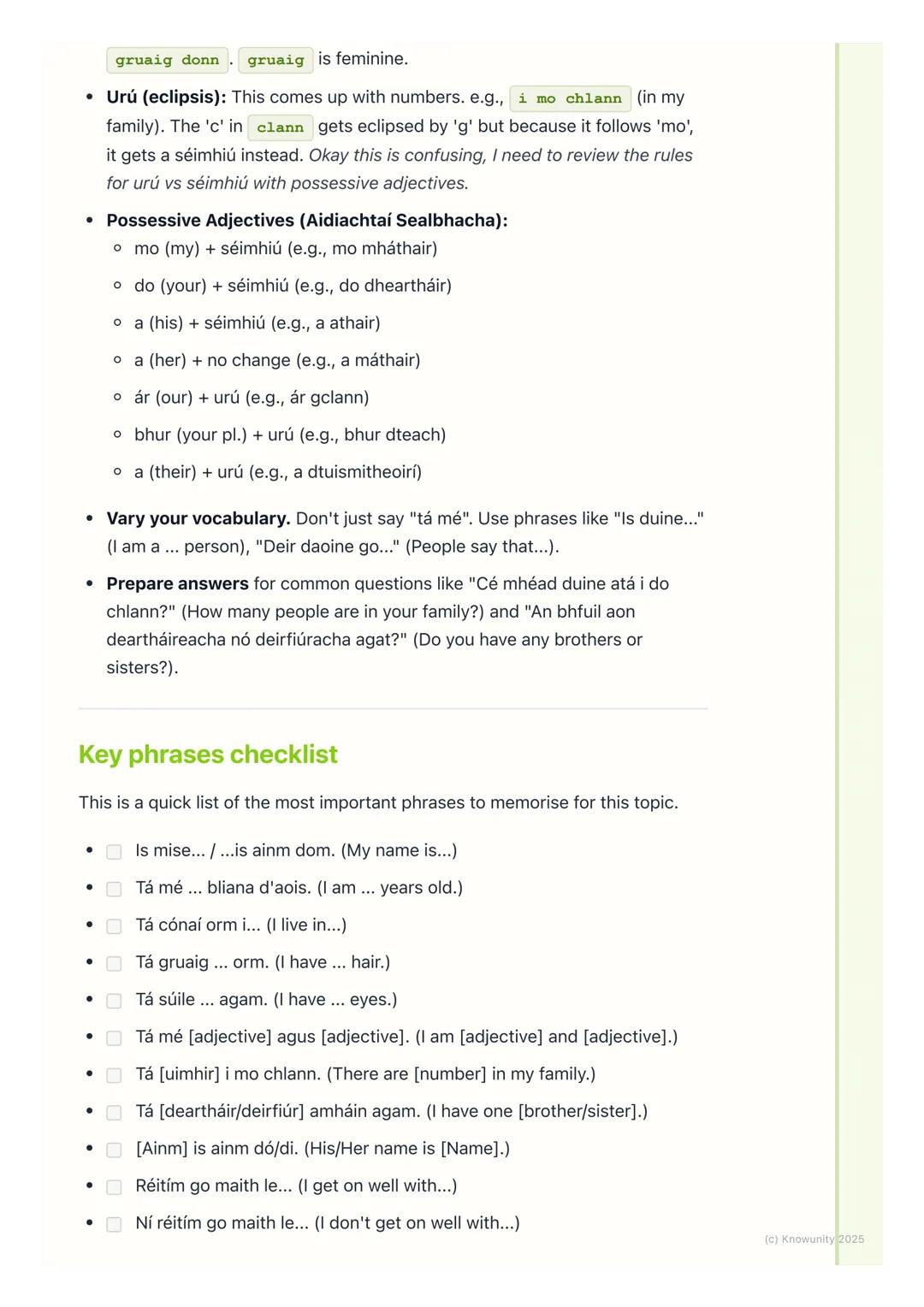
Essential Phrases for Success
These phrases are your absolute must-knows for any conversation about yourself and family. Get them so well-learned that you can say them without thinking, even when you're nervous in an exam.
The core introduction phrases are Is mise.../...is ainm dom (My name is...), Tá mé... bliana d'aois (I am ... years old), and Tá cónaí orm i... (I live in...). For family, master Tá [uimhir] i mo chlann (There are [number] in my family) and [Ainm] is ainm dó/di .
Relationship phrases like Réitím go maith le... (I get on well with...) and Ní réitím go maith le... (I don't get on well with...) add depth to your answers. They show you can express real opinions, not just basic facts.
Final Tip: Record yourself saying these phrases and listen back - you'll spot pronunciation issues and build confidence for the oral exam!
8
of 8
Myśleliśmy, że nigdy nie zapytasz...
Czym jest Towarzysz AI z Knowunity?
Nasz asystent AI jest specjalnie dostosowany do potrzeb uczniów. W oparciu o miliony treści, które mamy na platformie, możemy udzielać uczniom naprawdę znaczących i trafnych odpowiedzi. Ale nie chodzi tylko o odpowiedzi, towarzysz prowadzi również uczniów przez codzienne wyzwania związane z nauką, ze spersonalizowanymi planami nauki, quizami lub treściami na czacie i 100% personalizacją opartą na umiejętnościach i rozwoju uczniów.
Gdzie mogę pobrać aplikację Knowunity?
Aplikację możesz pobrać z Google Play i Apple Store.
Czy aplikacja Knowunity naprawdę jest darmowa?
Tak, masz całkowicie darmowy dostęp do wszystkich notatek w aplikacji, możesz w każdej chwili rozmawiać z Ekspertami lub ich obserwować. Możesz użyć punktów, aby odblokować pewne funkcje w aplikacji, które również możesz otrzymać za darmo. Dodatkowo oferujemy usługę Knowunity Premium, która pozwala na odblokowanie większej liczby funkcji.
Najpopularniejsze notatki z Irish
9IrishIrish oral questions and answers
Questions and answers for the leaving cert oral
5th Year4264
IrishIrish oral questions
Outline of oral questions
5th Year2055
IrishIníon- le hÁine Durkin
Aine Durkin’s poem, Iníon: Themes & summary
5th Year850
IrishIrish poetry 2027
Iníon + Dínit an Bhróin
5th Year1133
IrishLC HL notes- Iníon (poem)
Includes poem in English and Irish, theme, key words & phrases
5th Year2284
IrishGaeilge Grammar Office
All the basics you need to know on Irish grammar.
6th Year1063
IrishAn Gaeilge Aiste
Irish Language essay
6th Year1320
IrishMo Ghrá-sa (Idir Lúibíní)
Notes on mo ghrá-sa
5th Year380
IrishIrish notes- Drama: Gleann Alain
Includes key words from the scenes, themes, characters and exam questions
1st Year1471
Najpopularniejsze notatki
9IrishIrish oral questions and answers
Questions and answers for the leaving cert oral
5th Year4264
IrishIrish oral questions
Outline of oral questions
5th Year2055
 English
Key Quotes : Sive
Key Quotes and explanations: Sive
6th Year2822
IrishIníon- le hÁine Durkin
Aine Durkin’s poem, Iníon: Themes & summary
5th Year850
IrishIrish poetry 2027
Iníon + Dínit an Bhróin
5th Year1133
IrishLC HL notes- Iníon (poem)
Includes poem in English and Irish, theme, key words & phrases
5th Year2284
IrishGaeilge Grammar Office
All the basics you need to know on Irish grammar.
6th Year1063
EnglishCultural Context : Shawshank Redemption : Sive : Small Things Like These
Comparative Study : Cultural Context : Shawshank Redemption, Sive and Small Things Like These
6th Year1420
IrishAn Gaeilge Aiste
Irish Language essay
6th Year1320
Nie ma nic odpowiedniego? Sprawdź inne przedmioty.
Zobacz, co mówią o nas nasi użytkownicy. Pokochali nas — pokochasz też i Ty.
4.6/5App Store
4.7/5Google Play
Aplikacja jest bardzo prosta i dobrze przemyślana. Do tej pory znalazłem wszystko, czego szukałem i mogłem się wiele nauczyć z innych notatek! Na pewno wykorzystam aplikację do pomocy przy robieniu prac domowych! No i oczywiście bardzo pomaga też jako inspiracja do robienia swoich notatek.
Stefan Sużytkownik iOS
Ta aplikacja jest naprawdę świetna. Jest tak wiele notatek i pomocnych informacji [...]. Moim problematycznym przedmiotem jest język niemiecki, a w aplikacji jest w czym wybierać. Dzięki tej aplikacji poprawiłam swój niemiecki. Polecam ją każdemu.
Samantha Klichużytkownik Androida
Wow, jestem w szoku. Właśnie wypróbowałam aplikację, ponieważ widziałam ją kilka razy reklamowaną na TikToku jestem absolutnie w szoku. Ta aplikacja jest POMOCĄ, której potrzebujesz w szkole i przede wszystkim oferuje tak wiele rzeczy jak notatki czy streszczenia, które są BARDZO pomocne w moim przypadku.
Annaużytkownik iOS
Irish29 wyświetleń·Zaktualizowano May 20, 2026·8 stronyMé Féin & Mo Chlann: Ag Cur Síor Lé Chéile
Learning how to talk about yourself and your family in Irish is absolutely essential for your Leaving Cert oral exam and written compositions. This topic gives you the foundation to introduce yourself confidently and describe the people who matter most... Pokaż więcej
1
of 8Zarejestruj się, aby zobaczyć notatkę. To nic nie kosztuje!
- Dostęp do wszystkich materiałów
- Popraw swoje oceny
- Dołącz do milionów studentów
Introduction & Basic Self-Description
You'll use these phrases constantly in Irish exams, so they need to become second nature. The key is knowing exactly when to use Is mise versus Tá mé - it trips up loads of students but it's actually straightforward once you get it.
Is mise [Ainm] or [Ainm] is ainm dom both mean "My name is [Name]". Use these for introductions. For everything else about yourself, you'll use Tá mé - like Tá mé cúig bliana déag d'aois (I am 15 years old) and Tá cónaí orm i [Baile] (I live in [Town]).
Don't forget the birthday phrase Is é an [dáta] mo bhreithlá - it's a nice extra detail that shows you can handle more complex structures. Practice saying your actual age, town, and birthday until they roll off your tongue naturally.
Quick Tip: Master these basics first before moving on to descriptions - they're your safety net in any speaking situation!
2
of 8Zarejestruj się, aby zobaczyć notatkę. To nic nie kosztuje!
- Dostęp do wszystkich materiałów
- Popraw swoje oceny
- Dołącz do milionów studentów
Describing Your Appearance
Physical descriptions in Irish follow specific patterns that you need to memorise. The trickiest bit is remembering whether to use orm (on me) or agam (at me) - and yes, it does seem backwards at first!
For hair, always use orm: Tá gruaig dhonn orm (I have brown hair). For eyes, it's always agam: Tá súile gorma agam (I have blue eyes). Height and build descriptions are simple - just Tá mé ard (I am tall) or Tá mé caol (I am slim).
The key vocabulary you absolutely need includes gruaig (hair), súile (eyes), ard (tall), íseal (short), and caol (slim). Learn at least three descriptions so you can give a proper picture of yourself.
Remember: Hair takes orm, eyes take agam - there's no logic to it, just memorise it!
3
of 8Zarejestruj się, aby zobaczyć notatkę. To nic nie kosztuje!
- Dostęp do wszystkich materiałów
- Popraw swoje oceny
- Dołącz do milionów studentów
Personality Traits
Your personality description is where you can really shine and show off your Irish vocabulary. Learn at least four good adjectives so you can paint a full picture of who you are as a person.
The most useful personality words include cairdiúil (friendly), cineálta (kind), greannmhar (funny), cliste (clever), sportúil (sporty), and ciúin (quiet). Mix positive traits with one that shows you're realistic about yourself.
Try building sentences like Tá mé an-chairdiúil agus sportúil, ach tá mé beagáinín ciúin uaireanta (I am very friendly and sporty, but I am a little bit quiet sometimes). The word beagáinín (a little bit) is brilliant for softening statements.
Top Tip: Use Deir mo chairde go bhfuil mé... (My friends say that I am...) to add variety to your sentences!
4
of 8Zarejestruj się, aby zobaczyć notatkę. To nic nie kosztuje!
- Dostęp do wszystkich materiałów
- Popraw swoje oceny
- Dołącz do milionów studentów
Family Members & Numbers
Talking about your family starts with knowing the special counting system Irish uses for people. Instead of regular numbers, you'll use beirt (2), triúr (3), ceathrar (4), cúigear (5), and seisear (6) people.
Essential family vocabulary includes máthair/mam , athair/daid , deartháir (brother), deirfiúr (sister), and tuismitheoirí (parents). The structure Tá ceathrar i mo chlann (There are four people in my family) is your starting point.
When listing family members, use phrases like Tá mé féin, mo thuismitheoirí agus deartháir amháin ann (There is myself, my parents and one brother). This shows you can handle more complex sentence structures confidently.
Quick Check: Practice counting your actual family members using the special people numbers - it's different from regular Irish counting!
5
of 8Zarejestruj się, aby zobaczyć notatkę. To nic nie kosztuje!
- Dostęp do wszystkich materiałów
- Popraw swoje oceny
- Dołącz do milionów studentów
Describing Family Members
Once you've introduced your family, you need to give details about each person. Start with names using [Ainm] is ainm do mo dheartháir (My brother's name is [Name]) and ages with Tá sé [aois] bliana d'aois (He is [age] years old).
Don't just list facts - add personality traits and relationships. Tá sí an-chliste agus an-chineálta (She is very smart and very kind) brings your family to life. The phrase Réitím go maith léi (I get on well with her) is perfect for showing family dynamics.
For parents, mention their jobs if you know the Irish words: Oibríonn mo dhaid mar mhúinteoir (My dad works as a teacher). If you don't know specific job vocabulary, keep it simple with oibríonn sé/sí .
Smart Move: Learn to say whether you get on well with siblings - examiners love hearing about real relationships!
6
of 8Zarejestruj się, aby zobaczyć notatkę. To nic nie kosztuje!
- Dostęp do wszystkich materiałów
- Popraw swoje oceny
- Dołącz do milionów studentów
Grammar Essentials & Common Mistakes
Séimhiú (lenition) is crucial when describing appearance. Feminine nouns like gruaig cause the following adjective to get a 'h': gruaig dhonn (brown hair), not gruaig donn. This catches out loads of students in exams.
Possessive adjectives follow strict patterns: mo and do cause séimhiú (mo mháthair), while ár and bhur cause urú (ár gclann). The different forms of a are tricky - a athair (his father) gets séimhiú, but a máthair (her mother) stays unchanged.
Vary your sentence starters to avoid sounding repetitive. Instead of always using Tá mé, try Is duine cairdiúil mé (I am a friendly person) or Deir daoine go bhfuil mé... (People say that I am...). This shows real fluency.
Exam Saver: If you're unsure about grammar, stick to simple structures you know are correct - it's better than making mistakes with complex ones!
7
of 8Zarejestruj się, aby zobaczyć notatkę. To nic nie kosztuje!
- Dostęp do wszystkich materiałów
- Popraw swoje oceny
- Dołącz do milionów studentów
Essential Phrases for Success
These phrases are your absolute must-knows for any conversation about yourself and family. Get them so well-learned that you can say them without thinking, even when you're nervous in an exam.
The core introduction phrases are Is mise.../...is ainm dom (My name is...), Tá mé... bliana d'aois (I am ... years old), and Tá cónaí orm i... (I live in...). For family, master Tá [uimhir] i mo chlann (There are [number] in my family) and [Ainm] is ainm dó/di .
Relationship phrases like Réitím go maith le... (I get on well with...) and Ní réitím go maith le... (I don't get on well with...) add depth to your answers. They show you can express real opinions, not just basic facts.
Final Tip: Record yourself saying these phrases and listen back - you'll spot pronunciation issues and build confidence for the oral exam!
8
of 8Zarejestruj się, aby zobaczyć notatkę. To nic nie kosztuje!
- Dostęp do wszystkich materiałów
- Popraw swoje oceny
- Dołącz do milionów studentów
Myśleliśmy, że nigdy nie zapytasz...
Czym jest Towarzysz AI z Knowunity?
Nasz asystent AI jest specjalnie dostosowany do potrzeb uczniów. W oparciu o miliony treści, które mamy na platformie, możemy udzielać uczniom naprawdę znaczących i trafnych odpowiedzi. Ale nie chodzi tylko o odpowiedzi, towarzysz prowadzi również uczniów przez codzienne wyzwania związane z nauką, ze spersonalizowanymi planami nauki, quizami lub treściami na czacie i 100% personalizacją opartą na umiejętnościach i rozwoju uczniów.
Gdzie mogę pobrać aplikację Knowunity?
Aplikację możesz pobrać z Google Play i Apple Store.
Czy aplikacja Knowunity naprawdę jest darmowa?
Tak, masz całkowicie darmowy dostęp do wszystkich notatek w aplikacji, możesz w każdej chwili rozmawiać z Ekspertami lub ich obserwować. Możesz użyć punktów, aby odblokować pewne funkcje w aplikacji, które również możesz otrzymać za darmo. Dodatkowo oferujemy usługę Knowunity Premium, która pozwala na odblokowanie większej liczby funkcji.
Najpopularniejsze notatki z Irish
9IrishIrish oral questions and answers
Questions and answers for the leaving cert oral
5th Year4264
IrishIrish oral questions
Outline of oral questions
5th Year2055
IrishIníon- le hÁine Durkin
Aine Durkin’s poem, Iníon: Themes & summary
5th Year850
IrishIrish poetry 2027
Iníon + Dínit an Bhróin
5th Year1133
IrishLC HL notes- Iníon (poem)
Includes poem in English and Irish, theme, key words & phrases
5th Year2284
IrishGaeilge Grammar Office
All the basics you need to know on Irish grammar.
6th Year1063
IrishAn Gaeilge Aiste
Irish Language essay
6th Year1320
IrishMo Ghrá-sa (Idir Lúibíní)
Notes on mo ghrá-sa
5th Year380
IrishIrish notes- Drama: Gleann Alain
Includes key words from the scenes, themes, characters and exam questions
1st Year1471
Najpopularniejsze notatki
9IrishIrish oral questions and answers
Questions and answers for the leaving cert oral
5th Year4264
IrishIrish oral questions
Outline of oral questions
5th Year2055
EnglishKey Quotes : Sive
Key Quotes and explanations: Sive
6th Year2822
IrishIníon- le hÁine Durkin
Aine Durkin’s poem, Iníon: Themes & summary
5th Year850
IrishIrish poetry 2027
Iníon + Dínit an Bhróin
5th Year1133
IrishLC HL notes- Iníon (poem)
Includes poem in English and Irish, theme, key words & phrases
5th Year2284
IrishGaeilge Grammar Office
All the basics you need to know on Irish grammar.
6th Year1063
EnglishCultural Context : Shawshank Redemption : Sive : Small Things Like These
Comparative Study : Cultural Context : Shawshank Redemption, Sive and Small Things Like These
6th Year1420
IrishAn Gaeilge Aiste
Irish Language essay
6th Year1320
Nie ma nic odpowiedniego? Sprawdź inne przedmioty.
Zobacz, co mówią o nas nasi użytkownicy. Pokochali nas — pokochasz też i Ty.
4.6/5App Store
4.7/5Google Play
Aplikacja jest bardzo prosta i dobrze przemyślana. Do tej pory znalazłem wszystko, czego szukałem i mogłem się wiele nauczyć z innych notatek! Na pewno wykorzystam aplikację do pomocy przy robieniu prac domowych! No i oczywiście bardzo pomaga też jako inspiracja do robienia swoich notatek.
Stefan Sużytkownik iOS
Ta aplikacja jest naprawdę świetna. Jest tak wiele notatek i pomocnych informacji [...]. Moim problematycznym przedmiotem jest język niemiecki, a w aplikacji jest w czym wybierać. Dzięki tej aplikacji poprawiłam swój niemiecki. Polecam ją każdemu.
Samantha Klichużytkownik Androida
Wow, jestem w szoku. Właśnie wypróbowałam aplikację, ponieważ widziałam ją kilka razy reklamowaną na TikToku jestem absolutnie w szoku. Ta aplikacja jest POMOCĄ, której potrzebujesz w szkole i przede wszystkim oferuje tak wiele rzeczy jak notatki czy streszczenia, które są BARDZO pomocne w moim przypadku.
Annaużytkownik iOS