
Ever wondered why some training sessions feel like torture whilst...
 LCPE1 wyświetleń·Zaktualizowano Jun 14, 2026·6 strony
Types of Practice Methods

1 / 6
1
of 6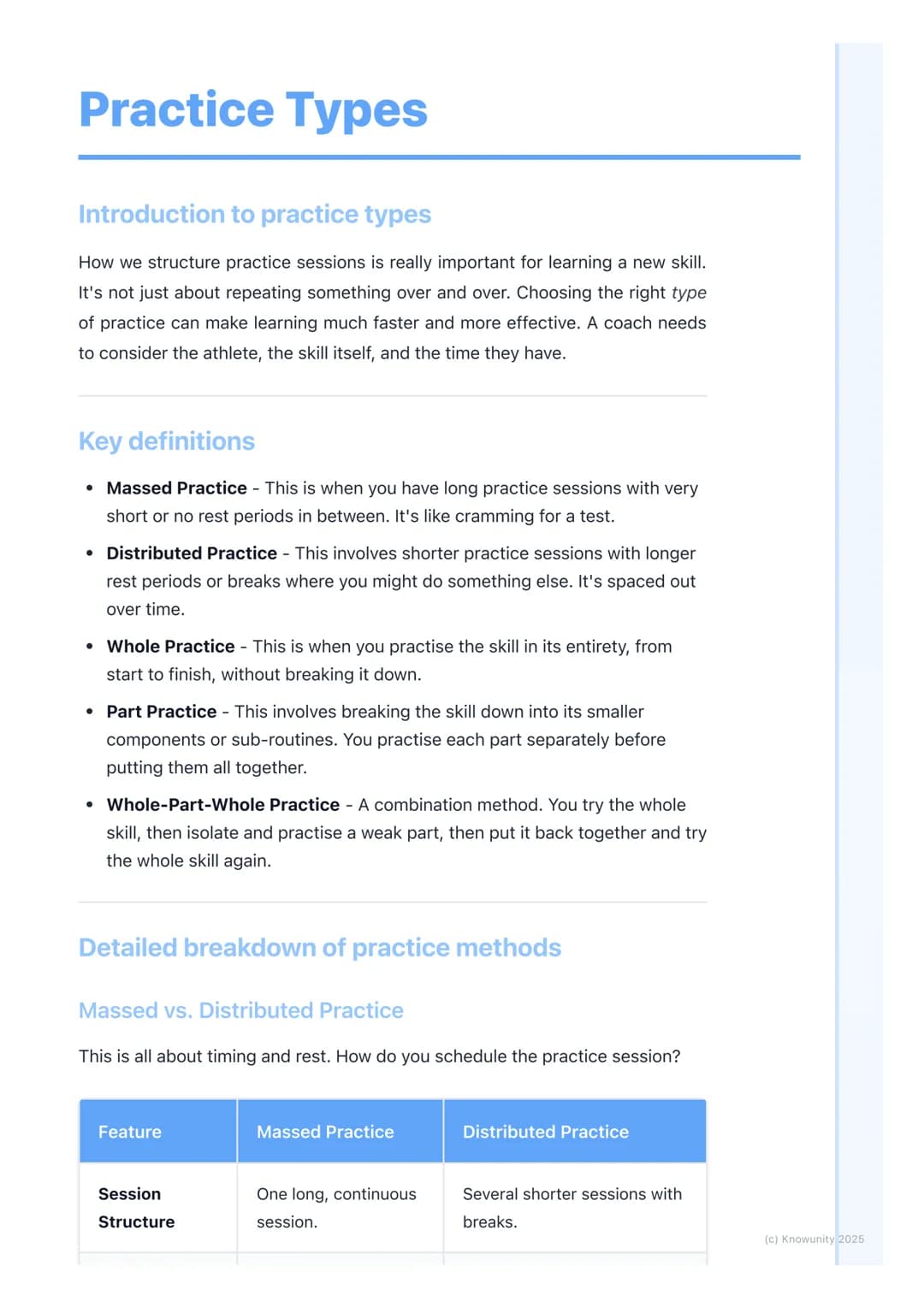
Introduction to Practice Types
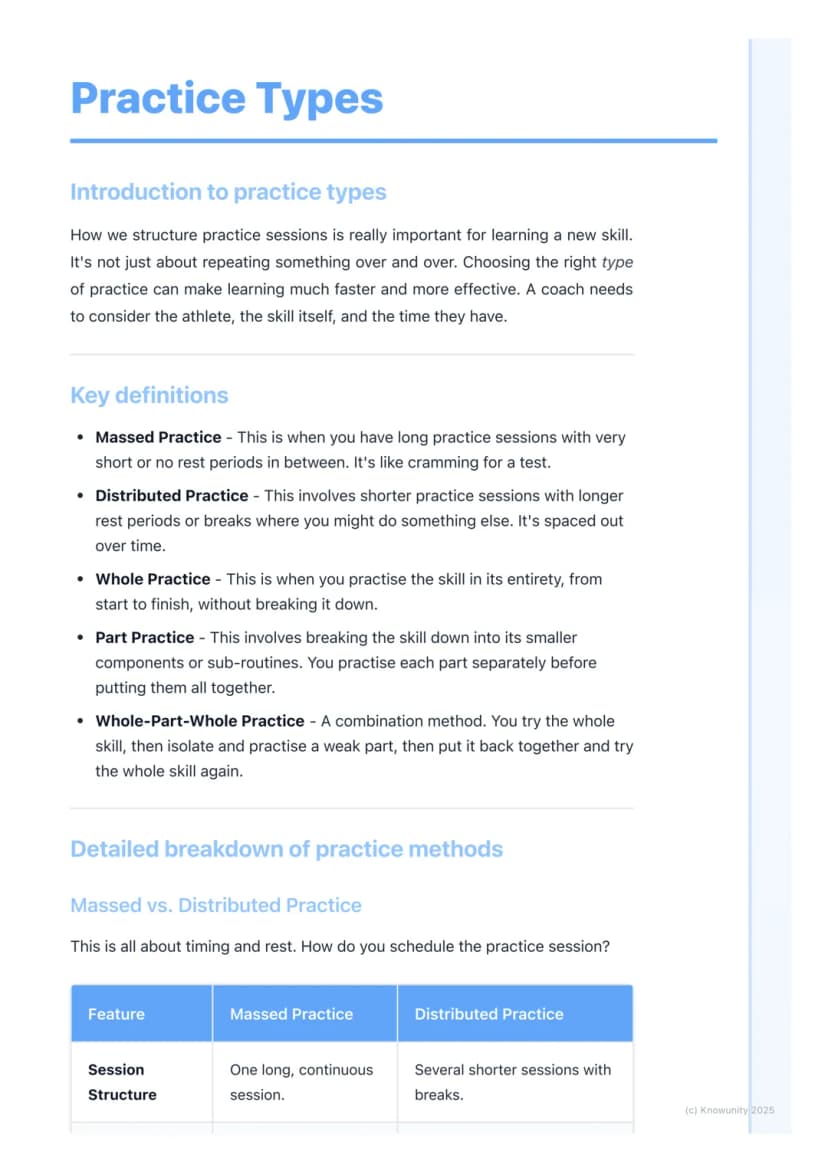
Practice isn't just about repeating something until you're sick of it. How you structure your training sessions massively affects how quickly you'll learn new skills and how well you'll perform under pressure.
Coaches need to think about three key things when planning practice: the athlete (are they a beginner or experienced?), the skill itself (is it simple or complex?), and the situation (how much time do we have?). Get this right, and learning becomes much more effective.
There are four main ways to organise practice sessions. Massed practice means long sessions with barely any breaks - like cramming for an exam. Distributed practice involves shorter sessions with proper rest periods. Whole practice means doing the complete skill from start to finish, whilst part practice breaks skills down into smaller chunks.
Quick Tip: Most complex sports skills benefit from distributed practice rather than marathon training sessions that leave you exhausted.
2
of 6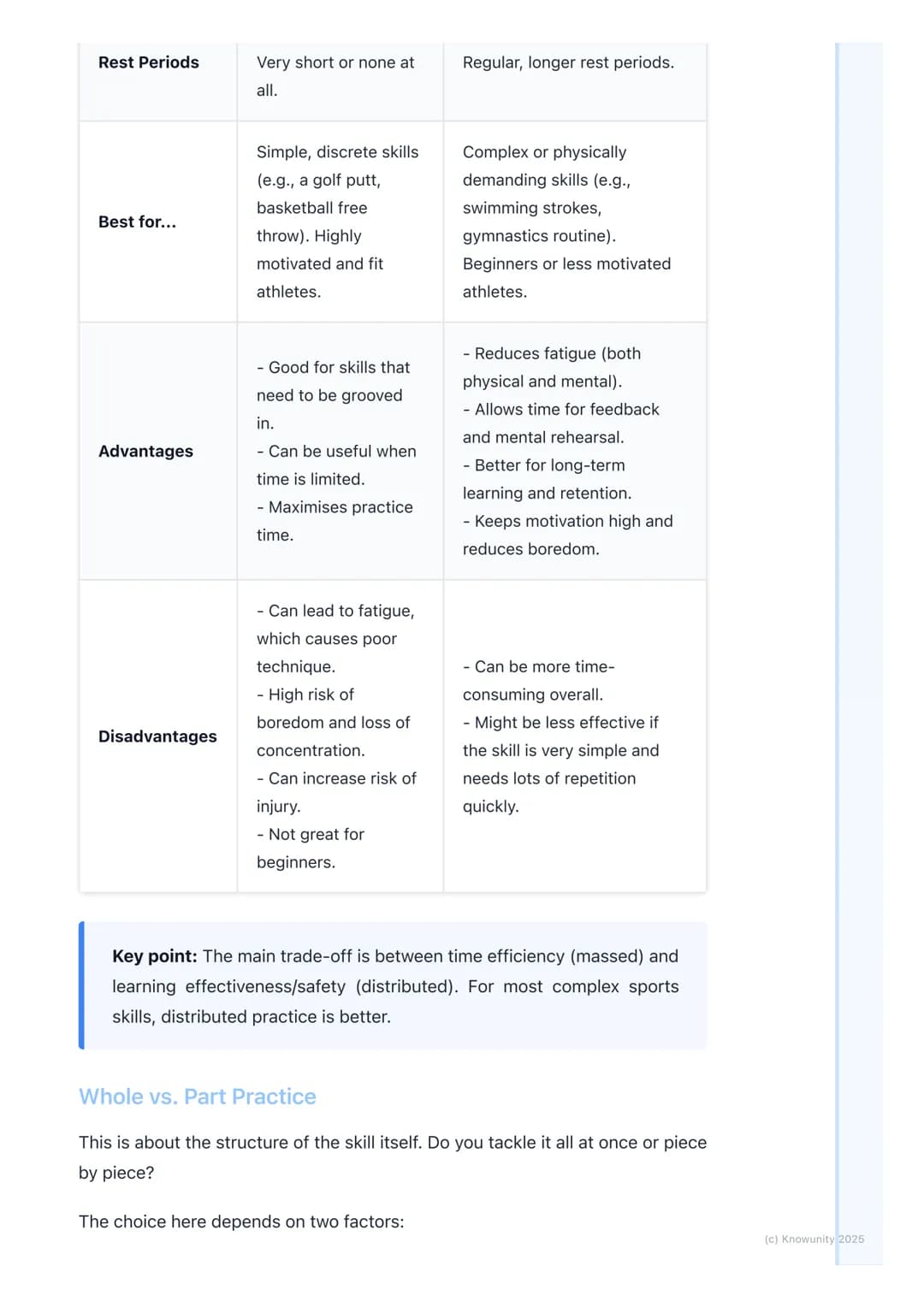
Massed vs. Distributed Practice
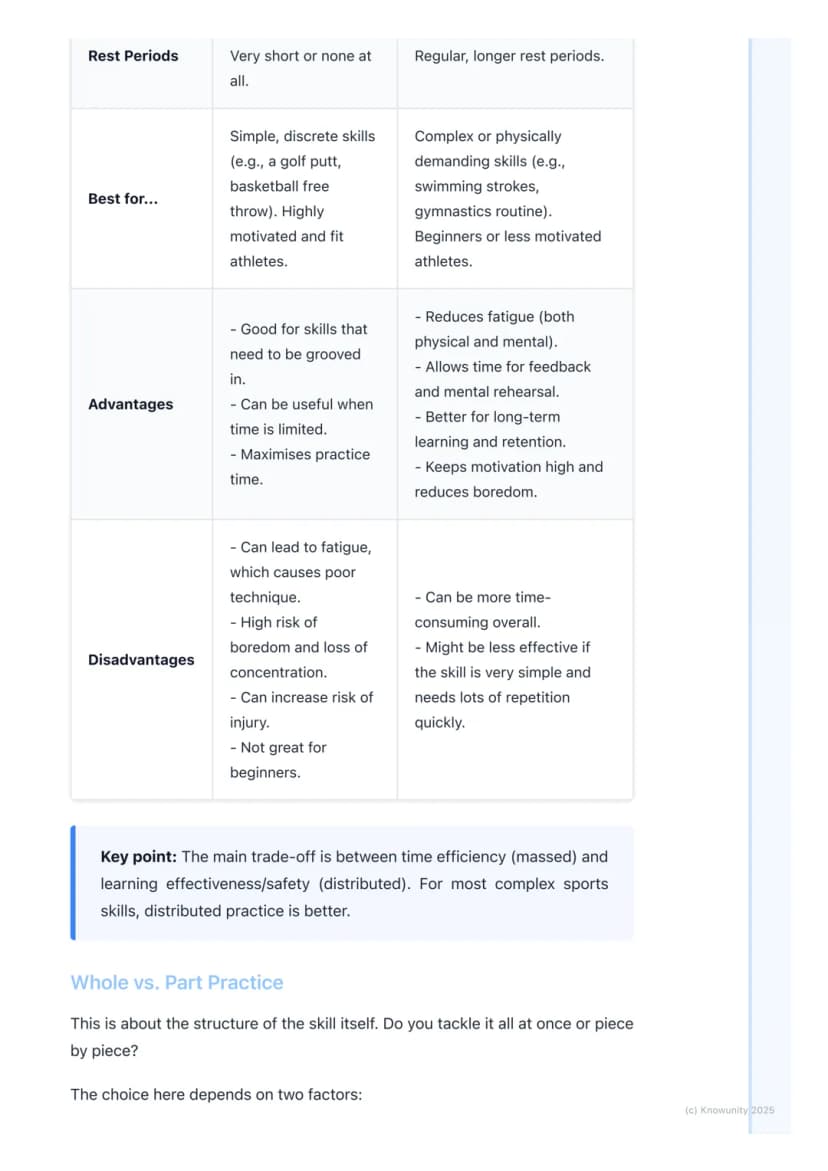
This is all about timing your practice sessions and rest periods. Think of it like the difference between binge-watching an entire series in one night versus watching an episode each evening.
Massed practice works best for simple, discrete skills like free throws or golf putts, especially with highly motivated and fit athletes. You get maximum practice time and can really groove in the movement pattern. However, it's a recipe for disaster with complex skills because fatigue leads to sloppy technique and potential injuries.
Distributed practice is brilliant for complex or physically demanding skills like swimming strokes or gymnastics routines. The regular breaks prevent fatigue, keep motivation high, and give time for feedback and mental rehearsal. Yes, it takes more time overall, but the learning quality is much better.
The key trade-off is simple: massed practice saves time but distributed practice actually works better for learning. For most sports skills you'll encounter, distributed practice is the smarter choice.
Reality Check: If you're getting tired and your technique is falling apart, you're probably doing massed practice when you should be taking breaks.
3
of 6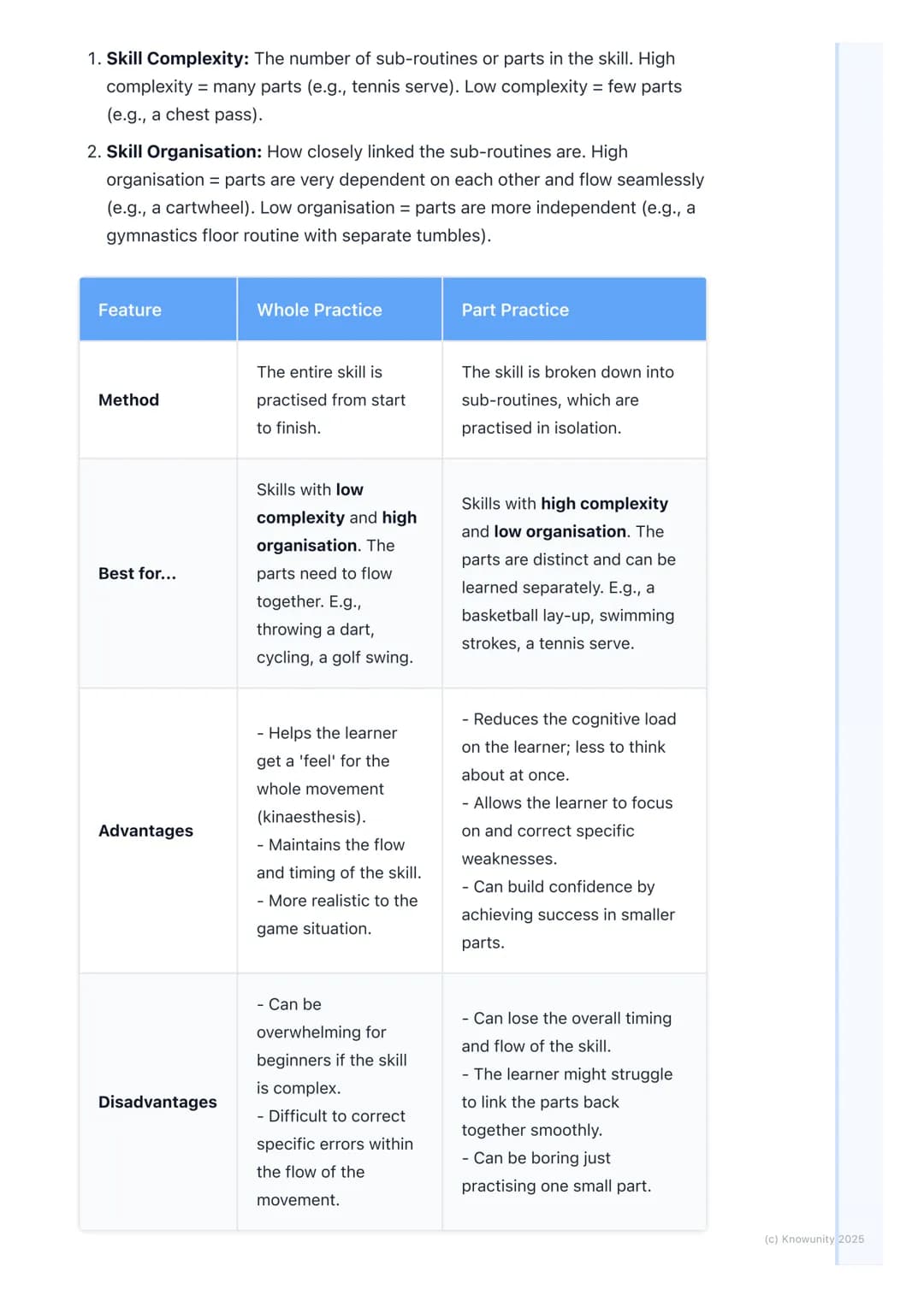
Whole vs. Part Practice
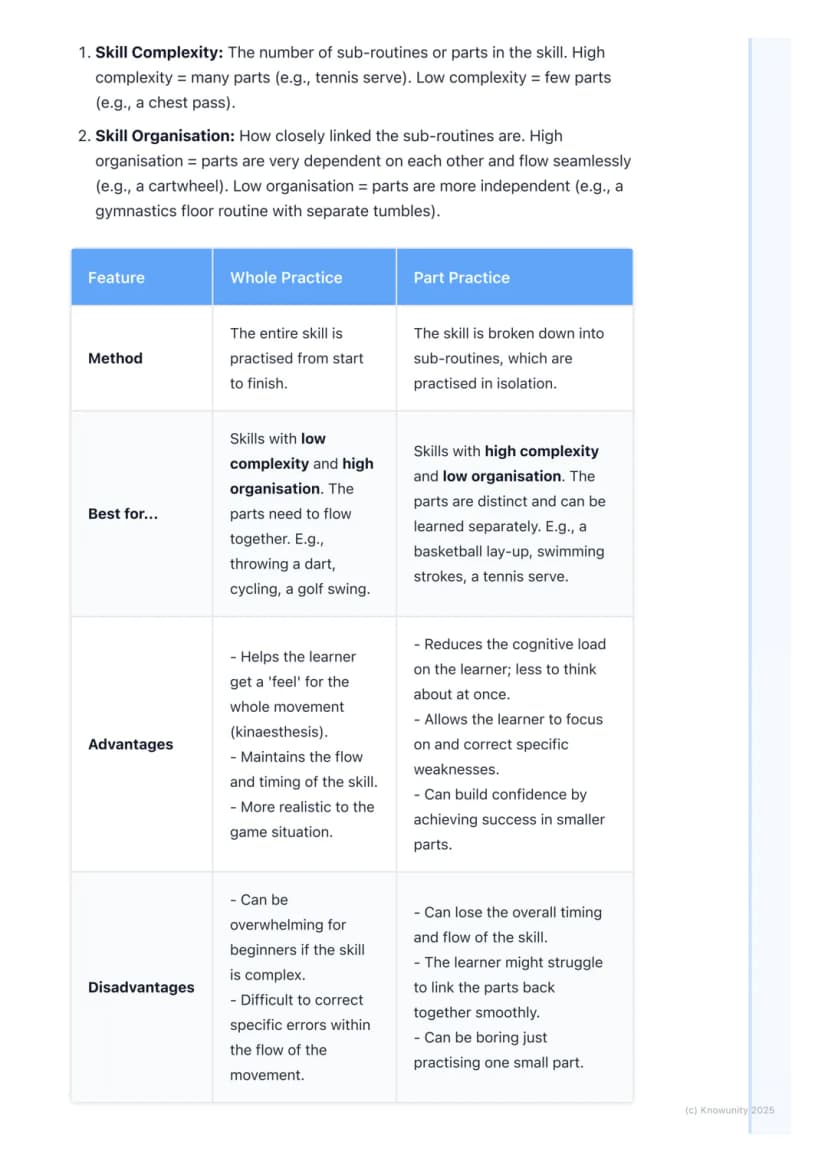
This decision depends on two crucial factors about the skill itself. Skill complexity refers to how many parts or sub-routines the skill has - a tennis serve has loads of parts (high complexity) whilst a chest pass has few (low complexity).
Skill organisation is about how tightly linked these parts are. In a cartwheel, everything flows seamlessly together (high organisation), but in a gymnastics floor routine, you can separate the different tumbles (low organisation).
Whole practice works brilliantly for skills that are simple and flow naturally together. Breaking these down would actually mess up the rhythm and feel of the movement. Think golf swings or penalty kicks - they need to be practised as complete movements.
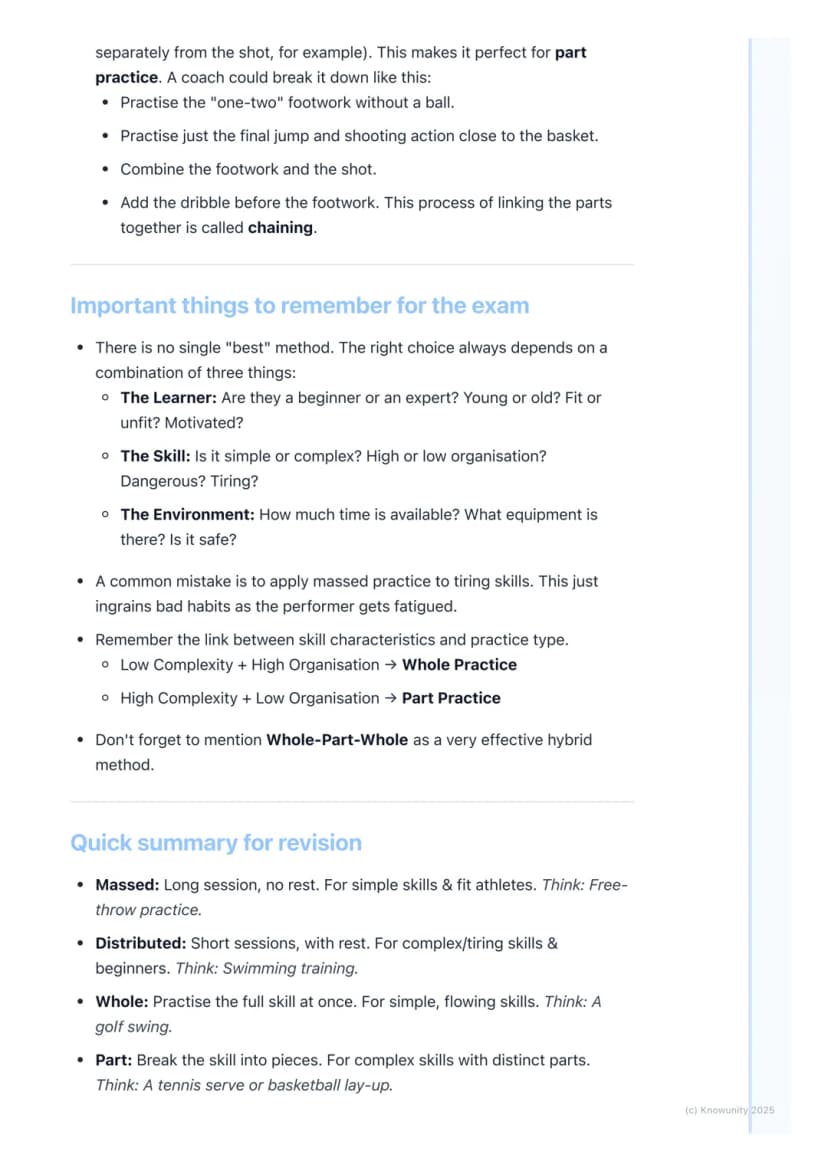
Part practice is perfect for complex skills where the parts can be separated. A basketball lay-up, for example, has distinct elements (dribble, footwork, jump, shoot) that can be practised individually before being linked together through a process called chaining.
Coach's Secret: The sweet spot is often whole-part-whole practice - try the full skill, isolate the weak bit, then put it back together.
4
of 6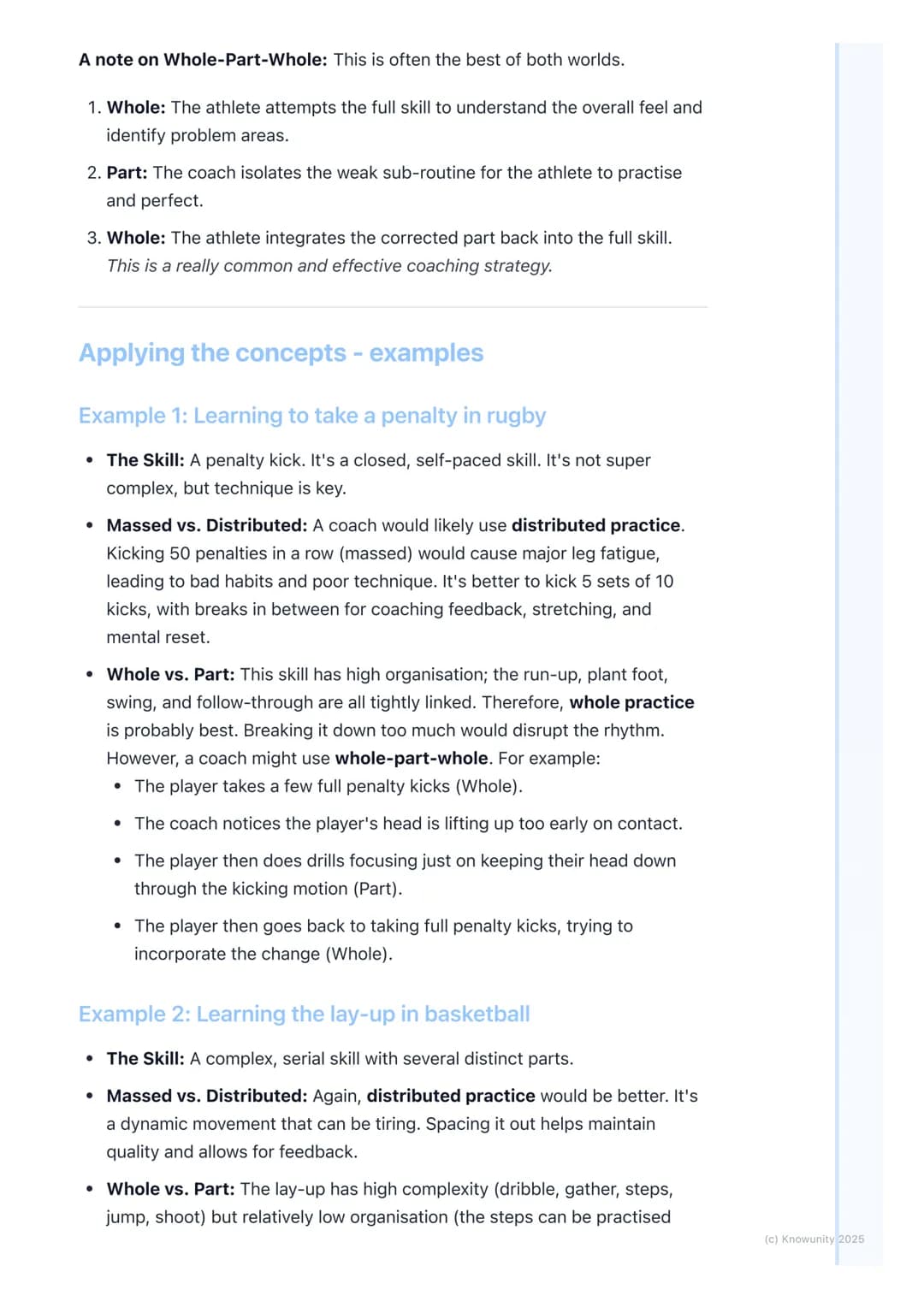
Putting It Into Practice
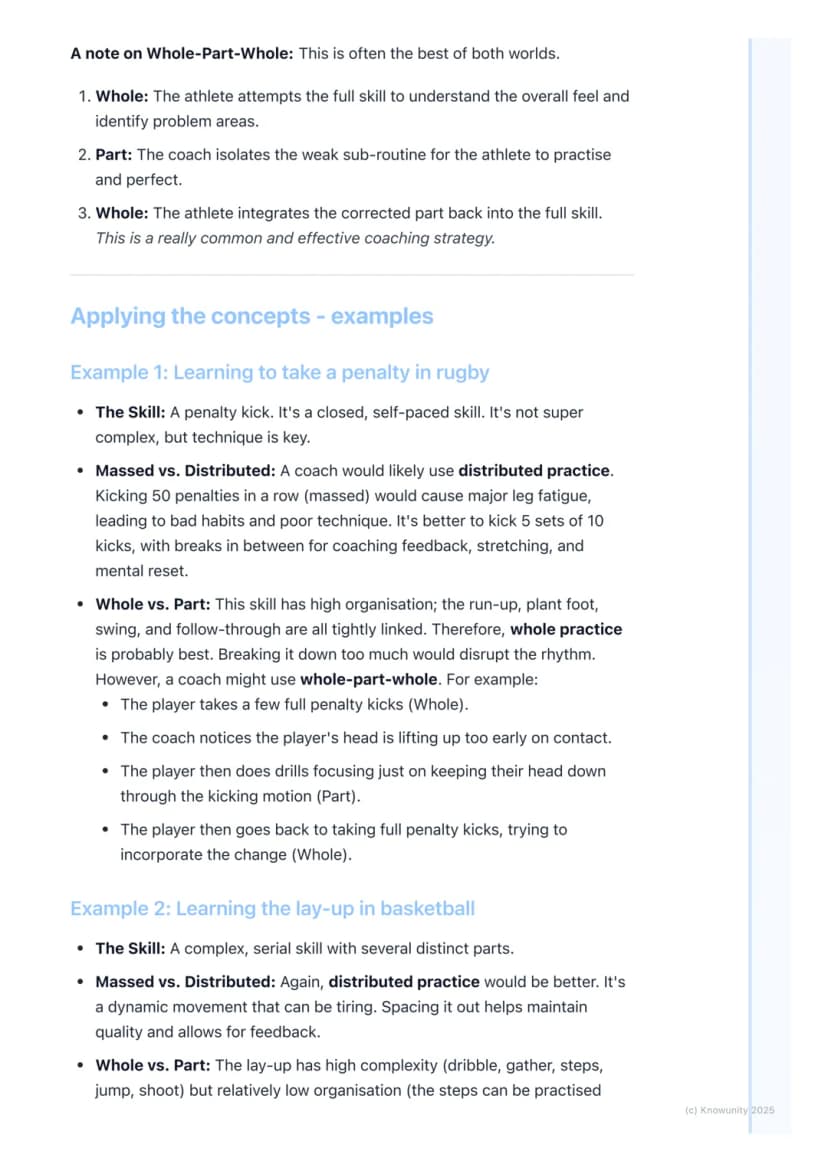
Whole-part-whole practice is often the most effective approach because it combines the benefits of both methods. You start with the complete skill to get the overall feel, isolate any problem areas for focused work, then integrate everything back together.
Let's look at learning a rugby penalty kick. This skill has high organisation (everything flows together), so you'd mainly use whole practice. However, you might use distributed practice with breaks between sets of kicks to prevent leg fatigue and maintain technique quality.
For a basketball lay-up, you'd probably choose part practice because it's highly complex but has parts that can be separated. Start with footwork without the ball, add the shooting motion, then gradually chain everything together including the dribble approach.
The key insight is that there's no universal "best" method. The right choice always depends on matching the practice type to the specific learner, skill, and situation you're dealing with.
Exam Gold: Always consider the learner, the skill characteristics, and the environment when choosing practice methods - mentioning all three shows proper understanding.
5
of 6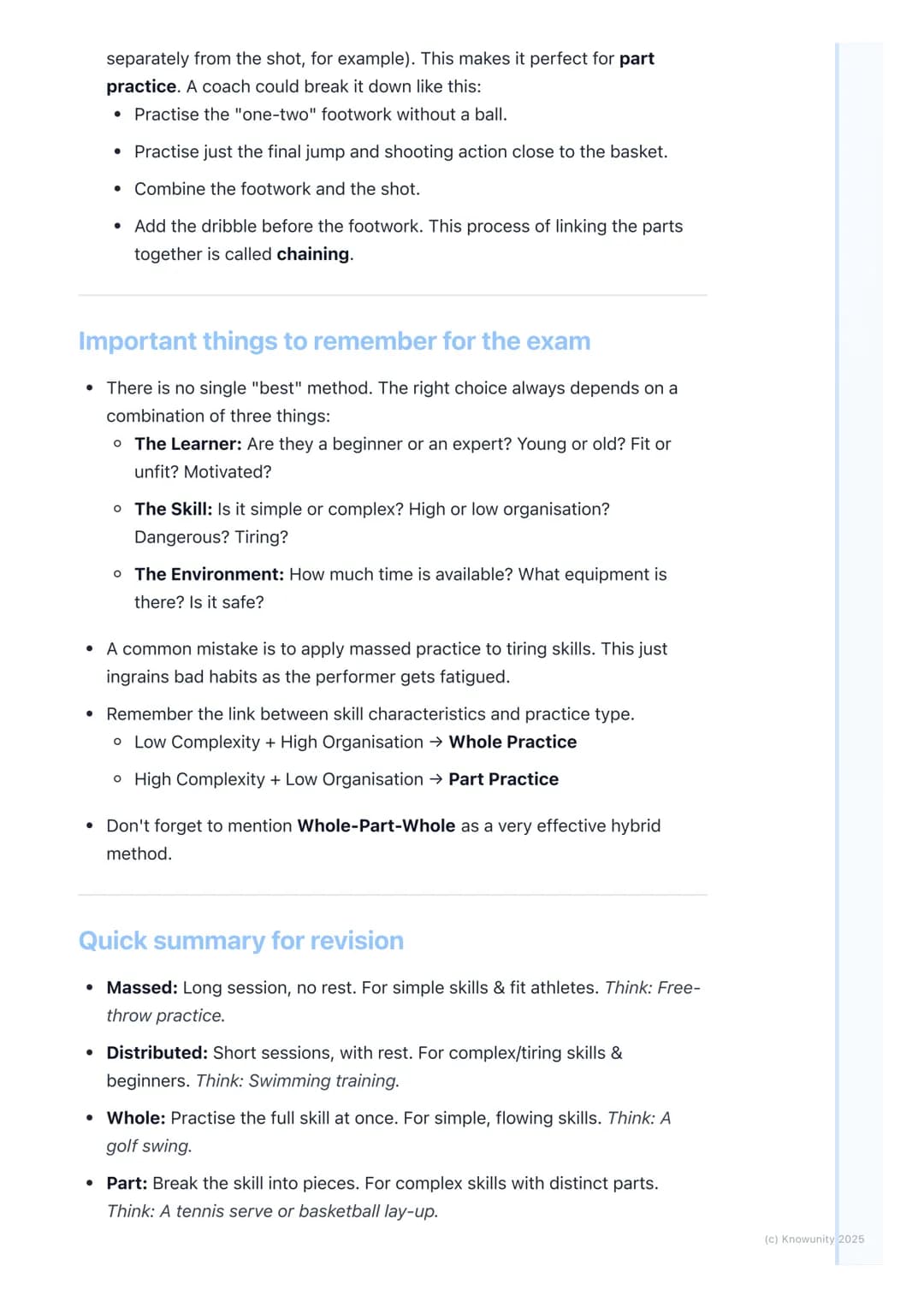
Key Points for Success
Remember that fatigue is the enemy of good technique. A common coaching mistake is using massed practice for tiring skills, which just ingrains bad habits as performance deteriorates. If you're getting tired and making mistakes, take a break.
The connection between skill characteristics and practice choice is crucial: low complexity + high organisation = whole practice, whilst high complexity + low organisation = part practice. This gives you a reliable framework for making decisions.
Distributed practice generally wins out over massed practice for most sports skills because it maintains quality, reduces injury risk, and leads to better long-term learning. The only time massed practice really shines is with very simple skills that need lots of repetition.
Don't forget that whole-part-whole practice is often the most practical solution. It allows athletes to understand the complete skill whilst still addressing specific weaknesses through focused part practice.
Revision Reminder: Think "Free-throw = massed, Swimming = distributed, Golf swing = whole, Tennis serve = part" as quick memory aids for each practice type.
6
of 6
Myśleliśmy, że nigdy nie zapytasz...
Czym jest Towarzysz AI z Knowunity?
Nasz asystent AI jest specjalnie dostosowany do potrzeb uczniów. W oparciu o miliony treści, które mamy na platformie, możemy udzielać uczniom naprawdę znaczących i trafnych odpowiedzi. Ale nie chodzi tylko o odpowiedzi, towarzysz prowadzi również uczniów przez codzienne wyzwania związane z nauką, ze spersonalizowanymi planami nauki, quizami lub treściami na czacie i 100% personalizacją opartą na umiejętnościach i rozwoju uczniów.
Gdzie mogę pobrać aplikację Knowunity?
Aplikację możesz pobrać z Google Play i Apple Store.
Czy aplikacja Knowunity naprawdę jest darmowa?
Tak, masz całkowicie darmowy dostęp do wszystkich notatek w aplikacji, możesz w każdej chwili rozmawiać z Ekspertami lub ich obserwować. Możesz użyć punktów, aby odblokować pewne funkcje w aplikacji, które również możesz otrzymać za darmo. Dodatkowo oferujemy usługę Knowunity Premium, która pozwala na odblokowanie większej liczby funkcji.
Najpopularniejsze notatki z LCPE
4LCPEHealthy Eating Guidelines
This section explores national healthy eating guidelines, such as the food pyramid or healthy eating plate, to promote balanced dietary choices.
5th Year50
LCPEBiomechanics of Movement
Applying fundamental biomechanical principles such as force, motion, levers, and stability to analyse and improve human movement efficiency and performance in sport.
6th Year200
LCPEFactors effecting sports psychology ( confidence and self efficacy)
Higher Level LCPE psychological preprration notes
5th Year230
LCPETechnology in Sport
Investigating how technology is used in areas such as performance analysis, equipment design, officiating, and athlete monitoring to enhance training and competition.
6th Year50
Najpopularniejsze notatki
9 Irish
IrishIrish oral questions and answers
Questions and answers for the leaving cert oral
5th Year4264
 English
Key Quotes : Sive
Key Quotes and explanations: Sive
6th Year2842
IrishIrish oral questions
Outline of oral questions
5th Year2055
IrishIníon- le hÁine Durkin
Aine Durkin’s poem, Iníon: Themes & summary
5th Year890
IrishIrish poetry 2027
Iníon + Dínit an Bhróin
5th Year1153
IrishLC HL notes- Iníon (poem)
Includes poem in English and Irish, theme, key words & phrases
5th Year2304
EnglishCultural Context : Shawshank Redemption : Sive : Small Things Like These
Comparative Study : Cultural Context : Shawshank Redemption, Sive and Small Things Like These
6th Year1430
IrishMo Ghrá-sa (Idir Lúibíní)
Notes on mo ghrá-sa
5th Year380
IrishAn Gaeilge Aiste
Irish Language essay
6th Year1320
Nie ma nic odpowiedniego? Sprawdź inne przedmioty.
Zobacz, co mówią o nas nasi użytkownicy. Pokochali nas — pokochasz też i Ty.
4.6/5App Store
4.7/5Google Play
Aplikacja jest bardzo prosta i dobrze przemyślana. Do tej pory znalazłem wszystko, czego szukałem i mogłem się wiele nauczyć z innych notatek! Na pewno wykorzystam aplikację do pomocy przy robieniu prac domowych! No i oczywiście bardzo pomaga też jako inspiracja do robienia swoich notatek.
Stefan Sużytkownik iOS
Ta aplikacja jest naprawdę świetna. Jest tak wiele notatek i pomocnych informacji [...]. Moim problematycznym przedmiotem jest język niemiecki, a w aplikacji jest w czym wybierać. Dzięki tej aplikacji poprawiłam swój niemiecki. Polecam ją każdemu.
Samantha Klichużytkownik Androida
Wow, jestem w szoku. Właśnie wypróbowałam aplikację, ponieważ widziałam ją kilka razy reklamowaną na TikToku jestem absolutnie w szoku. Ta aplikacja jest POMOCĄ, której potrzebujesz w szkole i przede wszystkim oferuje tak wiele rzeczy jak notatki czy streszczenia, które są BARDZO pomocne w moim przypadku.
Annaużytkownik iOS
LCPE1 wyświetleń·Zaktualizowano Jun 14, 2026·6 stronyTypes of Practice Methods
Ever wondered why some training sessions feel like torture whilst others actually help you improve? The secret lies in how coaches structure practice sessions. Choosing the right practice method can make the difference between mastering a skill quickly or getting...
1
of 6
Zarejestruj się, aby zobaczyć notatkę. To nic nie kosztuje!
- Dostęp do wszystkich materiałów
- Popraw swoje oceny
- Dołącz do milionów studentów
Introduction to Practice Types
Practice isn't just about repeating something until you're sick of it. How you structure your training sessions massively affects how quickly you'll learn new skills and how well you'll perform under pressure.
Coaches need to think about three key things when planning practice: the athlete (are they a beginner or experienced?), the skill itself (is it simple or complex?), and the situation (how much time do we have?). Get this right, and learning becomes much more effective.
There are four main ways to organise practice sessions. Massed practice means long sessions with barely any breaks - like cramming for an exam. Distributed practice involves shorter sessions with proper rest periods. Whole practice means doing the complete skill from start to finish, whilst part practice breaks skills down into smaller chunks.
Quick Tip: Most complex sports skills benefit from distributed practice rather than marathon training sessions that leave you exhausted.
2
of 6Zarejestruj się, aby zobaczyć notatkę. To nic nie kosztuje!
- Dostęp do wszystkich materiałów
- Popraw swoje oceny
- Dołącz do milionów studentów
Massed vs. Distributed Practice
This is all about timing your practice sessions and rest periods. Think of it like the difference between binge-watching an entire series in one night versus watching an episode each evening.
Massed practice works best for simple, discrete skills like free throws or golf putts, especially with highly motivated and fit athletes. You get maximum practice time and can really groove in the movement pattern. However, it's a recipe for disaster with complex skills because fatigue leads to sloppy technique and potential injuries.
Distributed practice is brilliant for complex or physically demanding skills like swimming strokes or gymnastics routines. The regular breaks prevent fatigue, keep motivation high, and give time for feedback and mental rehearsal. Yes, it takes more time overall, but the learning quality is much better.
The key trade-off is simple: massed practice saves time but distributed practice actually works better for learning. For most sports skills you'll encounter, distributed practice is the smarter choice.
Reality Check: If you're getting tired and your technique is falling apart, you're probably doing massed practice when you should be taking breaks.
3
of 6Zarejestruj się, aby zobaczyć notatkę. To nic nie kosztuje!
- Dostęp do wszystkich materiałów
- Popraw swoje oceny
- Dołącz do milionów studentów
Whole vs. Part Practice
This decision depends on two crucial factors about the skill itself. Skill complexity refers to how many parts or sub-routines the skill has - a tennis serve has loads of parts (high complexity) whilst a chest pass has few (low complexity).
Skill organisation is about how tightly linked these parts are. In a cartwheel, everything flows seamlessly together (high organisation), but in a gymnastics floor routine, you can separate the different tumbles (low organisation).
Whole practice works brilliantly for skills that are simple and flow naturally together. Breaking these down would actually mess up the rhythm and feel of the movement. Think golf swings or penalty kicks - they need to be practised as complete movements.
Part practice is perfect for complex skills where the parts can be separated. A basketball lay-up, for example, has distinct elements (dribble, footwork, jump, shoot) that can be practised individually before being linked together through a process called chaining.
Coach's Secret: The sweet spot is often whole-part-whole practice - try the full skill, isolate the weak bit, then put it back together.
4
of 6Zarejestruj się, aby zobaczyć notatkę. To nic nie kosztuje!
- Dostęp do wszystkich materiałów
- Popraw swoje oceny
- Dołącz do milionów studentów
Putting It Into Practice
Whole-part-whole practice is often the most effective approach because it combines the benefits of both methods. You start with the complete skill to get the overall feel, isolate any problem areas for focused work, then integrate everything back together.
Let's look at learning a rugby penalty kick. This skill has high organisation (everything flows together), so you'd mainly use whole practice. However, you might use distributed practice with breaks between sets of kicks to prevent leg fatigue and maintain technique quality.
For a basketball lay-up, you'd probably choose part practice because it's highly complex but has parts that can be separated. Start with footwork without the ball, add the shooting motion, then gradually chain everything together including the dribble approach.
The key insight is that there's no universal "best" method. The right choice always depends on matching the practice type to the specific learner, skill, and situation you're dealing with.
Exam Gold: Always consider the learner, the skill characteristics, and the environment when choosing practice methods - mentioning all three shows proper understanding.
5
of 6Zarejestruj się, aby zobaczyć notatkę. To nic nie kosztuje!
- Dostęp do wszystkich materiałów
- Popraw swoje oceny
- Dołącz do milionów studentów
Key Points for Success
Remember that fatigue is the enemy of good technique. A common coaching mistake is using massed practice for tiring skills, which just ingrains bad habits as performance deteriorates. If you're getting tired and making mistakes, take a break.
The connection between skill characteristics and practice choice is crucial: low complexity + high organisation = whole practice, whilst high complexity + low organisation = part practice. This gives you a reliable framework for making decisions.
Distributed practice generally wins out over massed practice for most sports skills because it maintains quality, reduces injury risk, and leads to better long-term learning. The only time massed practice really shines is with very simple skills that need lots of repetition.
Don't forget that whole-part-whole practice is often the most practical solution. It allows athletes to understand the complete skill whilst still addressing specific weaknesses through focused part practice.
Revision Reminder: Think "Free-throw = massed, Swimming = distributed, Golf swing = whole, Tennis serve = part" as quick memory aids for each practice type.
6
of 6Zarejestruj się, aby zobaczyć notatkę. To nic nie kosztuje!
- Dostęp do wszystkich materiałów
- Popraw swoje oceny
- Dołącz do milionów studentów
Myśleliśmy, że nigdy nie zapytasz...
Czym jest Towarzysz AI z Knowunity?
Nasz asystent AI jest specjalnie dostosowany do potrzeb uczniów. W oparciu o miliony treści, które mamy na platformie, możemy udzielać uczniom naprawdę znaczących i trafnych odpowiedzi. Ale nie chodzi tylko o odpowiedzi, towarzysz prowadzi również uczniów przez codzienne wyzwania związane z nauką, ze spersonalizowanymi planami nauki, quizami lub treściami na czacie i 100% personalizacją opartą na umiejętnościach i rozwoju uczniów.
Gdzie mogę pobrać aplikację Knowunity?
Aplikację możesz pobrać z Google Play i Apple Store.
Czy aplikacja Knowunity naprawdę jest darmowa?
Tak, masz całkowicie darmowy dostęp do wszystkich notatek w aplikacji, możesz w każdej chwili rozmawiać z Ekspertami lub ich obserwować. Możesz użyć punktów, aby odblokować pewne funkcje w aplikacji, które również możesz otrzymać za darmo. Dodatkowo oferujemy usługę Knowunity Premium, która pozwala na odblokowanie większej liczby funkcji.
Najpopularniejsze notatki z LCPE
4LCPEHealthy Eating Guidelines
This section explores national healthy eating guidelines, such as the food pyramid or healthy eating plate, to promote balanced dietary choices.
5th Year50
LCPEBiomechanics of Movement
Applying fundamental biomechanical principles such as force, motion, levers, and stability to analyse and improve human movement efficiency and performance in sport.
6th Year200
LCPEFactors effecting sports psychology ( confidence and self efficacy)
Higher Level LCPE psychological preprration notes
5th Year230
LCPETechnology in Sport
Investigating how technology is used in areas such as performance analysis, equipment design, officiating, and athlete monitoring to enhance training and competition.
6th Year50
Najpopularniejsze notatki
9IrishIrish oral questions and answers
Questions and answers for the leaving cert oral
5th Year4264
EnglishKey Quotes : Sive
Key Quotes and explanations: Sive
6th Year2842
IrishIrish oral questions
Outline of oral questions
5th Year2055
IrishIníon- le hÁine Durkin
Aine Durkin’s poem, Iníon: Themes & summary
5th Year890
IrishIrish poetry 2027
Iníon + Dínit an Bhróin
5th Year1153
IrishLC HL notes- Iníon (poem)
Includes poem in English and Irish, theme, key words & phrases
5th Year2304
EnglishCultural Context : Shawshank Redemption : Sive : Small Things Like These
Comparative Study : Cultural Context : Shawshank Redemption, Sive and Small Things Like These
6th Year1430
IrishMo Ghrá-sa (Idir Lúibíní)
Notes on mo ghrá-sa
5th Year380
IrishAn Gaeilge Aiste
Irish Language essay
6th Year1320
Nie ma nic odpowiedniego? Sprawdź inne przedmioty.
Zobacz, co mówią o nas nasi użytkownicy. Pokochali nas — pokochasz też i Ty.
4.6/5App Store
4.7/5Google Play
Aplikacja jest bardzo prosta i dobrze przemyślana. Do tej pory znalazłem wszystko, czego szukałem i mogłem się wiele nauczyć z innych notatek! Na pewno wykorzystam aplikację do pomocy przy robieniu prac domowych! No i oczywiście bardzo pomaga też jako inspiracja do robienia swoich notatek.
Stefan Sużytkownik iOS
Ta aplikacja jest naprawdę świetna. Jest tak wiele notatek i pomocnych informacji [...]. Moim problematycznym przedmiotem jest język niemiecki, a w aplikacji jest w czym wybierać. Dzięki tej aplikacji poprawiłam swój niemiecki. Polecam ją każdemu.
Samantha Klichużytkownik Androida
Wow, jestem w szoku. Właśnie wypróbowałam aplikację, ponieważ widziałam ją kilka razy reklamowaną na TikToku jestem absolutnie w szoku. Ta aplikacja jest POMOCĄ, której potrzebujesz w szkole i przede wszystkim oferuje tak wiele rzeczy jak notatki czy streszczenia, które są BARDZO pomocne w moim przypadku.
Annaużytkownik iOS