
Probability is everywhere in your life - from the chance... Pokaż więcej
 Mathematics8 wyświetleń·Zaktualizowano May 29, 2026·5 strony
Understanding Basic Probability Concepts
1 / 5
1
of 5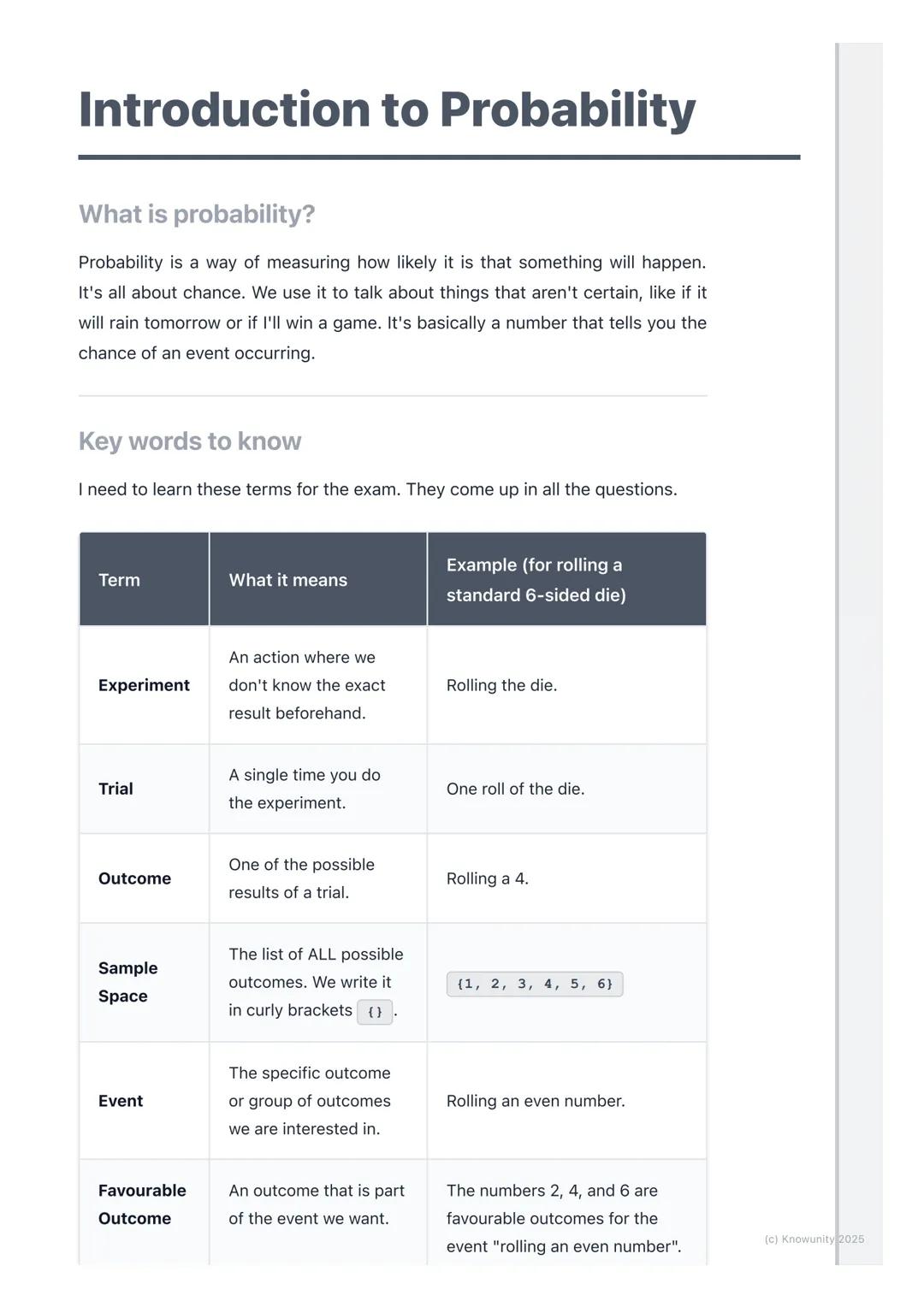
What is Probability?
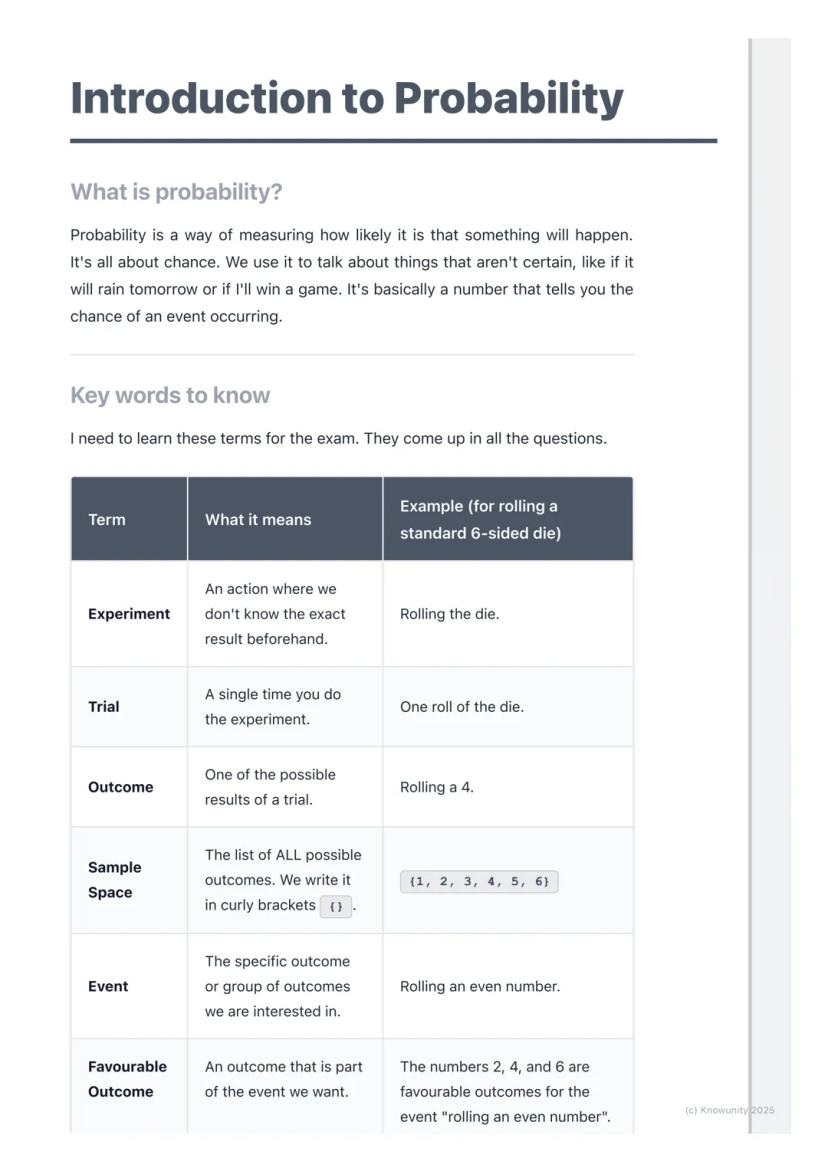
Ever wondered how to work out if something will actually happen? Probability gives you the answer by measuring chance using numbers. It's perfect for situations where you can't be 100% certain of the outcome.
Before diving into calculations, you need to master some key terms that'll pop up in every exam question. An experiment is any action where you don't know the exact result beforehand, like rolling a die. Each single attempt is called a trial.
The sample space lists every possible result in curly brackets - for a standard die, that's {1, 2, 3, 4, 5, 6}. An outcome is just one specific result, whilst an event is what you're actually interested in finding out about.
Quick Tip: Always start by writing down your sample space - it helps you spot all the possibilities and avoid missing any!
2
of 5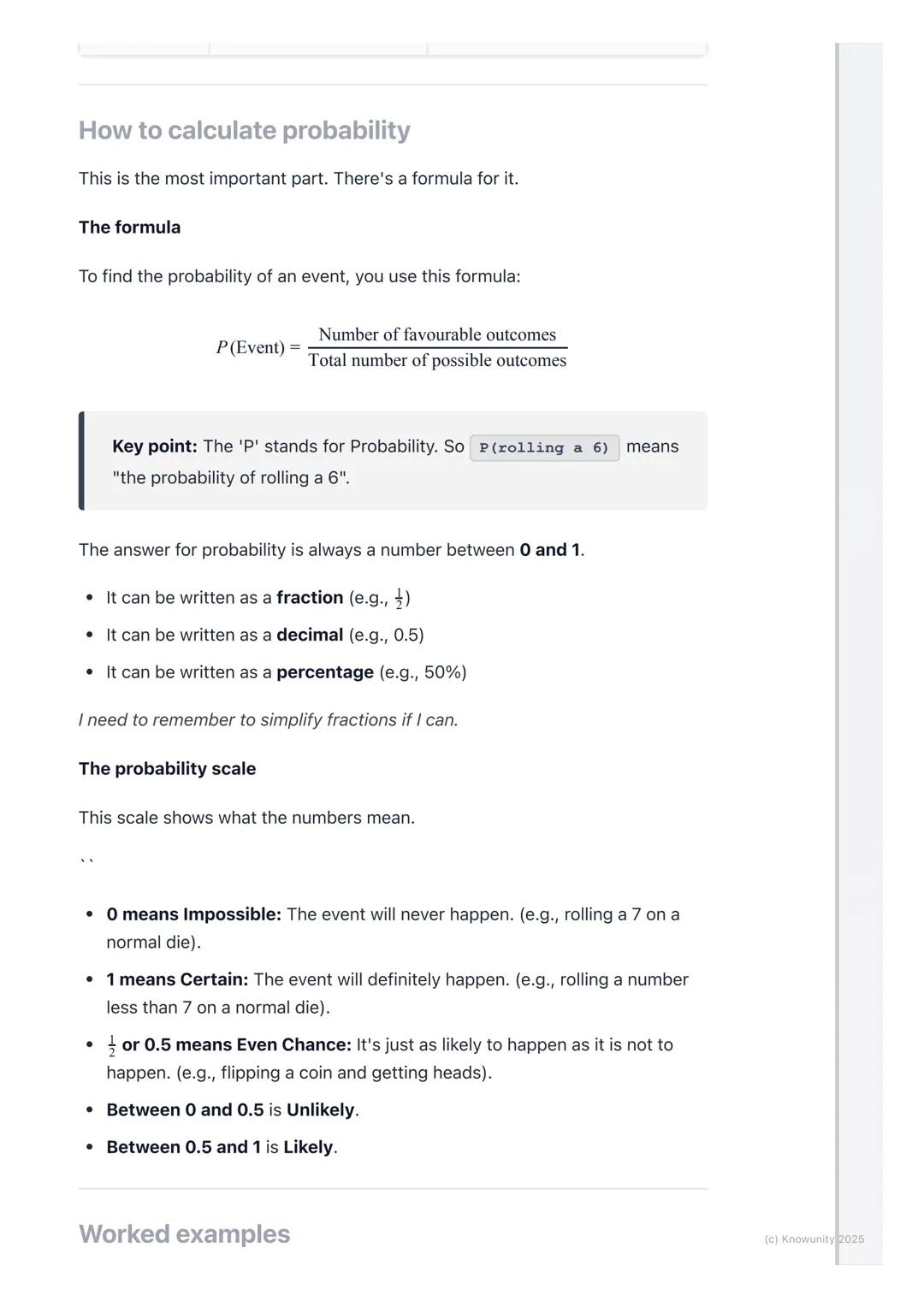
The Probability Formula
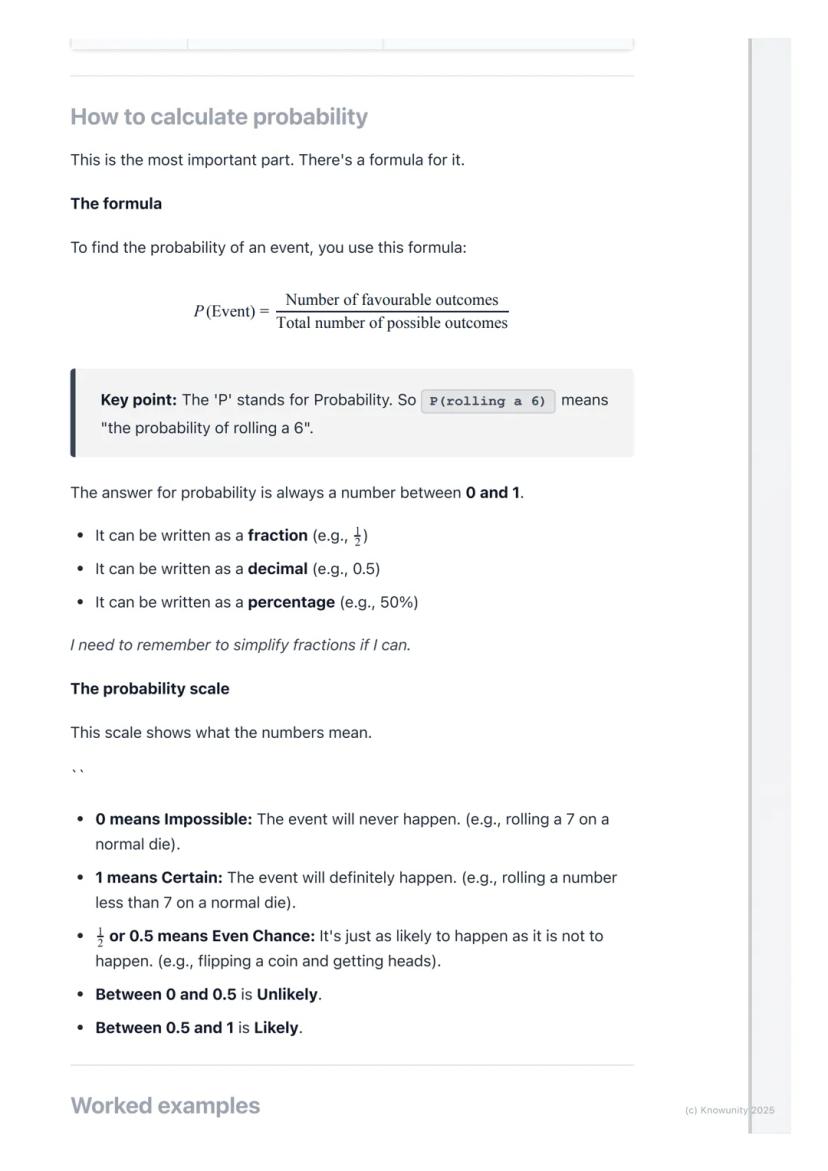
Here's the formula that'll solve every probability problem you'll face: P(Event) = Number of favourable outcomes ÷ Total number of possible outcomes. The 'P' simply stands for probability, so P(rolling a 6) means "the probability of rolling a 6".
Your answer will always be a number between 0 and 1. You can write it as a fraction, decimal, or percentage - just remember to simplify fractions when possible.
The probability scale is dead useful for understanding what your answers mean. 0 means impossible (like rolling a 7 on a normal die), whilst 1 means certain (like rolling less than 7). If you get 0.5, that's an even chance - exactly like flipping a coin.
Remember: Numbers between 0 and 0.5 are unlikely, whilst numbers between 0.5 and 1 are likely to happen.
3
of 5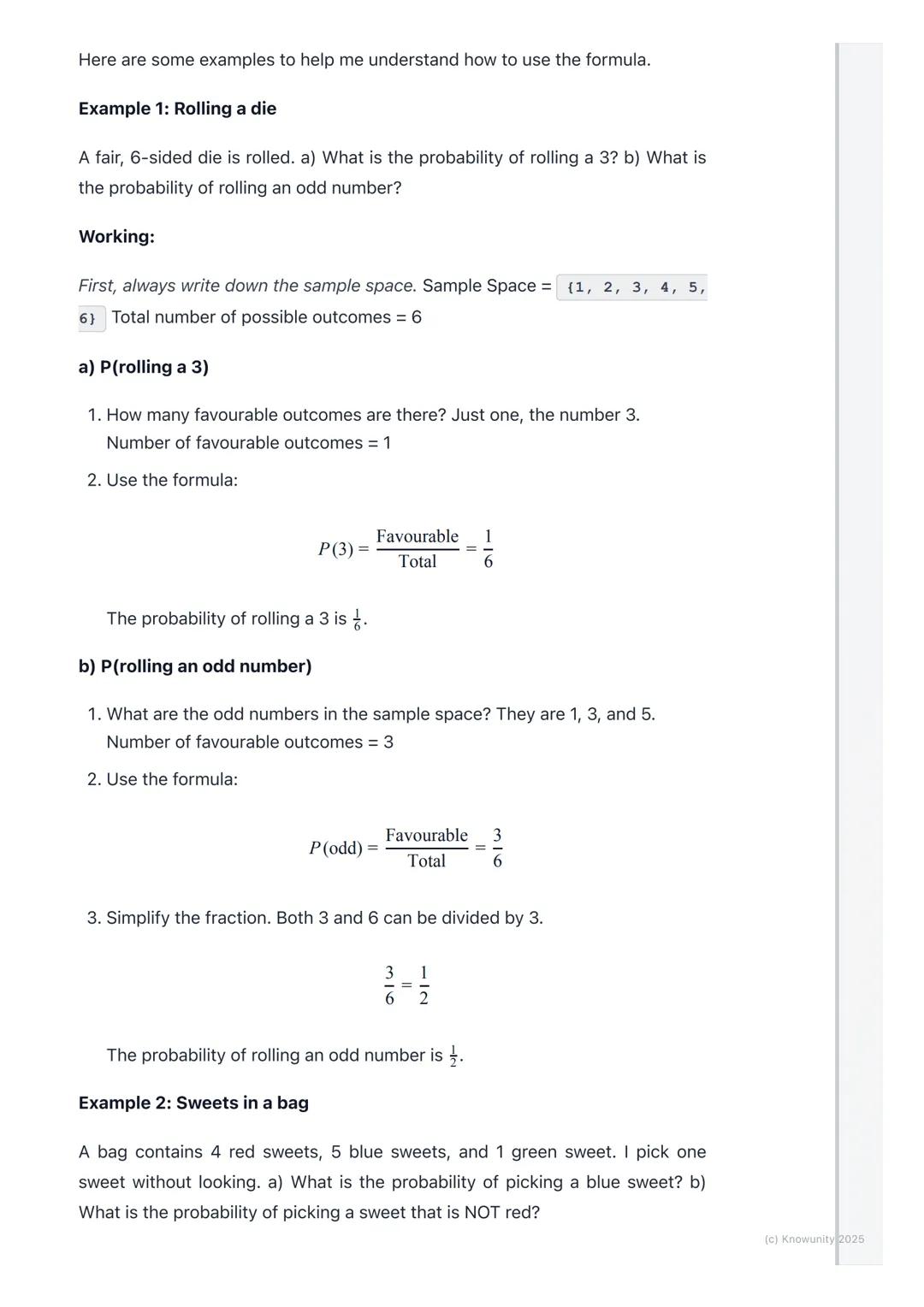
Working Through Examples
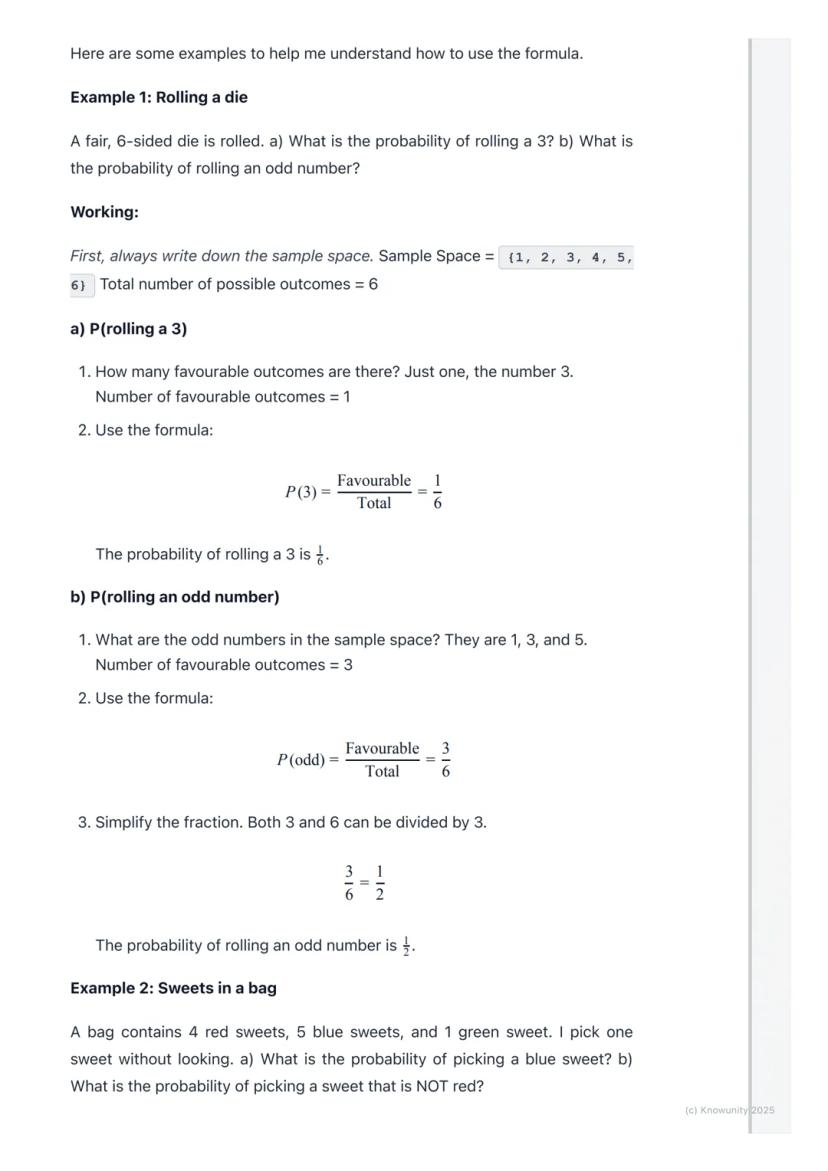
Let's tackle a classic die problem to see the formula in action. When rolling a fair 6-sided die, always start by writing your sample space: {1, 2, 3, 4, 5, 6}, giving you 6 total possible outcomes.
For finding P(rolling a 3), there's only one favourable outcome (the number 3), so you get 1÷6 = 1/6. For P(rolling an odd number), count the odd numbers: 1, 3, and 5 give you 3 favourable outcomes, so 3÷6 = 1/2 after simplifying.
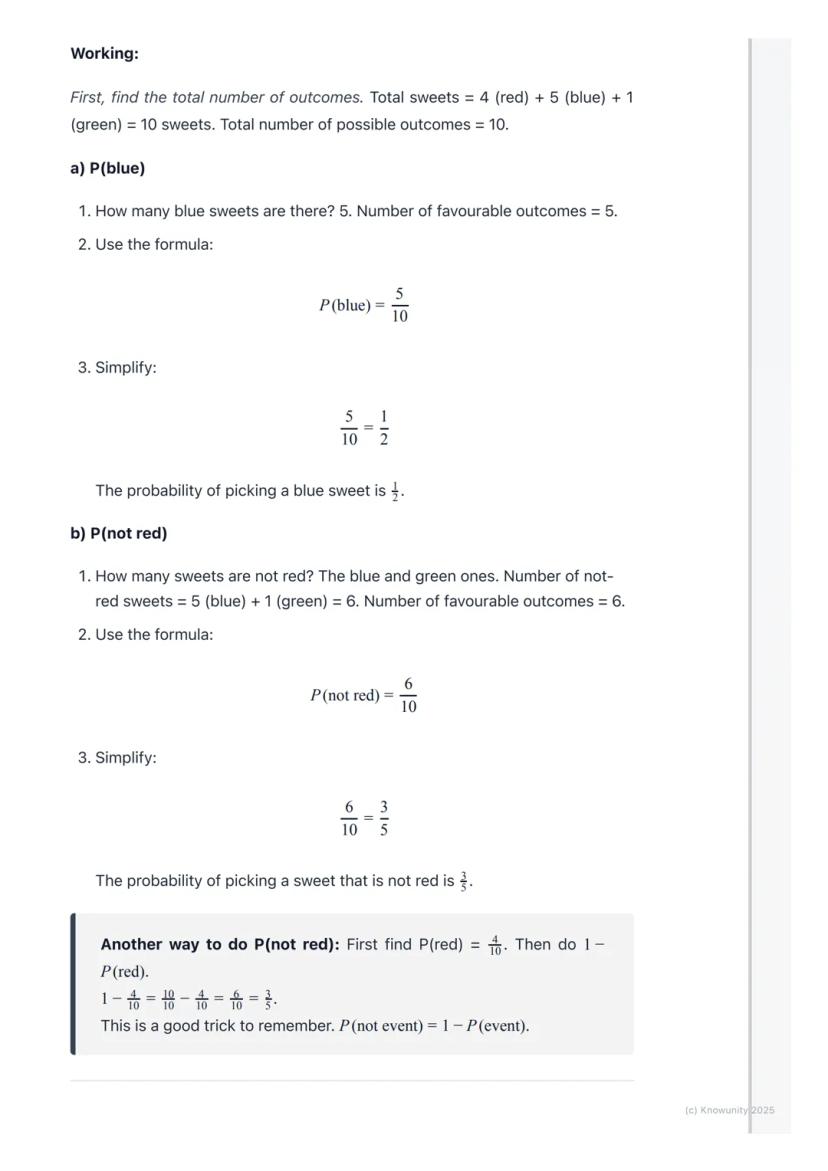
Sweet problems work exactly the same way. With 4 red, 5 blue, and 1 green sweet (10 total), P(blue) = 5÷10 = 1/2. The key is always counting your total first, then identifying what counts as "favourable" for your specific question.
Pro Tip: For "not red" events, you can either count non-red sweets directly, or use the shortcut: 1 - P(red) = 1 - 4/10 = 6/10 = 3/5.
4
of 5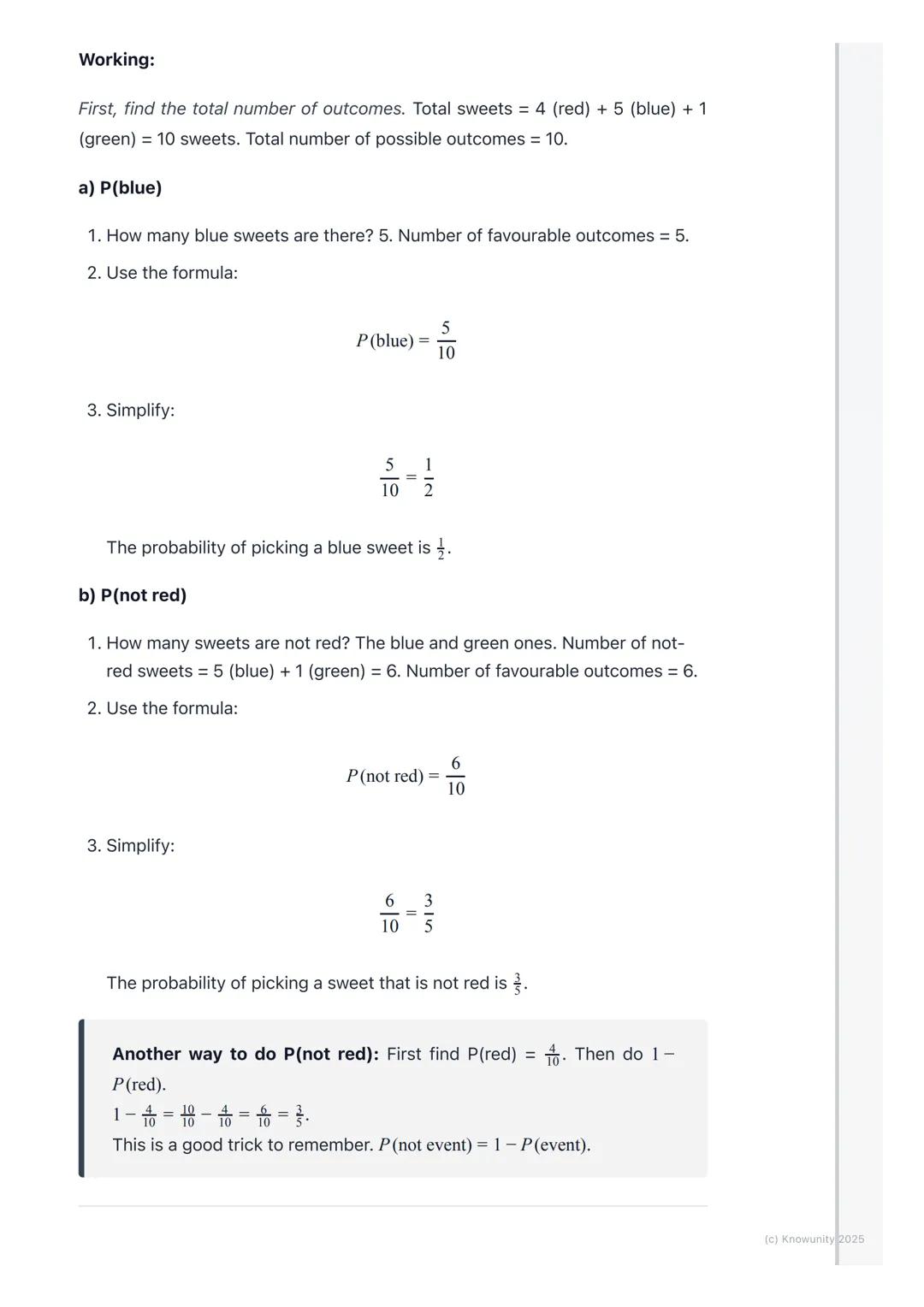
Advanced Techniques and Shortcuts
The "1 minus" trick is brilliant for complementary events. Instead of counting everything that's "not red", just work out P(red) first, then subtract from 1. This method often saves time and reduces mistakes.
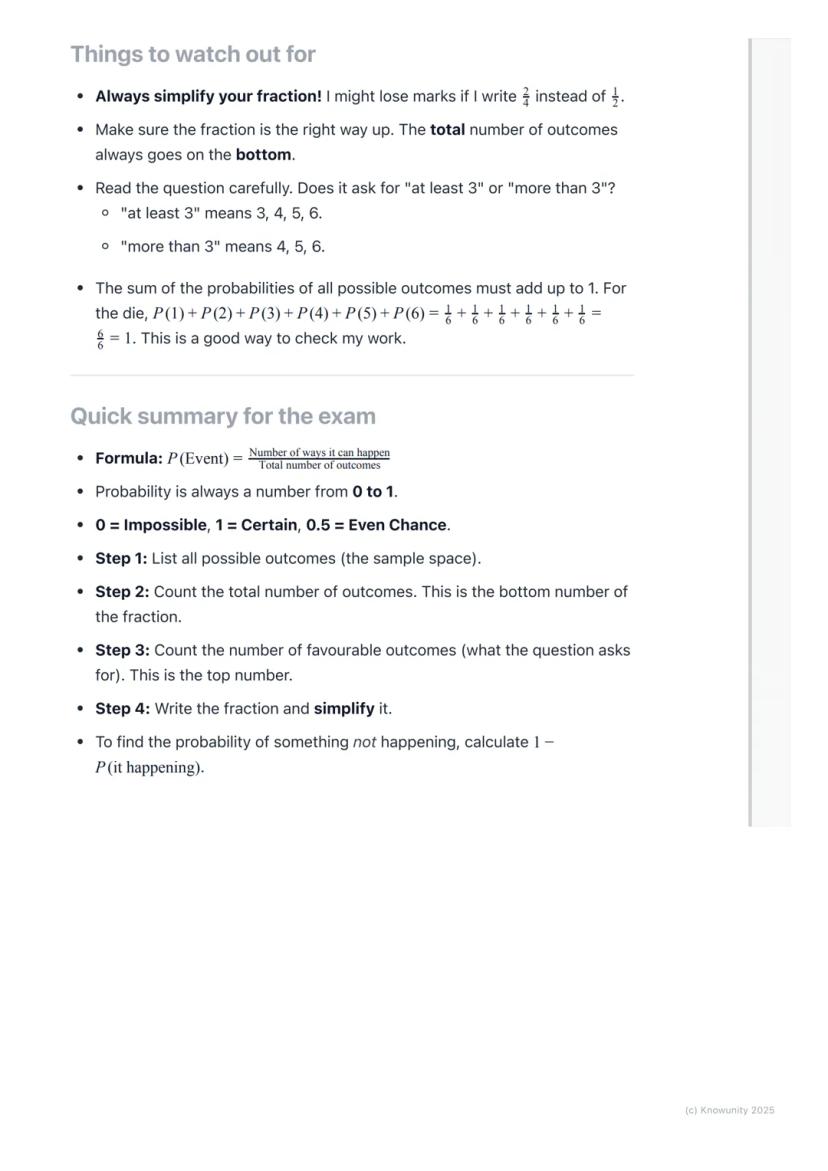
Watch out for tricky wording in questions. "At least 3" includes 3, 4, 5, and 6, whilst "more than 3" only includes 4, 5, and 6. These small differences can completely change your answer.
Here's a clever way to check your work: all probabilities for every possible outcome must add up to 1. For a die, P(1) + P(2) + P(3) + P(4) + P(5) + P(6) = 6 × 1/6 = 1. If your total doesn't equal 1, you've made an error somewhere.
Check Yourself: Always verify that your fraction is the right way up - total outcomes go on the bottom, favourable outcomes on top!
5
of 5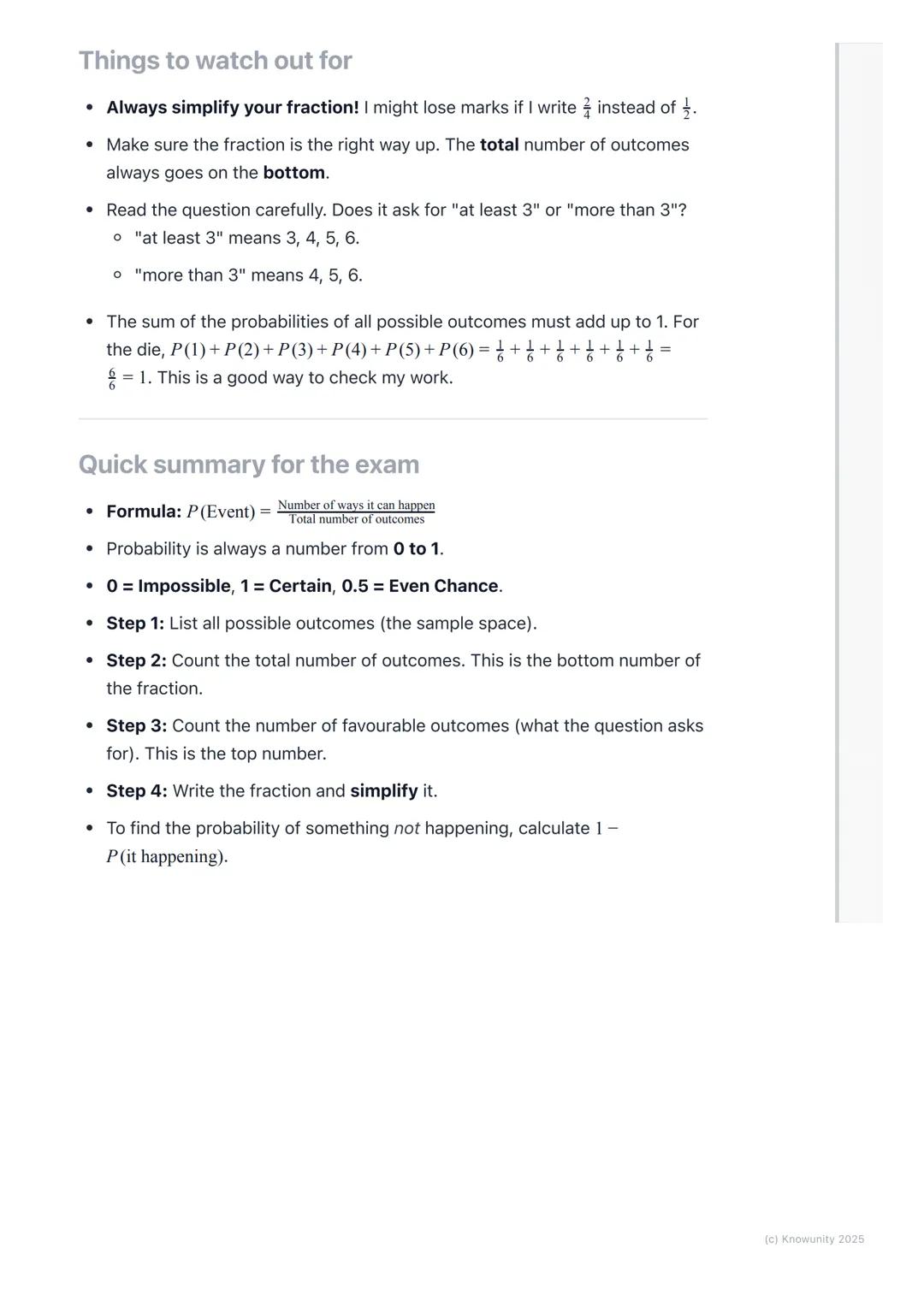
Exam Success Tips
Your step-by-step method should become automatic: list the sample space, count total outcomes (bottom of fraction), count favourable outcomes (top of fraction), then write and simplify your fraction.
Common mistakes to avoid include forgetting to simplify fractions and misreading questions. Always double-check whether the question asks for "at least" or "more than" - they're not the same thing.
Remember that probability always ranges from 0 to 1. If you get a number outside this range, you've definitely made an error. The formula P(Event) = Favourable outcomes ÷ Total outcomes will solve any basic probability problem you encounter.
Final Reminder: Take your time reading questions carefully - most mistakes happen from rushing, not from lack of understanding!
Myśleliśmy, że nigdy nie zapytasz...
Czym jest Towarzysz AI z Knowunity?
Nasz asystent AI jest specjalnie dostosowany do potrzeb uczniów. W oparciu o miliony treści, które mamy na platformie, możemy udzielać uczniom naprawdę znaczących i trafnych odpowiedzi. Ale nie chodzi tylko o odpowiedzi, towarzysz prowadzi również uczniów przez codzienne wyzwania związane z nauką, ze spersonalizowanymi planami nauki, quizami lub treściami na czacie i 100% personalizacją opartą na umiejętnościach i rozwoju uczniów.
Gdzie mogę pobrać aplikację Knowunity?
Aplikację możesz pobrać z Google Play i Apple Store.
Czy aplikacja Knowunity naprawdę jest darmowa?
Tak, masz całkowicie darmowy dostęp do wszystkich notatek w aplikacji, możesz w każdej chwili rozmawiać z Ekspertami lub ich obserwować. Możesz użyć punktów, aby odblokować pewne funkcje w aplikacji, które również możesz otrzymać za darmo. Dodatkowo oferujemy usługę Knowunity Premium, która pozwala na odblokowanie większej liczby funkcji.
Najpopularniejsze notatki z Mathematics
7Najpopularniejsze notatki
9Nie ma nic odpowiedniego? Sprawdź inne przedmioty.
Zobacz, co mówią o nas nasi użytkownicy. Pokochali nas — pokochasz też i Ty.
4.6/5App Store
4.7/5Google Play
Aplikacja jest bardzo prosta i dobrze przemyślana. Do tej pory znalazłem wszystko, czego szukałem i mogłem się wiele nauczyć z innych notatek! Na pewno wykorzystam aplikację do pomocy przy robieniu prac domowych! No i oczywiście bardzo pomaga też jako inspiracja do robienia swoich notatek.
Stefan Sużytkownik iOS
Ta aplikacja jest naprawdę świetna. Jest tak wiele notatek i pomocnych informacji [...]. Moim problematycznym przedmiotem jest język niemiecki, a w aplikacji jest w czym wybierać. Dzięki tej aplikacji poprawiłam swój niemiecki. Polecam ją każdemu.
Samantha Klichużytkownik Androida
Wow, jestem w szoku. Właśnie wypróbowałam aplikację, ponieważ widziałam ją kilka razy reklamowaną na TikToku jestem absolutnie w szoku. Ta aplikacja jest POMOCĄ, której potrzebujesz w szkole i przede wszystkim oferuje tak wiele rzeczy jak notatki czy streszczenia, które są BARDZO pomocne w moim przypadku.
Annaużytkownik iOS
Mathematics8 wyświetleń·Zaktualizowano May 29, 2026·5 stronyUnderstanding Basic Probability Concepts
Probability is everywhere in your life - from the chance of rain to winning a game or picking your favourite sweet from a bag. It's simply a way to measure how likely something is to happen, using numbers between 0... Pokaż więcej
1
of 5Zarejestruj się, aby zobaczyć notatkę. To nic nie kosztuje!
- Dostęp do wszystkich materiałów
- Popraw swoje oceny
- Dołącz do milionów studentów
What is Probability?
Ever wondered how to work out if something will actually happen? Probability gives you the answer by measuring chance using numbers. It's perfect for situations where you can't be 100% certain of the outcome.
Before diving into calculations, you need to master some key terms that'll pop up in every exam question. An experiment is any action where you don't know the exact result beforehand, like rolling a die. Each single attempt is called a trial.
The sample space lists every possible result in curly brackets - for a standard die, that's {1, 2, 3, 4, 5, 6}. An outcome is just one specific result, whilst an event is what you're actually interested in finding out about.
Quick Tip: Always start by writing down your sample space - it helps you spot all the possibilities and avoid missing any!
2
of 5Zarejestruj się, aby zobaczyć notatkę. To nic nie kosztuje!
- Dostęp do wszystkich materiałów
- Popraw swoje oceny
- Dołącz do milionów studentów
The Probability Formula
Here's the formula that'll solve every probability problem you'll face: P(Event) = Number of favourable outcomes ÷ Total number of possible outcomes. The 'P' simply stands for probability, so P(rolling a 6) means "the probability of rolling a 6".
Your answer will always be a number between 0 and 1. You can write it as a fraction, decimal, or percentage - just remember to simplify fractions when possible.
The probability scale is dead useful for understanding what your answers mean. 0 means impossible (like rolling a 7 on a normal die), whilst 1 means certain (like rolling less than 7). If you get 0.5, that's an even chance - exactly like flipping a coin.
Remember: Numbers between 0 and 0.5 are unlikely, whilst numbers between 0.5 and 1 are likely to happen.
3
of 5Zarejestruj się, aby zobaczyć notatkę. To nic nie kosztuje!
- Dostęp do wszystkich materiałów
- Popraw swoje oceny
- Dołącz do milionów studentów
Working Through Examples
Let's tackle a classic die problem to see the formula in action. When rolling a fair 6-sided die, always start by writing your sample space: {1, 2, 3, 4, 5, 6}, giving you 6 total possible outcomes.
For finding P(rolling a 3), there's only one favourable outcome (the number 3), so you get 1÷6 = 1/6. For P(rolling an odd number), count the odd numbers: 1, 3, and 5 give you 3 favourable outcomes, so 3÷6 = 1/2 after simplifying.
Sweet problems work exactly the same way. With 4 red, 5 blue, and 1 green sweet (10 total), P(blue) = 5÷10 = 1/2. The key is always counting your total first, then identifying what counts as "favourable" for your specific question.
Pro Tip: For "not red" events, you can either count non-red sweets directly, or use the shortcut: 1 - P(red) = 1 - 4/10 = 6/10 = 3/5.
4
of 5Zarejestruj się, aby zobaczyć notatkę. To nic nie kosztuje!
- Dostęp do wszystkich materiałów
- Popraw swoje oceny
- Dołącz do milionów studentów
Advanced Techniques and Shortcuts
The "1 minus" trick is brilliant for complementary events. Instead of counting everything that's "not red", just work out P(red) first, then subtract from 1. This method often saves time and reduces mistakes.
Watch out for tricky wording in questions. "At least 3" includes 3, 4, 5, and 6, whilst "more than 3" only includes 4, 5, and 6. These small differences can completely change your answer.
Here's a clever way to check your work: all probabilities for every possible outcome must add up to 1. For a die, P(1) + P(2) + P(3) + P(4) + P(5) + P(6) = 6 × 1/6 = 1. If your total doesn't equal 1, you've made an error somewhere.
Check Yourself: Always verify that your fraction is the right way up - total outcomes go on the bottom, favourable outcomes on top!
5
of 5Zarejestruj się, aby zobaczyć notatkę. To nic nie kosztuje!
- Dostęp do wszystkich materiałów
- Popraw swoje oceny
- Dołącz do milionów studentów
Exam Success Tips
Your step-by-step method should become automatic: list the sample space, count total outcomes (bottom of fraction), count favourable outcomes (top of fraction), then write and simplify your fraction.
Common mistakes to avoid include forgetting to simplify fractions and misreading questions. Always double-check whether the question asks for "at least" or "more than" - they're not the same thing.
Remember that probability always ranges from 0 to 1. If you get a number outside this range, you've definitely made an error. The formula P(Event) = Favourable outcomes ÷ Total outcomes will solve any basic probability problem you encounter.
Final Reminder: Take your time reading questions carefully - most mistakes happen from rushing, not from lack of understanding!
Myśleliśmy, że nigdy nie zapytasz...
Czym jest Towarzysz AI z Knowunity?
Nasz asystent AI jest specjalnie dostosowany do potrzeb uczniów. W oparciu o miliony treści, które mamy na platformie, możemy udzielać uczniom naprawdę znaczących i trafnych odpowiedzi. Ale nie chodzi tylko o odpowiedzi, towarzysz prowadzi również uczniów przez codzienne wyzwania związane z nauką, ze spersonalizowanymi planami nauki, quizami lub treściami na czacie i 100% personalizacją opartą na umiejętnościach i rozwoju uczniów.
Gdzie mogę pobrać aplikację Knowunity?
Aplikację możesz pobrać z Google Play i Apple Store.
Czy aplikacja Knowunity naprawdę jest darmowa?
Tak, masz całkowicie darmowy dostęp do wszystkich notatek w aplikacji, możesz w każdej chwili rozmawiać z Ekspertami lub ich obserwować. Możesz użyć punktów, aby odblokować pewne funkcje w aplikacji, które również możesz otrzymać za darmo. Dodatkowo oferujemy usługę Knowunity Premium, która pozwala na odblokowanie większej liczby funkcji.
Najpopularniejsze notatki z Mathematics
7Najpopularniejsze notatki
9Nie ma nic odpowiedniego? Sprawdź inne przedmioty.
Zobacz, co mówią o nas nasi użytkownicy. Pokochali nas — pokochasz też i Ty.
4.6/5App Store
4.7/5Google Play
Aplikacja jest bardzo prosta i dobrze przemyślana. Do tej pory znalazłem wszystko, czego szukałem i mogłem się wiele nauczyć z innych notatek! Na pewno wykorzystam aplikację do pomocy przy robieniu prac domowych! No i oczywiście bardzo pomaga też jako inspiracja do robienia swoich notatek.
Stefan Sużytkownik iOS
Ta aplikacja jest naprawdę świetna. Jest tak wiele notatek i pomocnych informacji [...]. Moim problematycznym przedmiotem jest język niemiecki, a w aplikacji jest w czym wybierać. Dzięki tej aplikacji poprawiłam swój niemiecki. Polecam ją każdemu.
Samantha Klichużytkownik Androida
Wow, jestem w szoku. Właśnie wypróbowałam aplikację, ponieważ widziałam ją kilka razy reklamowaną na TikToku jestem absolutnie w szoku. Ta aplikacja jest POMOCĄ, której potrzebujesz w szkole i przede wszystkim oferuje tak wiele rzeczy jak notatki czy streszczenia, które są BARDZO pomocne w moim przypadku.
Annaużytkownik iOS