
Solving equations is like being a detective - you're hunting... Pokaż więcej
 Mathematics13 wyświetleń·Zaktualizowano May 27, 2026·5 strony
Mastering Linear Equations: Solve Like a Pro
1 / 5
1
of 5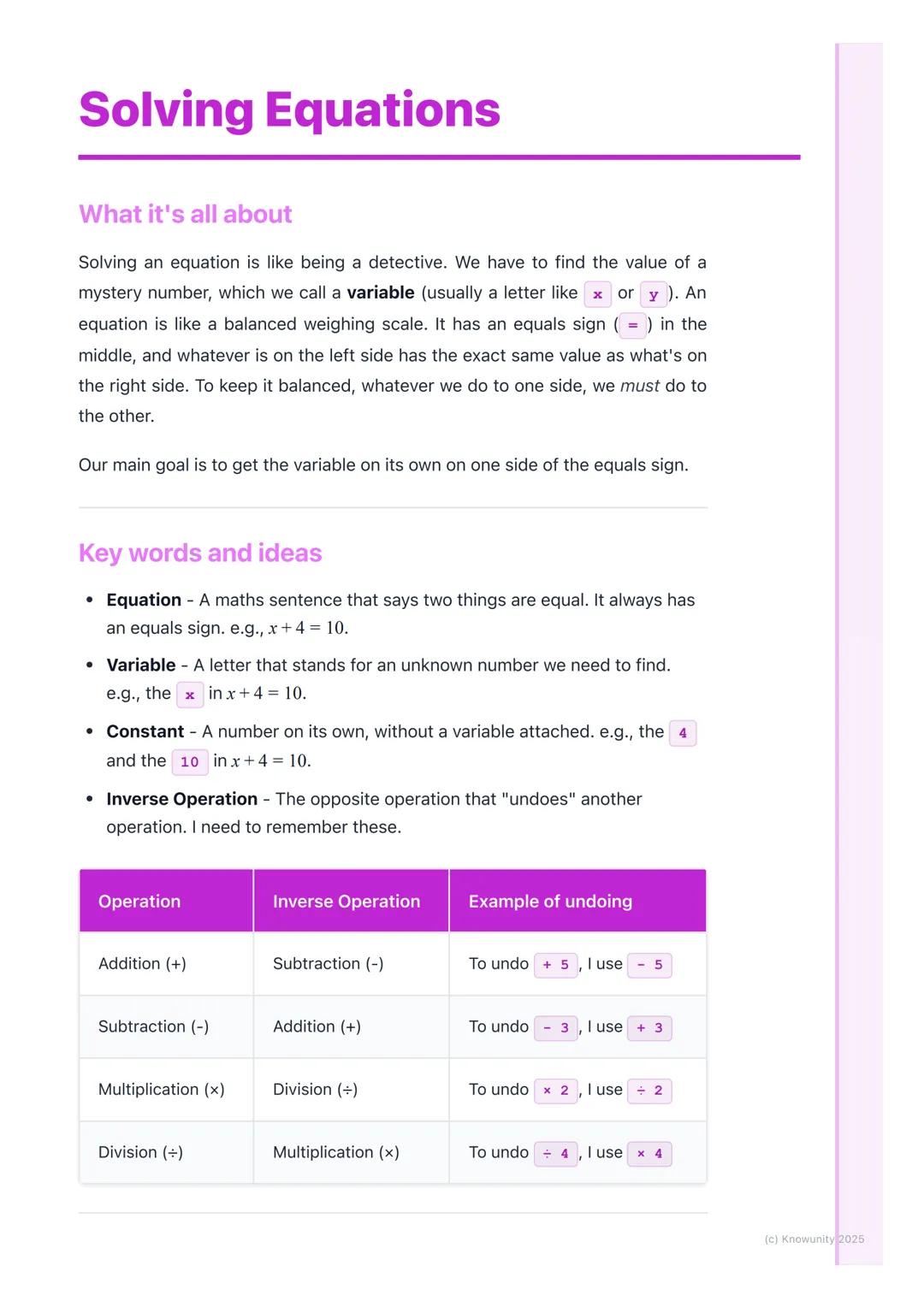
What's All This About?
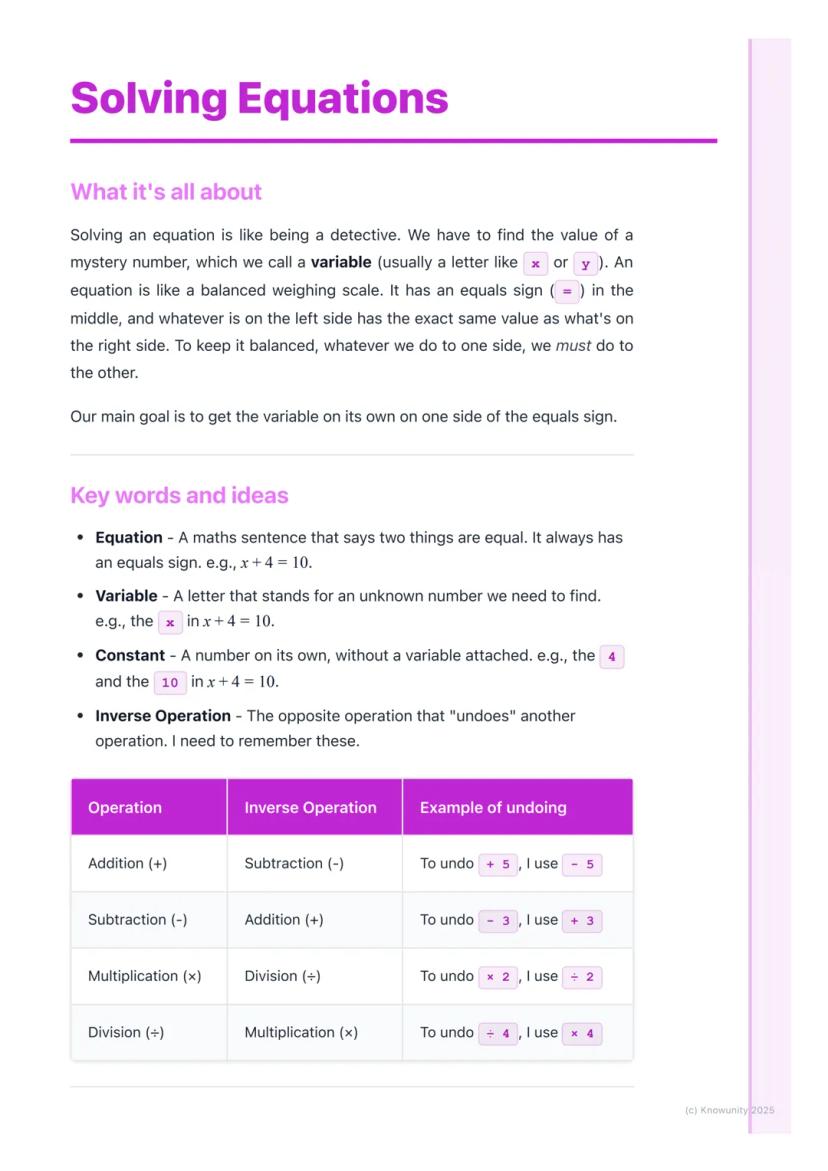
Solving equations means finding the value of an unknown number, called a variable. Your main mission is simple: get that variable all by itself on one side of the equals sign.
An equation is just a maths sentence saying two things are equal - it always has that equals sign in the middle. The variable is the mystery letter (like x or y) you need to find, while constants are just regular numbers hanging about.
Here's your secret weapon: inverse operations. These are opposite operations that undo each other - addition undoes subtraction, multiplication undoes division, and so on.
Remember: Addition ↔ Subtraction and Multiplication ↔ Division are perfect pairs!
2
of 5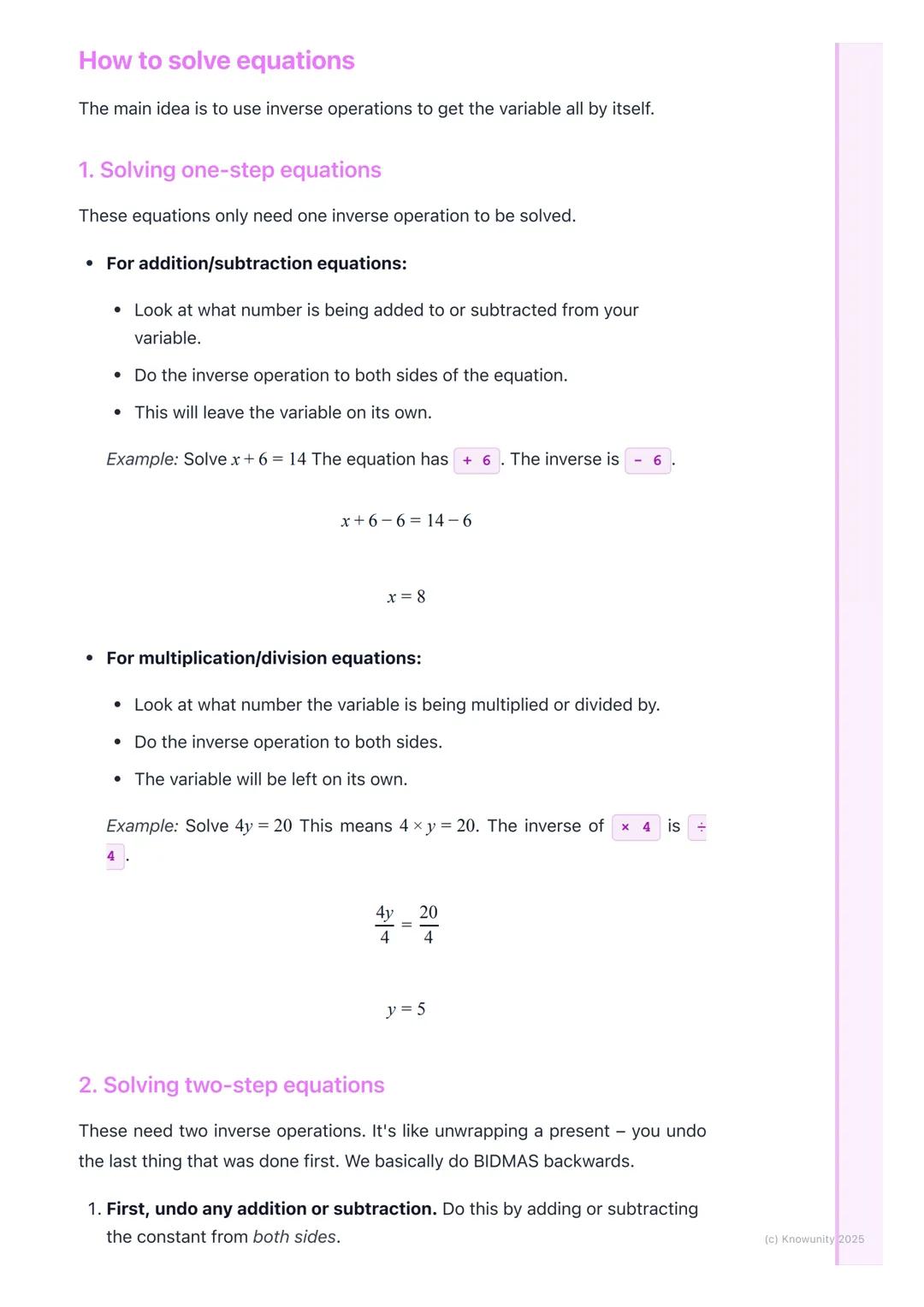
Cracking One-Step Equations
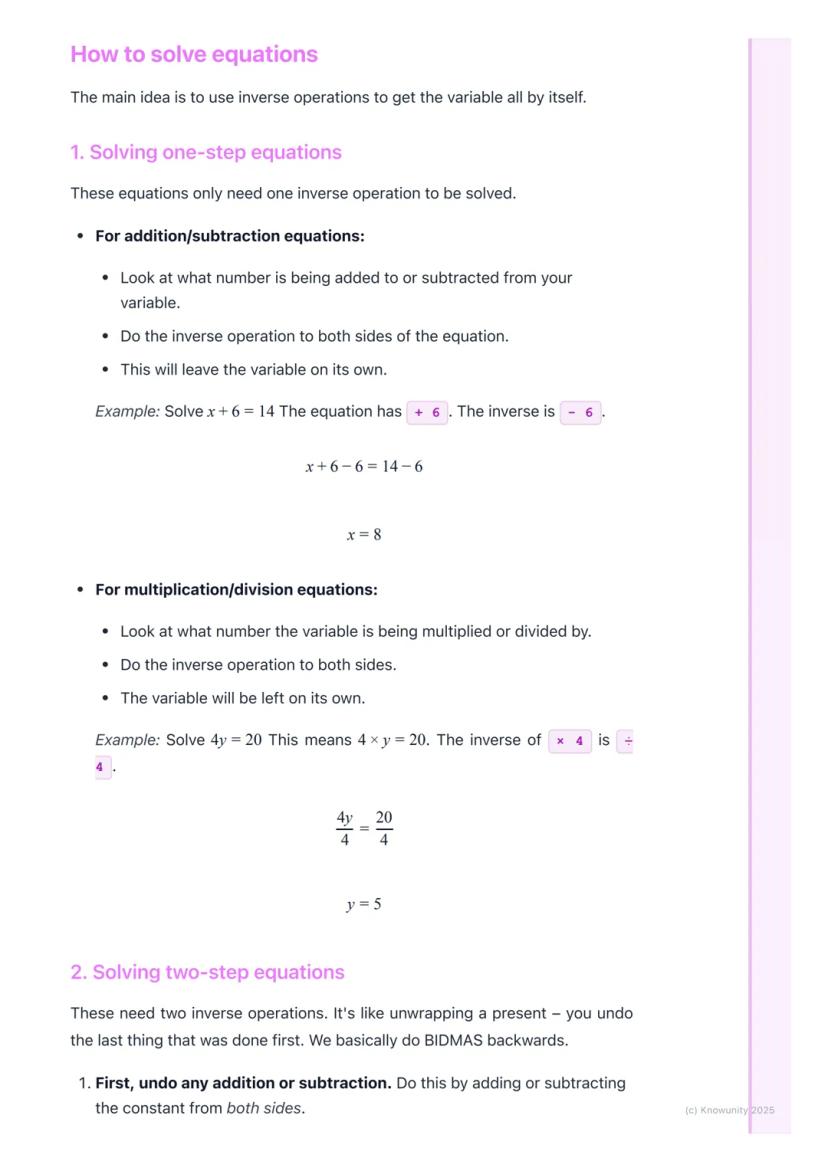
These are the easiest equations because they only need one inverse operation to solve. You've basically got two types to deal with.
For addition and subtraction equations, spot what number is being added or subtracted from your variable. Then do the opposite to both sides. If you see x + 6 = 14, subtract 6 from both sides to get x = 8.
For multiplication and division equations, look at what number your variable is being multiplied or divided by. Then do the reverse to both sides. If you have 4y = 20, divide both sides by 4 to get y = 5.
Top Tip: Always do the same operation to both sides - this keeps your equation balanced like a perfect seesaw!
3
of 5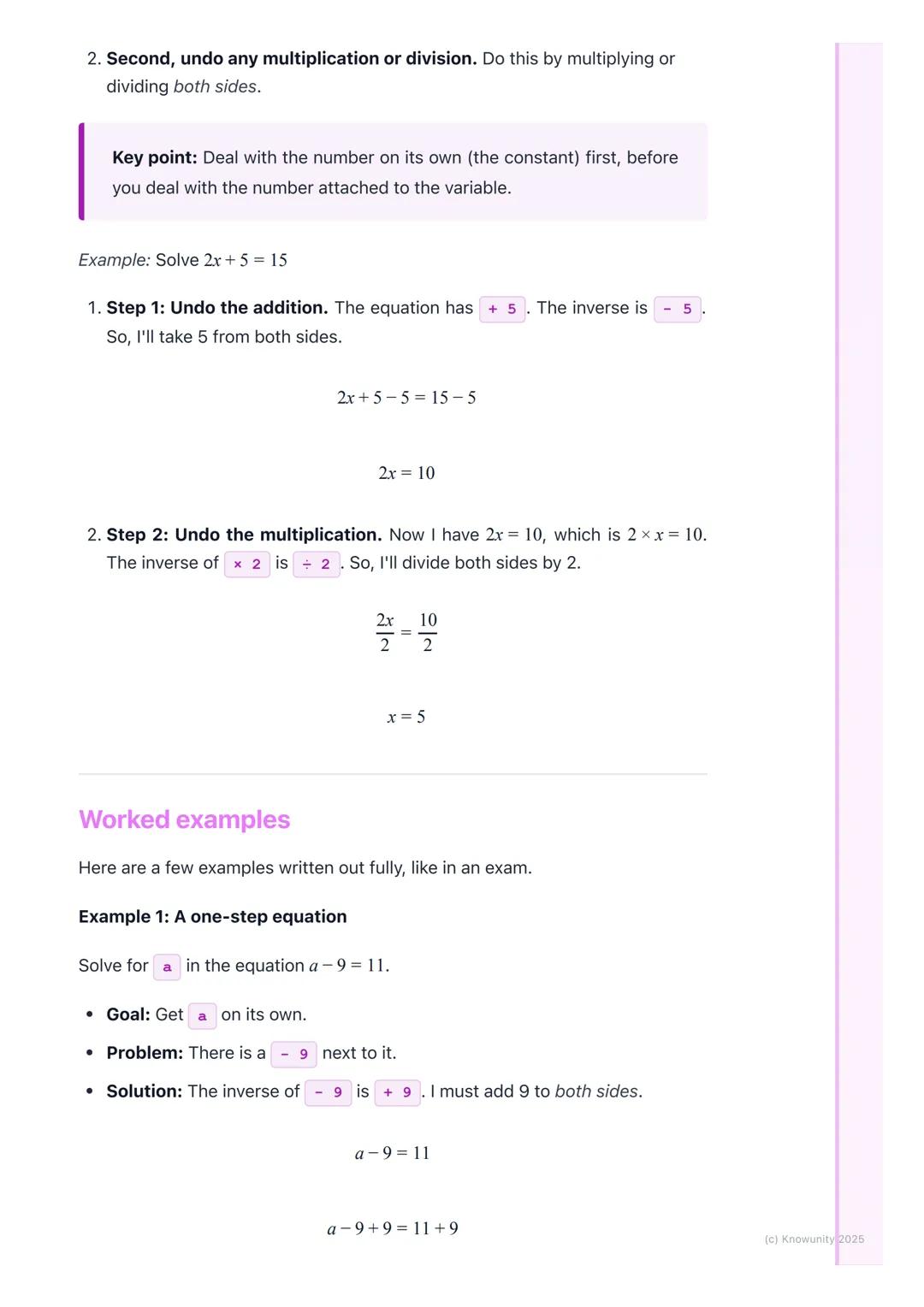
Tackling Two-Step Equations
Two-step equations need two moves to solve, and here's the clever bit - you work backwards through BIDMAS. Think of it like unwrapping a present where you undo the last thing that was done first.
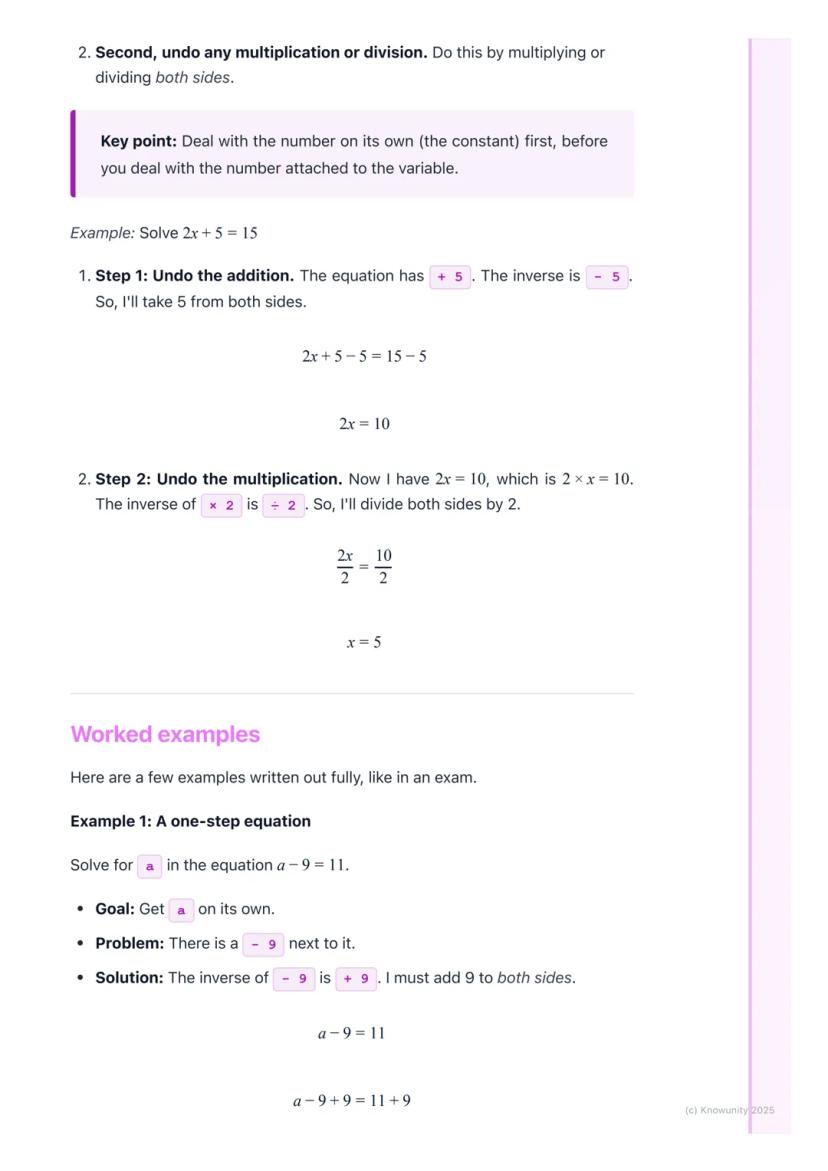
Step 1: Deal with any addition or subtraction first. Get rid of the constant (the number on its own) by doing the opposite operation to both sides.
Step 2: Then handle any multiplication or division. Work on the number attached to your variable by using its inverse operation.
For example, with 2x + 5 = 15, first subtract 5 from both sides , then divide both sides by 2 .
Golden Rule: Always tackle the lone number first, then deal with whatever's attached to your variable!
4
of 5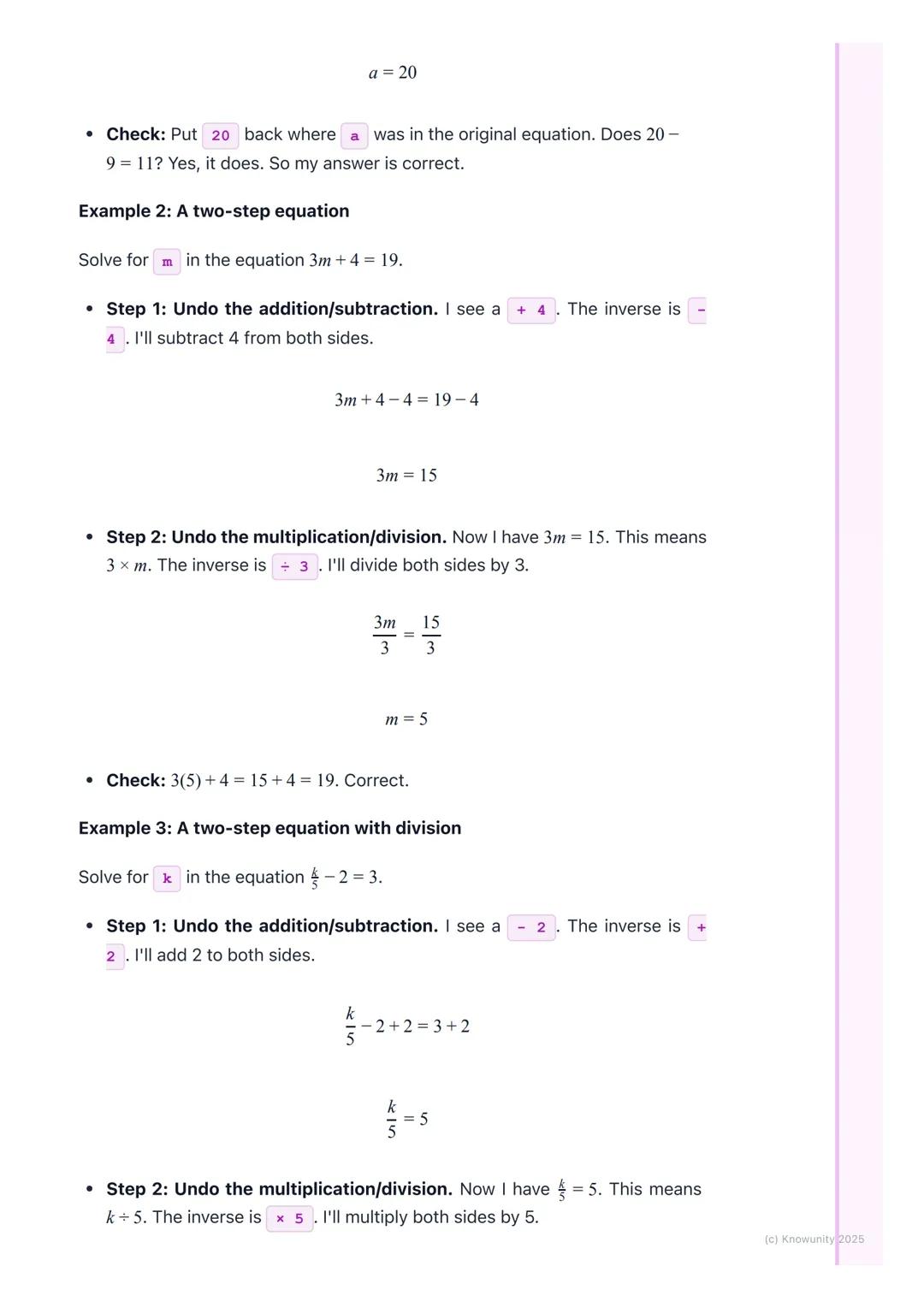
Working Through Real Examples
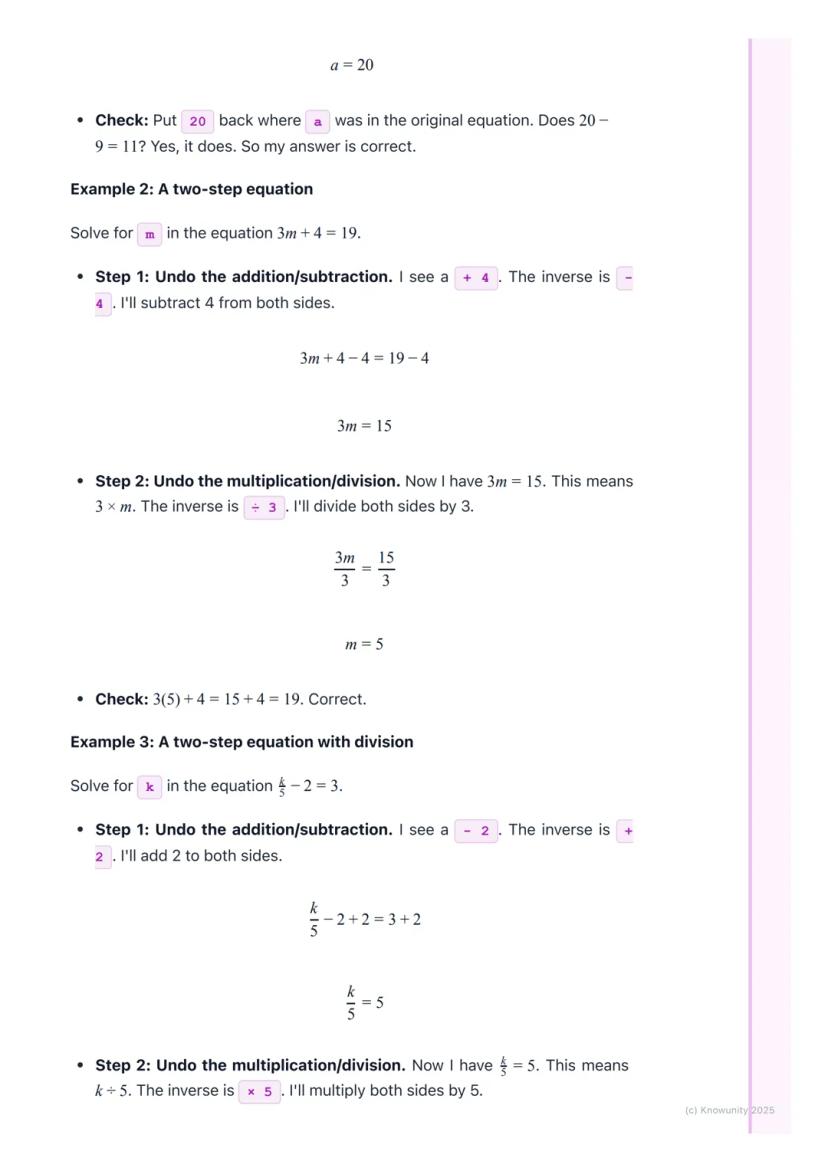
Let's see how this works with proper exam-style examples. For a simple equation like a - 9 = 11, you add 9 to both sides to get a = 20.
With two-step equations like 3m + 4 = 19, first subtract 4 from both sides , then divide both sides by 3 . Easy when you know the steps!
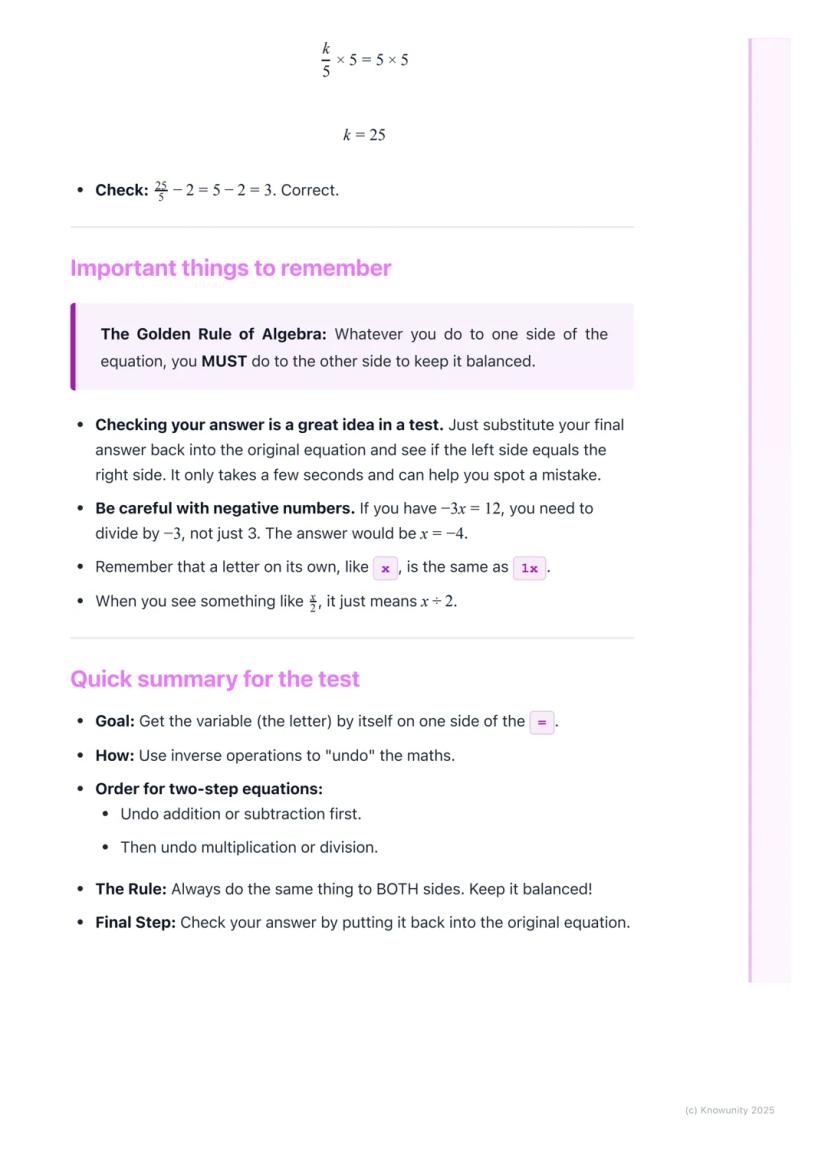
Even trickier ones like k/5 - 2 = 3 follow the same pattern. Add 2 to both sides first , then multiply both sides by 5 .
Always check your answer by popping it back into the original equation. It takes seconds and can save you marks in a test!
Pro Move: Checking your answer is like having a safety net - it catches mistakes before they cost you points!
5
of 5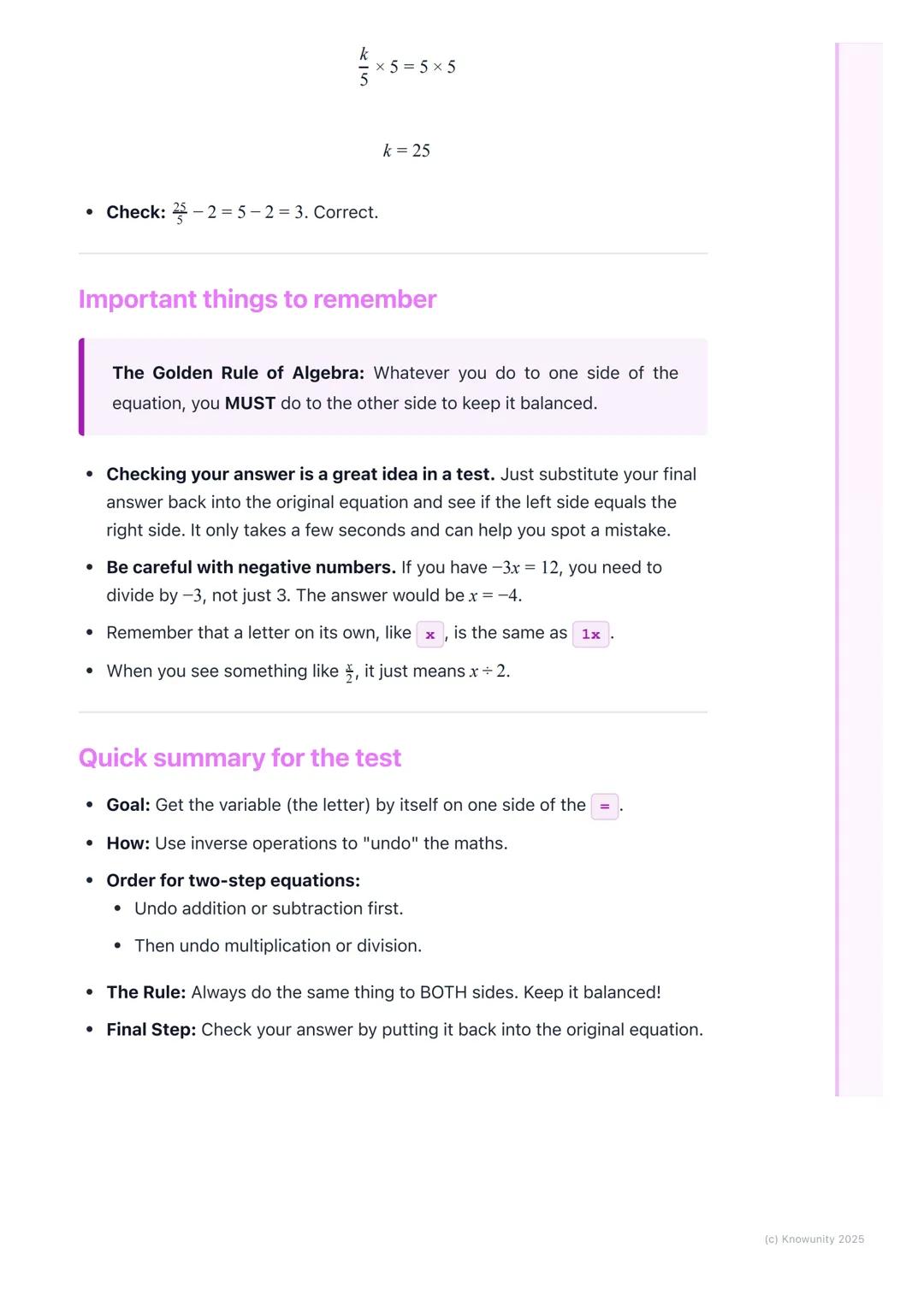
Key Things to Remember
The golden rule of algebra is sacred: whatever you do to one side, you absolutely must do to the other. No exceptions, ever!
Watch out for negative numbers - if you have -3x = 12, you divide by -3 (not just 3) to get x = -4. Also remember that x on its own is really 1x, and x/2 just means x ÷ 2.
For two-step equations, your order of attack is: undo addition or subtraction first, then tackle multiplication or division. Keep everything balanced and always check your final answer.
Test Strategy: Goal → Get the variable alone. Method → Use inverse operations. Rule → Do the same to both sides. Check → Put your answer back in!
Myśleliśmy, że nigdy nie zapytasz...
Czym jest Towarzysz AI z Knowunity?
Nasz asystent AI jest specjalnie dostosowany do potrzeb uczniów. W oparciu o miliony treści, które mamy na platformie, możemy udzielać uczniom naprawdę znaczących i trafnych odpowiedzi. Ale nie chodzi tylko o odpowiedzi, towarzysz prowadzi również uczniów przez codzienne wyzwania związane z nauką, ze spersonalizowanymi planami nauki, quizami lub treściami na czacie i 100% personalizacją opartą na umiejętnościach i rozwoju uczniów.
Gdzie mogę pobrać aplikację Knowunity?
Aplikację możesz pobrać z Google Play i Apple Store.
Czy aplikacja Knowunity naprawdę jest darmowa?
Tak, masz całkowicie darmowy dostęp do wszystkich notatek w aplikacji, możesz w każdej chwili rozmawiać z Ekspertami lub ich obserwować. Możesz użyć punktów, aby odblokować pewne funkcje w aplikacji, które również możesz otrzymać za darmo. Dodatkowo oferujemy usługę Knowunity Premium, która pozwala na odblokowanie większej liczby funkcji.
Najpopularniejsze notatki z Mathematics
7Najpopularniejsze notatki
9Nie ma nic odpowiedniego? Sprawdź inne przedmioty.
Zobacz, co mówią o nas nasi użytkownicy. Pokochali nas — pokochasz też i Ty.
4.6/5App Store
4.7/5Google Play
Aplikacja jest bardzo prosta i dobrze przemyślana. Do tej pory znalazłem wszystko, czego szukałem i mogłem się wiele nauczyć z innych notatek! Na pewno wykorzystam aplikację do pomocy przy robieniu prac domowych! No i oczywiście bardzo pomaga też jako inspiracja do robienia swoich notatek.
Stefan Sużytkownik iOS
Ta aplikacja jest naprawdę świetna. Jest tak wiele notatek i pomocnych informacji [...]. Moim problematycznym przedmiotem jest język niemiecki, a w aplikacji jest w czym wybierać. Dzięki tej aplikacji poprawiłam swój niemiecki. Polecam ją każdemu.
Samantha Klichużytkownik Androida
Wow, jestem w szoku. Właśnie wypróbowałam aplikację, ponieważ widziałam ją kilka razy reklamowaną na TikToku jestem absolutnie w szoku. Ta aplikacja jest POMOCĄ, której potrzebujesz w szkole i przede wszystkim oferuje tak wiele rzeczy jak notatki czy streszczenia, które są BARDZO pomocne w moim przypadku.
Annaużytkownik iOS
Mathematics13 wyświetleń·Zaktualizowano May 27, 2026·5 stronyMastering Linear Equations: Solve Like a Pro
Solving equations is like being a detective - you're hunting for the mystery value of a variable (usually x or y). Think of an equation as a perfectly balanced weighing scale, where whatever you do to one side, you must... Pokaż więcej
1
of 5Zarejestruj się, aby zobaczyć notatkę. To nic nie kosztuje!
- Dostęp do wszystkich materiałów
- Popraw swoje oceny
- Dołącz do milionów studentów
What's All This About?
Solving equations means finding the value of an unknown number, called a variable. Your main mission is simple: get that variable all by itself on one side of the equals sign.
An equation is just a maths sentence saying two things are equal - it always has that equals sign in the middle. The variable is the mystery letter (like x or y) you need to find, while constants are just regular numbers hanging about.
Here's your secret weapon: inverse operations. These are opposite operations that undo each other - addition undoes subtraction, multiplication undoes division, and so on.
Remember: Addition ↔ Subtraction and Multiplication ↔ Division are perfect pairs!
2
of 5Zarejestruj się, aby zobaczyć notatkę. To nic nie kosztuje!
- Dostęp do wszystkich materiałów
- Popraw swoje oceny
- Dołącz do milionów studentów
Cracking One-Step Equations
These are the easiest equations because they only need one inverse operation to solve. You've basically got two types to deal with.
For addition and subtraction equations, spot what number is being added or subtracted from your variable. Then do the opposite to both sides. If you see x + 6 = 14, subtract 6 from both sides to get x = 8.
For multiplication and division equations, look at what number your variable is being multiplied or divided by. Then do the reverse to both sides. If you have 4y = 20, divide both sides by 4 to get y = 5.
Top Tip: Always do the same operation to both sides - this keeps your equation balanced like a perfect seesaw!
3
of 5Zarejestruj się, aby zobaczyć notatkę. To nic nie kosztuje!
- Dostęp do wszystkich materiałów
- Popraw swoje oceny
- Dołącz do milionów studentów
Tackling Two-Step Equations
Two-step equations need two moves to solve, and here's the clever bit - you work backwards through BIDMAS. Think of it like unwrapping a present where you undo the last thing that was done first.
Step 1: Deal with any addition or subtraction first. Get rid of the constant (the number on its own) by doing the opposite operation to both sides.
Step 2: Then handle any multiplication or division. Work on the number attached to your variable by using its inverse operation.
For example, with 2x + 5 = 15, first subtract 5 from both sides , then divide both sides by 2 .
Golden Rule: Always tackle the lone number first, then deal with whatever's attached to your variable!
4
of 5Zarejestruj się, aby zobaczyć notatkę. To nic nie kosztuje!
- Dostęp do wszystkich materiałów
- Popraw swoje oceny
- Dołącz do milionów studentów
Working Through Real Examples
Let's see how this works with proper exam-style examples. For a simple equation like a - 9 = 11, you add 9 to both sides to get a = 20.
With two-step equations like 3m + 4 = 19, first subtract 4 from both sides , then divide both sides by 3 . Easy when you know the steps!
Even trickier ones like k/5 - 2 = 3 follow the same pattern. Add 2 to both sides first , then multiply both sides by 5 .
Always check your answer by popping it back into the original equation. It takes seconds and can save you marks in a test!
Pro Move: Checking your answer is like having a safety net - it catches mistakes before they cost you points!
5
of 5Zarejestruj się, aby zobaczyć notatkę. To nic nie kosztuje!
- Dostęp do wszystkich materiałów
- Popraw swoje oceny
- Dołącz do milionów studentów
Key Things to Remember
The golden rule of algebra is sacred: whatever you do to one side, you absolutely must do to the other. No exceptions, ever!
Watch out for negative numbers - if you have -3x = 12, you divide by -3 (not just 3) to get x = -4. Also remember that x on its own is really 1x, and x/2 just means x ÷ 2.
For two-step equations, your order of attack is: undo addition or subtraction first, then tackle multiplication or division. Keep everything balanced and always check your final answer.
Test Strategy: Goal → Get the variable alone. Method → Use inverse operations. Rule → Do the same to both sides. Check → Put your answer back in!
Myśleliśmy, że nigdy nie zapytasz...
Czym jest Towarzysz AI z Knowunity?
Nasz asystent AI jest specjalnie dostosowany do potrzeb uczniów. W oparciu o miliony treści, które mamy na platformie, możemy udzielać uczniom naprawdę znaczących i trafnych odpowiedzi. Ale nie chodzi tylko o odpowiedzi, towarzysz prowadzi również uczniów przez codzienne wyzwania związane z nauką, ze spersonalizowanymi planami nauki, quizami lub treściami na czacie i 100% personalizacją opartą na umiejętnościach i rozwoju uczniów.
Gdzie mogę pobrać aplikację Knowunity?
Aplikację możesz pobrać z Google Play i Apple Store.
Czy aplikacja Knowunity naprawdę jest darmowa?
Tak, masz całkowicie darmowy dostęp do wszystkich notatek w aplikacji, możesz w każdej chwili rozmawiać z Ekspertami lub ich obserwować. Możesz użyć punktów, aby odblokować pewne funkcje w aplikacji, które również możesz otrzymać za darmo. Dodatkowo oferujemy usługę Knowunity Premium, która pozwala na odblokowanie większej liczby funkcji.
Najpopularniejsze notatki z Mathematics
7Najpopularniejsze notatki
9Nie ma nic odpowiedniego? Sprawdź inne przedmioty.
Zobacz, co mówią o nas nasi użytkownicy. Pokochali nas — pokochasz też i Ty.
4.6/5App Store
4.7/5Google Play
Aplikacja jest bardzo prosta i dobrze przemyślana. Do tej pory znalazłem wszystko, czego szukałem i mogłem się wiele nauczyć z innych notatek! Na pewno wykorzystam aplikację do pomocy przy robieniu prac domowych! No i oczywiście bardzo pomaga też jako inspiracja do robienia swoich notatek.
Stefan Sużytkownik iOS
Ta aplikacja jest naprawdę świetna. Jest tak wiele notatek i pomocnych informacji [...]. Moim problematycznym przedmiotem jest język niemiecki, a w aplikacji jest w czym wybierać. Dzięki tej aplikacji poprawiłam swój niemiecki. Polecam ją każdemu.
Samantha Klichużytkownik Androida
Wow, jestem w szoku. Właśnie wypróbowałam aplikację, ponieważ widziałam ją kilka razy reklamowaną na TikToku jestem absolutnie w szoku. Ta aplikacja jest POMOCĄ, której potrzebujesz w szkole i przede wszystkim oferuje tak wiele rzeczy jak notatki czy streszczenia, które są BARDZO pomocne w moim przypadku.
Annaużytkownik iOS