
Ever wondered why triangles and quadrilaterals are everywhere around you?...
 Mathematics4 wyświetleń·Zaktualizowano Jun 6, 2026·8 strony
Understanding Triangles and Quadrilaterals
1 / 8
1
of 8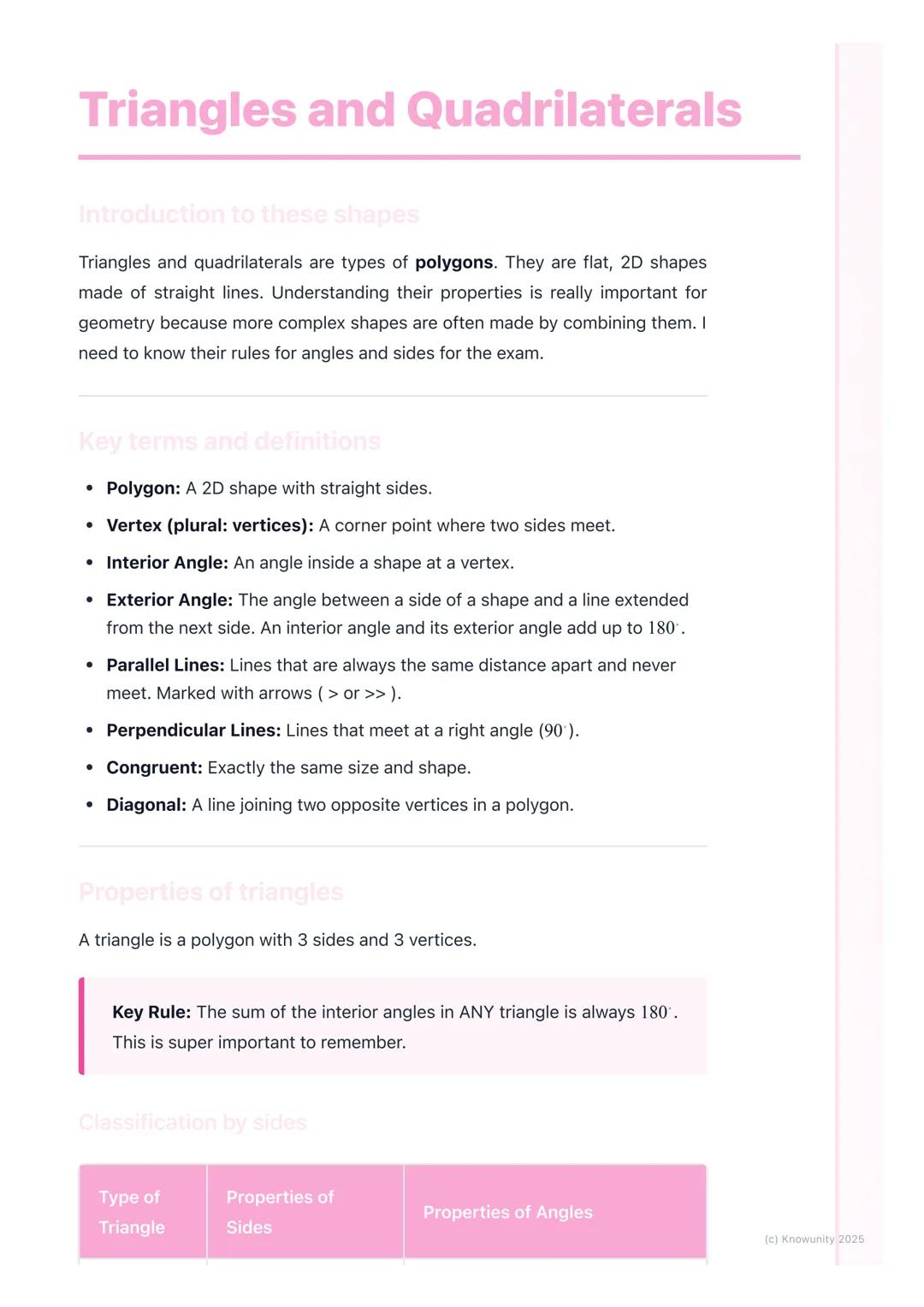
Introduction to Polygons and Key Terms
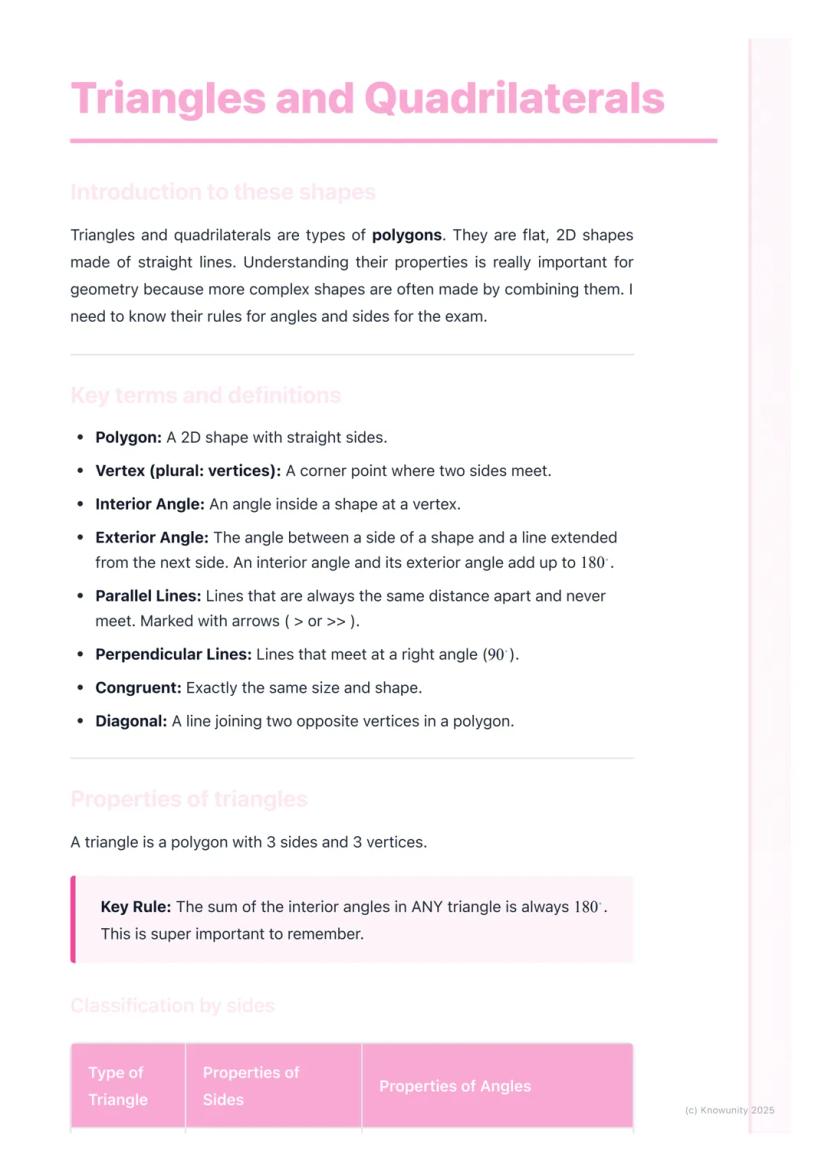
Understanding polygons is like learning the alphabet of geometry - once you know these basics, everything else makes sense. A polygon is simply a flat, 2D shape made of straight lines, and triangles and quadrilaterals are the most important ones you'll encounter.
The key terms you absolutely need to know include vertices (corner points), interior angles (angles inside the shape), and exterior angles (formed when you extend a side). Remember that an interior angle and its exterior angle always add up to 180°.
Parallel lines never meet and are marked with arrows, whilst perpendicular lines meet at 90°. When shapes are congruent, they're exactly the same size and shape - think of identical twins!
Quick Tip: Master these definitions first - they're the foundation for everything else in geometry and will save you marks in exams.
2
of 8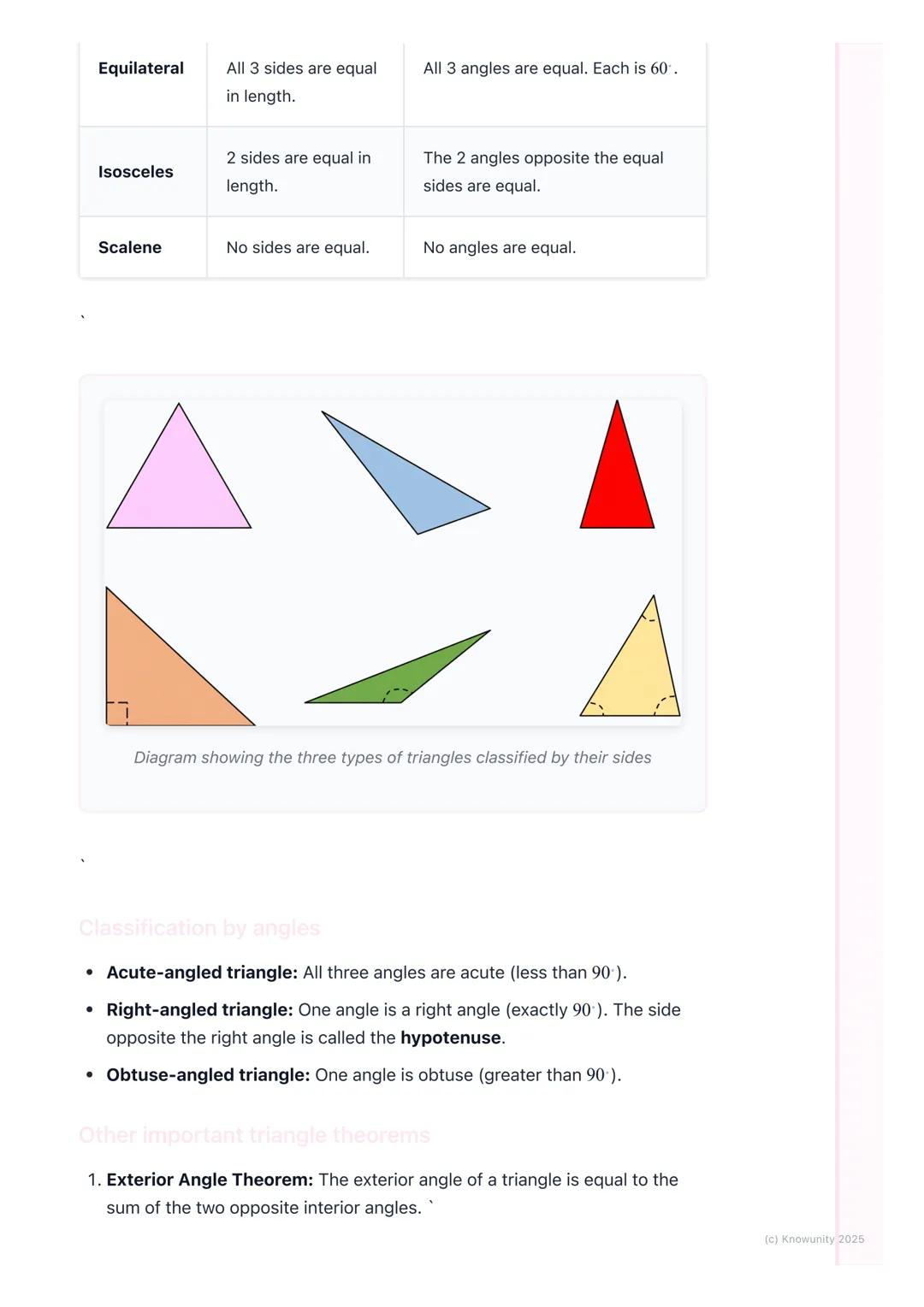
Triangle Properties and Classifications
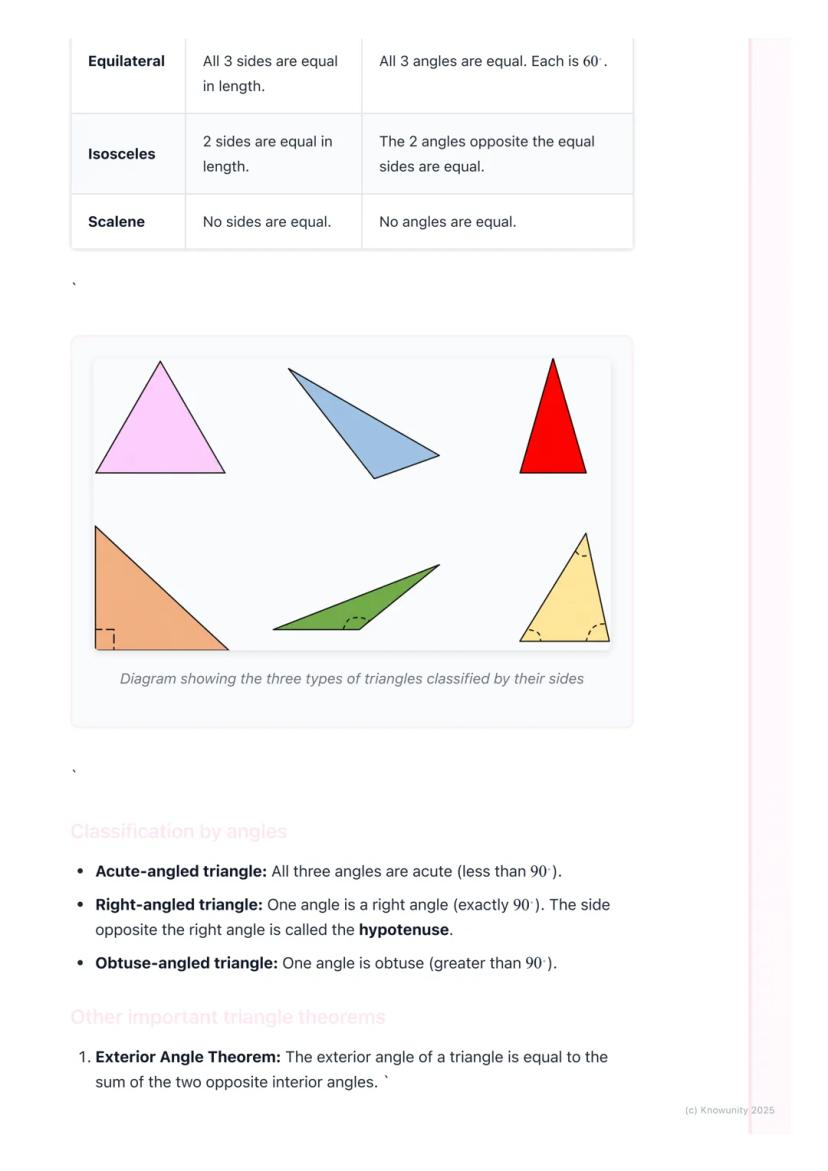
Here's the golden rule that'll save you in every triangle question: the sum of interior angles in ANY triangle is always 180°. This works whether your triangle is huge or tiny, wonky or perfect.
Triangles get sorted by their sides in three ways. Equilateral triangles have all sides equal and all angles are exactly 60°. Isosceles triangles have two equal sides, and the angles opposite those equal sides are also equal. Scalene triangles are the rebels - no sides or angles are equal.
You can also classify triangles by their angles. Acute triangles have all angles less than 90°, right-angled triangles have exactly one 90° angle, and obtuse triangles have one angle greater than 90°.
Exam Gold: In right-angled triangles, the longest side opposite the right angle is called the hypotenuse - you'll need this for Pythagoras' theorem!
3
of 8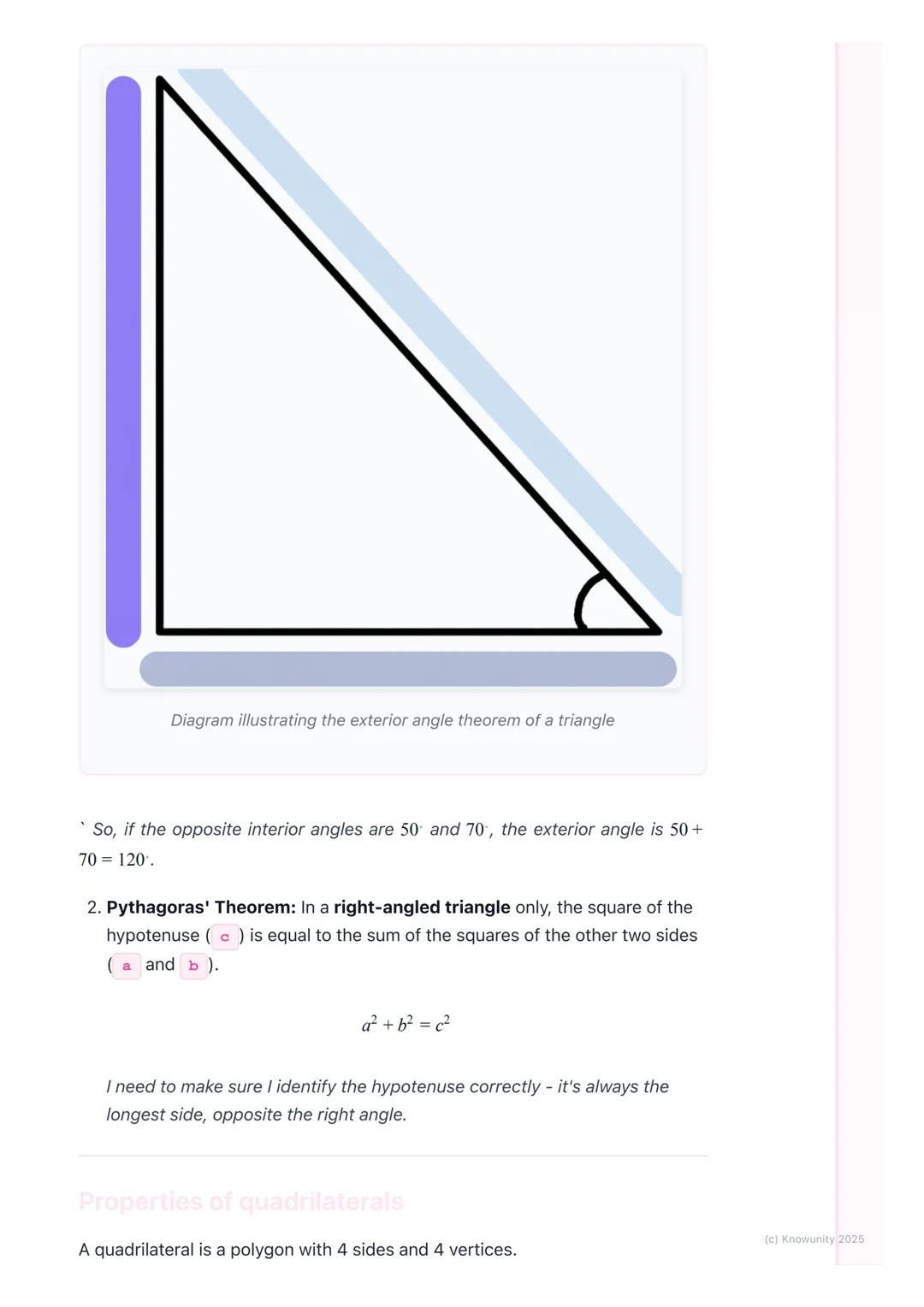
Important Triangle Theorems
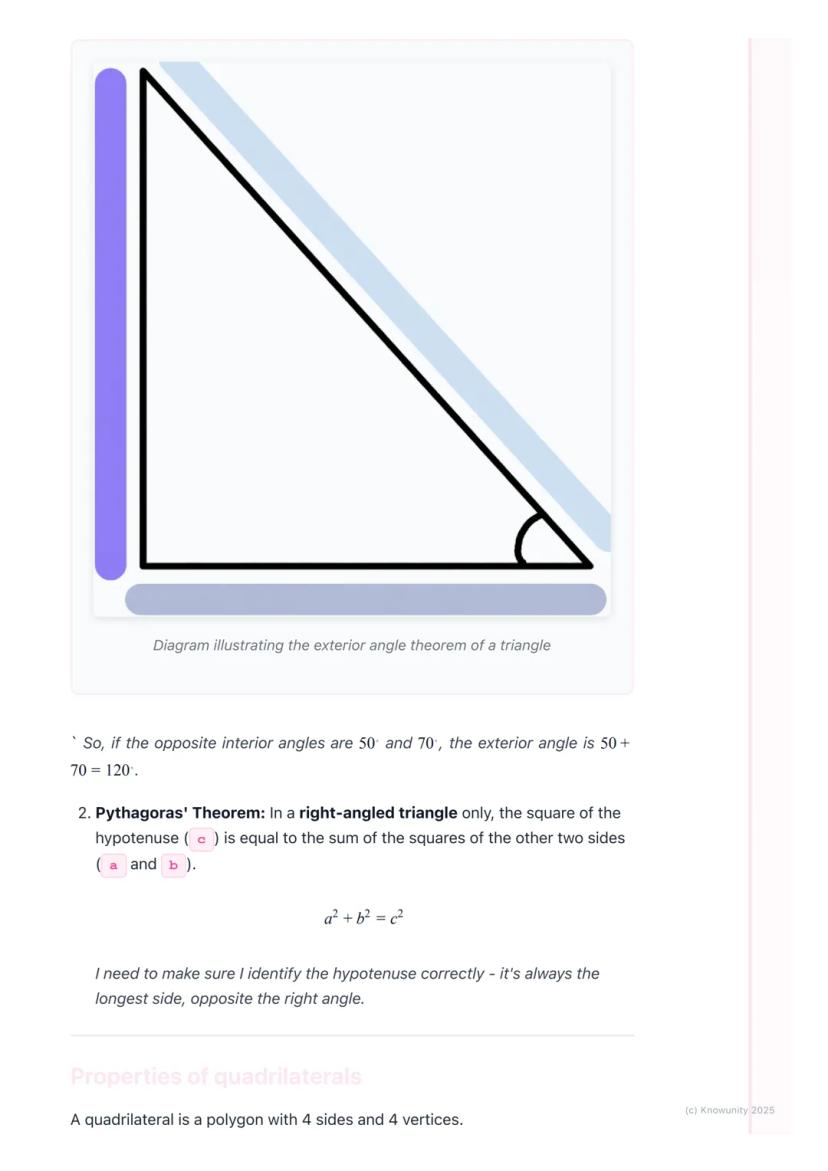
The Exterior Angle Theorem is brilliantly simple: any exterior angle of a triangle equals the sum of the two opposite interior angles. So if those opposite angles are 50° and 70°, your exterior angle is 120°. Easy!
Pythagoras' Theorem only works for right-angled triangles, but it's incredibly useful: a² + b² = c². The key is identifying the hypotenuse correctly - it's always the longest side, opposite the right angle.
These theorems aren't just random rules - they're your problem-solving toolkit. When you're stuck on a triangle question, ask yourself: "Can I use the 180° rule? Is there an exterior angle? Is this a right triangle where Pythagoras applies?"
Memory Trick: Think of Pythagoras like a recipe - you need the right ingredients for it to work!
4
of 8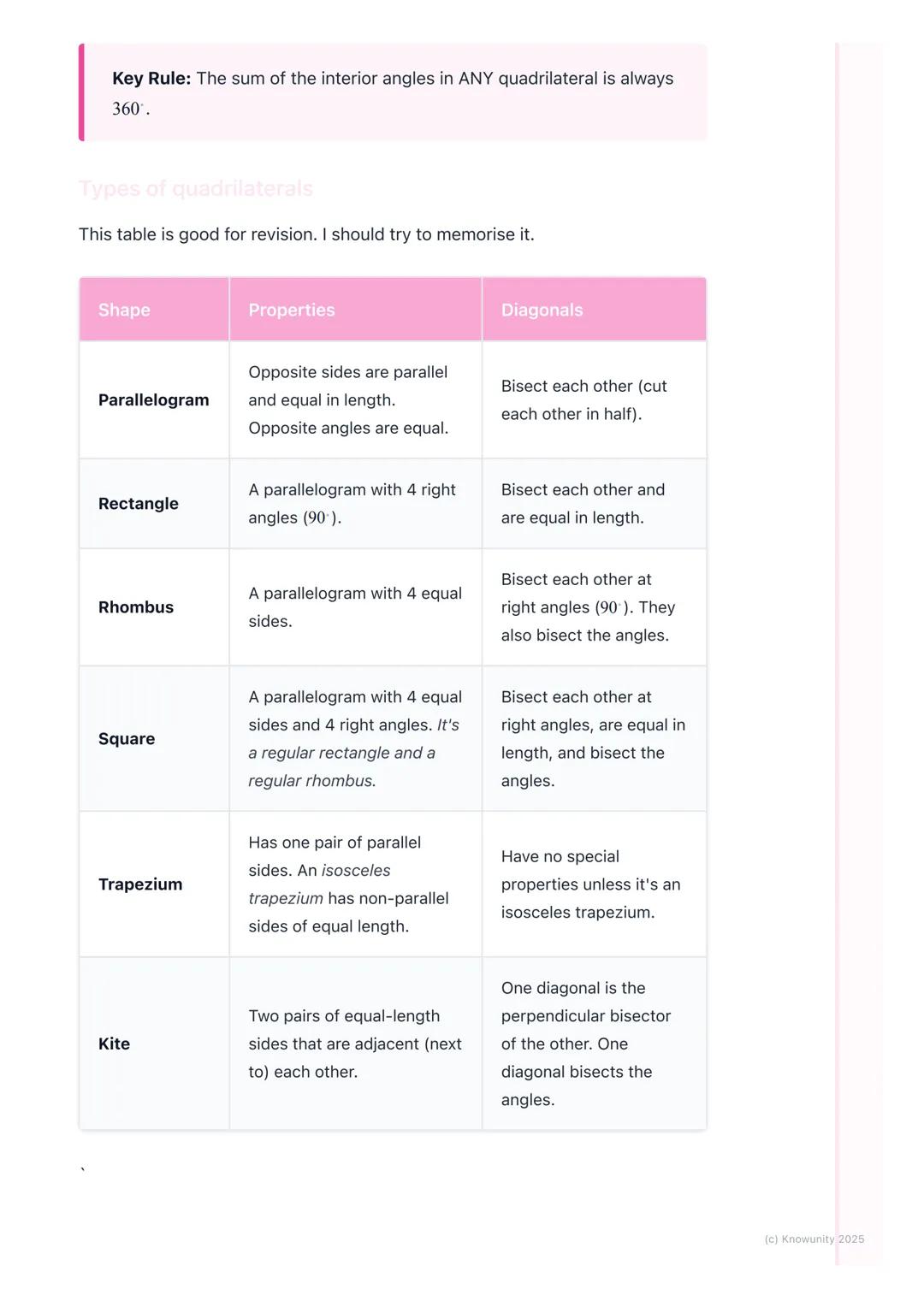
Quadrilateral Properties and Types
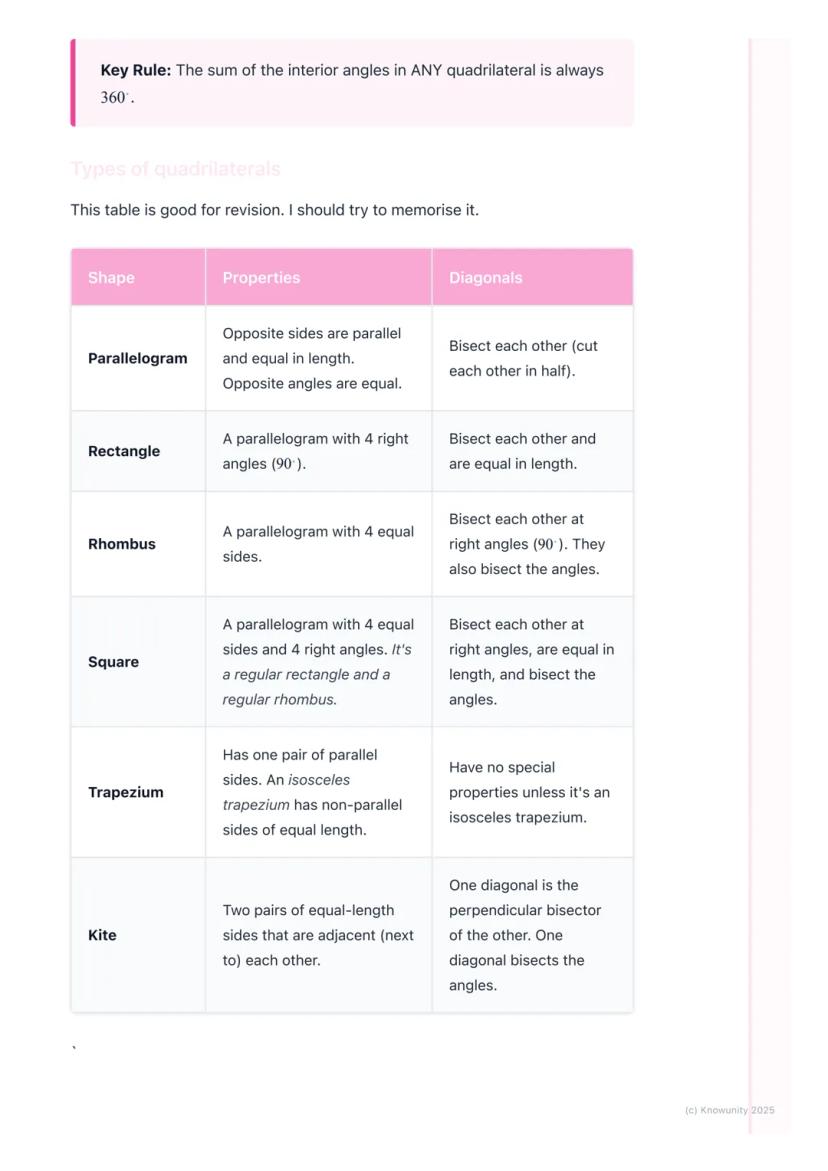
Quadrilaterals are four-sided shapes, and here's your second golden rule: the sum of interior angles in ANY quadrilateral is always 360°. Whether it's a square, rectangle, or weird wonky shape, the angles always add up to 360°.
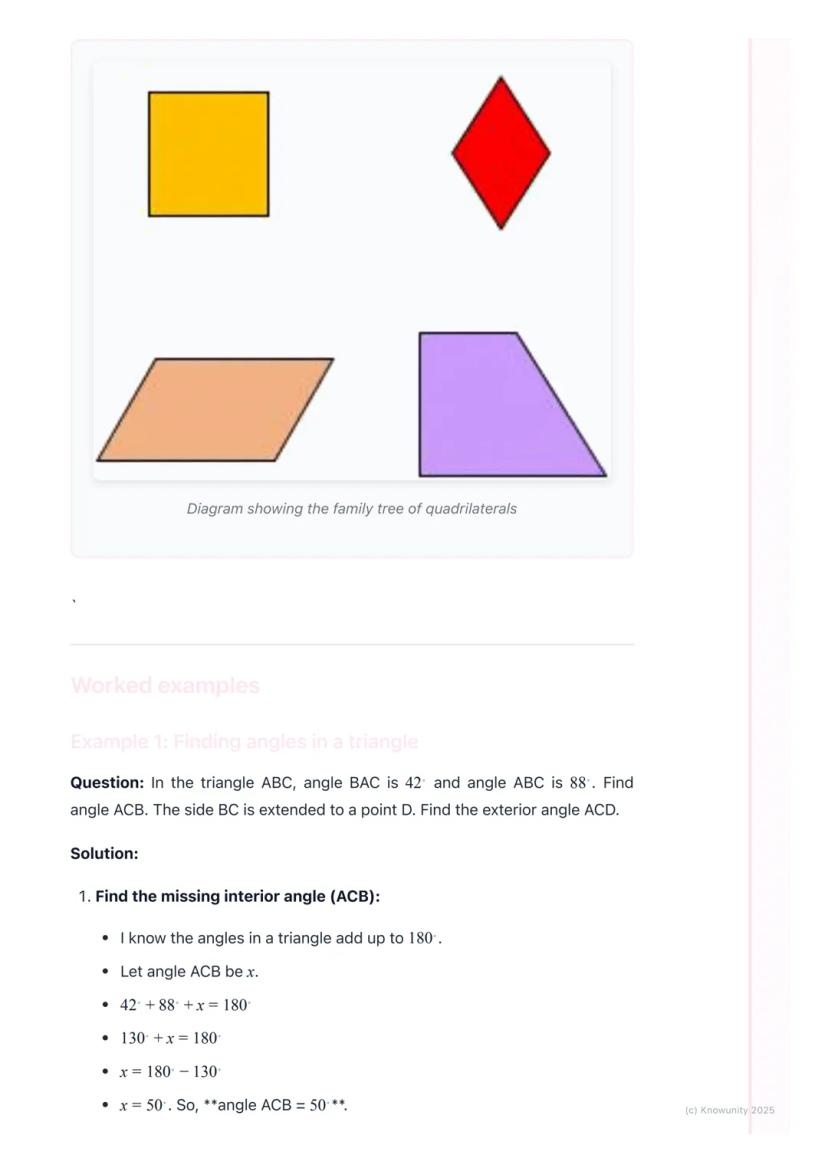
The quadrilateral family tree starts with the basic parallelogram (opposite sides parallel and equal, opposite angles equal). From there, you get rectangles (parallelograms with four right angles), rhombuses (parallelograms with four equal sides), and squares (both rectangle AND rhombus).
Don't forget about trapeziums (one pair of parallel sides) and kites (two pairs of adjacent equal sides). Each shape has its own special properties, but they all follow that 360° rule.
Exam Strategy: When tackling quadrilateral problems, always start by identifying what type of shape you're dealing with - this tells you which properties you can use!
5
of 8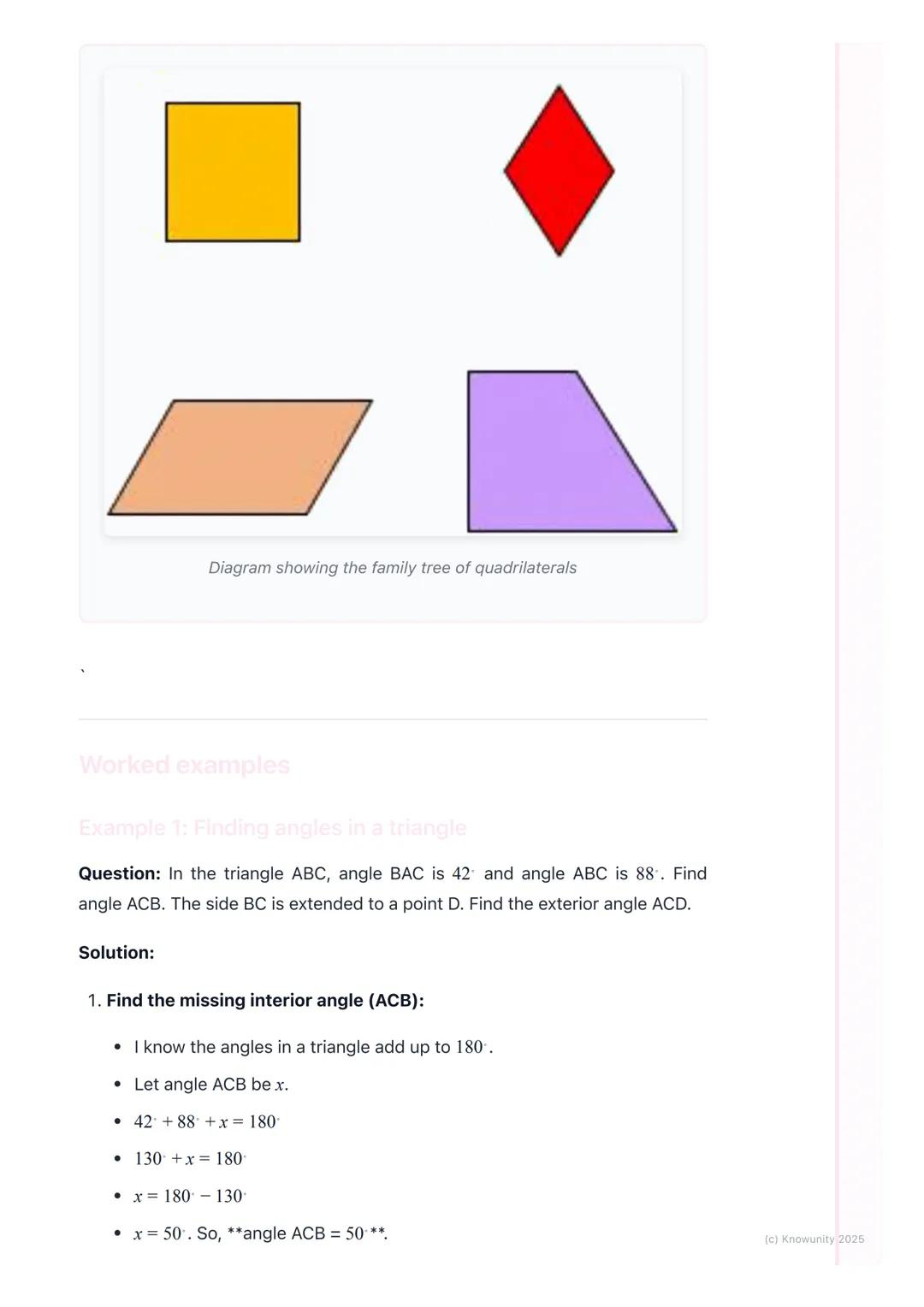
Worked Examples - Finding Triangle Angles
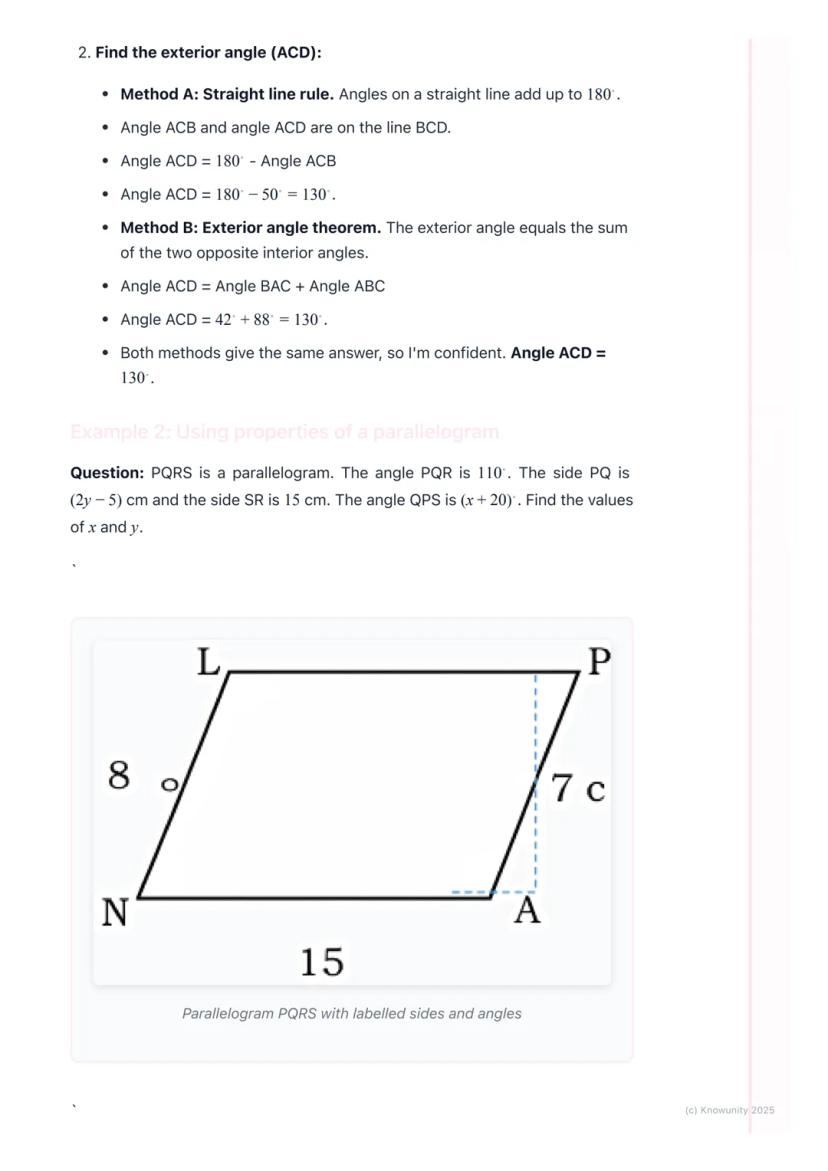
Let's tackle a real problem! If angle BAC is 42° and angle ABC is 88°, finding angle ACB is straightforward using the 180° rule: 42° + 88° + x = 180°, so x = 50°.
For the exterior angle ACD, you've got two methods. Method A uses the straight line rule , so ACD = 180° - 50° = 130°. Method B uses the exterior angle theorem: ACD = 42° + 88° = 130°.
Both methods give the same answer, which is brilliant for checking your work! This double-checking technique can save you marks in exams when you're unsure.
Pro Tip: Always try to solve angle problems using two different methods when possible - if you get the same answer, you know you're right!
6
of 8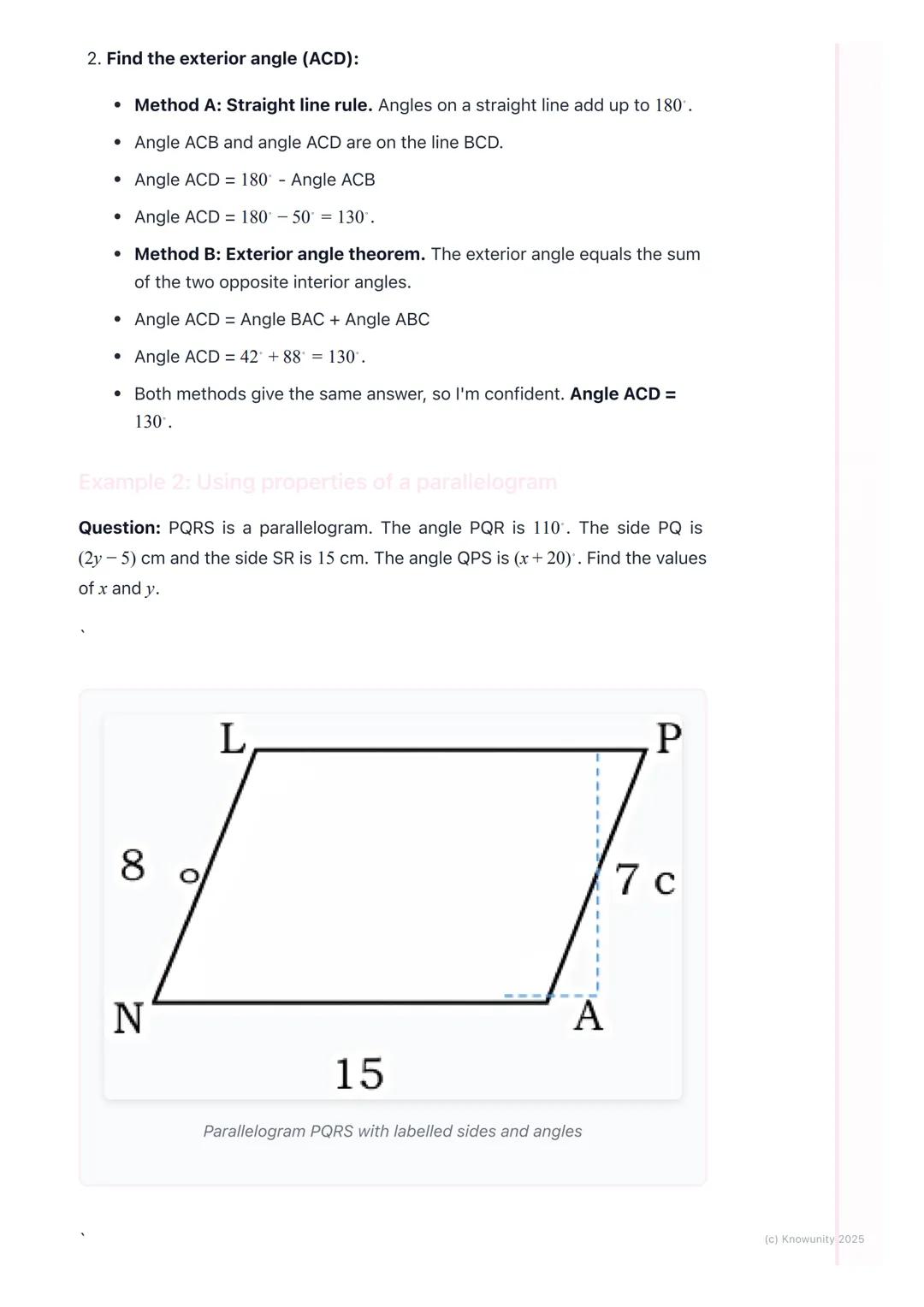
Worked Examples - Parallelogram Properties
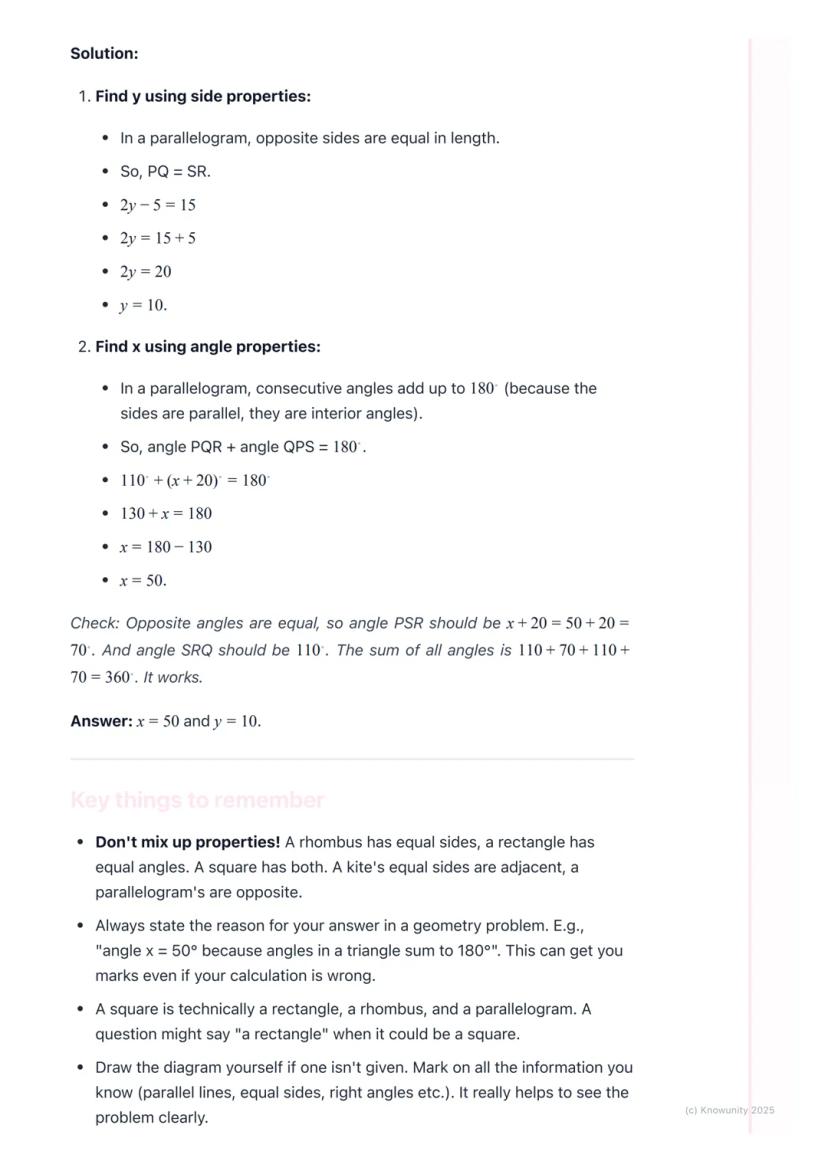
Here's a parallelogram problem that combines algebra with geometry. If PQ = cm and the opposite side SR = 15 cm, you can find y because opposite sides in parallelograms are equal.
So 2y - 5 = 15, which gives us 2y = 20, therefore y = 10. Simple algebra meets geometry!
For finding angle x, remember that consecutive angles in parallelograms add up to 180° (because the sides are parallel). If angle PQR = 110° and angle QPS = °, then 110° + ° = 180°, giving us x = 50°.
Key Insight: Parallelogram problems often mix algebra and geometry - use the shape's properties to set up equations, then solve with algebra!
7
of 8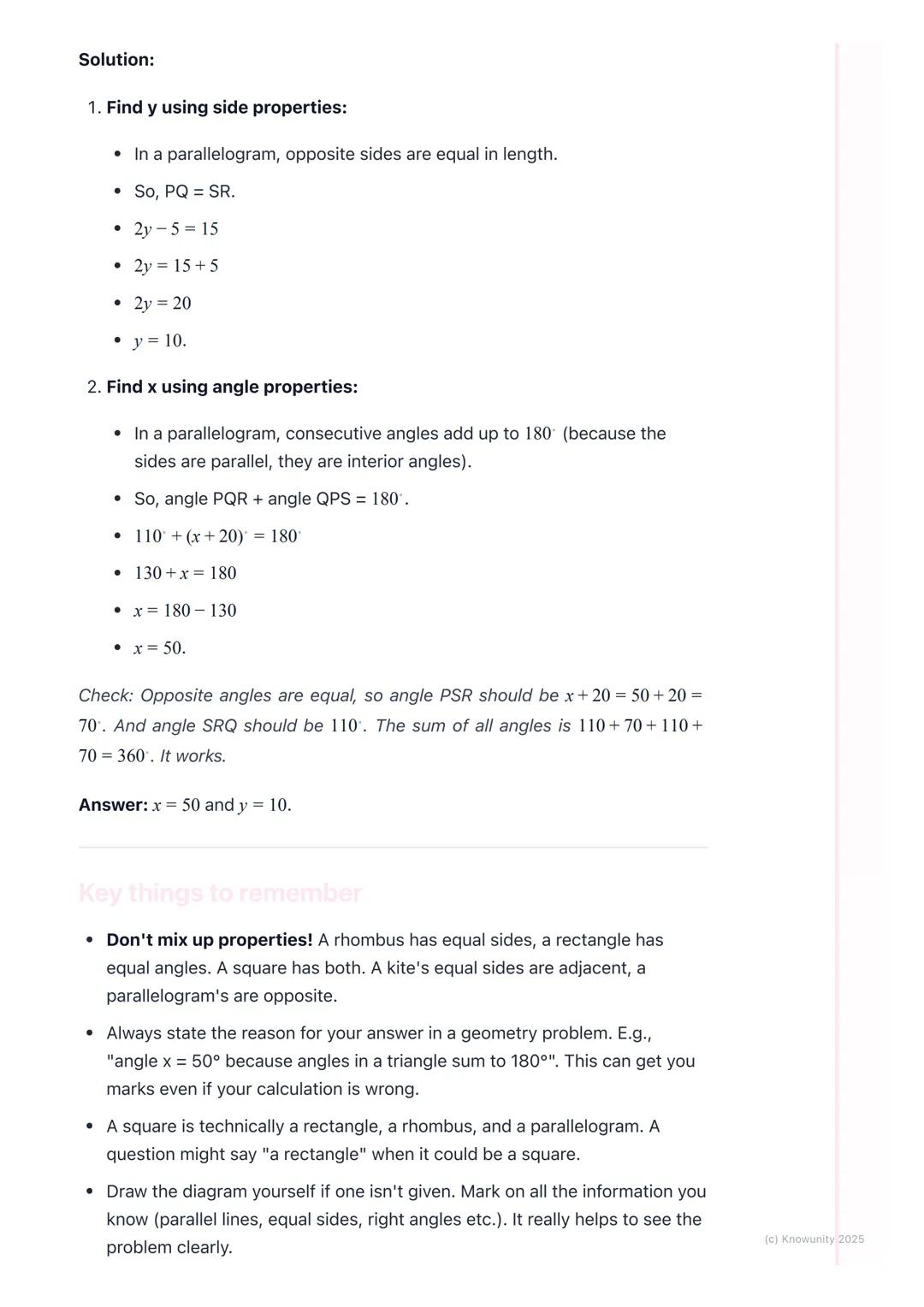
Essential Exam Tips and Common Mistakes
Don't mix up properties! A rhombus has equal sides, a rectangle has right angles, and a square has both. It's like remembering that a square is the overachiever of the quadrilateral family.
Always state your reasoning in geometry problems. Writing "angle x = 50° because angles in a triangle sum to 180°" can earn you marks even if your calculation goes wrong. Examiners love to see your thinking process.
Draw diagrams when they're not provided, and mark everything you know - parallel lines, equal sides, right angles. Visual information makes problems much clearer and prevents silly mistakes.
Exam Success: Remember that a square is technically a rectangle, rhombus, AND parallelogram - so questions about "rectangles" might actually involve squares!
8
of 8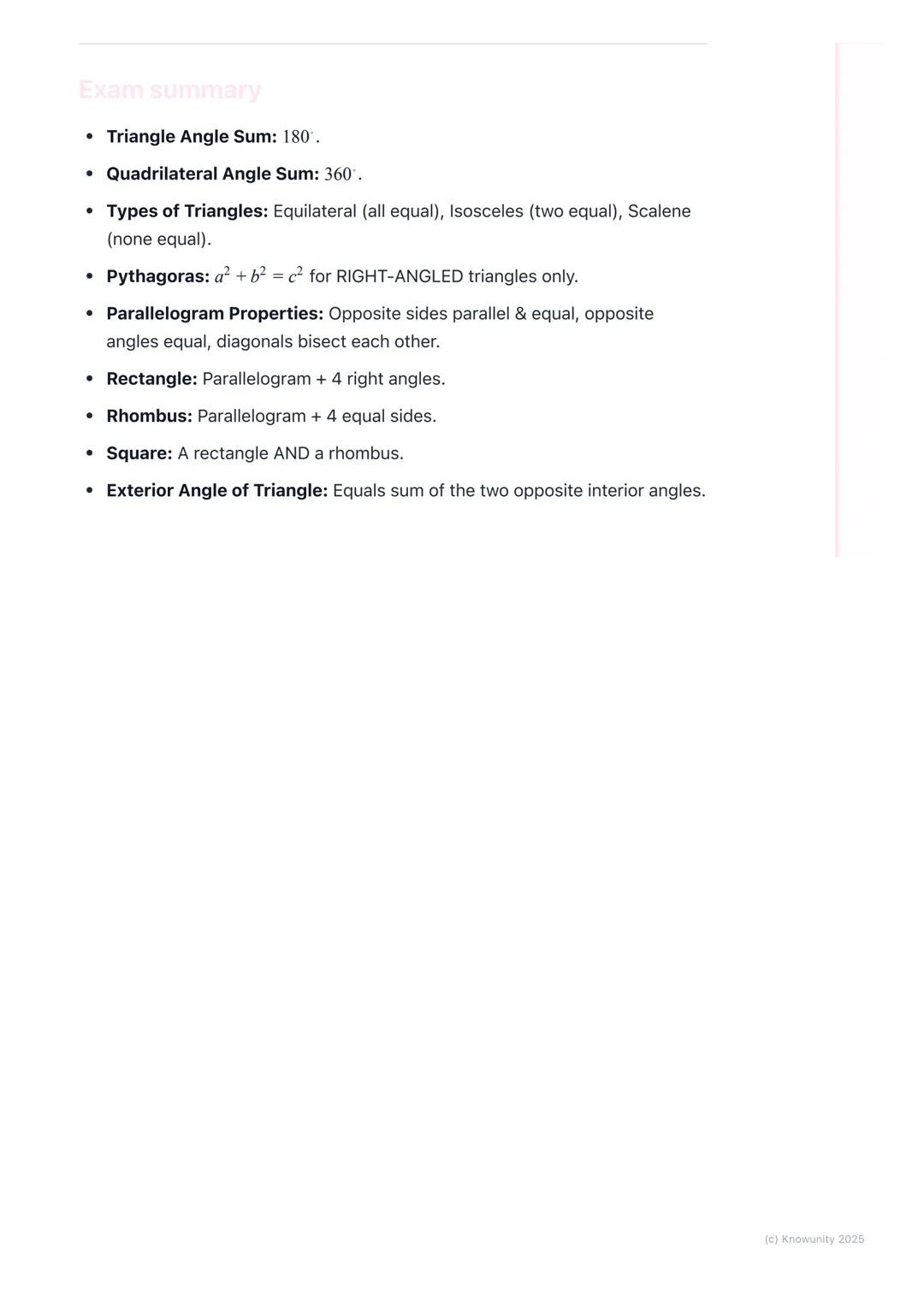
Quick Revision Summary
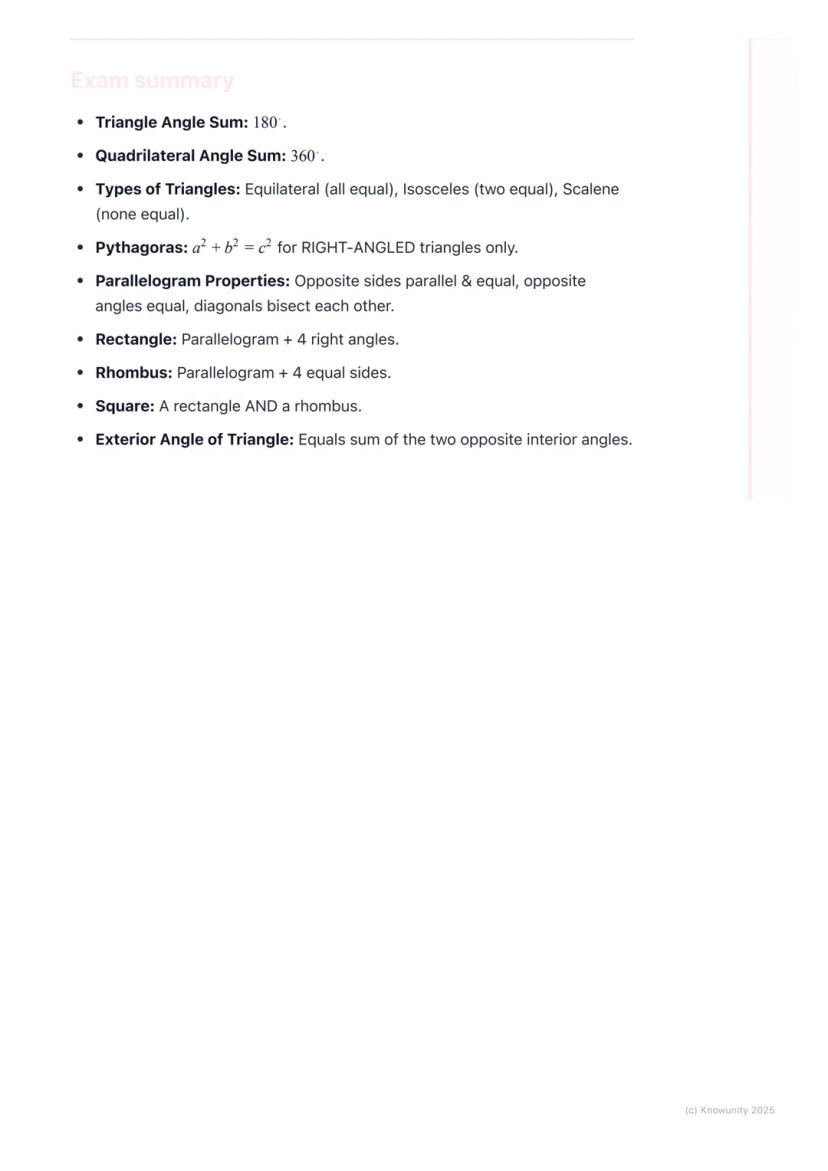
Here's your exam cheat sheet! Triangle angles sum to 180°, quadrilateral angles sum to 360°. Know your triangle types: equilateral (all equal), isosceles (two equal), scalene (none equal).
Pythagoras' theorem only works for right-angled triangles - don't try using it on other triangles! The exterior angle of a triangle equals the sum of the two opposite interior angles.
For quadrilaterals, start with parallelograms (opposite sides parallel and equal, opposite angles equal). Add right angles to get rectangles, add equal sides to get rhombuses, add both to get squares. Master these basics and you're sorted for most geometry questions!
Final Reminder: Practice identifying shape types quickly - once you know what you're dealing with, the properties follow naturally!
Myśleliśmy, że nigdy nie zapytasz...
Czym jest Towarzysz AI z Knowunity?
Nasz asystent AI jest specjalnie dostosowany do potrzeb uczniów. W oparciu o miliony treści, które mamy na platformie, możemy udzielać uczniom naprawdę znaczących i trafnych odpowiedzi. Ale nie chodzi tylko o odpowiedzi, towarzysz prowadzi również uczniów przez codzienne wyzwania związane z nauką, ze spersonalizowanymi planami nauki, quizami lub treściami na czacie i 100% personalizacją opartą na umiejętnościach i rozwoju uczniów.
Gdzie mogę pobrać aplikację Knowunity?
Aplikację możesz pobrać z Google Play i Apple Store.
Czy aplikacja Knowunity naprawdę jest darmowa?
Tak, masz całkowicie darmowy dostęp do wszystkich notatek w aplikacji, możesz w każdej chwili rozmawiać z Ekspertami lub ich obserwować. Możesz użyć punktów, aby odblokować pewne funkcje w aplikacji, które również możesz otrzymać za darmo. Dodatkowo oferujemy usługę Knowunity Premium, która pozwala na odblokowanie większej liczby funkcji.
Najpopularniejsze notatki z Mathematics
8Najpopularniejsze notatki
9Nie ma nic odpowiedniego? Sprawdź inne przedmioty.
Zobacz, co mówią o nas nasi użytkownicy. Pokochali nas — pokochasz też i Ty.
4.6/5App Store
4.7/5Google Play
Aplikacja jest bardzo prosta i dobrze przemyślana. Do tej pory znalazłem wszystko, czego szukałem i mogłem się wiele nauczyć z innych notatek! Na pewno wykorzystam aplikację do pomocy przy robieniu prac domowych! No i oczywiście bardzo pomaga też jako inspiracja do robienia swoich notatek.
Stefan Sużytkownik iOS
Ta aplikacja jest naprawdę świetna. Jest tak wiele notatek i pomocnych informacji [...]. Moim problematycznym przedmiotem jest język niemiecki, a w aplikacji jest w czym wybierać. Dzięki tej aplikacji poprawiłam swój niemiecki. Polecam ją każdemu.
Samantha Klichużytkownik Androida
Wow, jestem w szoku. Właśnie wypróbowałam aplikację, ponieważ widziałam ją kilka razy reklamowaną na TikToku jestem absolutnie w szoku. Ta aplikacja jest POMOCĄ, której potrzebujesz w szkole i przede wszystkim oferuje tak wiele rzeczy jak notatki czy streszczenia, które są BARDZO pomocne w moim przypadku.
Annaużytkownik iOS
Mathematics4 wyświetleń·Zaktualizowano Jun 6, 2026·8 stronyUnderstanding Triangles and Quadrilaterals
Ever wondered why triangles and quadrilaterals are everywhere around you? From the roof of your house to your phone screen, these basic shapes are the building blocks of geometry and appear constantly in your maths exams!
1
of 8
Zarejestruj się, aby zobaczyć notatkę. To nic nie kosztuje!
- Dostęp do wszystkich materiałów
- Popraw swoje oceny
- Dołącz do milionów studentów
Introduction to Polygons and Key Terms
Understanding polygons is like learning the alphabet of geometry - once you know these basics, everything else makes sense. A polygon is simply a flat, 2D shape made of straight lines, and triangles and quadrilaterals are the most important ones you'll encounter.
The key terms you absolutely need to know include vertices (corner points), interior angles (angles inside the shape), and exterior angles (formed when you extend a side). Remember that an interior angle and its exterior angle always add up to 180°.
Parallel lines never meet and are marked with arrows, whilst perpendicular lines meet at 90°. When shapes are congruent, they're exactly the same size and shape - think of identical twins!
Quick Tip: Master these definitions first - they're the foundation for everything else in geometry and will save you marks in exams.
2
of 8Zarejestruj się, aby zobaczyć notatkę. To nic nie kosztuje!
- Dostęp do wszystkich materiałów
- Popraw swoje oceny
- Dołącz do milionów studentów
Triangle Properties and Classifications
Here's the golden rule that'll save you in every triangle question: the sum of interior angles in ANY triangle is always 180°. This works whether your triangle is huge or tiny, wonky or perfect.
Triangles get sorted by their sides in three ways. Equilateral triangles have all sides equal and all angles are exactly 60°. Isosceles triangles have two equal sides, and the angles opposite those equal sides are also equal. Scalene triangles are the rebels - no sides or angles are equal.
You can also classify triangles by their angles. Acute triangles have all angles less than 90°, right-angled triangles have exactly one 90° angle, and obtuse triangles have one angle greater than 90°.
Exam Gold: In right-angled triangles, the longest side opposite the right angle is called the hypotenuse - you'll need this for Pythagoras' theorem!
3
of 8Zarejestruj się, aby zobaczyć notatkę. To nic nie kosztuje!
- Dostęp do wszystkich materiałów
- Popraw swoje oceny
- Dołącz do milionów studentów
Important Triangle Theorems
The Exterior Angle Theorem is brilliantly simple: any exterior angle of a triangle equals the sum of the two opposite interior angles. So if those opposite angles are 50° and 70°, your exterior angle is 120°. Easy!
Pythagoras' Theorem only works for right-angled triangles, but it's incredibly useful: a² + b² = c². The key is identifying the hypotenuse correctly - it's always the longest side, opposite the right angle.
These theorems aren't just random rules - they're your problem-solving toolkit. When you're stuck on a triangle question, ask yourself: "Can I use the 180° rule? Is there an exterior angle? Is this a right triangle where Pythagoras applies?"
Memory Trick: Think of Pythagoras like a recipe - you need the right ingredients for it to work!
4
of 8Zarejestruj się, aby zobaczyć notatkę. To nic nie kosztuje!
- Dostęp do wszystkich materiałów
- Popraw swoje oceny
- Dołącz do milionów studentów
Quadrilateral Properties and Types
Quadrilaterals are four-sided shapes, and here's your second golden rule: the sum of interior angles in ANY quadrilateral is always 360°. Whether it's a square, rectangle, or weird wonky shape, the angles always add up to 360°.
The quadrilateral family tree starts with the basic parallelogram (opposite sides parallel and equal, opposite angles equal). From there, you get rectangles (parallelograms with four right angles), rhombuses (parallelograms with four equal sides), and squares (both rectangle AND rhombus).
Don't forget about trapeziums (one pair of parallel sides) and kites (two pairs of adjacent equal sides). Each shape has its own special properties, but they all follow that 360° rule.
Exam Strategy: When tackling quadrilateral problems, always start by identifying what type of shape you're dealing with - this tells you which properties you can use!
5
of 8Zarejestruj się, aby zobaczyć notatkę. To nic nie kosztuje!
- Dostęp do wszystkich materiałów
- Popraw swoje oceny
- Dołącz do milionów studentów
Worked Examples - Finding Triangle Angles
Let's tackle a real problem! If angle BAC is 42° and angle ABC is 88°, finding angle ACB is straightforward using the 180° rule: 42° + 88° + x = 180°, so x = 50°.
For the exterior angle ACD, you've got two methods. Method A uses the straight line rule , so ACD = 180° - 50° = 130°. Method B uses the exterior angle theorem: ACD = 42° + 88° = 130°.
Both methods give the same answer, which is brilliant for checking your work! This double-checking technique can save you marks in exams when you're unsure.
Pro Tip: Always try to solve angle problems using two different methods when possible - if you get the same answer, you know you're right!
6
of 8Zarejestruj się, aby zobaczyć notatkę. To nic nie kosztuje!
- Dostęp do wszystkich materiałów
- Popraw swoje oceny
- Dołącz do milionów studentów
Worked Examples - Parallelogram Properties
Here's a parallelogram problem that combines algebra with geometry. If PQ = cm and the opposite side SR = 15 cm, you can find y because opposite sides in parallelograms are equal.
So 2y - 5 = 15, which gives us 2y = 20, therefore y = 10. Simple algebra meets geometry!
For finding angle x, remember that consecutive angles in parallelograms add up to 180° (because the sides are parallel). If angle PQR = 110° and angle QPS = °, then 110° + ° = 180°, giving us x = 50°.
Key Insight: Parallelogram problems often mix algebra and geometry - use the shape's properties to set up equations, then solve with algebra!
7
of 8Zarejestruj się, aby zobaczyć notatkę. To nic nie kosztuje!
- Dostęp do wszystkich materiałów
- Popraw swoje oceny
- Dołącz do milionów studentów
Essential Exam Tips and Common Mistakes
Don't mix up properties! A rhombus has equal sides, a rectangle has right angles, and a square has both. It's like remembering that a square is the overachiever of the quadrilateral family.
Always state your reasoning in geometry problems. Writing "angle x = 50° because angles in a triangle sum to 180°" can earn you marks even if your calculation goes wrong. Examiners love to see your thinking process.
Draw diagrams when they're not provided, and mark everything you know - parallel lines, equal sides, right angles. Visual information makes problems much clearer and prevents silly mistakes.
Exam Success: Remember that a square is technically a rectangle, rhombus, AND parallelogram - so questions about "rectangles" might actually involve squares!
8
of 8Zarejestruj się, aby zobaczyć notatkę. To nic nie kosztuje!
- Dostęp do wszystkich materiałów
- Popraw swoje oceny
- Dołącz do milionów studentów
Quick Revision Summary
Here's your exam cheat sheet! Triangle angles sum to 180°, quadrilateral angles sum to 360°. Know your triangle types: equilateral (all equal), isosceles (two equal), scalene (none equal).
Pythagoras' theorem only works for right-angled triangles - don't try using it on other triangles! The exterior angle of a triangle equals the sum of the two opposite interior angles.
For quadrilaterals, start with parallelograms (opposite sides parallel and equal, opposite angles equal). Add right angles to get rectangles, add equal sides to get rhombuses, add both to get squares. Master these basics and you're sorted for most geometry questions!
Final Reminder: Practice identifying shape types quickly - once you know what you're dealing with, the properties follow naturally!
Myśleliśmy, że nigdy nie zapytasz...
Czym jest Towarzysz AI z Knowunity?
Nasz asystent AI jest specjalnie dostosowany do potrzeb uczniów. W oparciu o miliony treści, które mamy na platformie, możemy udzielać uczniom naprawdę znaczących i trafnych odpowiedzi. Ale nie chodzi tylko o odpowiedzi, towarzysz prowadzi również uczniów przez codzienne wyzwania związane z nauką, ze spersonalizowanymi planami nauki, quizami lub treściami na czacie i 100% personalizacją opartą na umiejętnościach i rozwoju uczniów.
Gdzie mogę pobrać aplikację Knowunity?
Aplikację możesz pobrać z Google Play i Apple Store.
Czy aplikacja Knowunity naprawdę jest darmowa?
Tak, masz całkowicie darmowy dostęp do wszystkich notatek w aplikacji, możesz w każdej chwili rozmawiać z Ekspertami lub ich obserwować. Możesz użyć punktów, aby odblokować pewne funkcje w aplikacji, które również możesz otrzymać za darmo. Dodatkowo oferujemy usługę Knowunity Premium, która pozwala na odblokowanie większej liczby funkcji.
Najpopularniejsze notatki z Mathematics
8Najpopularniejsze notatki
9Nie ma nic odpowiedniego? Sprawdź inne przedmioty.
Zobacz, co mówią o nas nasi użytkownicy. Pokochali nas — pokochasz też i Ty.
4.6/5App Store
4.7/5Google Play
Aplikacja jest bardzo prosta i dobrze przemyślana. Do tej pory znalazłem wszystko, czego szukałem i mogłem się wiele nauczyć z innych notatek! Na pewno wykorzystam aplikację do pomocy przy robieniu prac domowych! No i oczywiście bardzo pomaga też jako inspiracja do robienia swoich notatek.
Stefan Sużytkownik iOS
Ta aplikacja jest naprawdę świetna. Jest tak wiele notatek i pomocnych informacji [...]. Moim problematycznym przedmiotem jest język niemiecki, a w aplikacji jest w czym wybierać. Dzięki tej aplikacji poprawiłam swój niemiecki. Polecam ją każdemu.
Samantha Klichużytkownik Androida
Wow, jestem w szoku. Właśnie wypróbowałam aplikację, ponieważ widziałam ją kilka razy reklamowaną na TikToku jestem absolutnie w szoku. Ta aplikacja jest POMOCĄ, której potrzebujesz w szkole i przede wszystkim oferuje tak wiele rzeczy jak notatki czy streszczenia, które są BARDZO pomocne w moim przypadku.
Annaużytkownik iOS