
Right-angled triangles are everywhere - from the ladders you climb...
 Mathematics5 wyświetleń·Zaktualizowano Jun 10, 2026·9 strony
Master Trigonometry: Learn SOHCAHTOA for Real-Life Problems
1 / 9
1
of 9
The Basics of Right-Angled Triangles
You'll use trigonometry in loads of practical situations like construction, navigation, and even video game design. The key is mastering the relationship between angles and side lengths in triangles with one 90° angle.
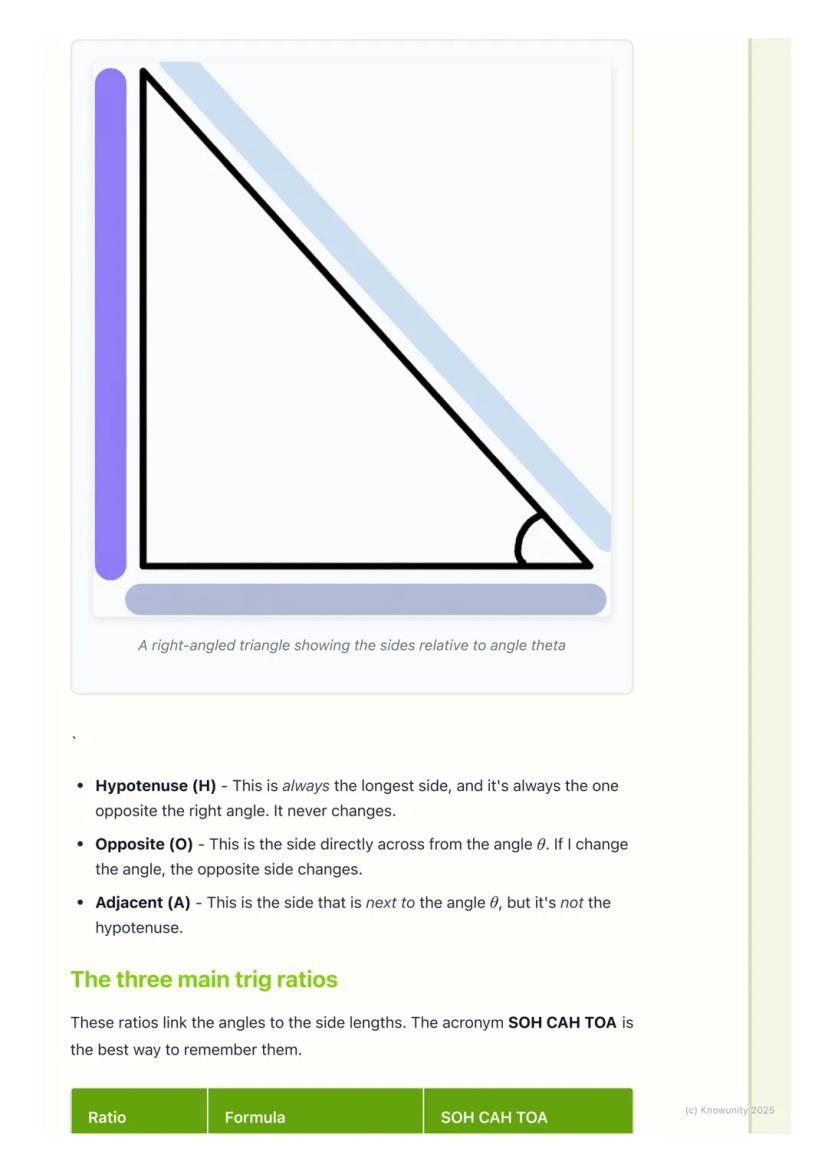
Getting the labelling right is absolutely crucial. The side names depend on which angle you're focusing on (usually called theta or θ). The hypotenuse is always the longest side opposite the right angle - that never changes.
The opposite side sits directly across from your angle θ. If you change the angle, the opposite side changes too. The adjacent side is next to angle θ, but it's not the hypotenuse.
Key Tip: Always label your triangle sides before attempting any calculation - this prevents costly mistakes!
2
of 9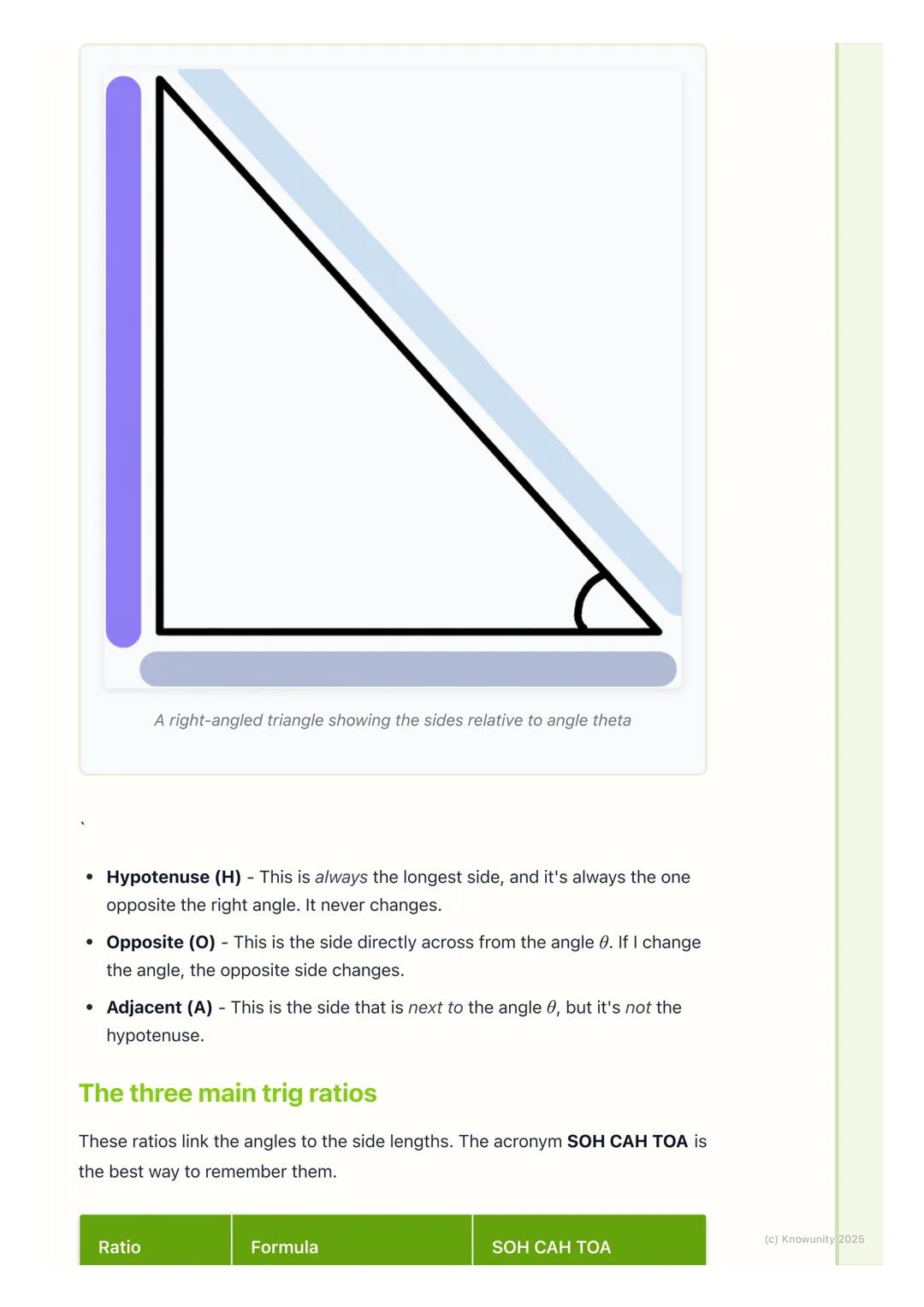
SOH CAH TOA - Your Best Friend
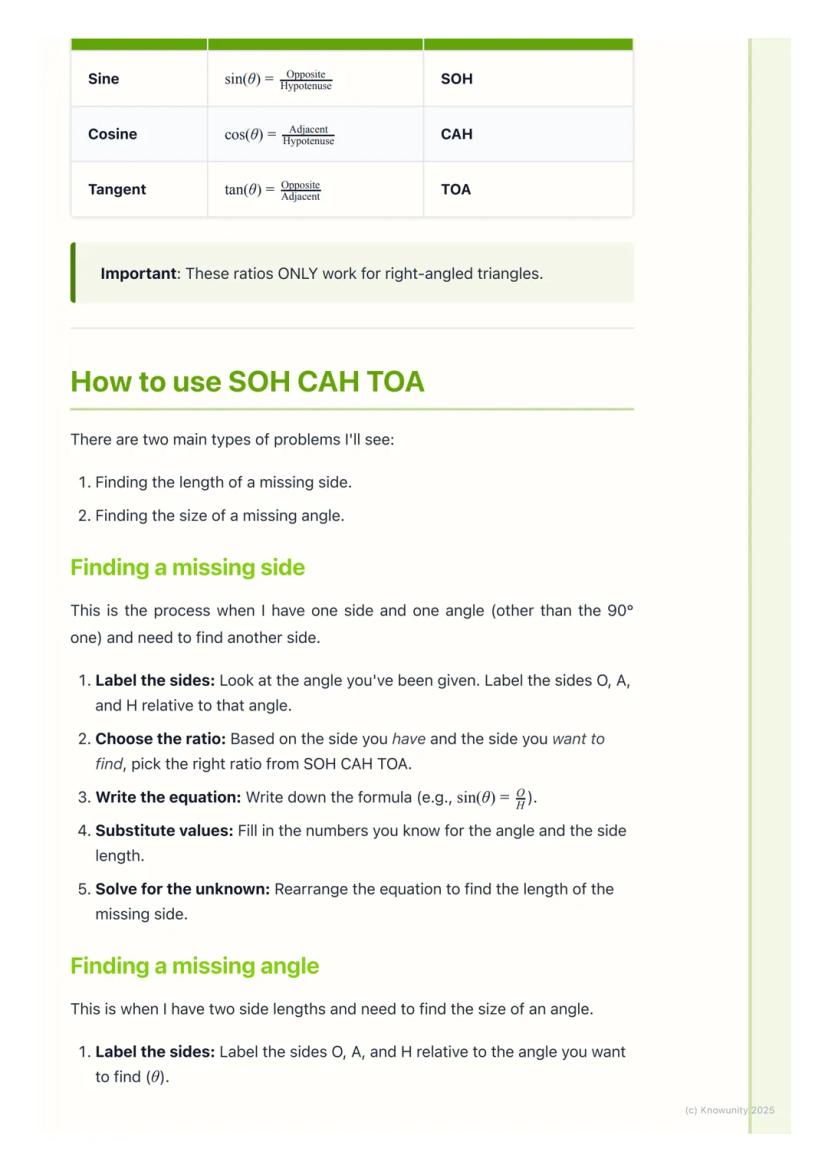
SOH CAH TOA is the magic acronym that'll save you in every exam. It represents the three main trigonometric ratios that link angles to side lengths.
SOH means sin(θ) = Opposite/Hypotenuse. CAH means cos(θ) = Adjacent/Hypotenuse. TOA means tan(θ) = Opposite/Adjacent.
These ratios ONLY work for right-angled triangles - don't try using them elsewhere! You'll encounter two main problem types: finding missing sides and finding missing angles.
Remember: These ratios are your toolkit for solving any right-angled triangle problem you'll face.
3
of 9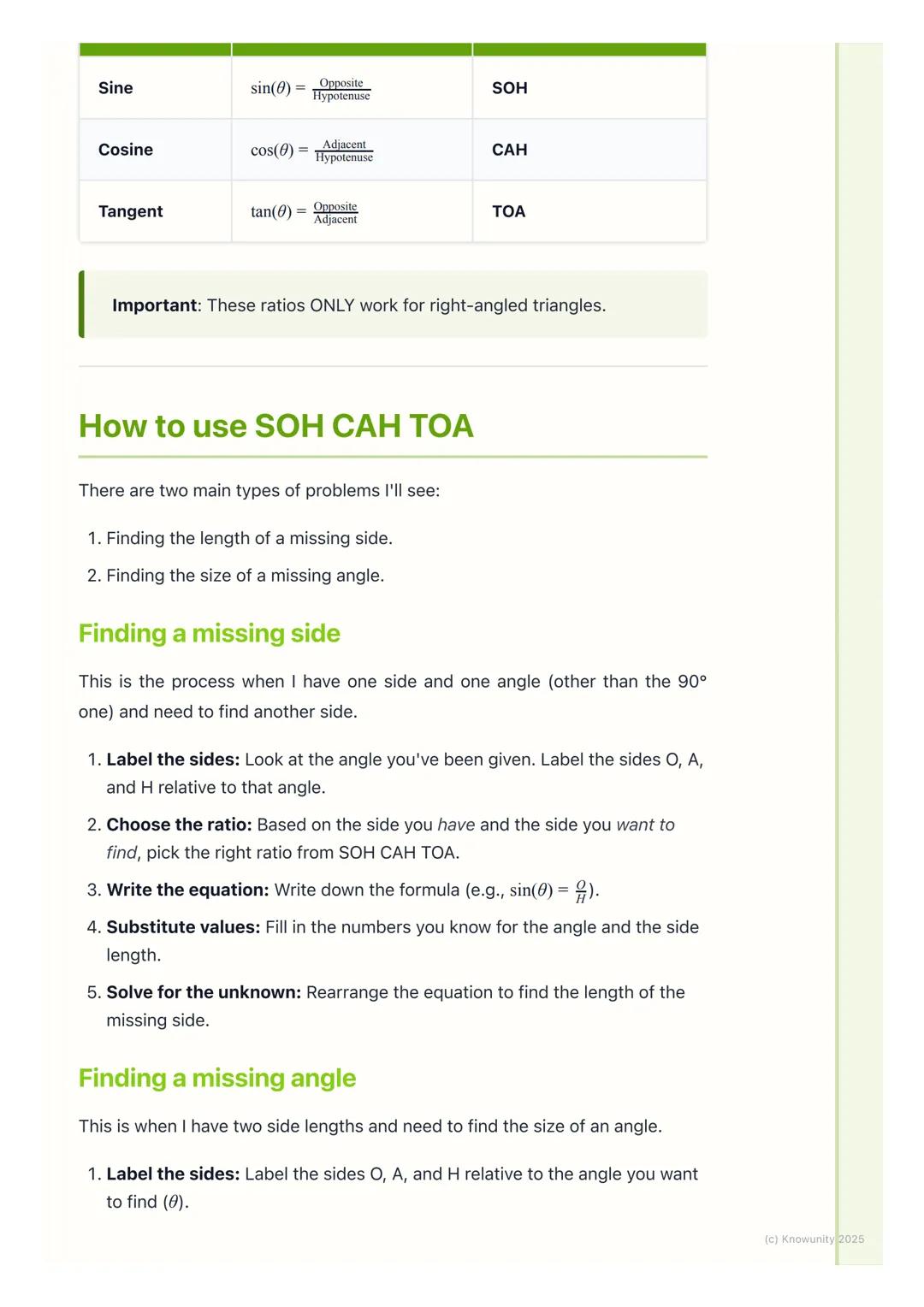
Finding Missing Sides
When you've got one side and one angle (besides the 90° one), finding another side becomes straightforward with the right approach.
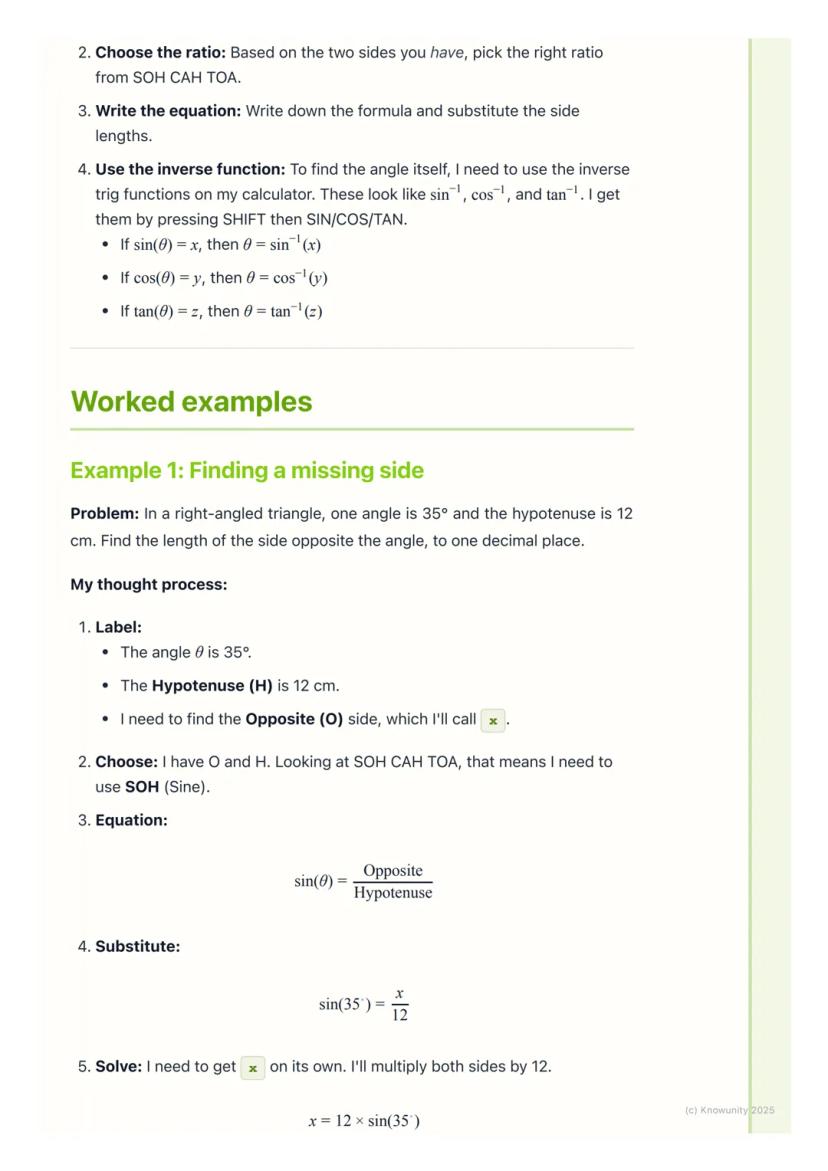
Follow this foolproof process: Label the sides O, A, and H relative to your given angle. Choose the correct ratio from SOH CAH TOA based on what you have and what you need. Write the equation and substitute your known values.
Finally, solve for the unknown by rearranging the equation. For example, if sin(35°) = x/12, then x = 12 × sin(35°) = 6.9 cm.
Pro Tip: Always double-check your labelling - mixing up opposite and adjacent is the most common mistake students make.
4
of 9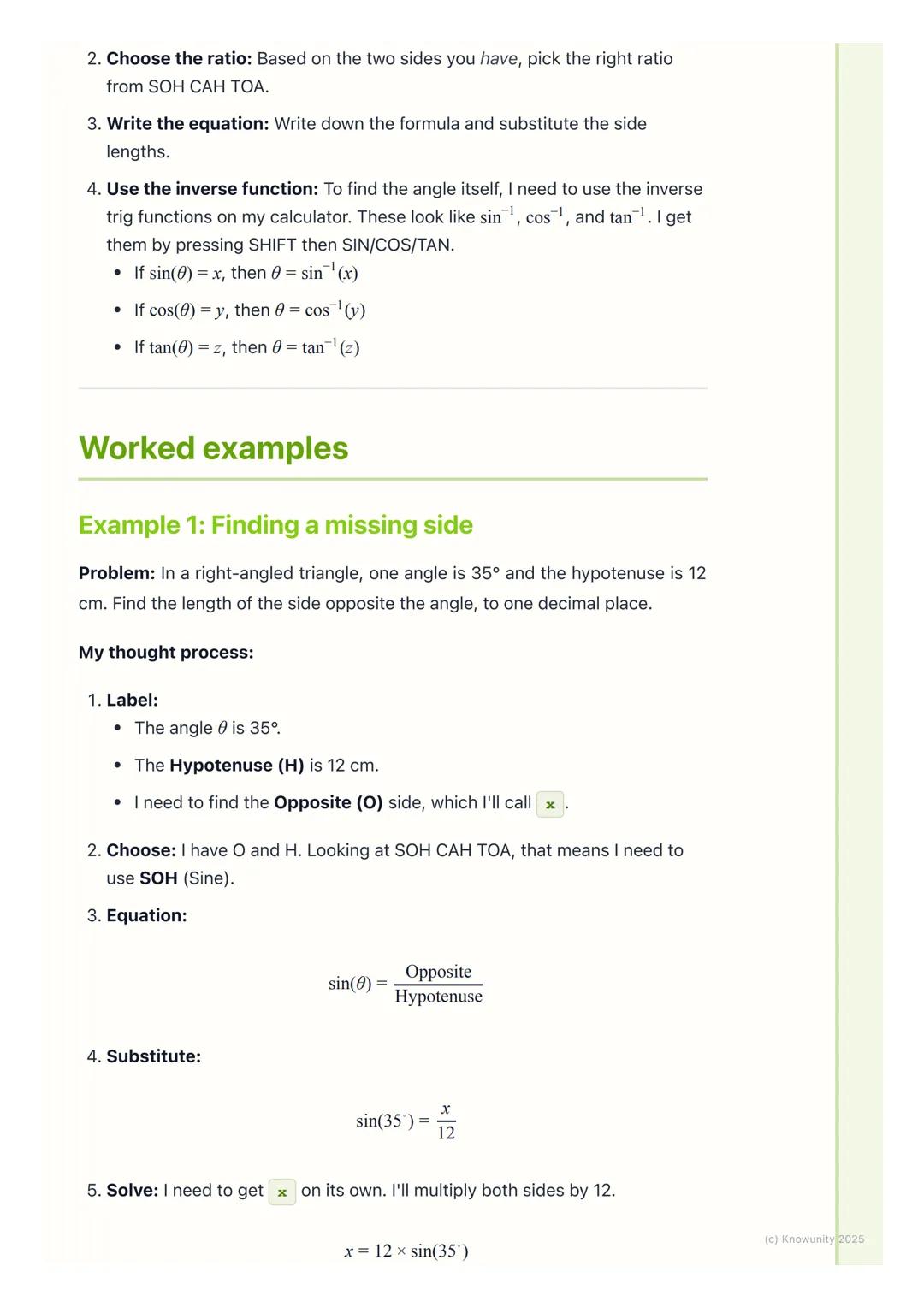
Finding Missing Angles
Working backwards from two known sides to find an angle requires inverse trigonometric functions. These appear as sin⁻¹, cos⁻¹, and tan⁻¹ on your calculator.
Start by labelling your sides and choosing the right ratio from SOH CAH TOA. Write your equation and substitute the side lengths you know.
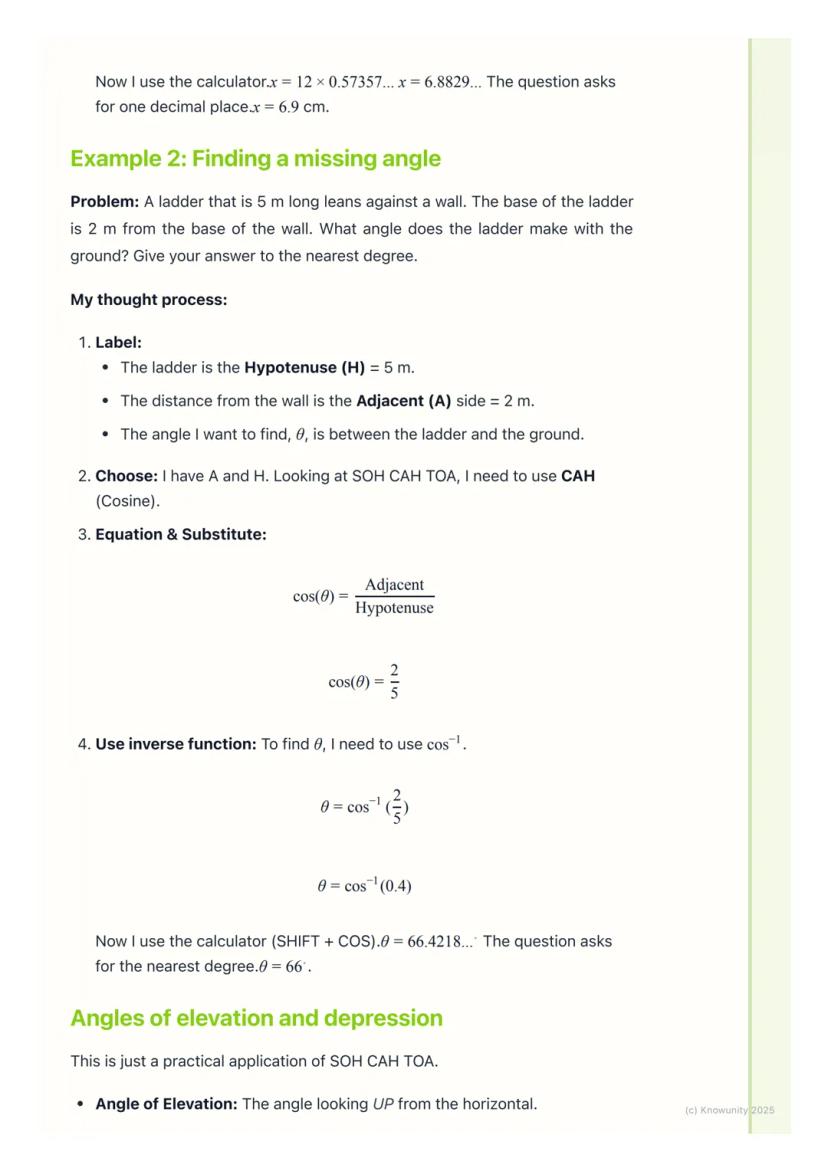
To find the actual angle, use the inverse function. If cos(θ) = 2/5, then θ = cos⁻¹(2/5) = 66°. Access these functions by pressing SHIFT then the relevant trig button.
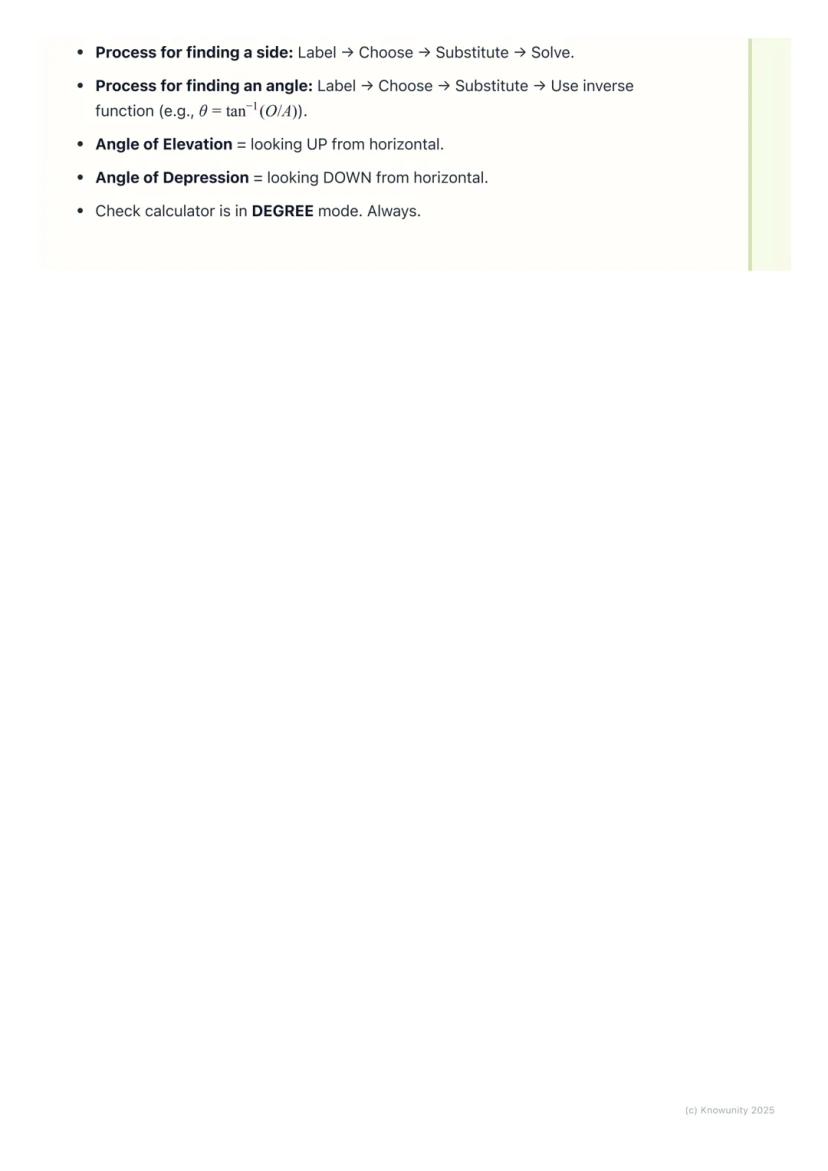
Calculator Alert: Make sure you're in DEGREE mode, not radians - this mistake costs students loads of marks!
5
of 9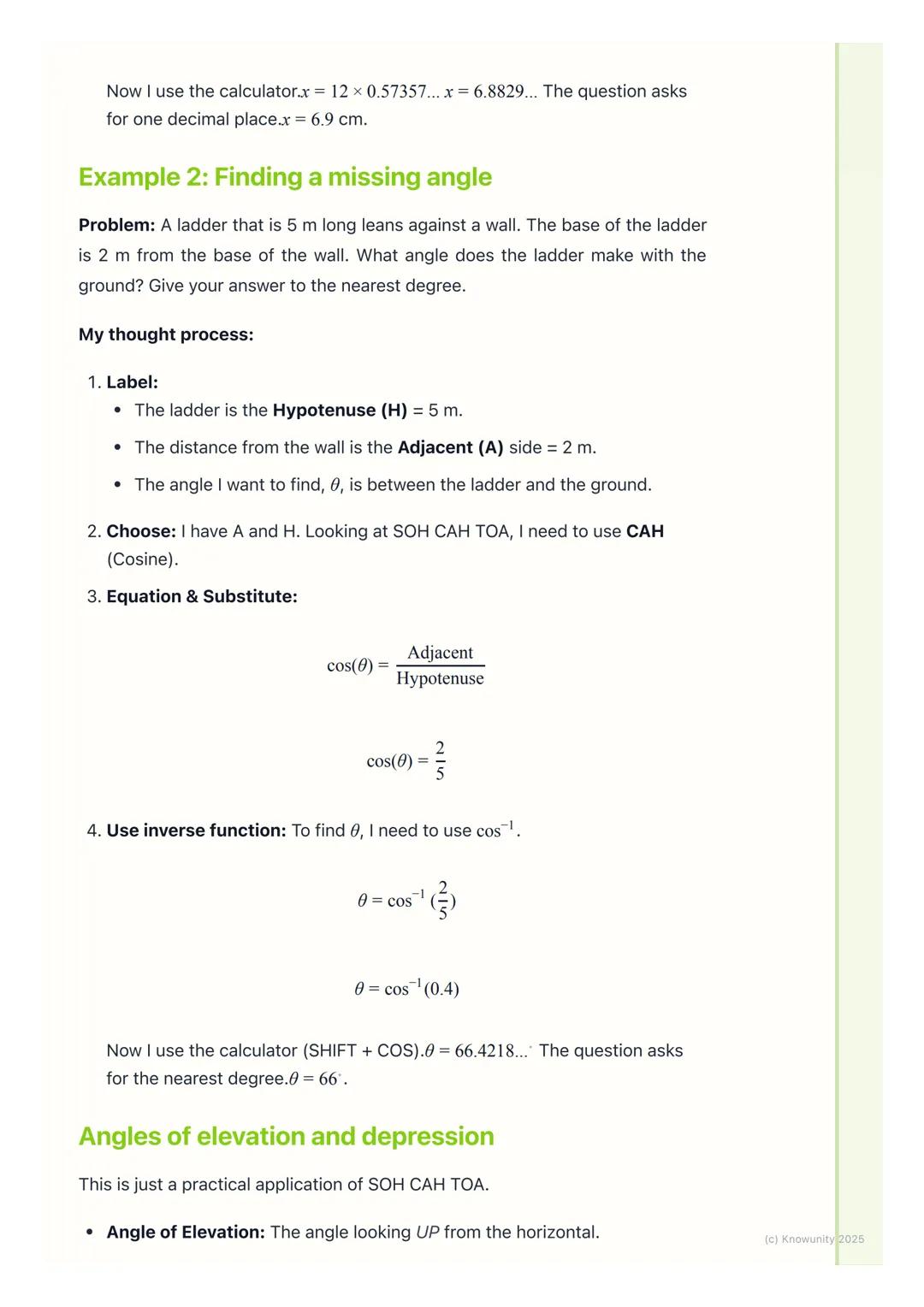
Angles of Elevation and Depression
These concepts bring trigonometry into real-world scenarios you'll actually encounter. Understanding them makes word problems much easier to tackle.
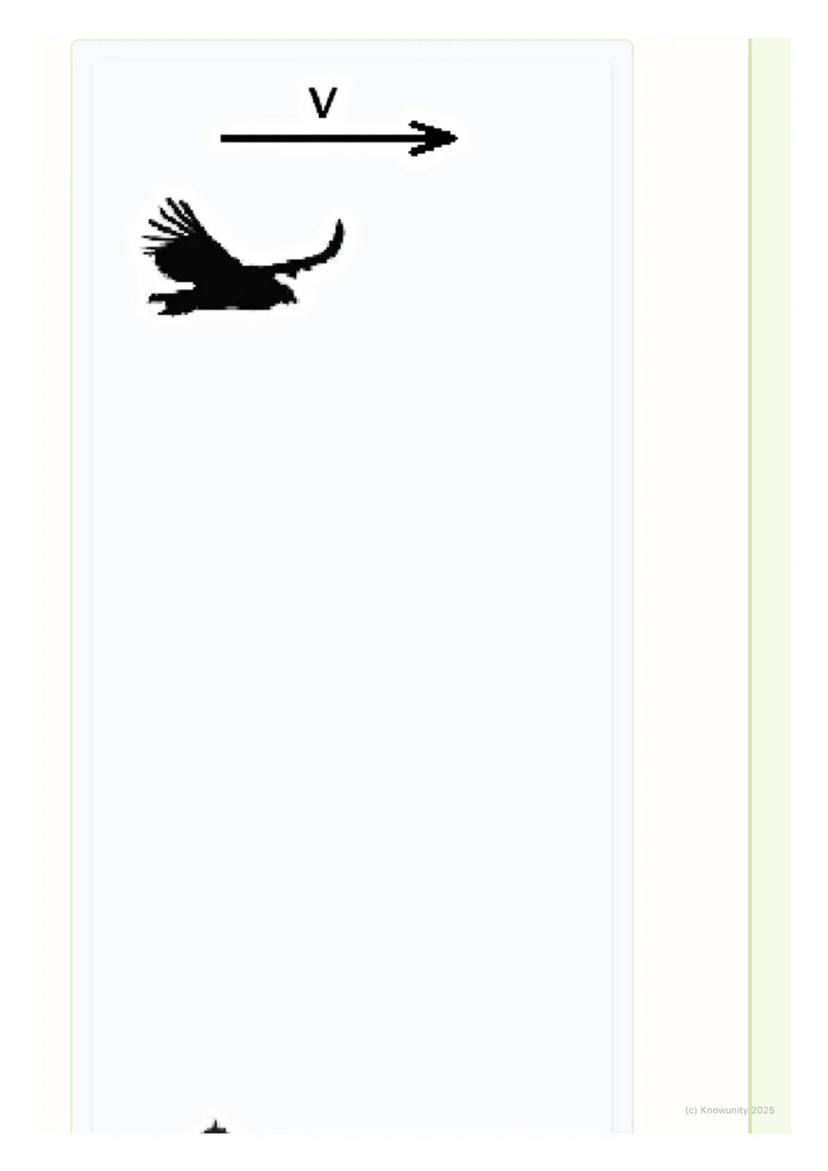
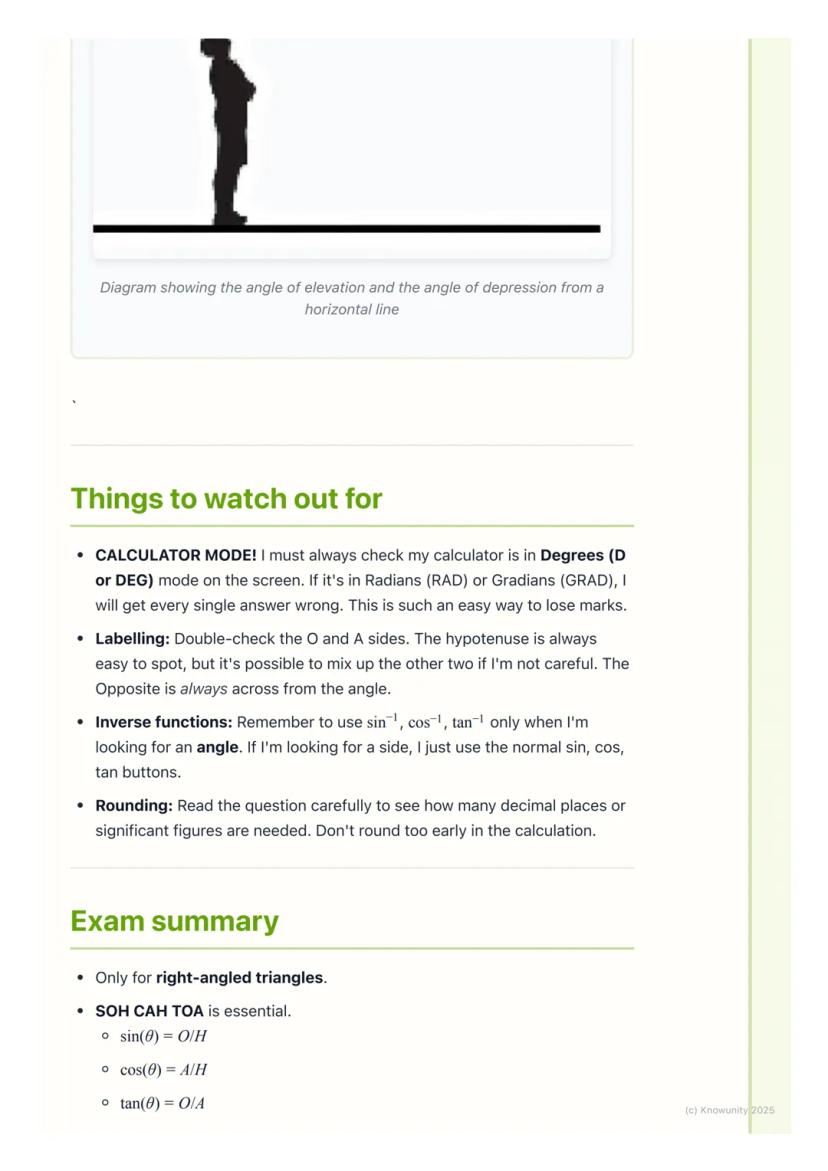
The angle of elevation is when you're looking UP from horizontal - like viewing the top of a building from ground level. The angle of depression is looking DOWN from horizontal - like a pilot viewing the ground.
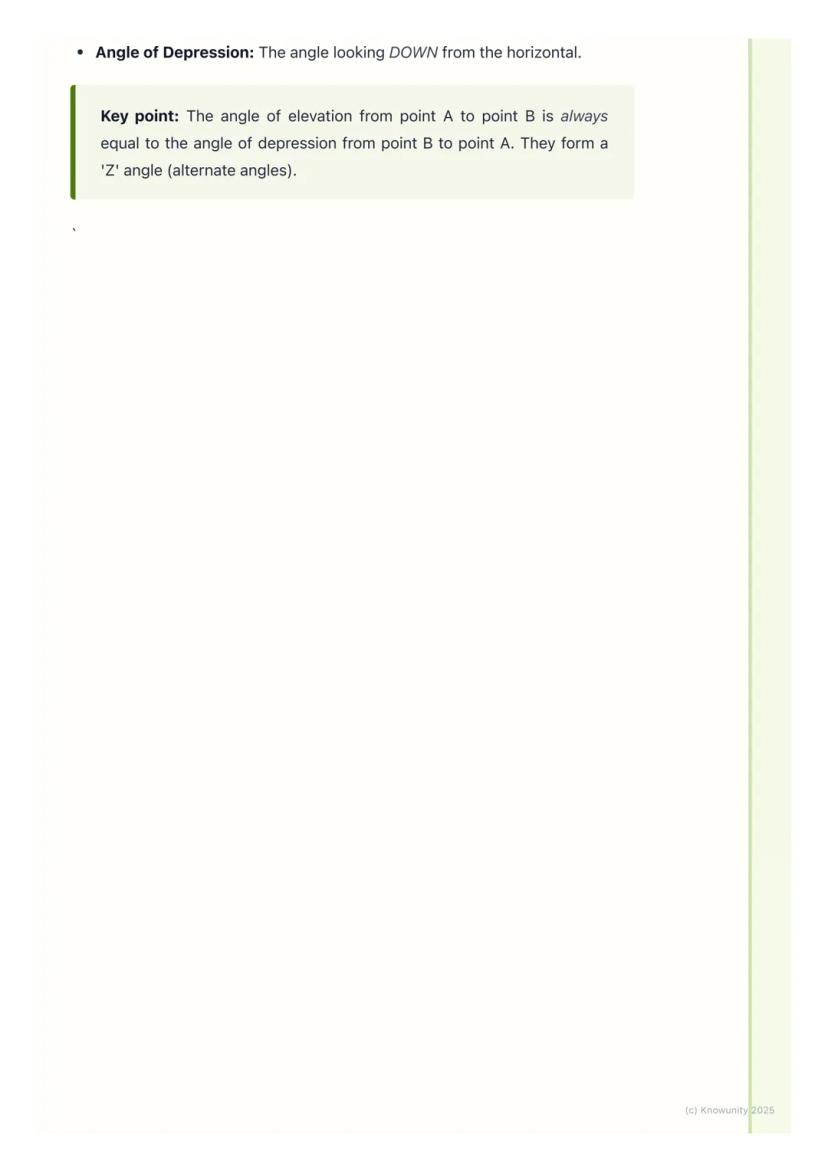
Here's a neat fact: the angle of elevation from point A to point B always equals the angle of depression from point B to point A. They form alternate angles in a 'Z' pattern.
Real-World Connection: These angles are used in surveying, aviation, and architecture - skills that translate directly to careers!
6
of 9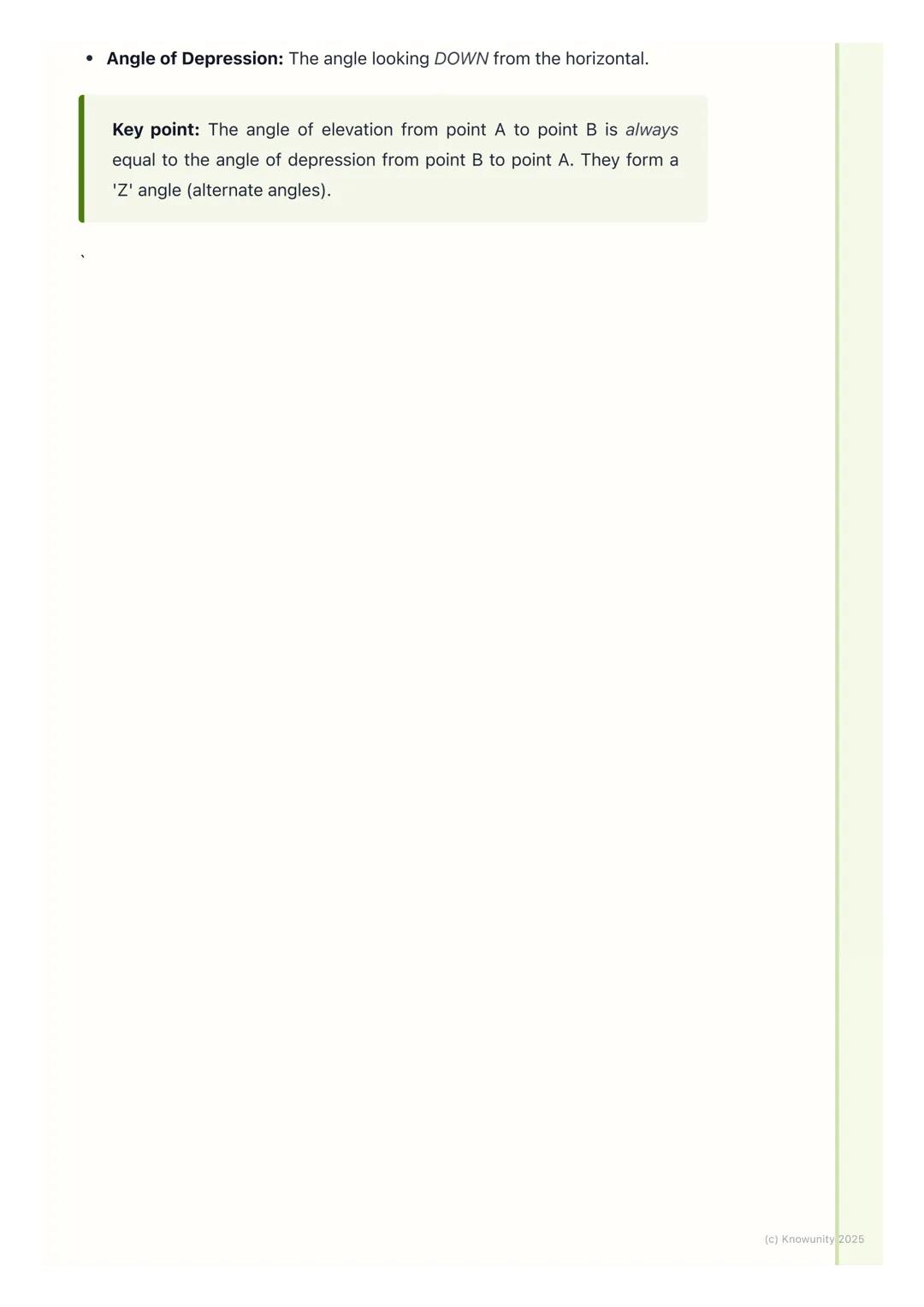
Common Pitfalls and Exam Tips
Your calculator mode can make or break your exam performance. Always check you're in DEGREES mode (look for D or DEG on screen). Being in radians or gradians will give you completely wrong answers.
Double-check your side labelling every time. The hypotenuse is easy to spot, but mixing up opposite and adjacent sides is surprisingly common. Remember: opposite is always across from your angle.
Use inverse functions (sin⁻¹, cos⁻¹, tan⁻¹) only when finding angles, not sides. Read questions carefully for rounding instructions, and don't round until your final answer.
Exam Success: These basic checks will save you more marks than learning complex techniques - master the fundamentals first!
7
of 9
8
of 9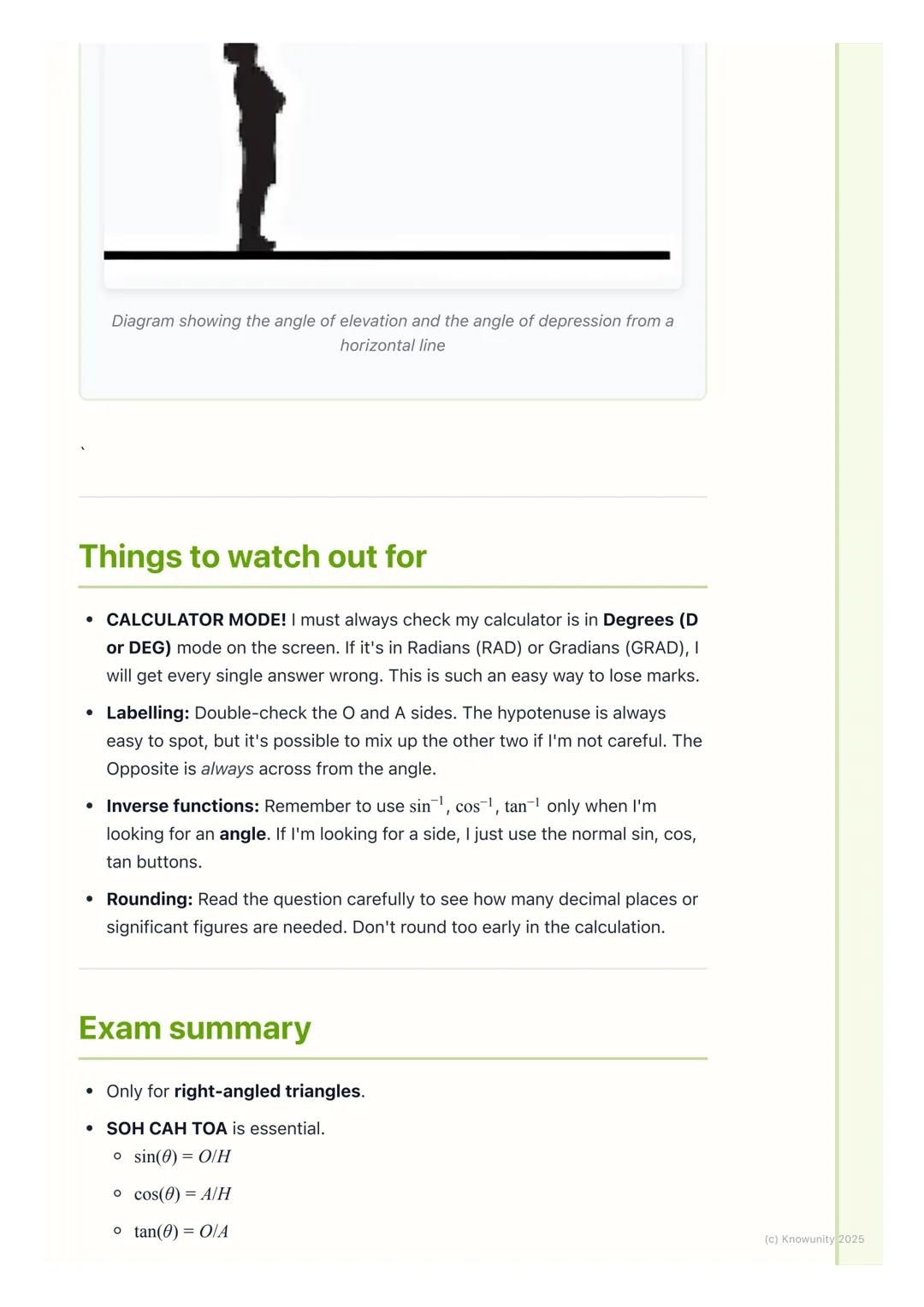
9
of 9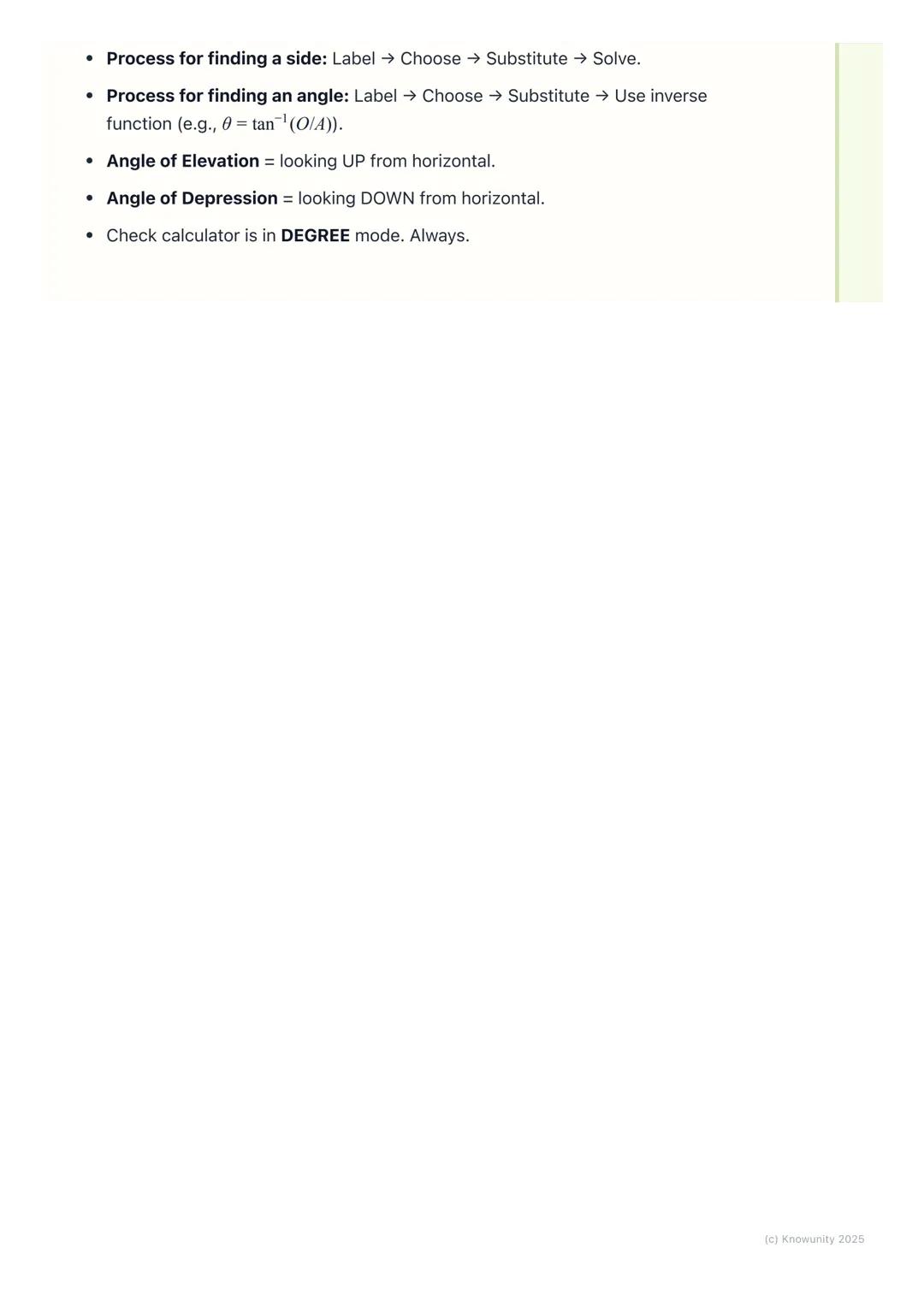
Myśleliśmy, że nigdy nie zapytasz...
Czym jest Towarzysz AI z Knowunity?
Nasz asystent AI jest specjalnie dostosowany do potrzeb uczniów. W oparciu o miliony treści, które mamy na platformie, możemy udzielać uczniom naprawdę znaczących i trafnych odpowiedzi. Ale nie chodzi tylko o odpowiedzi, towarzysz prowadzi również uczniów przez codzienne wyzwania związane z nauką, ze spersonalizowanymi planami nauki, quizami lub treściami na czacie i 100% personalizacją opartą na umiejętnościach i rozwoju uczniów.
Gdzie mogę pobrać aplikację Knowunity?
Aplikację możesz pobrać z Google Play i Apple Store.
Czy aplikacja Knowunity naprawdę jest darmowa?
Tak, masz całkowicie darmowy dostęp do wszystkich notatek w aplikacji, możesz w każdej chwili rozmawiać z Ekspertami lub ich obserwować. Możesz użyć punktów, aby odblokować pewne funkcje w aplikacji, które również możesz otrzymać za darmo. Dodatkowo oferujemy usługę Knowunity Premium, która pozwala na odblokowanie większej liczby funkcji.
Najpopularniejsze notatki z Mathematics
8MathematicsAlgebra
Algebra
5th Year91
MathematicsAlgebra 2
Algebra notes focusing on the factor theorem, completing the square, -b formula, graphs of polynomials
5th Year130
MathematicsSolving Equations
This section focuses on solving one-step and two-step linear equations to find the value of an unknown variable.
1st Year131
MathematicsArithmetic sequences and series
With examples
5th Year130
MathematicsIntroduction to Probability
This topic introduces basic probability concepts, including calculating the probability of simple events and understanding the difference between experimental and theoretical probability.
2nd Year91
MathematicsMaths jc algebra
Maths jc
1st Year230
MathematicsNatural Numbers and Integers
Students will learn about positive whole numbers, zero, and negative whole numbers, and how to add, subtract, multiply, and divide them correctly.
1st Year131
MathematicsDifferential Calculus
Calculus is a topic that comes up nearly everywhere on your maths LC. This is just starter notes that could be useful end of 5th year or start of 6th year
5th Year271
Najpopularniejsze notatki
9 Irish
IrishIrish oral questions and answers
Questions and answers for the leaving cert oral
5th Year4264
 English
Key Quotes : Sive
Key Quotes and explanations: Sive
6th Year2842
IrishIrish oral questions
Outline of oral questions
5th Year2055
IrishIníon- le hÁine Durkin
Aine Durkin’s poem, Iníon: Themes & summary
5th Year850
IrishIrish poetry 2027
Iníon + Dínit an Bhróin
5th Year1133
IrishLC HL notes- Iníon (poem)
Includes poem in English and Irish, theme, key words & phrases
5th Year2284
EnglishCultural Context : Shawshank Redemption : Sive : Small Things Like These
Comparative Study : Cultural Context : Shawshank Redemption, Sive and Small Things Like These
6th Year1430
IrishMo Ghrá-sa (Idir Lúibíní)
Notes on mo ghrá-sa
5th Year380
IrishAn Gaeilge Aiste
Irish Language essay
6th Year1320
Nie ma nic odpowiedniego? Sprawdź inne przedmioty.
Zobacz, co mówią o nas nasi użytkownicy. Pokochali nas — pokochasz też i Ty.
4.6/5App Store
4.7/5Google Play
Aplikacja jest bardzo prosta i dobrze przemyślana. Do tej pory znalazłem wszystko, czego szukałem i mogłem się wiele nauczyć z innych notatek! Na pewno wykorzystam aplikację do pomocy przy robieniu prac domowych! No i oczywiście bardzo pomaga też jako inspiracja do robienia swoich notatek.
Stefan Sużytkownik iOS
Ta aplikacja jest naprawdę świetna. Jest tak wiele notatek i pomocnych informacji [...]. Moim problematycznym przedmiotem jest język niemiecki, a w aplikacji jest w czym wybierać. Dzięki tej aplikacji poprawiłam swój niemiecki. Polecam ją każdemu.
Samantha Klichużytkownik Androida
Wow, jestem w szoku. Właśnie wypróbowałam aplikację, ponieważ widziałam ją kilka razy reklamowaną na TikToku jestem absolutnie w szoku. Ta aplikacja jest POMOCĄ, której potrzebujesz w szkole i przede wszystkim oferuje tak wiele rzeczy jak notatki czy streszczenia, które są BARDZO pomocne w moim przypadku.
Annaużytkownik iOS
Mathematics5 wyświetleń·Zaktualizowano Jun 10, 2026·9 stronyMaster Trigonometry: Learn SOHCAHTOA for Real-Life Problems
Right-angled triangles are everywhere - from the ladders you climb to the buildings around you. Understanding how angles and sides relate in these triangles is crucial for solving real-world problems and acing your maths exams.
1
of 9
Zarejestruj się, aby zobaczyć notatkę. To nic nie kosztuje!
- Dostęp do wszystkich materiałów
- Popraw swoje oceny
- Dołącz do milionów studentów
The Basics of Right-Angled Triangles
You'll use trigonometry in loads of practical situations like construction, navigation, and even video game design. The key is mastering the relationship between angles and side lengths in triangles with one 90° angle.
Getting the labelling right is absolutely crucial. The side names depend on which angle you're focusing on (usually called theta or θ). The hypotenuse is always the longest side opposite the right angle - that never changes.
The opposite side sits directly across from your angle θ. If you change the angle, the opposite side changes too. The adjacent side is next to angle θ, but it's not the hypotenuse.
Key Tip: Always label your triangle sides before attempting any calculation - this prevents costly mistakes!
2
of 9Zarejestruj się, aby zobaczyć notatkę. To nic nie kosztuje!
- Dostęp do wszystkich materiałów
- Popraw swoje oceny
- Dołącz do milionów studentów
SOH CAH TOA - Your Best Friend
SOH CAH TOA is the magic acronym that'll save you in every exam. It represents the three main trigonometric ratios that link angles to side lengths.
SOH means sin(θ) = Opposite/Hypotenuse. CAH means cos(θ) = Adjacent/Hypotenuse. TOA means tan(θ) = Opposite/Adjacent.
These ratios ONLY work for right-angled triangles - don't try using them elsewhere! You'll encounter two main problem types: finding missing sides and finding missing angles.
Remember: These ratios are your toolkit for solving any right-angled triangle problem you'll face.
3
of 9Zarejestruj się, aby zobaczyć notatkę. To nic nie kosztuje!
- Dostęp do wszystkich materiałów
- Popraw swoje oceny
- Dołącz do milionów studentów
Finding Missing Sides
When you've got one side and one angle (besides the 90° one), finding another side becomes straightforward with the right approach.
Follow this foolproof process: Label the sides O, A, and H relative to your given angle. Choose the correct ratio from SOH CAH TOA based on what you have and what you need. Write the equation and substitute your known values.
Finally, solve for the unknown by rearranging the equation. For example, if sin(35°) = x/12, then x = 12 × sin(35°) = 6.9 cm.
Pro Tip: Always double-check your labelling - mixing up opposite and adjacent is the most common mistake students make.
4
of 9Zarejestruj się, aby zobaczyć notatkę. To nic nie kosztuje!
- Dostęp do wszystkich materiałów
- Popraw swoje oceny
- Dołącz do milionów studentów
Finding Missing Angles
Working backwards from two known sides to find an angle requires inverse trigonometric functions. These appear as sin⁻¹, cos⁻¹, and tan⁻¹ on your calculator.
Start by labelling your sides and choosing the right ratio from SOH CAH TOA. Write your equation and substitute the side lengths you know.
To find the actual angle, use the inverse function. If cos(θ) = 2/5, then θ = cos⁻¹(2/5) = 66°. Access these functions by pressing SHIFT then the relevant trig button.
Calculator Alert: Make sure you're in DEGREE mode, not radians - this mistake costs students loads of marks!
5
of 9Zarejestruj się, aby zobaczyć notatkę. To nic nie kosztuje!
- Dostęp do wszystkich materiałów
- Popraw swoje oceny
- Dołącz do milionów studentów
Angles of Elevation and Depression
These concepts bring trigonometry into real-world scenarios you'll actually encounter. Understanding them makes word problems much easier to tackle.
The angle of elevation is when you're looking UP from horizontal - like viewing the top of a building from ground level. The angle of depression is looking DOWN from horizontal - like a pilot viewing the ground.
Here's a neat fact: the angle of elevation from point A to point B always equals the angle of depression from point B to point A. They form alternate angles in a 'Z' pattern.
Real-World Connection: These angles are used in surveying, aviation, and architecture - skills that translate directly to careers!
6
of 9Zarejestruj się, aby zobaczyć notatkę. To nic nie kosztuje!
- Dostęp do wszystkich materiałów
- Popraw swoje oceny
- Dołącz do milionów studentów
Common Pitfalls and Exam Tips
Your calculator mode can make or break your exam performance. Always check you're in DEGREES mode (look for D or DEG on screen). Being in radians or gradians will give you completely wrong answers.
Double-check your side labelling every time. The hypotenuse is easy to spot, but mixing up opposite and adjacent sides is surprisingly common. Remember: opposite is always across from your angle.
Use inverse functions (sin⁻¹, cos⁻¹, tan⁻¹) only when finding angles, not sides. Read questions carefully for rounding instructions, and don't round until your final answer.
Exam Success: These basic checks will save you more marks than learning complex techniques - master the fundamentals first!
7
of 9Zarejestruj się, aby zobaczyć notatkę. To nic nie kosztuje!
- Dostęp do wszystkich materiałów
- Popraw swoje oceny
- Dołącz do milionów studentów
8
of 9Zarejestruj się, aby zobaczyć notatkę. To nic nie kosztuje!
- Dostęp do wszystkich materiałów
- Popraw swoje oceny
- Dołącz do milionów studentów
9
of 9Zarejestruj się, aby zobaczyć notatkę. To nic nie kosztuje!
- Dostęp do wszystkich materiałów
- Popraw swoje oceny
- Dołącz do milionów studentów
Myśleliśmy, że nigdy nie zapytasz...
Czym jest Towarzysz AI z Knowunity?
Nasz asystent AI jest specjalnie dostosowany do potrzeb uczniów. W oparciu o miliony treści, które mamy na platformie, możemy udzielać uczniom naprawdę znaczących i trafnych odpowiedzi. Ale nie chodzi tylko o odpowiedzi, towarzysz prowadzi również uczniów przez codzienne wyzwania związane z nauką, ze spersonalizowanymi planami nauki, quizami lub treściami na czacie i 100% personalizacją opartą na umiejętnościach i rozwoju uczniów.
Gdzie mogę pobrać aplikację Knowunity?
Aplikację możesz pobrać z Google Play i Apple Store.
Czy aplikacja Knowunity naprawdę jest darmowa?
Tak, masz całkowicie darmowy dostęp do wszystkich notatek w aplikacji, możesz w każdej chwili rozmawiać z Ekspertami lub ich obserwować. Możesz użyć punktów, aby odblokować pewne funkcje w aplikacji, które również możesz otrzymać za darmo. Dodatkowo oferujemy usługę Knowunity Premium, która pozwala na odblokowanie większej liczby funkcji.
Najpopularniejsze notatki z Mathematics
8MathematicsAlgebra
Algebra
5th Year91
MathematicsAlgebra 2
Algebra notes focusing on the factor theorem, completing the square, -b formula, graphs of polynomials
5th Year130
MathematicsSolving Equations
This section focuses on solving one-step and two-step linear equations to find the value of an unknown variable.
1st Year131
MathematicsArithmetic sequences and series
With examples
5th Year130
MathematicsIntroduction to Probability
This topic introduces basic probability concepts, including calculating the probability of simple events and understanding the difference between experimental and theoretical probability.
2nd Year91
MathematicsMaths jc algebra
Maths jc
1st Year230
MathematicsNatural Numbers and Integers
Students will learn about positive whole numbers, zero, and negative whole numbers, and how to add, subtract, multiply, and divide them correctly.
1st Year131
MathematicsDifferential Calculus
Calculus is a topic that comes up nearly everywhere on your maths LC. This is just starter notes that could be useful end of 5th year or start of 6th year
5th Year271
Najpopularniejsze notatki
9IrishIrish oral questions and answers
Questions and answers for the leaving cert oral
5th Year4264
EnglishKey Quotes : Sive
Key Quotes and explanations: Sive
6th Year2842
IrishIrish oral questions
Outline of oral questions
5th Year2055
IrishIníon- le hÁine Durkin
Aine Durkin’s poem, Iníon: Themes & summary
5th Year850
IrishIrish poetry 2027
Iníon + Dínit an Bhróin
5th Year1133
IrishLC HL notes- Iníon (poem)
Includes poem in English and Irish, theme, key words & phrases
5th Year2284
EnglishCultural Context : Shawshank Redemption : Sive : Small Things Like These
Comparative Study : Cultural Context : Shawshank Redemption, Sive and Small Things Like These
6th Year1430
IrishMo Ghrá-sa (Idir Lúibíní)
Notes on mo ghrá-sa
5th Year380
IrishAn Gaeilge Aiste
Irish Language essay
6th Year1320
Nie ma nic odpowiedniego? Sprawdź inne przedmioty.
Zobacz, co mówią o nas nasi użytkownicy. Pokochali nas — pokochasz też i Ty.
4.6/5App Store
4.7/5Google Play
Aplikacja jest bardzo prosta i dobrze przemyślana. Do tej pory znalazłem wszystko, czego szukałem i mogłem się wiele nauczyć z innych notatek! Na pewno wykorzystam aplikację do pomocy przy robieniu prac domowych! No i oczywiście bardzo pomaga też jako inspiracja do robienia swoich notatek.
Stefan Sużytkownik iOS
Ta aplikacja jest naprawdę świetna. Jest tak wiele notatek i pomocnych informacji [...]. Moim problematycznym przedmiotem jest język niemiecki, a w aplikacji jest w czym wybierać. Dzięki tej aplikacji poprawiłam swój niemiecki. Polecam ją każdemu.
Samantha Klichużytkownik Androida
Wow, jestem w szoku. Właśnie wypróbowałam aplikację, ponieważ widziałam ją kilka razy reklamowaną na TikToku jestem absolutnie w szoku. Ta aplikacja jest POMOCĄ, której potrzebujesz w szkole i przede wszystkim oferuje tak wiele rzeczy jak notatki czy streszczenia, które są BARDZO pomocne w moim przypadku.
Annaużytkownik iOS