
Irish traditional music, or "trad" music, is the heartbeat of...
 Music3 wyświetleń·Zaktualizowano Jun 16, 2026·5 strony
Exploring Irish Traditional Music: Instruments, Forms, and Culture
1 / 5
1
of 5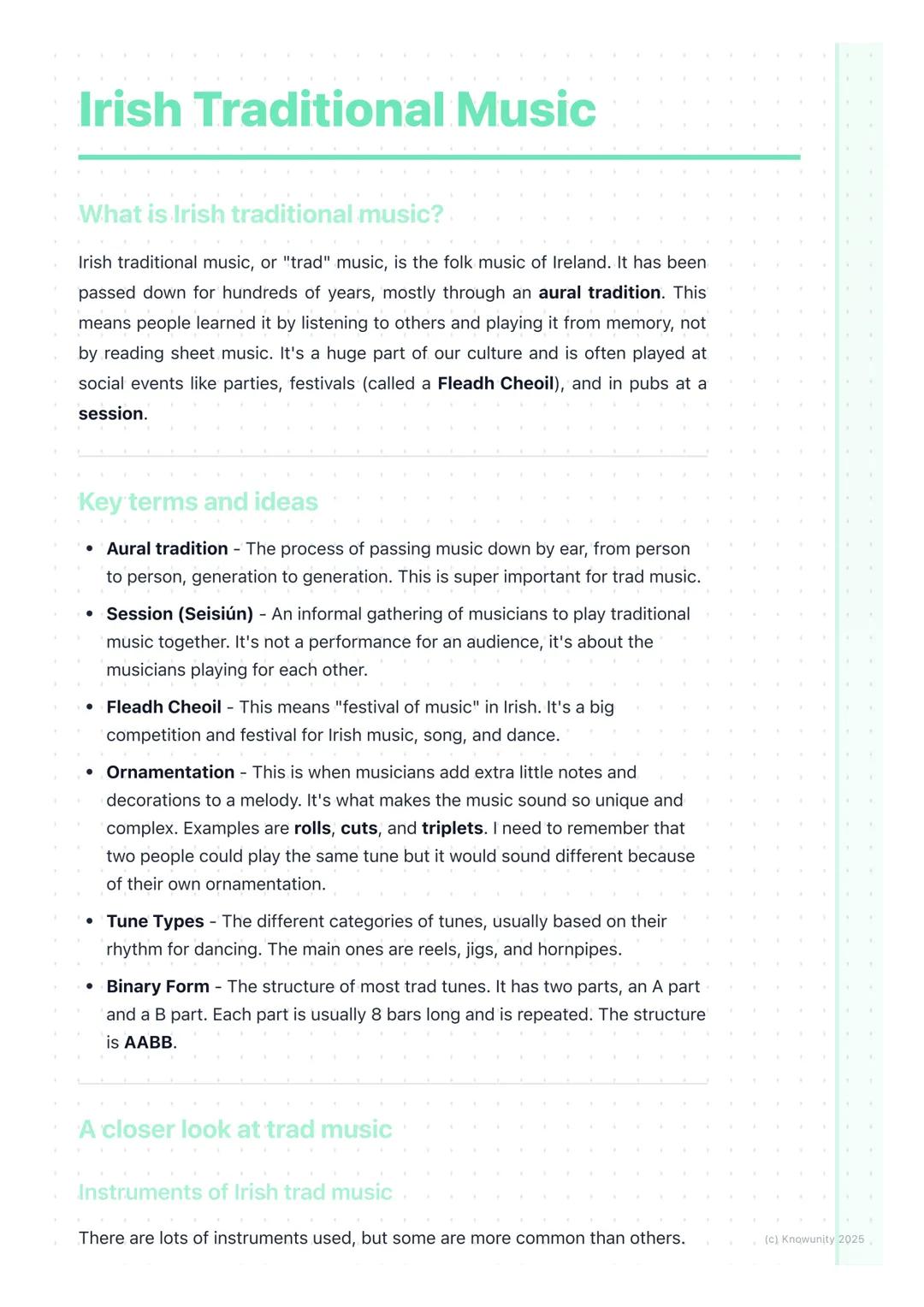
What is Irish Traditional Music?
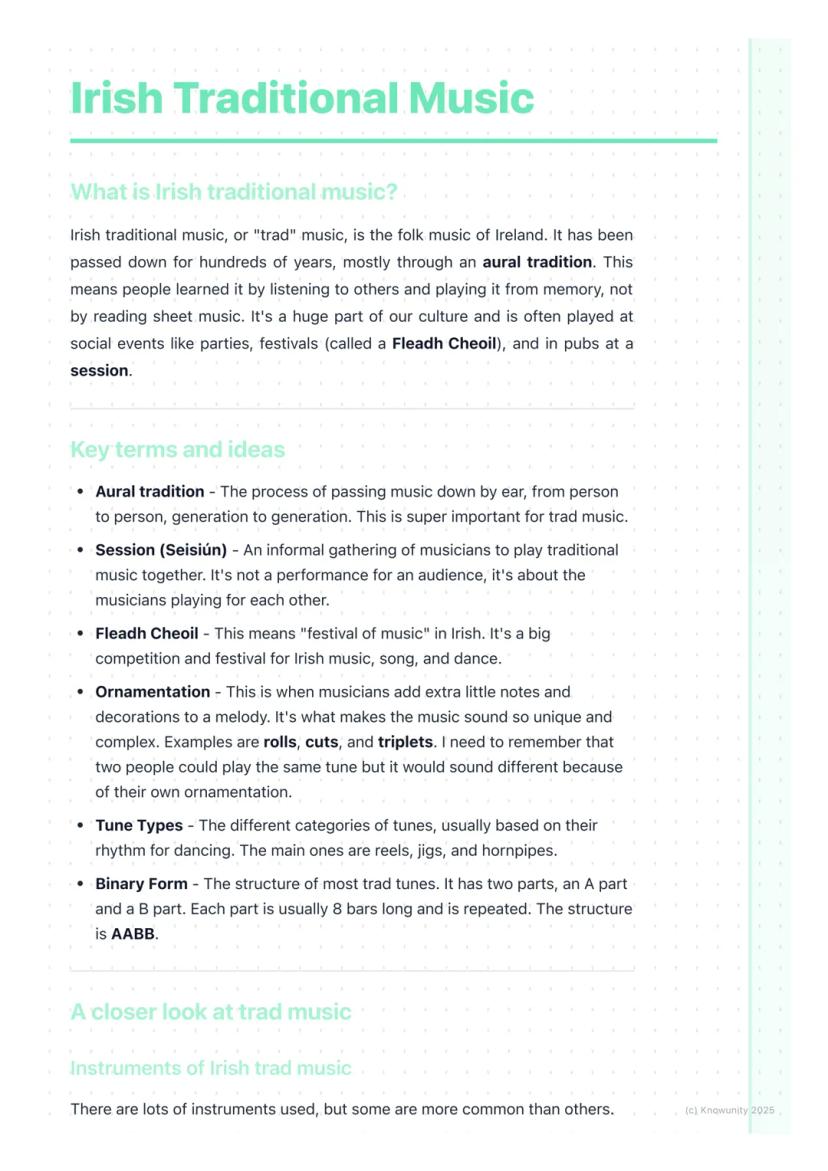
Ever wondered why Irish music sounds so distinctive and alive? Irish traditional music has survived for centuries through something called aural tradition - meaning people learned tunes by listening and playing from memory rather than reading sheet music. This creates a personal connection between musicians that you can actually hear in the music.
You'll encounter this music everywhere in Ireland, from informal sessions in pubs where musicians gather to play together, to massive Fleadh Cheoil festivals that celebrate Irish culture. These aren't performances for audiences - they're musicians playing for the pure joy of it.
The magic happens through ornamentation - those little decorative notes like rolls, cuts, and triplets that make each musician's version unique. Two people can play the same tune, but it'll sound completely different because of their personal ornamental style.
💡 Remember: Most Irish tunes follow binary form (AABB structure) - an A section and B section, each 8 bars long and repeated.
2
of 5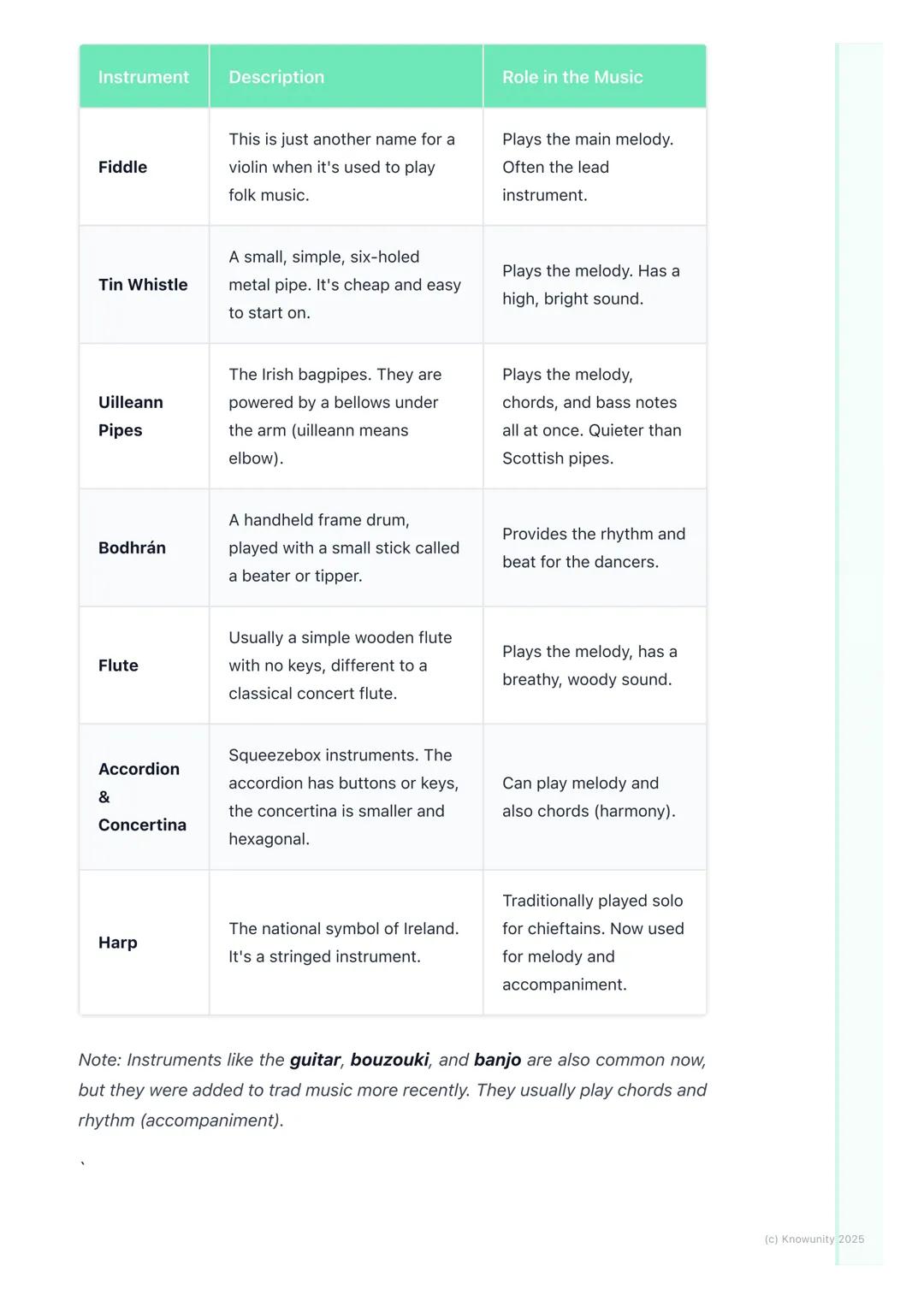
Traditional Irish Instruments
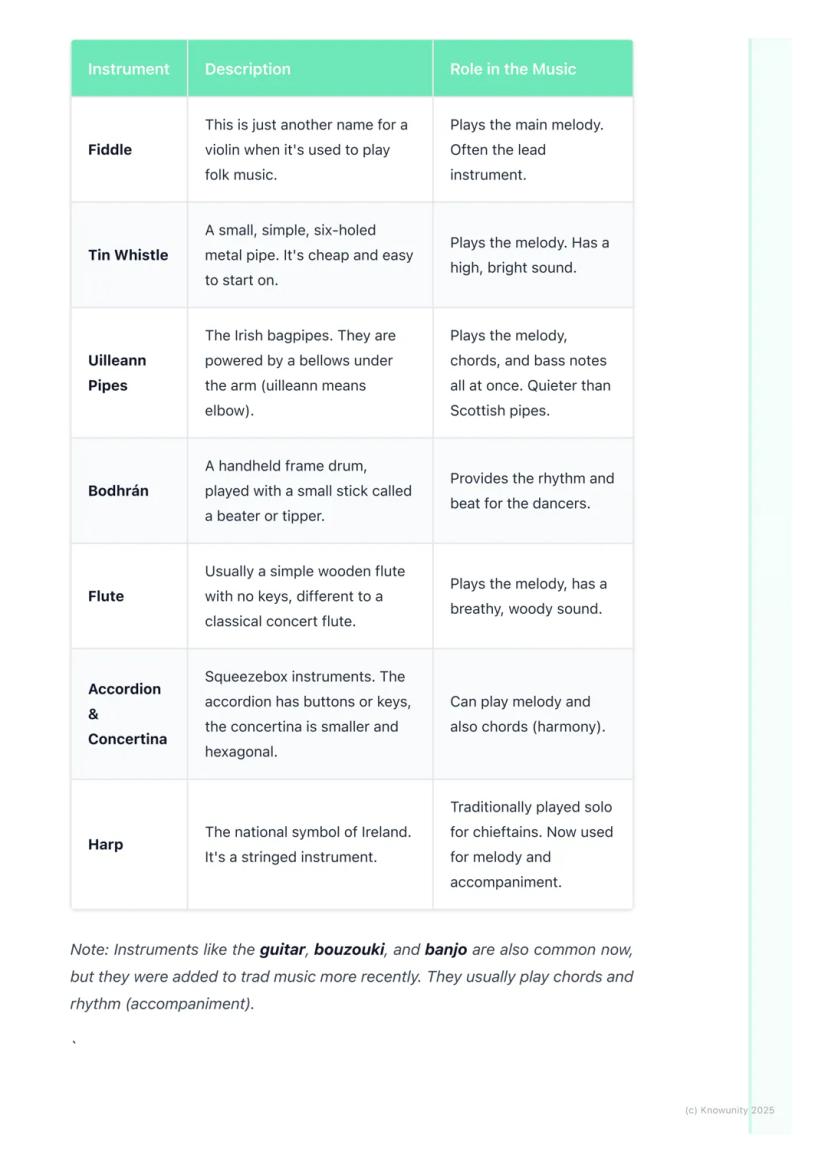
The fiddle (which is just a violin playing folk music) often leads the melody with its expressive, singing tone. For beginners, the tin whistle is brilliant - it's cheap, portable, and produces that bright, piercing sound you hear in Irish music.
Uilleann pipes are Ireland's answer to bagpipes, but they're powered by bellows under your arm (uilleann means "elbow") rather than breath. They're much quieter than Scottish pipes and can play melody, harmony, and bass all at once. The bodhrán provides the driving rhythm that gets dancers moving.
Traditional melody instruments also include wooden flutes and accordions or concertinas. The harp, Ireland's national symbol, was historically played for chieftains but now fits into modern sessions too.
💡 Quick tip: Instruments like guitar and banjo were added later for accompaniment - they're common now but aren't originally Irish.
3
of 5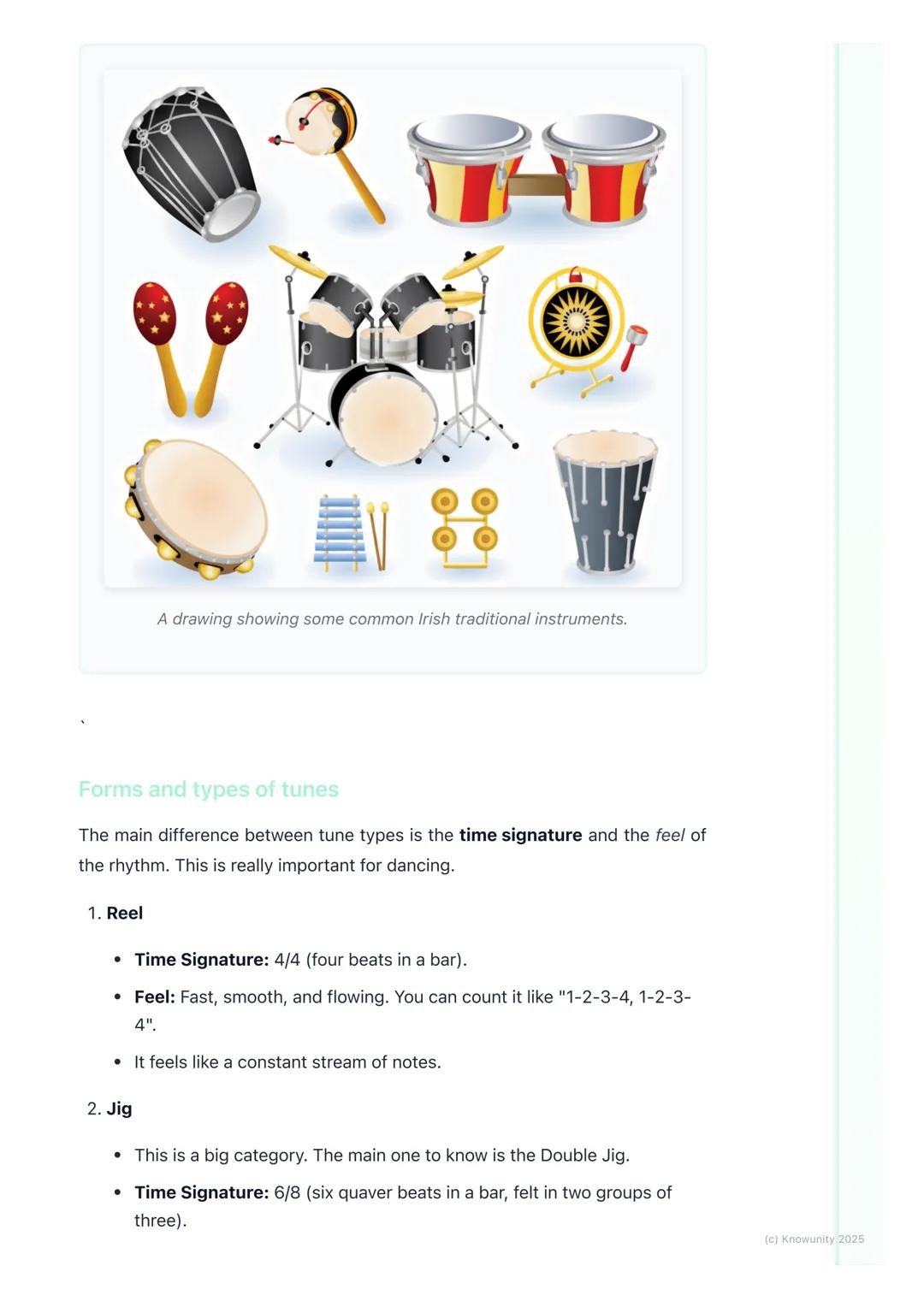
Understanding Tune Types
Learning to recognise different tune types is crucial because they determine how people dance. The rhythm and time signature completely change the feel of the music.
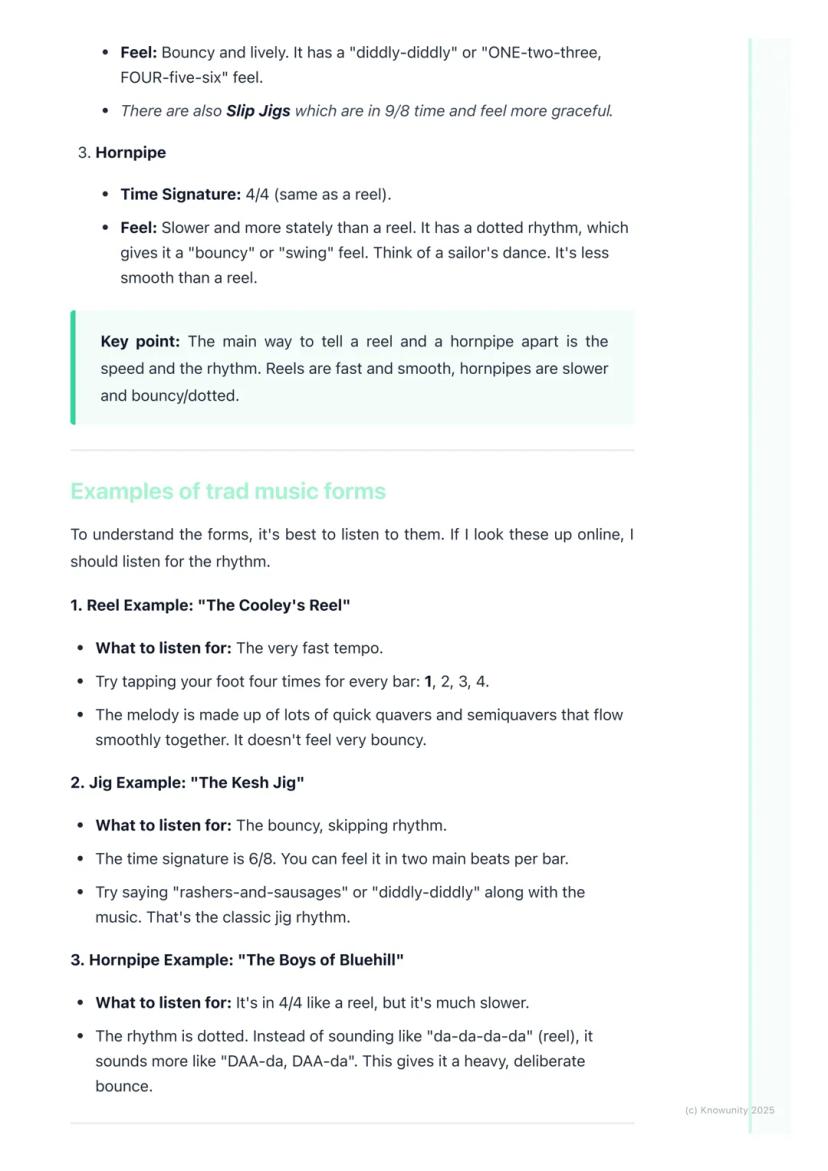
Reels are in 4/4 time and feel fast, smooth, and flowing like a constant stream of notes. Count "1-2-3-4" and tap your foot - that's a reel's steady pulse. They're probably the most common type you'll hear.
Jigs are the bouncy ones in 6/8 time that make you want to skip. The classic double jig has that "diddly-diddly" or "ONE-two-three, FOUR-five-six" feel. There are also slip jigs in 9/8 time that feel more graceful and flowing.
💡 Listen for: "The Cooley's Reel" and "The Kesh Jig" online to hear the difference - your ears will pick up the rhythmic patterns quickly.
4
of 5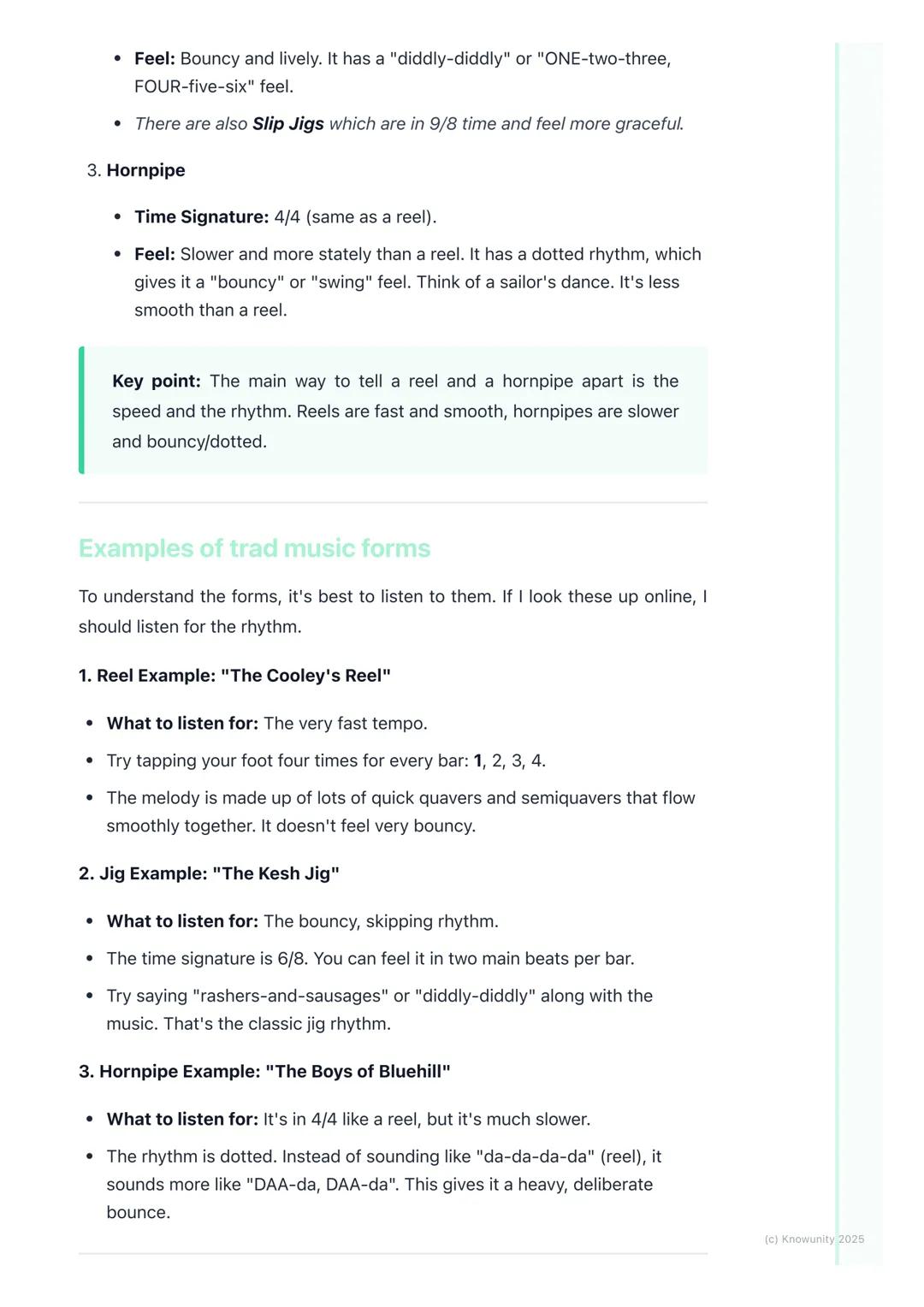
Hornpipes and Musical Examples
Hornpipes often confuse students because they're also in 4/4 like reels, but they're completely different in character. They're slower and have a dotted, bouncy rhythm that sounds like "DAA-da, DAA-da" instead of a reel's smooth "da-da-da-da". Think of a sailor's dance - deliberate and stately.
"The Boys of Bluehill" is a perfect hornpipe example. When you listen, notice how much heavier and more deliberate it sounds compared to a flowing reel. The dotted rhythms give it that characteristic swing feel.
The key difference between reels and hornpipes isn't just tempo - it's the entire rhythmic character. Reels flow like water, whilst hornpipes bounce with purpose.
💡 Exam tip: If you can distinguish between smooth flowing (reel) and bouncy dotted (hornpipe), you'll nail this topic in tests.
5
of 5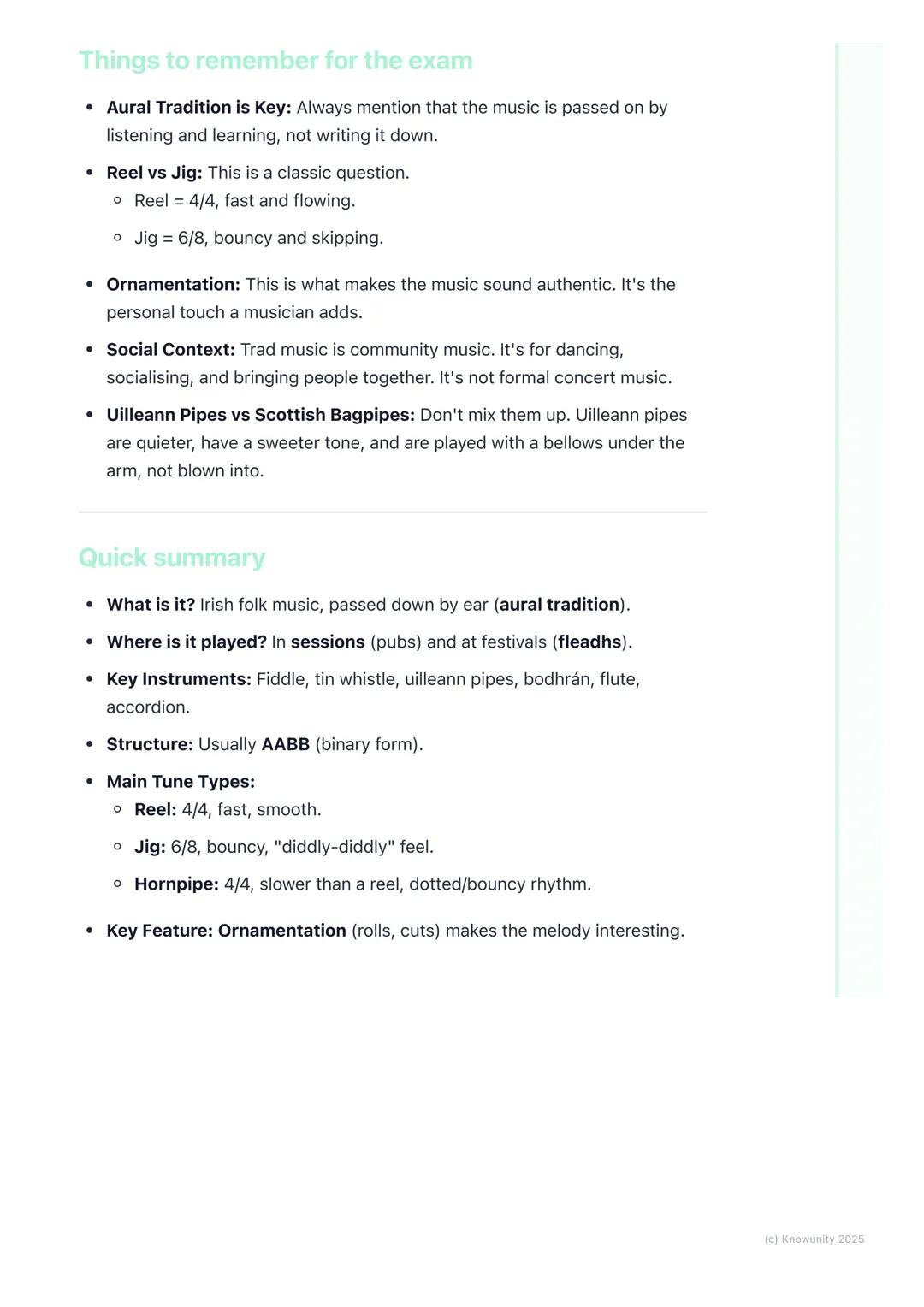
Key Points for Success
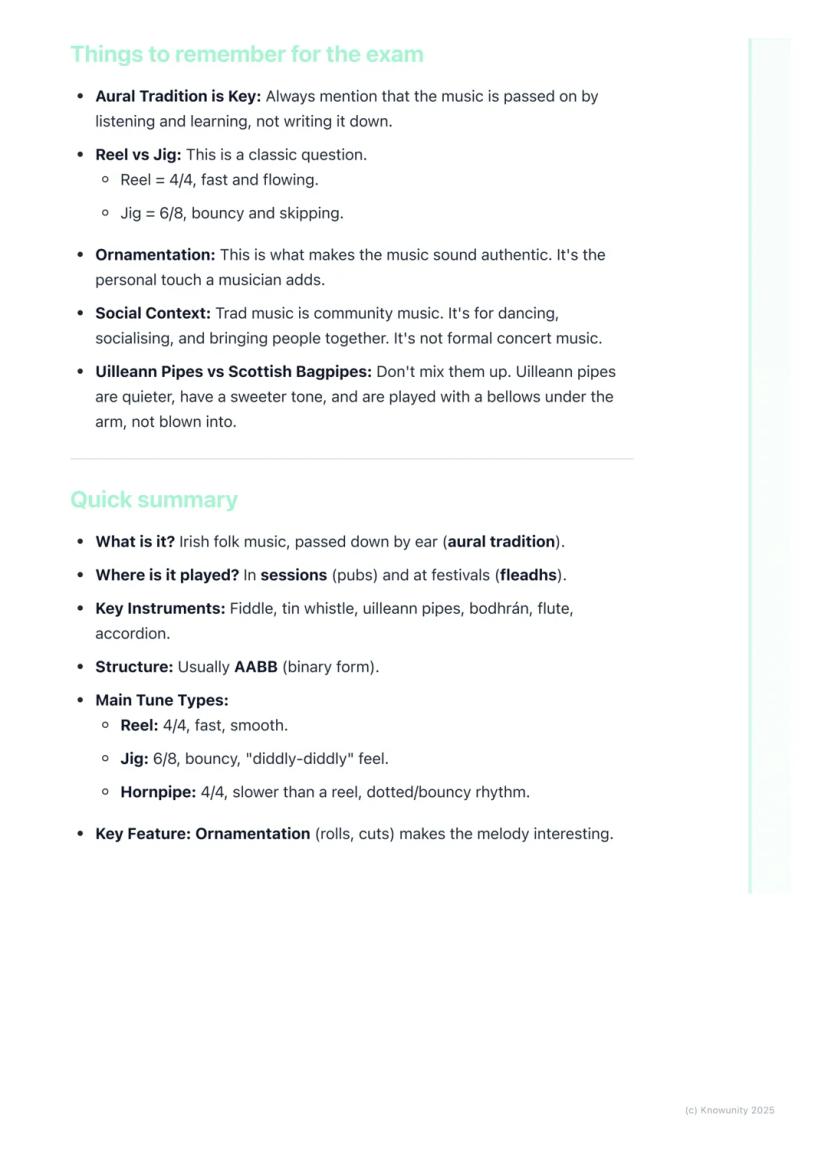
Aural tradition is the foundation of everything - always mention that this music lives through listening and learning by ear, not written notation. This creates the personal, intimate quality that makes Irish music so special.
Social context matters hugely. This isn't formal concert music - it's community music for dancing, socialising, and bringing people together. Sessions and fleadhs are where the tradition stays alive.
Ornamentation is what makes the music authentic and personal. It's how musicians add their own voice to ancient tunes, making each performance unique even when playing the same melody.
💡 Quick reference: Reel = 4/4 fast and smooth; Jig = 6/8 bouncy "diddly-diddly"; Hornpipe = 4/4 slower with dotted rhythm.
Remember that uilleann pipes are distinctly Irish - don't confuse them with Scottish bagpipes. They're quieter, sweeter, and use bellows instead of breath. Master these distinctions and you'll understand the heart of Irish traditional music.
Myśleliśmy, że nigdy nie zapytasz...
Czym jest Towarzysz AI z Knowunity?
Nasz asystent AI jest specjalnie dostosowany do potrzeb uczniów. W oparciu o miliony treści, które mamy na platformie, możemy udzielać uczniom naprawdę znaczących i trafnych odpowiedzi. Ale nie chodzi tylko o odpowiedzi, towarzysz prowadzi również uczniów przez codzienne wyzwania związane z nauką, ze spersonalizowanymi planami nauki, quizami lub treściami na czacie i 100% personalizacją opartą na umiejętnościach i rozwoju uczniów.
Gdzie mogę pobrać aplikację Knowunity?
Aplikację możesz pobrać z Google Play i Apple Store.
Czy aplikacja Knowunity naprawdę jest darmowa?
Tak, masz całkowicie darmowy dostęp do wszystkich notatek w aplikacji, możesz w każdej chwili rozmawiać z Ekspertami lub ich obserwować. Możesz użyć punktów, aby odblokować pewne funkcje w aplikacji, które również możesz otrzymać za darmo. Dodatkowo oferujemy usługę Knowunity Premium, która pozwala na odblokowanie większej liczby funkcji.
Najpopularniejsze notatki z Music
2MusicRhythm and Beat
Students will explore the steady pulse (beat) and the patterns of sounds and silences (rhythm) in music, including tempo (speed) and duration of notes.
1st Year50
MusicSean-nós singing
Main aspects of this Irish essay into bulkier material (may need to add a little more content, otherwise great for studying)
5th Year51
Najpopularniejsze notatki
9 Irish
IrishIrish oral questions and answers
Questions and answers for the leaving cert oral
5th Year4264
 English
Key Quotes : Sive
Key Quotes and explanations: Sive
6th Year2842
IrishIrish oral questions
Outline of oral questions
5th Year2055
IrishIníon- le hÁine Durkin
Aine Durkin’s poem, Iníon: Themes & summary
5th Year850
IrishIrish poetry 2027
Iníon + Dínit an Bhróin
5th Year1133
IrishLC HL notes- Iníon (poem)
Includes poem in English and Irish, theme, key words & phrases
5th Year2284
EnglishCultural Context : Shawshank Redemption : Sive : Small Things Like These
Comparative Study : Cultural Context : Shawshank Redemption, Sive and Small Things Like These
6th Year1430
IrishMo Ghrá-sa (Idir Lúibíní)
Notes on mo ghrá-sa
5th Year380
IrishAn Gaeilge Aiste
Irish Language essay
6th Year1320
Nie ma nic odpowiedniego? Sprawdź inne przedmioty.
Zobacz, co mówią o nas nasi użytkownicy. Pokochali nas — pokochasz też i Ty.
4.6/5App Store
4.7/5Google Play
Aplikacja jest bardzo prosta i dobrze przemyślana. Do tej pory znalazłem wszystko, czego szukałem i mogłem się wiele nauczyć z innych notatek! Na pewno wykorzystam aplikację do pomocy przy robieniu prac domowych! No i oczywiście bardzo pomaga też jako inspiracja do robienia swoich notatek.
Stefan Sużytkownik iOS
Ta aplikacja jest naprawdę świetna. Jest tak wiele notatek i pomocnych informacji [...]. Moim problematycznym przedmiotem jest język niemiecki, a w aplikacji jest w czym wybierać. Dzięki tej aplikacji poprawiłam swój niemiecki. Polecam ją każdemu.
Samantha Klichużytkownik Androida
Wow, jestem w szoku. Właśnie wypróbowałam aplikację, ponieważ widziałam ją kilka razy reklamowaną na TikToku jestem absolutnie w szoku. Ta aplikacja jest POMOCĄ, której potrzebujesz w szkole i przede wszystkim oferuje tak wiele rzeczy jak notatki czy streszczenia, które są BARDZO pomocne w moim przypadku.
Annaużytkownik iOS
Music3 wyświetleń·Zaktualizowano Jun 16, 2026·5 stronyExploring Irish Traditional Music: Instruments, Forms, and Culture
Irish traditional music, or "trad" music, is the heartbeat of Irish culture that's been passed down through generations by ear. This folk music isn't just entertainment - it's a living tradition that brings communities together in pubs, festivals, and social...
1
of 5
Zarejestruj się, aby zobaczyć notatkę. To nic nie kosztuje!
- Dostęp do wszystkich materiałów
- Popraw swoje oceny
- Dołącz do milionów studentów
What is Irish Traditional Music?
Ever wondered why Irish music sounds so distinctive and alive? Irish traditional music has survived for centuries through something called aural tradition - meaning people learned tunes by listening and playing from memory rather than reading sheet music. This creates a personal connection between musicians that you can actually hear in the music.
You'll encounter this music everywhere in Ireland, from informal sessions in pubs where musicians gather to play together, to massive Fleadh Cheoil festivals that celebrate Irish culture. These aren't performances for audiences - they're musicians playing for the pure joy of it.
The magic happens through ornamentation - those little decorative notes like rolls, cuts, and triplets that make each musician's version unique. Two people can play the same tune, but it'll sound completely different because of their personal ornamental style.
💡 Remember: Most Irish tunes follow binary form (AABB structure) - an A section and B section, each 8 bars long and repeated.
2
of 5Zarejestruj się, aby zobaczyć notatkę. To nic nie kosztuje!
- Dostęp do wszystkich materiałów
- Popraw swoje oceny
- Dołącz do milionów studentów
Traditional Irish Instruments
The fiddle (which is just a violin playing folk music) often leads the melody with its expressive, singing tone. For beginners, the tin whistle is brilliant - it's cheap, portable, and produces that bright, piercing sound you hear in Irish music.
Uilleann pipes are Ireland's answer to bagpipes, but they're powered by bellows under your arm (uilleann means "elbow") rather than breath. They're much quieter than Scottish pipes and can play melody, harmony, and bass all at once. The bodhrán provides the driving rhythm that gets dancers moving.
Traditional melody instruments also include wooden flutes and accordions or concertinas. The harp, Ireland's national symbol, was historically played for chieftains but now fits into modern sessions too.
💡 Quick tip: Instruments like guitar and banjo were added later for accompaniment - they're common now but aren't originally Irish.
3
of 5Zarejestruj się, aby zobaczyć notatkę. To nic nie kosztuje!
- Dostęp do wszystkich materiałów
- Popraw swoje oceny
- Dołącz do milionów studentów
Understanding Tune Types
Learning to recognise different tune types is crucial because they determine how people dance. The rhythm and time signature completely change the feel of the music.
Reels are in 4/4 time and feel fast, smooth, and flowing like a constant stream of notes. Count "1-2-3-4" and tap your foot - that's a reel's steady pulse. They're probably the most common type you'll hear.
Jigs are the bouncy ones in 6/8 time that make you want to skip. The classic double jig has that "diddly-diddly" or "ONE-two-three, FOUR-five-six" feel. There are also slip jigs in 9/8 time that feel more graceful and flowing.
💡 Listen for: "The Cooley's Reel" and "The Kesh Jig" online to hear the difference - your ears will pick up the rhythmic patterns quickly.
4
of 5Zarejestruj się, aby zobaczyć notatkę. To nic nie kosztuje!
- Dostęp do wszystkich materiałów
- Popraw swoje oceny
- Dołącz do milionów studentów
Hornpipes and Musical Examples
Hornpipes often confuse students because they're also in 4/4 like reels, but they're completely different in character. They're slower and have a dotted, bouncy rhythm that sounds like "DAA-da, DAA-da" instead of a reel's smooth "da-da-da-da". Think of a sailor's dance - deliberate and stately.
"The Boys of Bluehill" is a perfect hornpipe example. When you listen, notice how much heavier and more deliberate it sounds compared to a flowing reel. The dotted rhythms give it that characteristic swing feel.
The key difference between reels and hornpipes isn't just tempo - it's the entire rhythmic character. Reels flow like water, whilst hornpipes bounce with purpose.
💡 Exam tip: If you can distinguish between smooth flowing (reel) and bouncy dotted (hornpipe), you'll nail this topic in tests.
5
of 5Zarejestruj się, aby zobaczyć notatkę. To nic nie kosztuje!
- Dostęp do wszystkich materiałów
- Popraw swoje oceny
- Dołącz do milionów studentów
Key Points for Success
Aural tradition is the foundation of everything - always mention that this music lives through listening and learning by ear, not written notation. This creates the personal, intimate quality that makes Irish music so special.
Social context matters hugely. This isn't formal concert music - it's community music for dancing, socialising, and bringing people together. Sessions and fleadhs are where the tradition stays alive.
Ornamentation is what makes the music authentic and personal. It's how musicians add their own voice to ancient tunes, making each performance unique even when playing the same melody.
💡 Quick reference: Reel = 4/4 fast and smooth; Jig = 6/8 bouncy "diddly-diddly"; Hornpipe = 4/4 slower with dotted rhythm.
Remember that uilleann pipes are distinctly Irish - don't confuse them with Scottish bagpipes. They're quieter, sweeter, and use bellows instead of breath. Master these distinctions and you'll understand the heart of Irish traditional music.
Myśleliśmy, że nigdy nie zapytasz...
Czym jest Towarzysz AI z Knowunity?
Nasz asystent AI jest specjalnie dostosowany do potrzeb uczniów. W oparciu o miliony treści, które mamy na platformie, możemy udzielać uczniom naprawdę znaczących i trafnych odpowiedzi. Ale nie chodzi tylko o odpowiedzi, towarzysz prowadzi również uczniów przez codzienne wyzwania związane z nauką, ze spersonalizowanymi planami nauki, quizami lub treściami na czacie i 100% personalizacją opartą na umiejętnościach i rozwoju uczniów.
Gdzie mogę pobrać aplikację Knowunity?
Aplikację możesz pobrać z Google Play i Apple Store.
Czy aplikacja Knowunity naprawdę jest darmowa?
Tak, masz całkowicie darmowy dostęp do wszystkich notatek w aplikacji, możesz w każdej chwili rozmawiać z Ekspertami lub ich obserwować. Możesz użyć punktów, aby odblokować pewne funkcje w aplikacji, które również możesz otrzymać za darmo. Dodatkowo oferujemy usługę Knowunity Premium, która pozwala na odblokowanie większej liczby funkcji.
Najpopularniejsze notatki z Music
2MusicRhythm and Beat
Students will explore the steady pulse (beat) and the patterns of sounds and silences (rhythm) in music, including tempo (speed) and duration of notes.
1st Year50
MusicSean-nós singing
Main aspects of this Irish essay into bulkier material (may need to add a little more content, otherwise great for studying)
5th Year51
Najpopularniejsze notatki
9IrishIrish oral questions and answers
Questions and answers for the leaving cert oral
5th Year4264
EnglishKey Quotes : Sive
Key Quotes and explanations: Sive
6th Year2842
IrishIrish oral questions
Outline of oral questions
5th Year2055
IrishIníon- le hÁine Durkin
Aine Durkin’s poem, Iníon: Themes & summary
5th Year850
IrishIrish poetry 2027
Iníon + Dínit an Bhróin
5th Year1133
IrishLC HL notes- Iníon (poem)
Includes poem in English and Irish, theme, key words & phrases
5th Year2284
EnglishCultural Context : Shawshank Redemption : Sive : Small Things Like These
Comparative Study : Cultural Context : Shawshank Redemption, Sive and Small Things Like These
6th Year1430
IrishMo Ghrá-sa (Idir Lúibíní)
Notes on mo ghrá-sa
5th Year380
IrishAn Gaeilge Aiste
Irish Language essay
6th Year1320
Nie ma nic odpowiedniego? Sprawdź inne przedmioty.
Zobacz, co mówią o nas nasi użytkownicy. Pokochali nas — pokochasz też i Ty.
4.6/5App Store
4.7/5Google Play
Aplikacja jest bardzo prosta i dobrze przemyślana. Do tej pory znalazłem wszystko, czego szukałem i mogłem się wiele nauczyć z innych notatek! Na pewno wykorzystam aplikację do pomocy przy robieniu prac domowych! No i oczywiście bardzo pomaga też jako inspiracja do robienia swoich notatek.
Stefan Sużytkownik iOS
Ta aplikacja jest naprawdę świetna. Jest tak wiele notatek i pomocnych informacji [...]. Moim problematycznym przedmiotem jest język niemiecki, a w aplikacji jest w czym wybierać. Dzięki tej aplikacji poprawiłam swój niemiecki. Polecam ją każdemu.
Samantha Klichużytkownik Androida
Wow, jestem w szoku. Właśnie wypróbowałam aplikację, ponieważ widziałam ją kilka razy reklamowaną na TikToku jestem absolutnie w szoku. Ta aplikacja jest POMOCĄ, której potrzebujesz w szkole i przede wszystkim oferuje tak wiele rzeczy jak notatki czy streszczenia, które są BARDZO pomocne w moim przypadku.
Annaużytkownik iOS