
Ever wondered how musicians can look at squiggly lines and... Pokaż więcej
 Music3 wyświetleń·Zaktualizowano Jun 6, 2026·6 strony
Understanding the Staff, Lines, and Clefs
1 / 6
1
of 6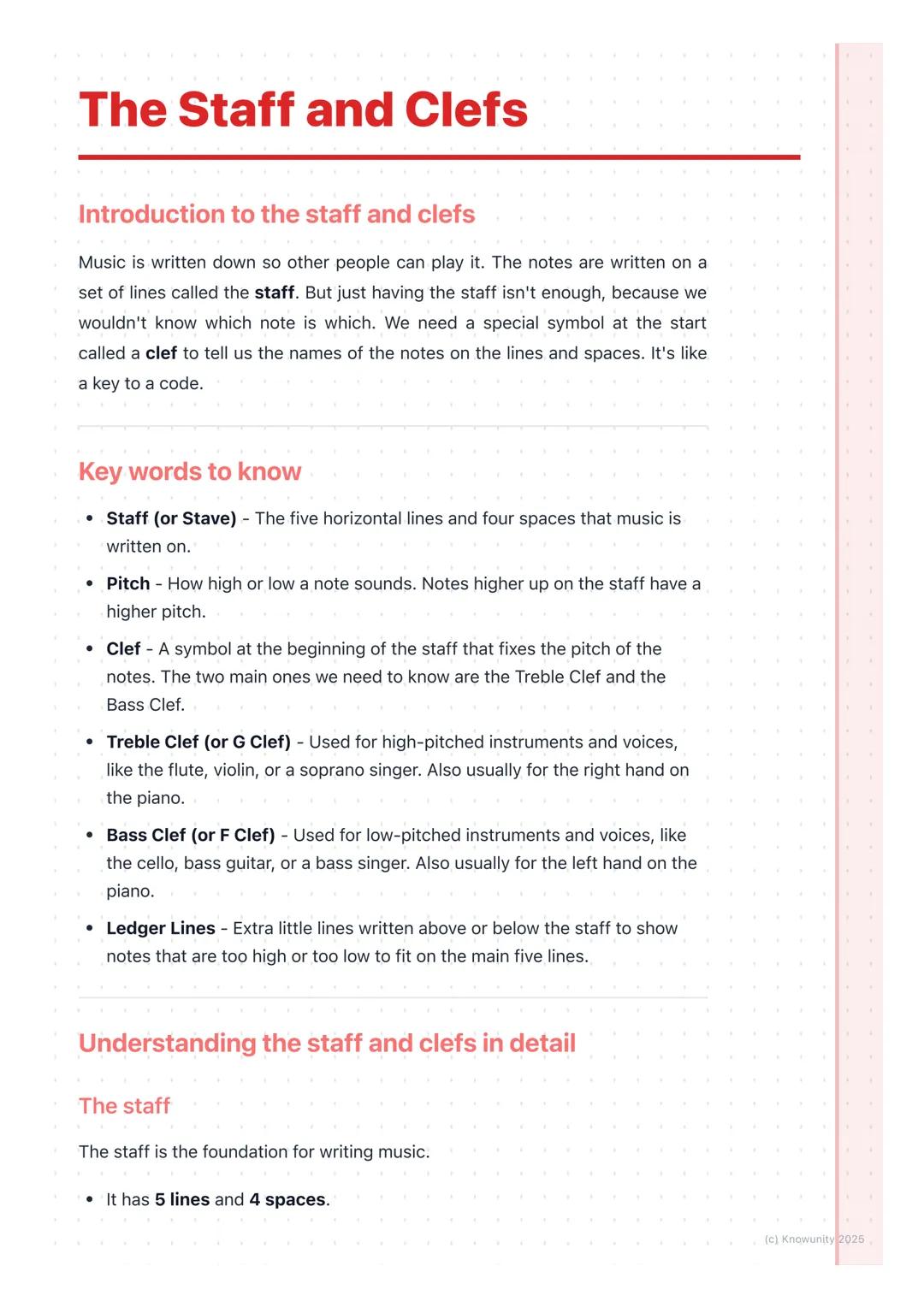
The Staff and Clefs Basics
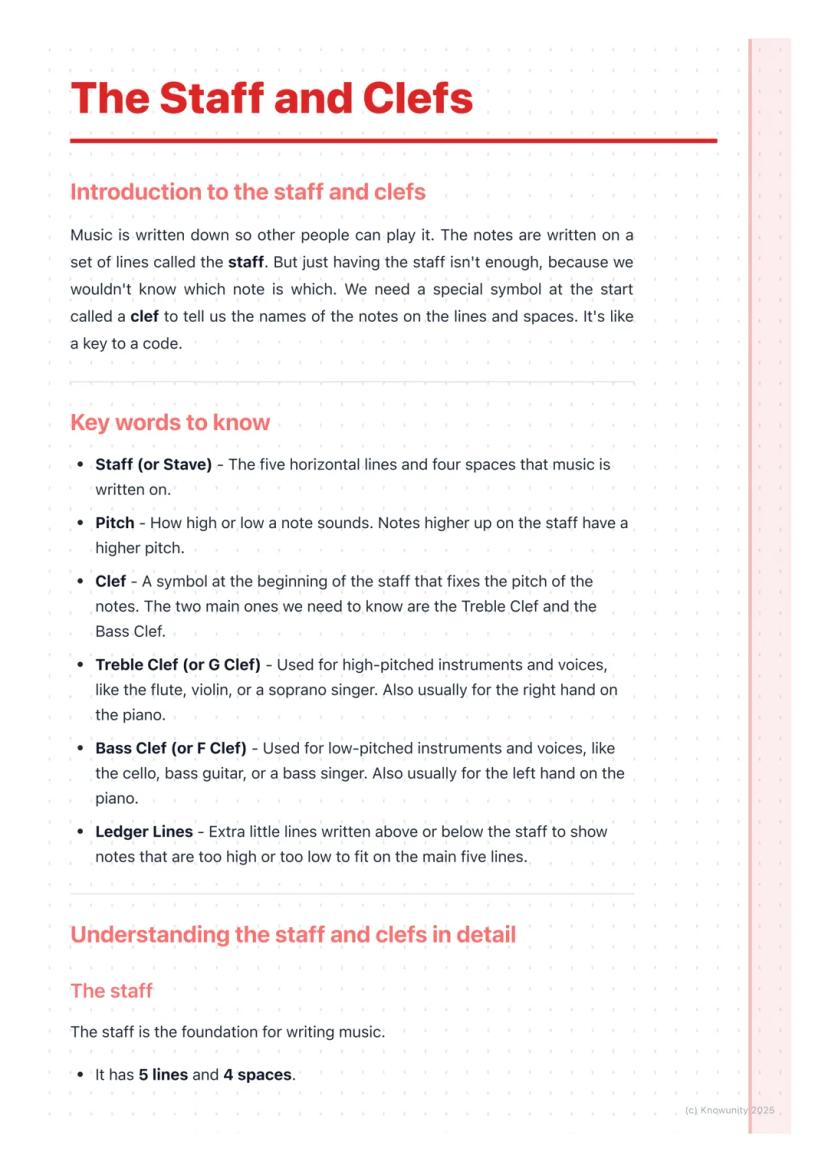
Think of the staff as music's address system - without it, notes would be homeless! The staff is made up of 5 horizontal lines and 4 spaces where all musical notes live. But here's the thing: those lines and spaces mean nothing without a special symbol at the beginning called a clef.
A clef is like a musical GPS - it tells you exactly which note is which. The pitch (how high or low a note sounds) depends on where it sits on the staff and which clef you're using. Notes higher up on the staff have a higher pitch than notes lower down.
There are two main clefs you need to master: the treble clef (for high sounds like flutes and sopranos) and the bass clef (for low sounds like cellos and bass guitars). Most piano music uses both - treble for the right hand, bass for the left.
Quick Tip: Always count lines and spaces from bottom to top - line 1 is at the bottom, line 5 is at the top!
2
of 6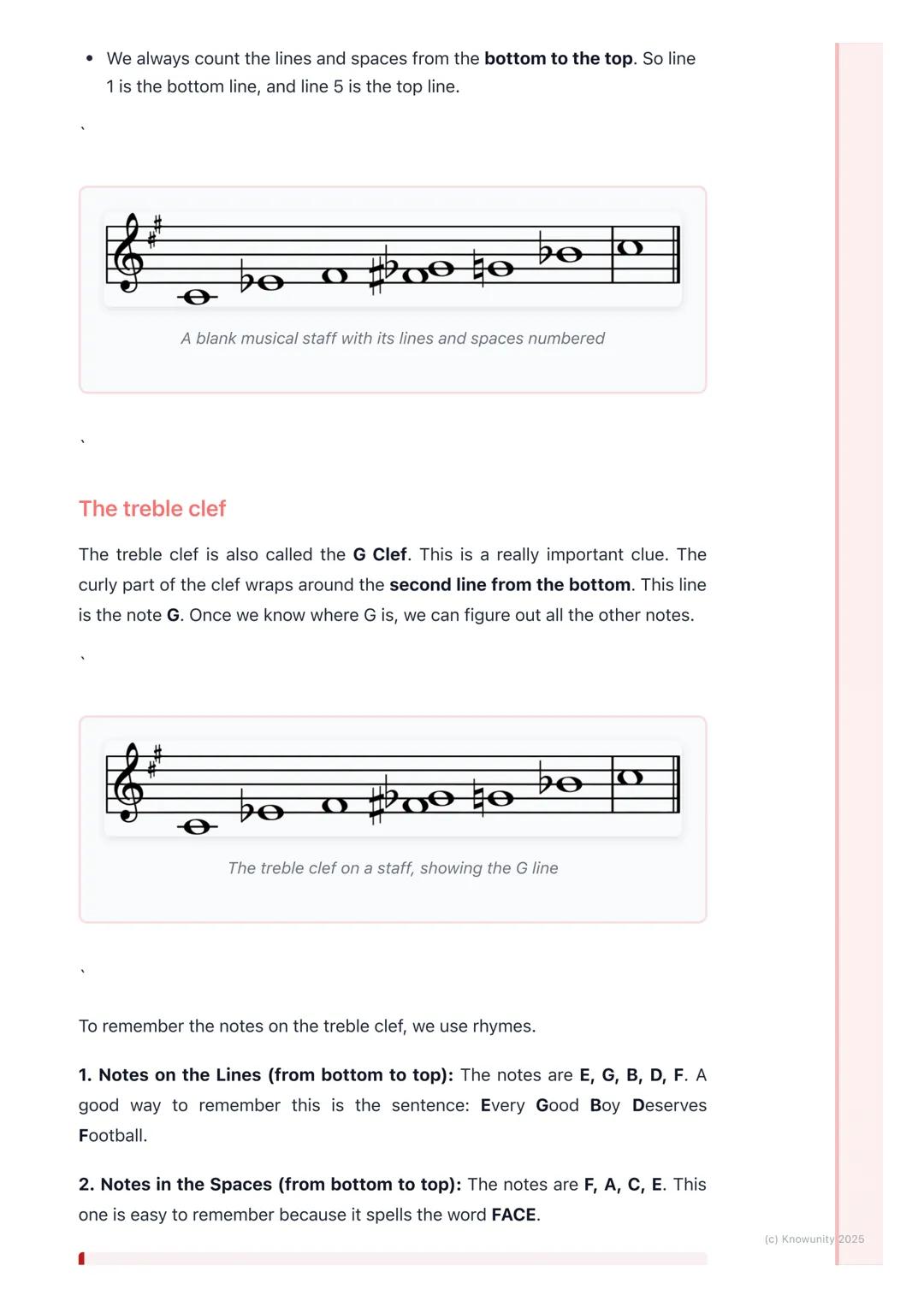
The Treble Clef (G Clef)
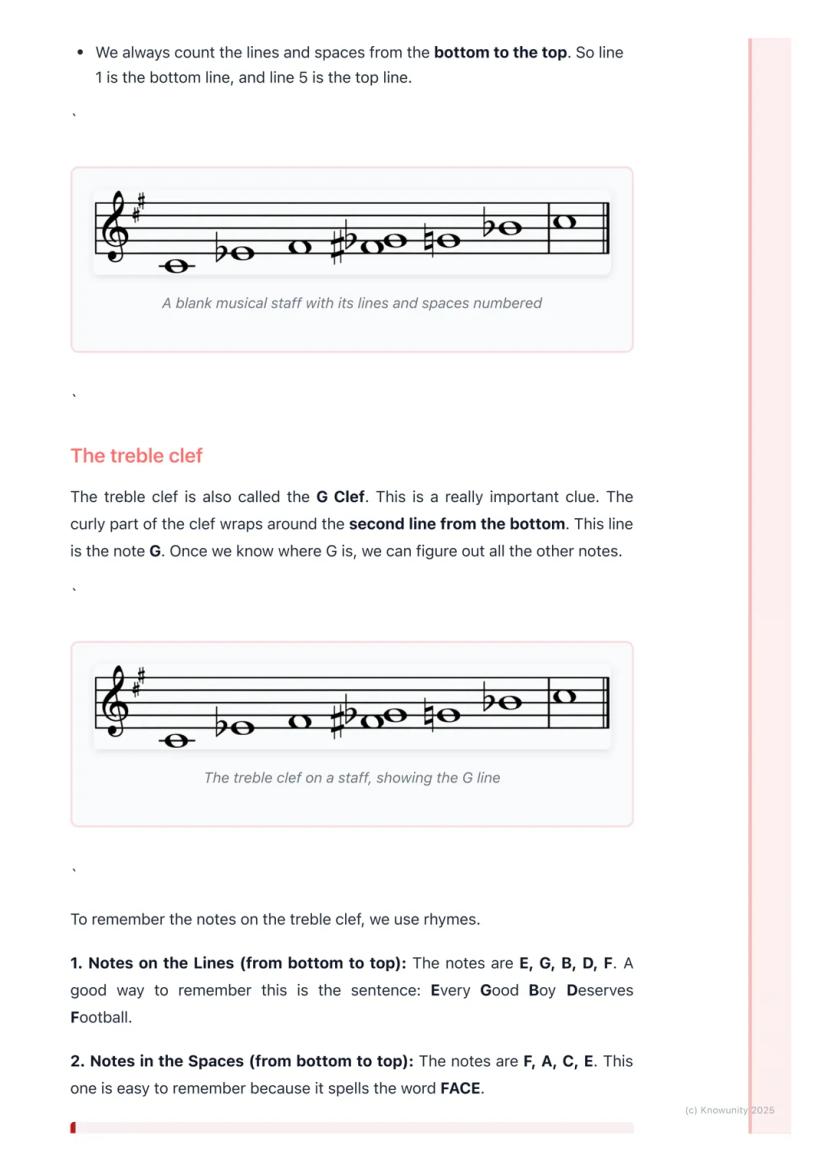
The treble clef is your best mate for reading high-pitched music. Here's a clever trick: it's also called the G clef because that curly bit wraps around the second line, marking where G lives. Once you know where G is, you can work out everything else!
For the lines (from bottom to top), the notes are E, G, B, D, F. Remember this with: "Every Good Boy Deserves Football". For the spaces (from bottom to top), you get F, A, C, E - which simply spells "FACE"!
The beauty of music is that notes follow alphabetical order: A, B, C, D, E, F, G, then back to A again. So if you know one note, just count up or down the alphabet to find the next one.
Memory Hack: FACE is super easy because it's actually a word - no complicated sentences to remember!
3
of 6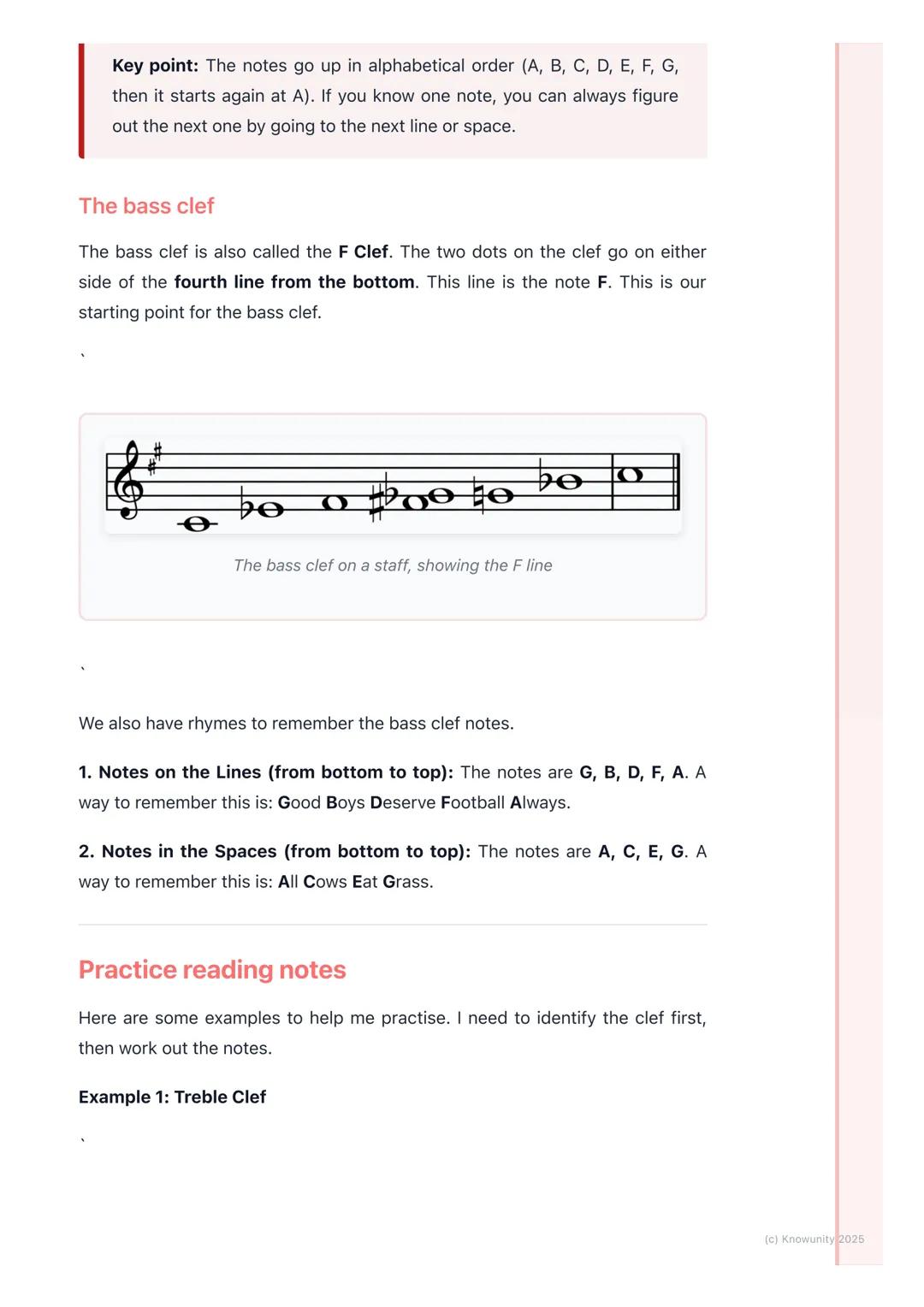
The Bass Clef (F Clef)
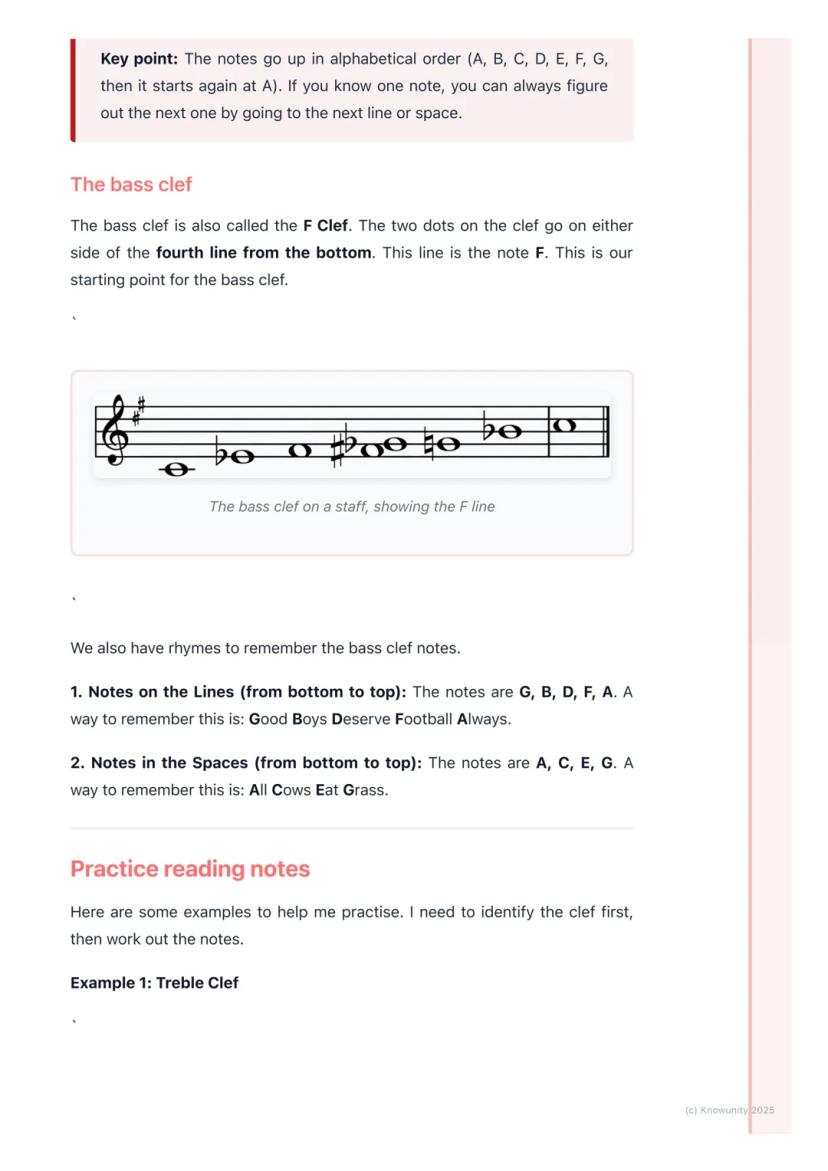
Now let's tackle the bass clef, also known as the F clef. Those two little dots sit on either side of the fourth line, marking where F lives. This is your starting point for reading bass clef notes.
For the lines in bass clef (bottom to top), you get G, B, D, F, A. Remember this with: "Good Boys Deserve Football Always". For the spaces, it's A, C, E, G - try "All Cows Eat Grass" to remember this one!
Notice how the bass clef rhymes are similar to treble clef but slightly different? That's because bass clef notes are positioned differently on the staff. The same line that's a B in treble clef is actually a D in bass clef!
Warning: Always check your clef first! This is the most common mistake students make - reading a note in the wrong clef.
4
of 6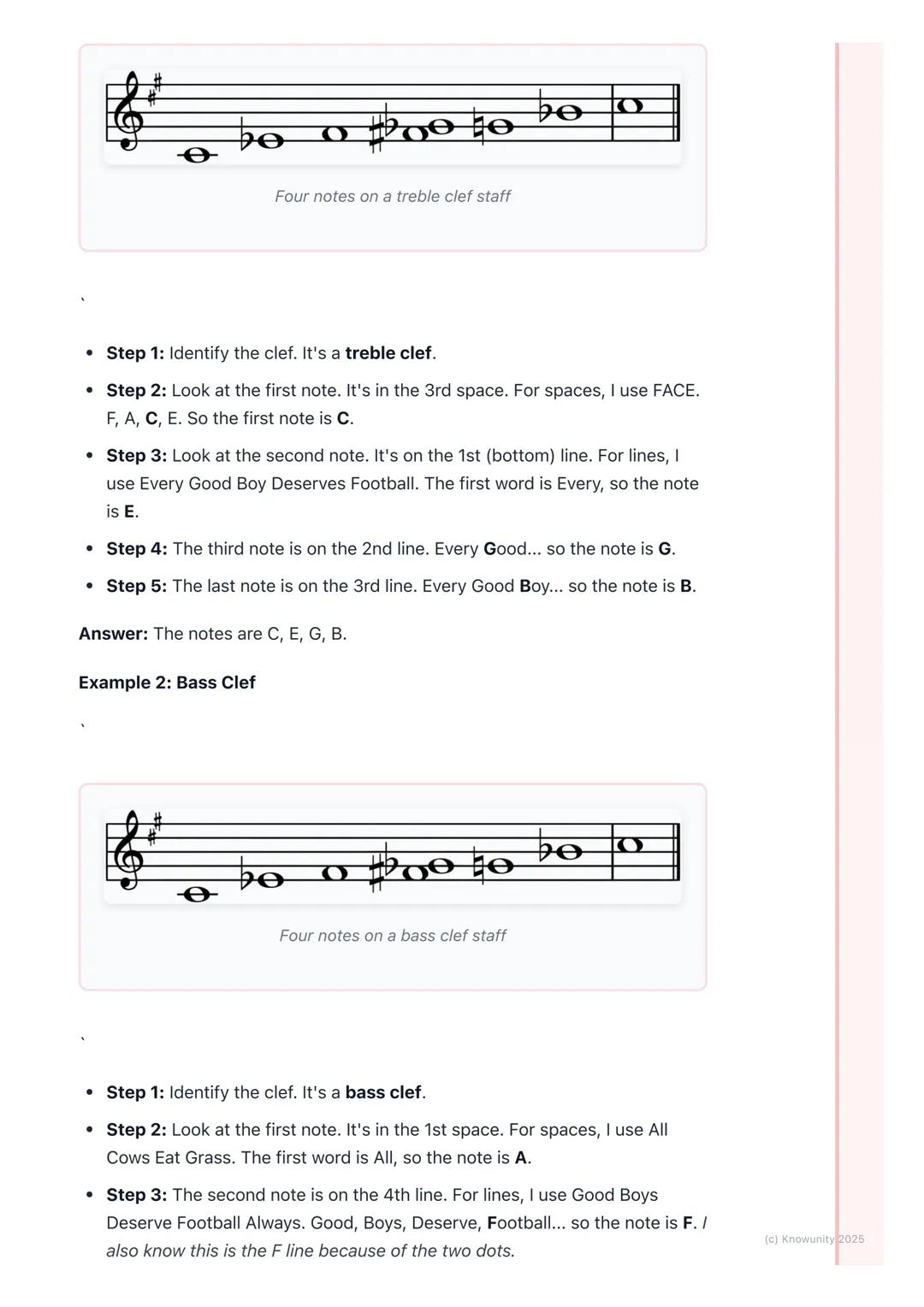
Reading Notes Step by Step
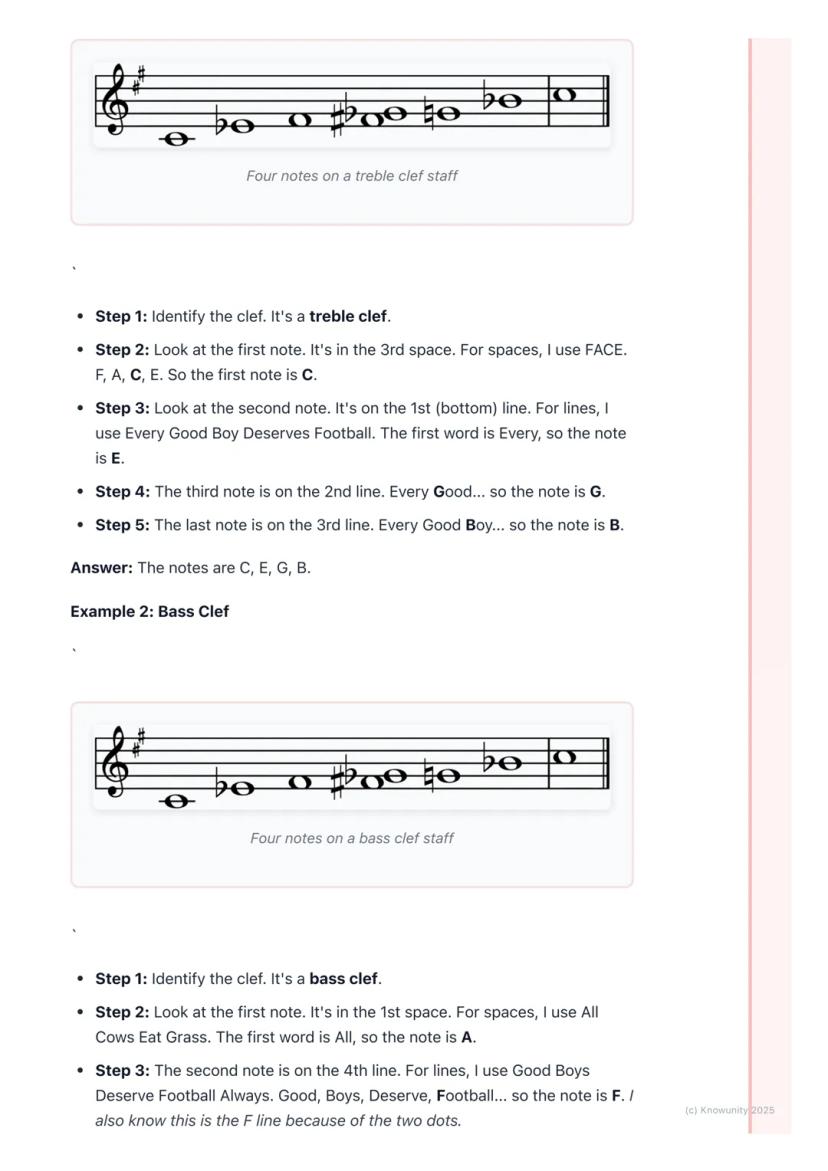
Let's put this into practice! When you see notes on a staff, follow these simple steps: identify the clef first, then use your rhymes to work out each note.
For treble clef example: If you see a note in the third space, think "FACE" - F, A, C... so it's C. If there's a note on the bottom line, think "Every Good Boy..." - the first word is Every, so it's E.
For bass clef example: A note in the first space means "All Cows Eat Grass" - All comes first, so it's A. A note on the fourth line (where the dots are) is always F in bass clef.
Pro Tip: The rhymes work like counting - use them in order from bottom to top, just like counting from 1 to 5!
5
of 6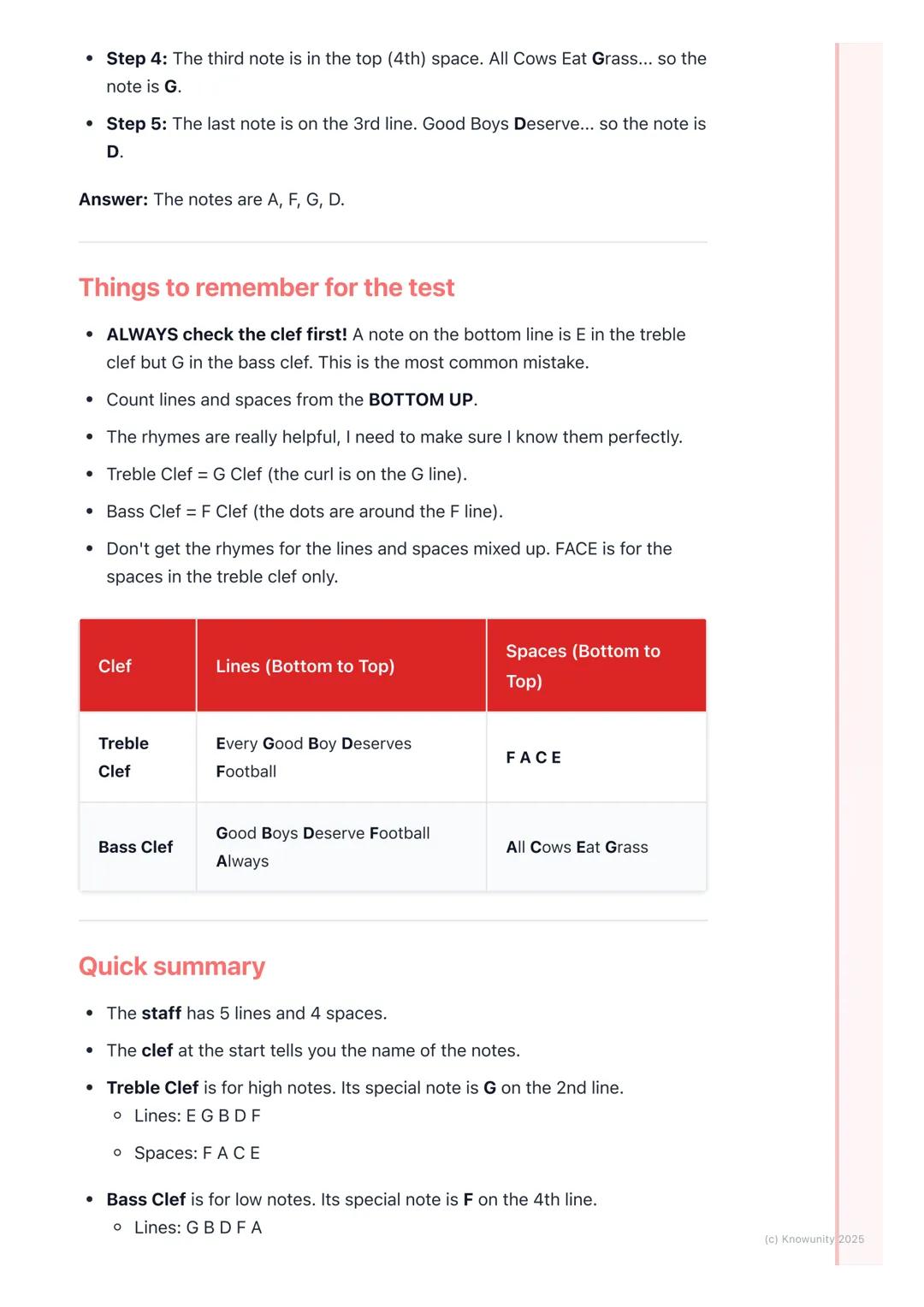
Test Preparation Essentials
Here's what you absolutely must remember for your test: always identify the clef before reading any notes! The same line can be completely different notes depending on the clef - E in treble becomes G in bass.
Your treble clef memory tools: Lines = "Every Good Boy Deserves Football" (EGBDF), Spaces = "FACE". Your bass clef memory tools: Lines = "Good Boys Deserve Football Always" (GBDFA), Spaces = "All Cows Eat Grass" (ACEG).
Remember that treble clef = G clef (the curl marks the G line) and bass clef = F clef (the dots mark the F line). Don't mix up the rhymes between clefs - FACE only works for treble clef spaces!
Exam Success: Practice identifying the clef first, then count from bottom to top using your rhymes - this method never fails!
6
of 6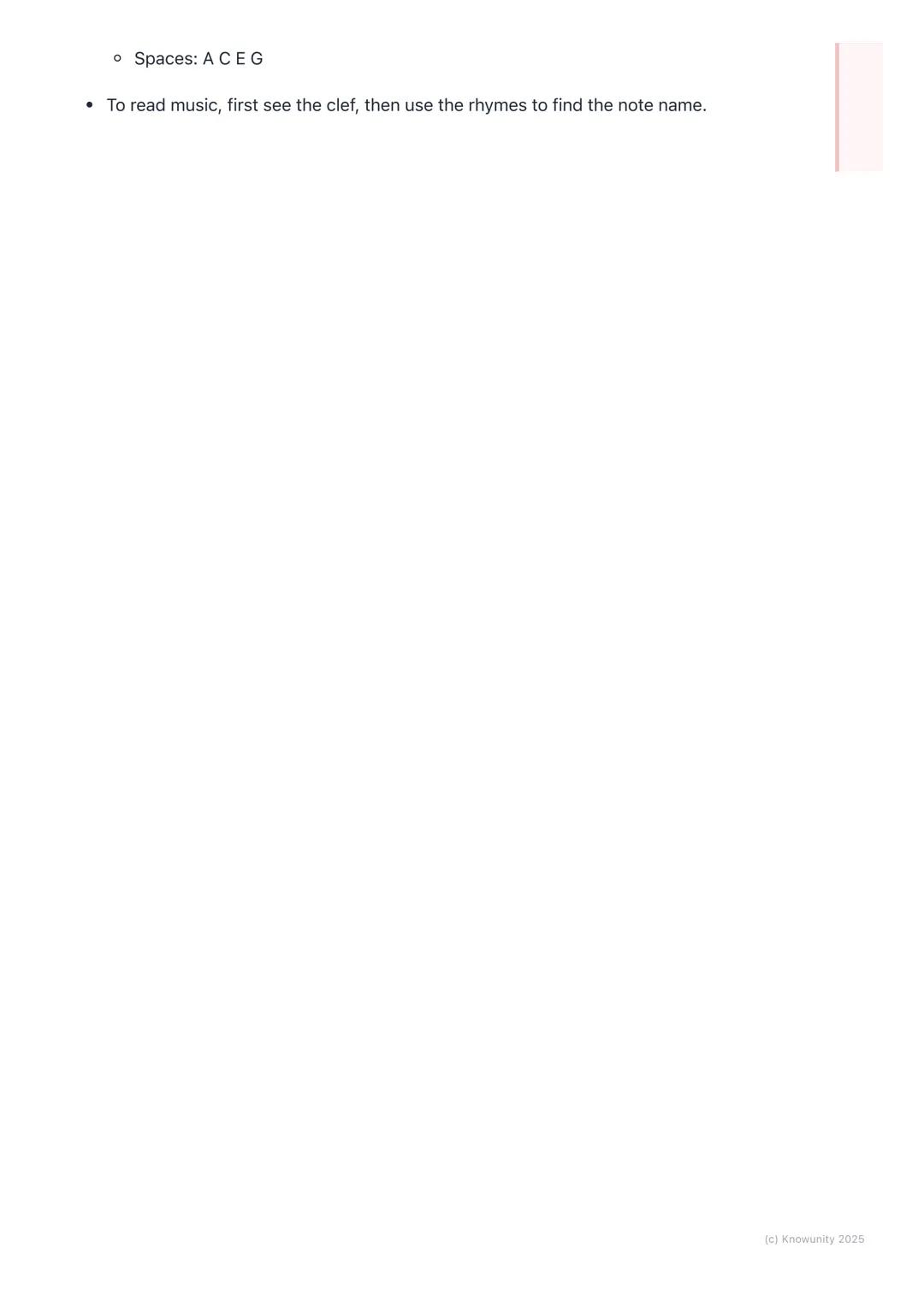
Quick Reference Summary
You've now got all the tools to read basic music notation! The staff gives notes their home, the clef tells you their names, and your rhymes help you remember everything.
Treble clef handles the high stuff (think violins and sopranos) with EGBDF for lines and FACE for spaces. Bass clef covers the low end (think cellos and bass guitars) with GBDFA for lines and ACEG for spaces. When in doubt, always check that clef symbol first - it's your musical compass that points you in the right direction every time!
Final Reminder: Master these rhymes and you'll never struggle with note reading again - it's like having a cheat code for music!
Myśleliśmy, że nigdy nie zapytasz...
Czym jest Towarzysz AI z Knowunity?
Nasz asystent AI jest specjalnie dostosowany do potrzeb uczniów. W oparciu o miliony treści, które mamy na platformie, możemy udzielać uczniom naprawdę znaczących i trafnych odpowiedzi. Ale nie chodzi tylko o odpowiedzi, towarzysz prowadzi również uczniów przez codzienne wyzwania związane z nauką, ze spersonalizowanymi planami nauki, quizami lub treściami na czacie i 100% personalizacją opartą na umiejętnościach i rozwoju uczniów.
Gdzie mogę pobrać aplikację Knowunity?
Aplikację możesz pobrać z Google Play i Apple Store.
Czy aplikacja Knowunity naprawdę jest darmowa?
Tak, masz całkowicie darmowy dostęp do wszystkich notatek w aplikacji, możesz w każdej chwili rozmawiać z Ekspertami lub ich obserwować. Możesz użyć punktów, aby odblokować pewne funkcje w aplikacji, które również możesz otrzymać za darmo. Dodatkowo oferujemy usługę Knowunity Premium, która pozwala na odblokowanie większej liczby funkcji.
Najpopularniejsze notatki z Music
2Najpopularniejsze notatki
9Nie ma nic odpowiedniego? Sprawdź inne przedmioty.
Zobacz, co mówią o nas nasi użytkownicy. Pokochali nas — pokochasz też i Ty.
4.6/5App Store
4.7/5Google Play
Aplikacja jest bardzo prosta i dobrze przemyślana. Do tej pory znalazłem wszystko, czego szukałem i mogłem się wiele nauczyć z innych notatek! Na pewno wykorzystam aplikację do pomocy przy robieniu prac domowych! No i oczywiście bardzo pomaga też jako inspiracja do robienia swoich notatek.
Stefan Sużytkownik iOS
Ta aplikacja jest naprawdę świetna. Jest tak wiele notatek i pomocnych informacji [...]. Moim problematycznym przedmiotem jest język niemiecki, a w aplikacji jest w czym wybierać. Dzięki tej aplikacji poprawiłam swój niemiecki. Polecam ją każdemu.
Samantha Klichużytkownik Androida
Wow, jestem w szoku. Właśnie wypróbowałam aplikację, ponieważ widziałam ją kilka razy reklamowaną na TikToku jestem absolutnie w szoku. Ta aplikacja jest POMOCĄ, której potrzebujesz w szkole i przede wszystkim oferuje tak wiele rzeczy jak notatki czy streszczenia, które są BARDZO pomocne w moim przypadku.
Annaużytkownik iOS
Music3 wyświetleń·Zaktualizowano Jun 6, 2026·6 stronyUnderstanding the Staff, Lines, and Clefs
Ever wondered how musicians can look at squiggly lines and turn them into beautiful music? It all starts with understanding the staff and clefs- the basic code that makes reading music possible. Once you crack this code, you'll be... Pokaż więcej
1
of 6Zarejestruj się, aby zobaczyć notatkę. To nic nie kosztuje!
- Dostęp do wszystkich materiałów
- Popraw swoje oceny
- Dołącz do milionów studentów
The Staff and Clefs Basics
Think of the staff as music's address system - without it, notes would be homeless! The staff is made up of 5 horizontal lines and 4 spaces where all musical notes live. But here's the thing: those lines and spaces mean nothing without a special symbol at the beginning called a clef.
A clef is like a musical GPS - it tells you exactly which note is which. The pitch (how high or low a note sounds) depends on where it sits on the staff and which clef you're using. Notes higher up on the staff have a higher pitch than notes lower down.
There are two main clefs you need to master: the treble clef (for high sounds like flutes and sopranos) and the bass clef (for low sounds like cellos and bass guitars). Most piano music uses both - treble for the right hand, bass for the left.
Quick Tip: Always count lines and spaces from bottom to top - line 1 is at the bottom, line 5 is at the top!
2
of 6Zarejestruj się, aby zobaczyć notatkę. To nic nie kosztuje!
- Dostęp do wszystkich materiałów
- Popraw swoje oceny
- Dołącz do milionów studentów
The Treble Clef (G Clef)
The treble clef is your best mate for reading high-pitched music. Here's a clever trick: it's also called the G clef because that curly bit wraps around the second line, marking where G lives. Once you know where G is, you can work out everything else!
For the lines (from bottom to top), the notes are E, G, B, D, F. Remember this with: "Every Good Boy Deserves Football". For the spaces (from bottom to top), you get F, A, C, E - which simply spells "FACE"!
The beauty of music is that notes follow alphabetical order: A, B, C, D, E, F, G, then back to A again. So if you know one note, just count up or down the alphabet to find the next one.
Memory Hack: FACE is super easy because it's actually a word - no complicated sentences to remember!
3
of 6Zarejestruj się, aby zobaczyć notatkę. To nic nie kosztuje!
- Dostęp do wszystkich materiałów
- Popraw swoje oceny
- Dołącz do milionów studentów
The Bass Clef (F Clef)
Now let's tackle the bass clef, also known as the F clef. Those two little dots sit on either side of the fourth line, marking where F lives. This is your starting point for reading bass clef notes.
For the lines in bass clef (bottom to top), you get G, B, D, F, A. Remember this with: "Good Boys Deserve Football Always". For the spaces, it's A, C, E, G - try "All Cows Eat Grass" to remember this one!
Notice how the bass clef rhymes are similar to treble clef but slightly different? That's because bass clef notes are positioned differently on the staff. The same line that's a B in treble clef is actually a D in bass clef!
Warning: Always check your clef first! This is the most common mistake students make - reading a note in the wrong clef.
4
of 6Zarejestruj się, aby zobaczyć notatkę. To nic nie kosztuje!
- Dostęp do wszystkich materiałów
- Popraw swoje oceny
- Dołącz do milionów studentów
Reading Notes Step by Step
Let's put this into practice! When you see notes on a staff, follow these simple steps: identify the clef first, then use your rhymes to work out each note.
For treble clef example: If you see a note in the third space, think "FACE" - F, A, C... so it's C. If there's a note on the bottom line, think "Every Good Boy..." - the first word is Every, so it's E.
For bass clef example: A note in the first space means "All Cows Eat Grass" - All comes first, so it's A. A note on the fourth line (where the dots are) is always F in bass clef.
Pro Tip: The rhymes work like counting - use them in order from bottom to top, just like counting from 1 to 5!
5
of 6Zarejestruj się, aby zobaczyć notatkę. To nic nie kosztuje!
- Dostęp do wszystkich materiałów
- Popraw swoje oceny
- Dołącz do milionów studentów
Test Preparation Essentials
Here's what you absolutely must remember for your test: always identify the clef before reading any notes! The same line can be completely different notes depending on the clef - E in treble becomes G in bass.
Your treble clef memory tools: Lines = "Every Good Boy Deserves Football" (EGBDF), Spaces = "FACE". Your bass clef memory tools: Lines = "Good Boys Deserve Football Always" (GBDFA), Spaces = "All Cows Eat Grass" (ACEG).
Remember that treble clef = G clef (the curl marks the G line) and bass clef = F clef (the dots mark the F line). Don't mix up the rhymes between clefs - FACE only works for treble clef spaces!
Exam Success: Practice identifying the clef first, then count from bottom to top using your rhymes - this method never fails!
6
of 6Zarejestruj się, aby zobaczyć notatkę. To nic nie kosztuje!
- Dostęp do wszystkich materiałów
- Popraw swoje oceny
- Dołącz do milionów studentów
Quick Reference Summary
You've now got all the tools to read basic music notation! The staff gives notes their home, the clef tells you their names, and your rhymes help you remember everything.
Treble clef handles the high stuff (think violins and sopranos) with EGBDF for lines and FACE for spaces. Bass clef covers the low end (think cellos and bass guitars) with GBDFA for lines and ACEG for spaces. When in doubt, always check that clef symbol first - it's your musical compass that points you in the right direction every time!
Final Reminder: Master these rhymes and you'll never struggle with note reading again - it's like having a cheat code for music!
Myśleliśmy, że nigdy nie zapytasz...
Czym jest Towarzysz AI z Knowunity?
Nasz asystent AI jest specjalnie dostosowany do potrzeb uczniów. W oparciu o miliony treści, które mamy na platformie, możemy udzielać uczniom naprawdę znaczących i trafnych odpowiedzi. Ale nie chodzi tylko o odpowiedzi, towarzysz prowadzi również uczniów przez codzienne wyzwania związane z nauką, ze spersonalizowanymi planami nauki, quizami lub treściami na czacie i 100% personalizacją opartą na umiejętnościach i rozwoju uczniów.
Gdzie mogę pobrać aplikację Knowunity?
Aplikację możesz pobrać z Google Play i Apple Store.
Czy aplikacja Knowunity naprawdę jest darmowa?
Tak, masz całkowicie darmowy dostęp do wszystkich notatek w aplikacji, możesz w każdej chwili rozmawiać z Ekspertami lub ich obserwować. Możesz użyć punktów, aby odblokować pewne funkcje w aplikacji, które również możesz otrzymać za darmo. Dodatkowo oferujemy usługę Knowunity Premium, która pozwala na odblokowanie większej liczby funkcji.
Najpopularniejsze notatki z Music
2Najpopularniejsze notatki
9Nie ma nic odpowiedniego? Sprawdź inne przedmioty.
Zobacz, co mówią o nas nasi użytkownicy. Pokochali nas — pokochasz też i Ty.
4.6/5App Store
4.7/5Google Play
Aplikacja jest bardzo prosta i dobrze przemyślana. Do tej pory znalazłem wszystko, czego szukałem i mogłem się wiele nauczyć z innych notatek! Na pewno wykorzystam aplikację do pomocy przy robieniu prac domowych! No i oczywiście bardzo pomaga też jako inspiracja do robienia swoich notatek.
Stefan Sużytkownik iOS
Ta aplikacja jest naprawdę świetna. Jest tak wiele notatek i pomocnych informacji [...]. Moim problematycznym przedmiotem jest język niemiecki, a w aplikacji jest w czym wybierać. Dzięki tej aplikacji poprawiłam swój niemiecki. Polecam ją każdemu.
Samantha Klichużytkownik Androida
Wow, jestem w szoku. Właśnie wypróbowałam aplikację, ponieważ widziałam ją kilka razy reklamowaną na TikToku jestem absolutnie w szoku. Ta aplikacja jest POMOCĄ, której potrzebujesz w szkole i przede wszystkim oferuje tak wiele rzeczy jak notatki czy streszczenia, które są BARDZO pomocne w moim przypadku.
Annaużytkownik iOS