
Every living thing on Earth is made up of cells...
 Science2 wyświetleń·Zaktualizowano Jun 3, 2026·7 strony
Understanding Cells: Structures and Functions
1 / 7
1
of 7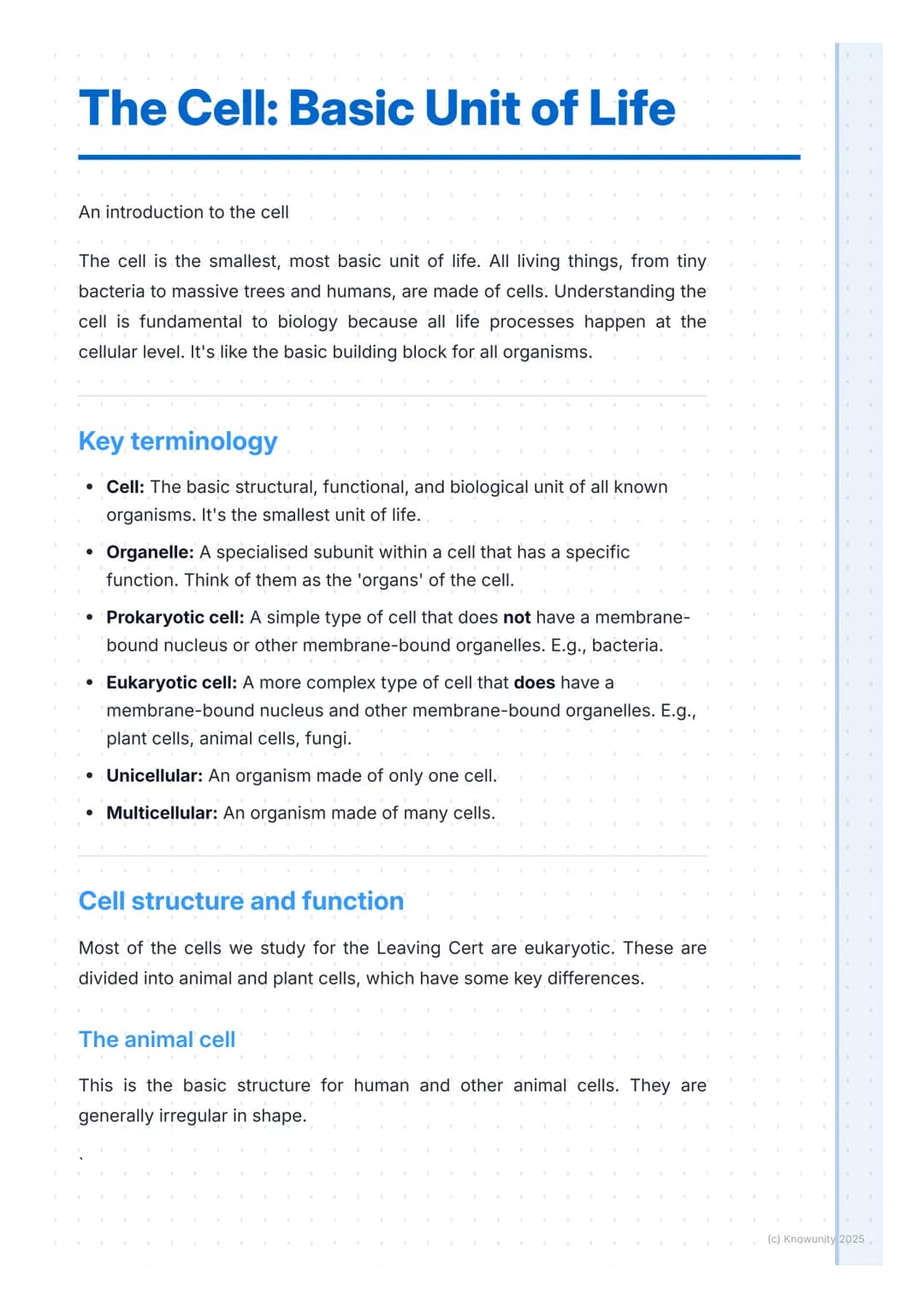
The Cell: Basic Unit of Life
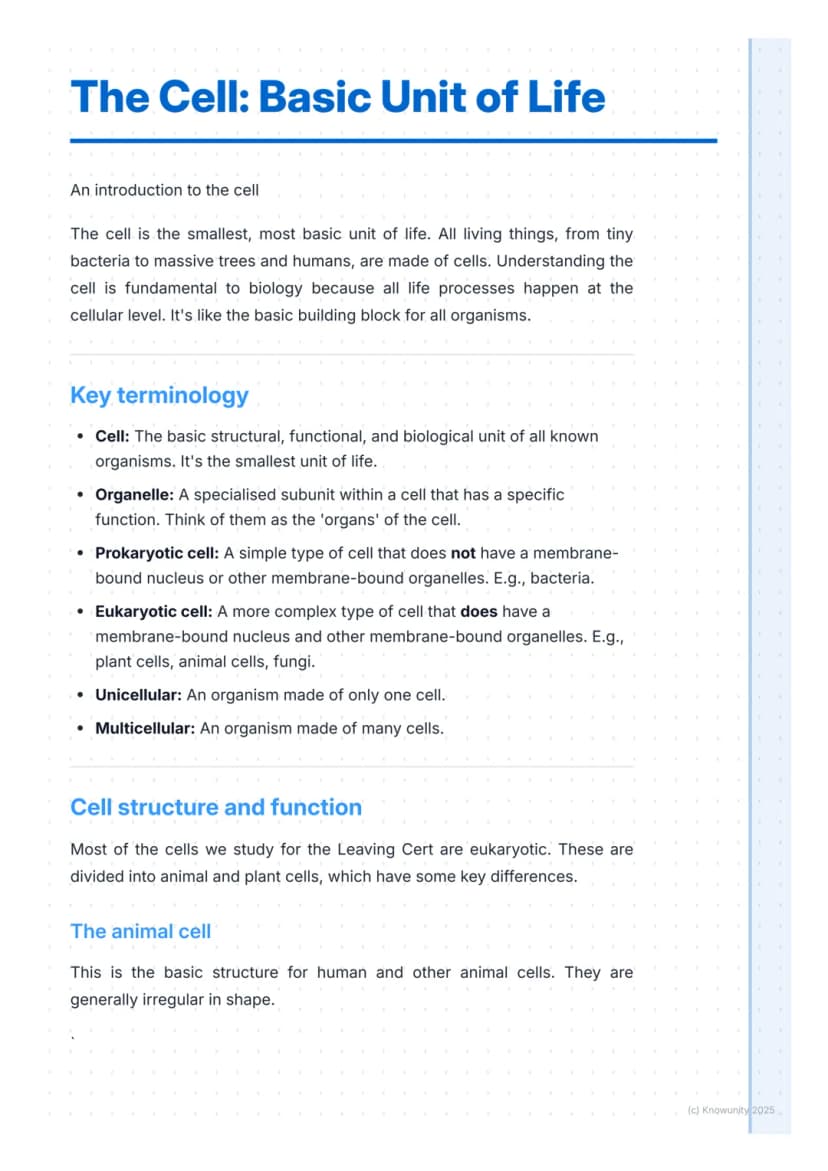
You're constantly surrounded by trillions of cells - they're literally everywhere, including the roughly 37 trillion that make up your own body! Cells are the fundamental building blocks of all living organisms, and every single life process happens at the cellular level.
There are two main types of cells you need to know. Prokaryotic cells are the simple ones - think bacteria - that don't have a proper nucleus or organised compartments. Eukaryotic cells are the complex ones that make up plants, animals, and fungi, complete with a nucleus and specialised compartments called organelles.
Living things can be unicellular (made of just one cell, like bacteria) or multicellular (made of many cells working together, like you). For your Leaving Cert, you'll mainly focus on eukaryotic cells, particularly plant and animal cells.
Remember: Organelles are like the "organs" of a cell - each one has a specific job to keep the cell functioning properly.
2
of 7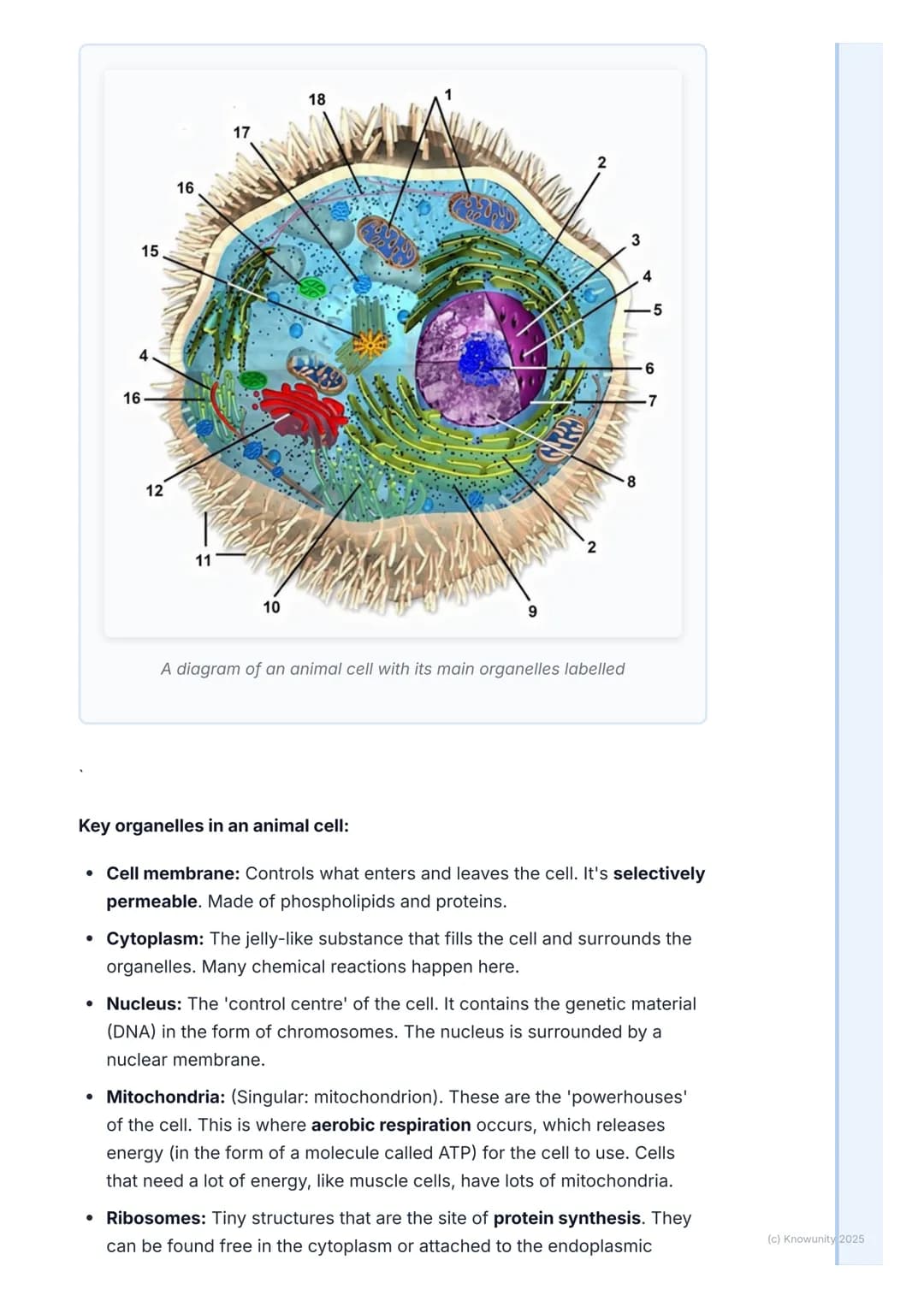
Animal Cell Structure
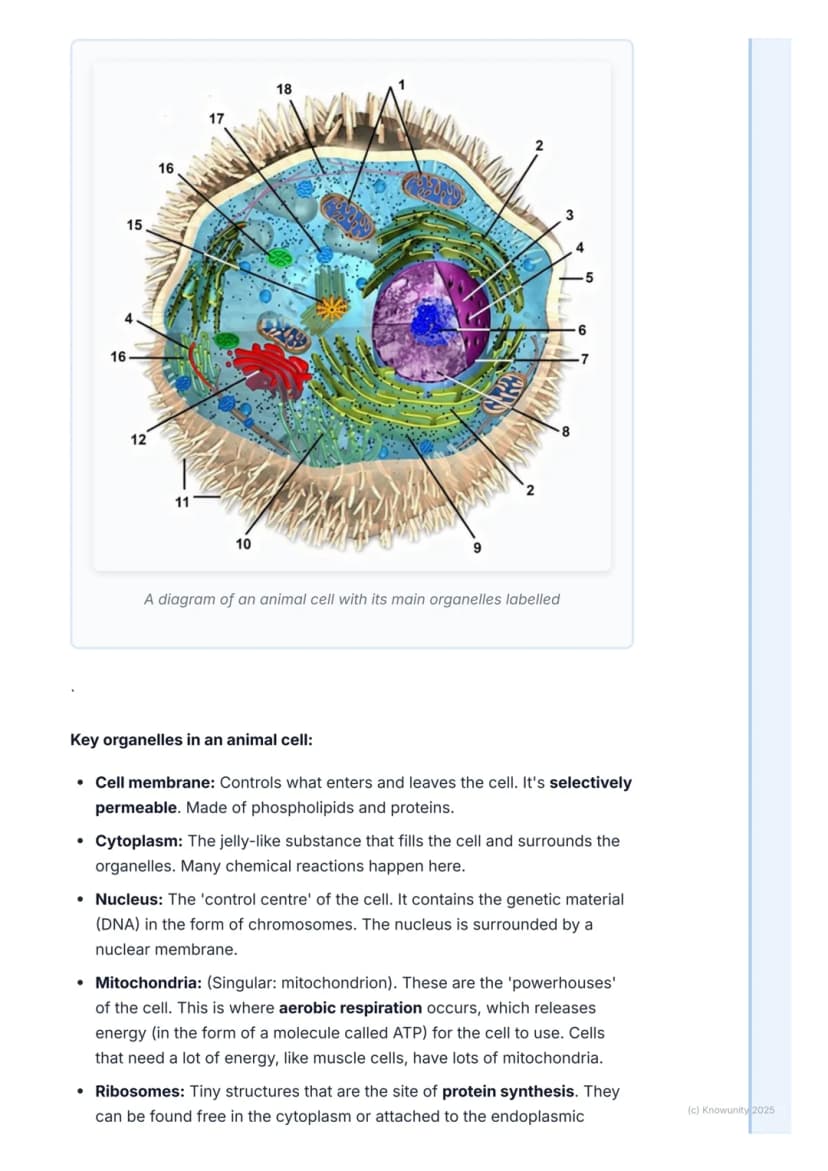
Animal cells are your basic cellular template - they're usually round or irregular in shape and packed with amazing tiny machines. The cell membrane acts like a bouncer at a club, deciding what gets in and out of the cell using its selective permeability.
Inside, the cytoplasm is like a jelly-filled workspace where loads of chemical reactions happen. The nucleus is absolutely crucial - it's the control centre containing all your genetic material (DNA) wrapped up in chromosomes, surrounded by its own protective membrane.
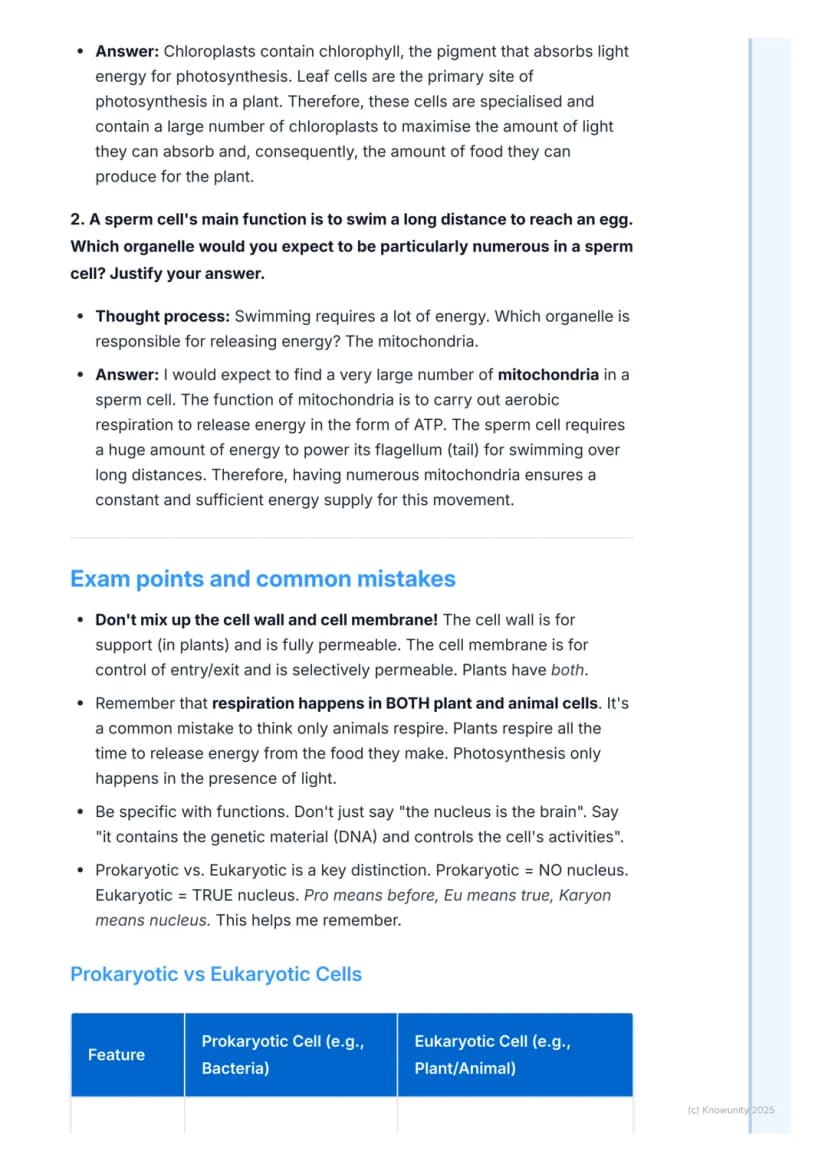
Mitochondria are the real heroes here - they're often called the "powerhouses" because they carry out respiration to release energy as ATP. Muscle cells are packed with these because they need loads of energy! Ribosomes are tiny protein-making factories that can float freely or attach to the endoplasmic reticulum.
Top Tip: Cells that need more energy (like heart muscle cells) contain way more mitochondria - this shows how structure relates to function!
3
of 7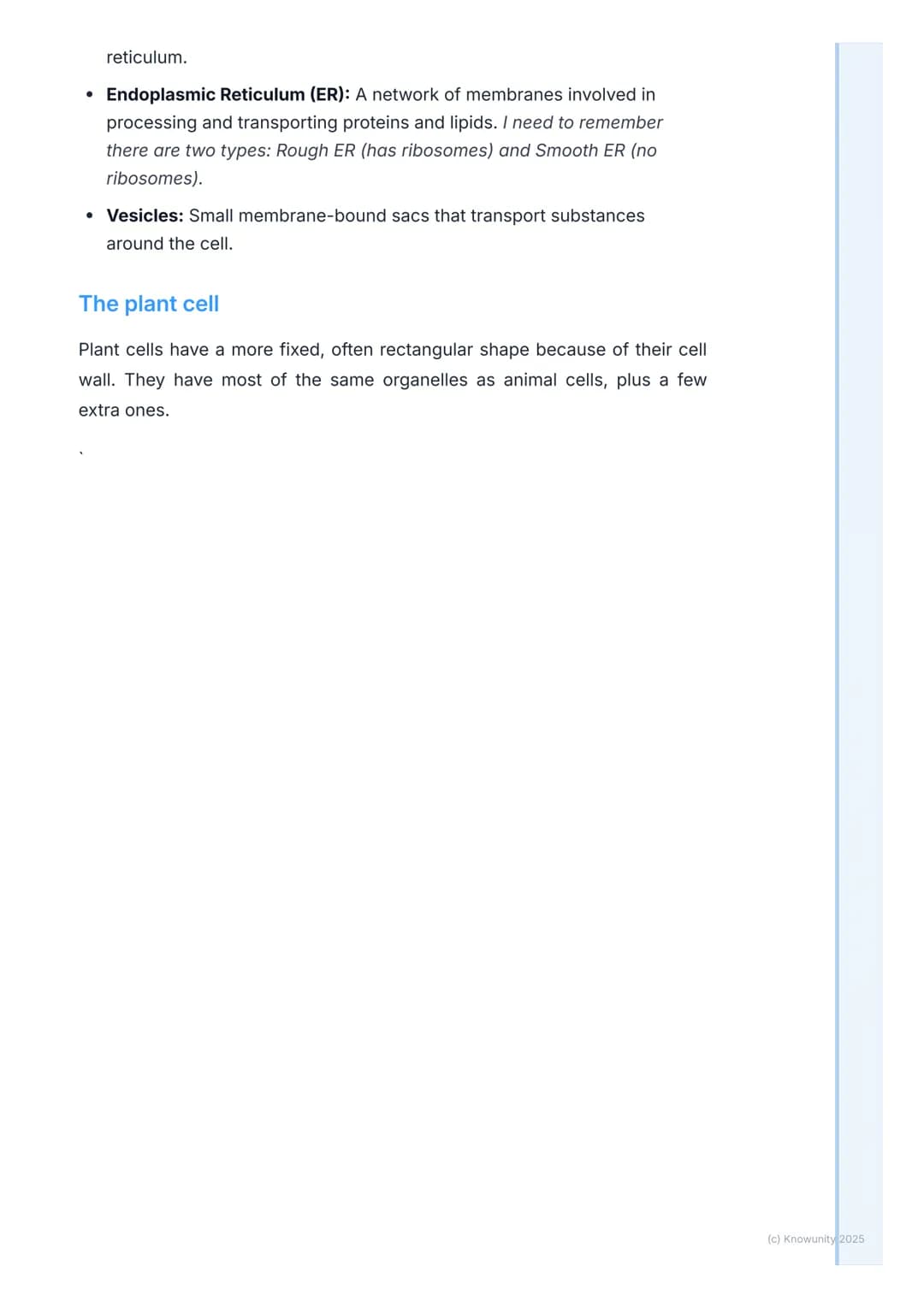
More Animal Cell Components
The endoplasmic reticulum (ER) is like the cell's internal highway system for transporting materials. There are two types: rough ER (covered in ribosomes, looks bumpy) handles proteins, whilst smooth ER (no ribosomes) deals with lipids and other substances.
Vesicles are like tiny delivery vans - small membrane-bound sacs that transport substances around the cell. They're constantly moving materials from one place to another, keeping everything organised.
These organelles work together like a well-oiled machine. When you understand how each part contributes to the whole system, cell biology starts making perfect sense!
Exam Smart: Remember that animal cells can have small, temporary vacuoles, but they're nothing like the massive ones in plant cells.
4
of 7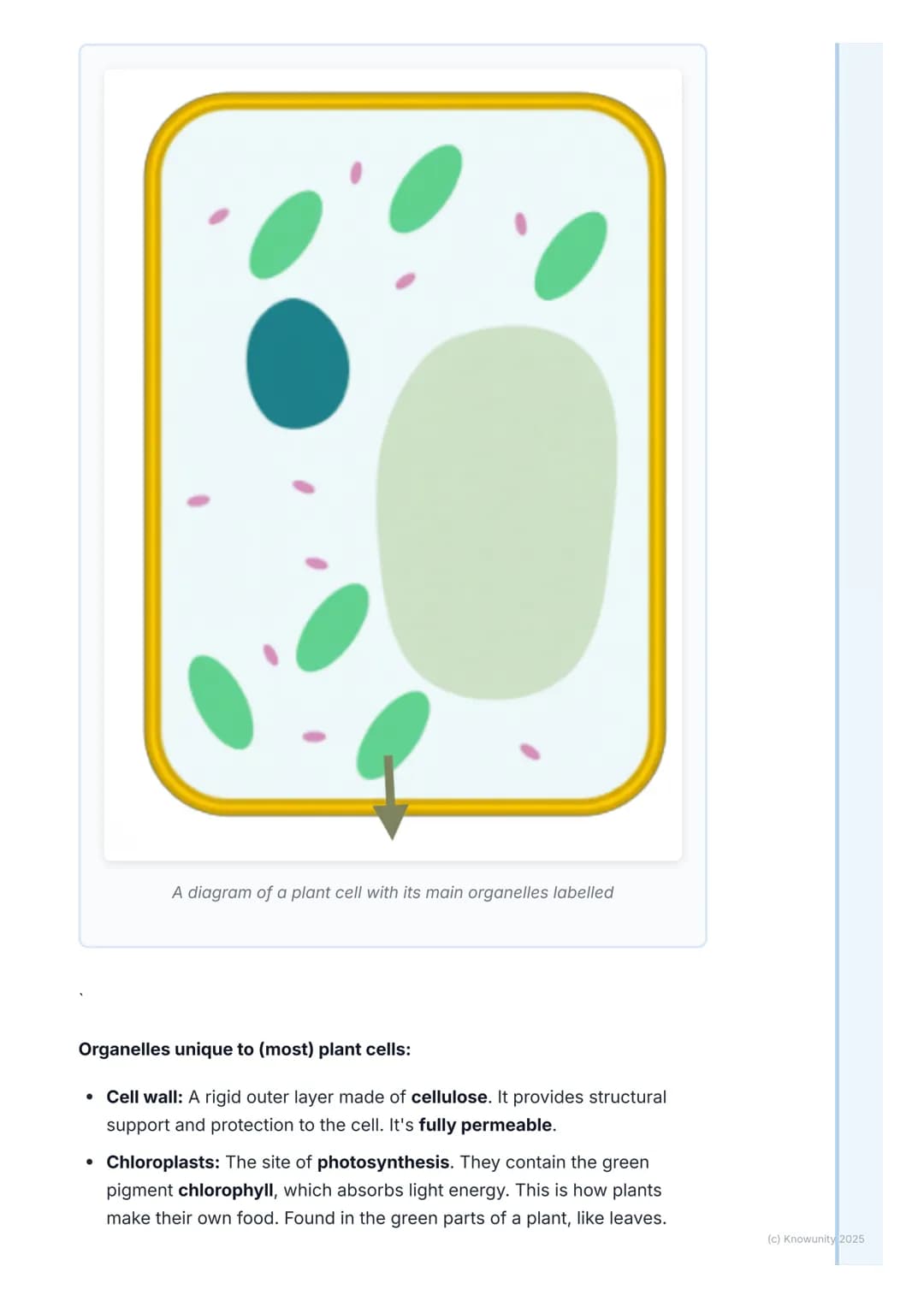
Plant Cell Structure
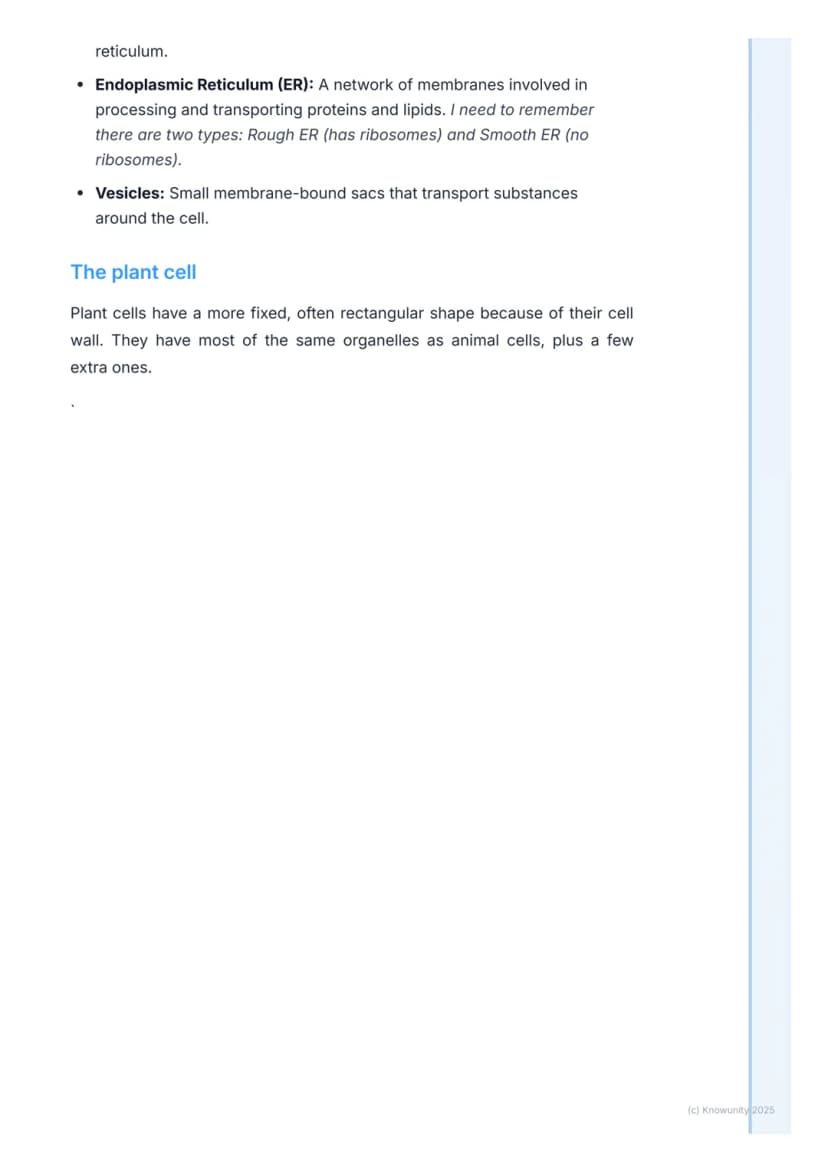
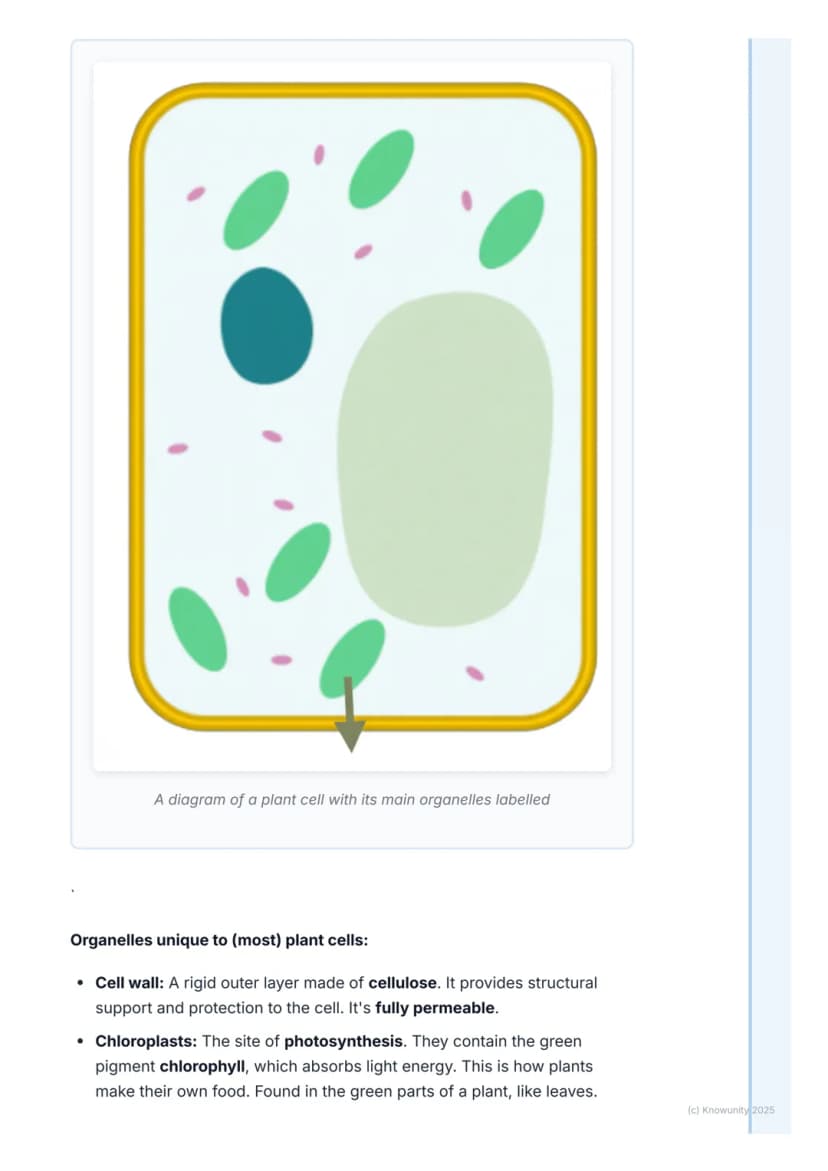
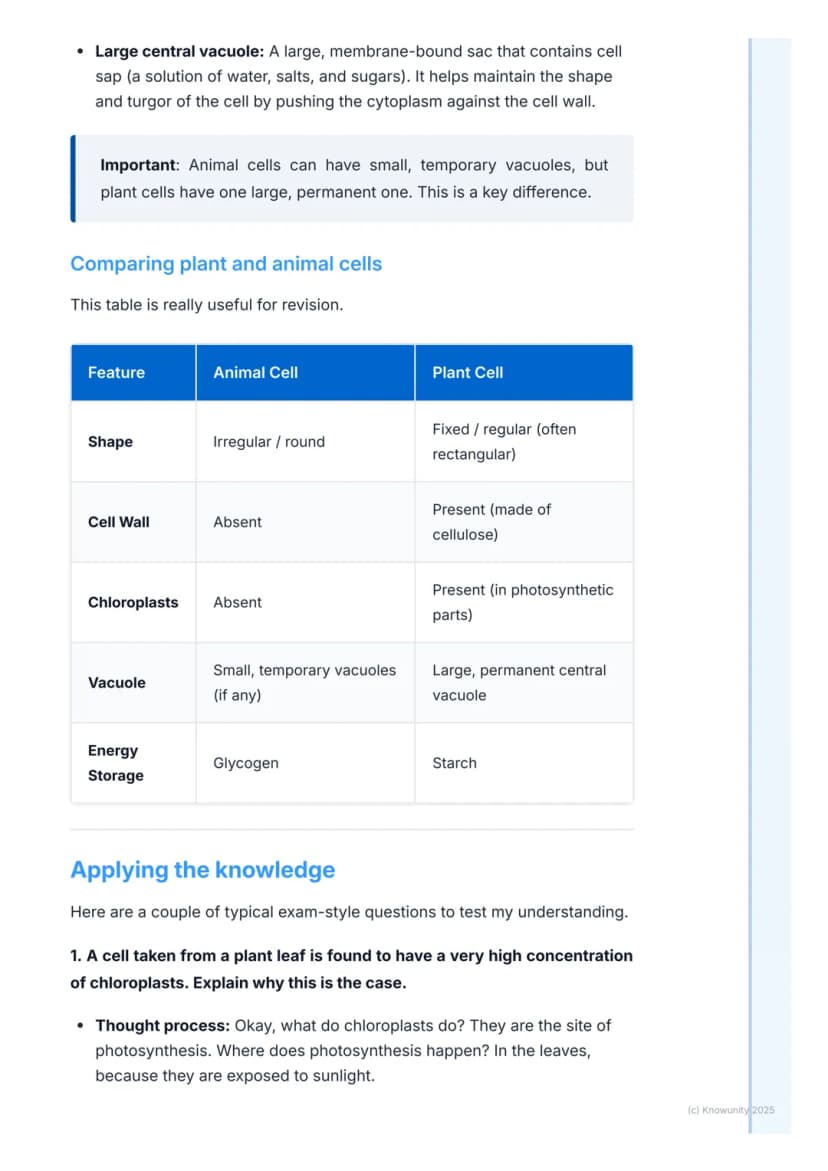
Plant cells are like upgraded animal cells with some brilliant extras that help them make their own food and stand upright. They typically have a more fixed, rectangular shape thanks to their rigid cell wall made of cellulose.
The cell wall is the plant's suit of armour - it provides structural support and protection whilst being fully permeable (unlike the selective cell membrane). This is why plants can grow so tall without collapsing!
Chloroplasts are the green magic-makers containing chlorophyll, the pigment that captures sunlight for photosynthesis. You'll find loads of these in leaf cells because that's where most photosynthesis happens. They're basically the plant's solar panels!
Key Point: Plant cells have all the same organelles as animal cells PLUS the cell wall, chloroplasts, and a large central vacuole.
5
of 7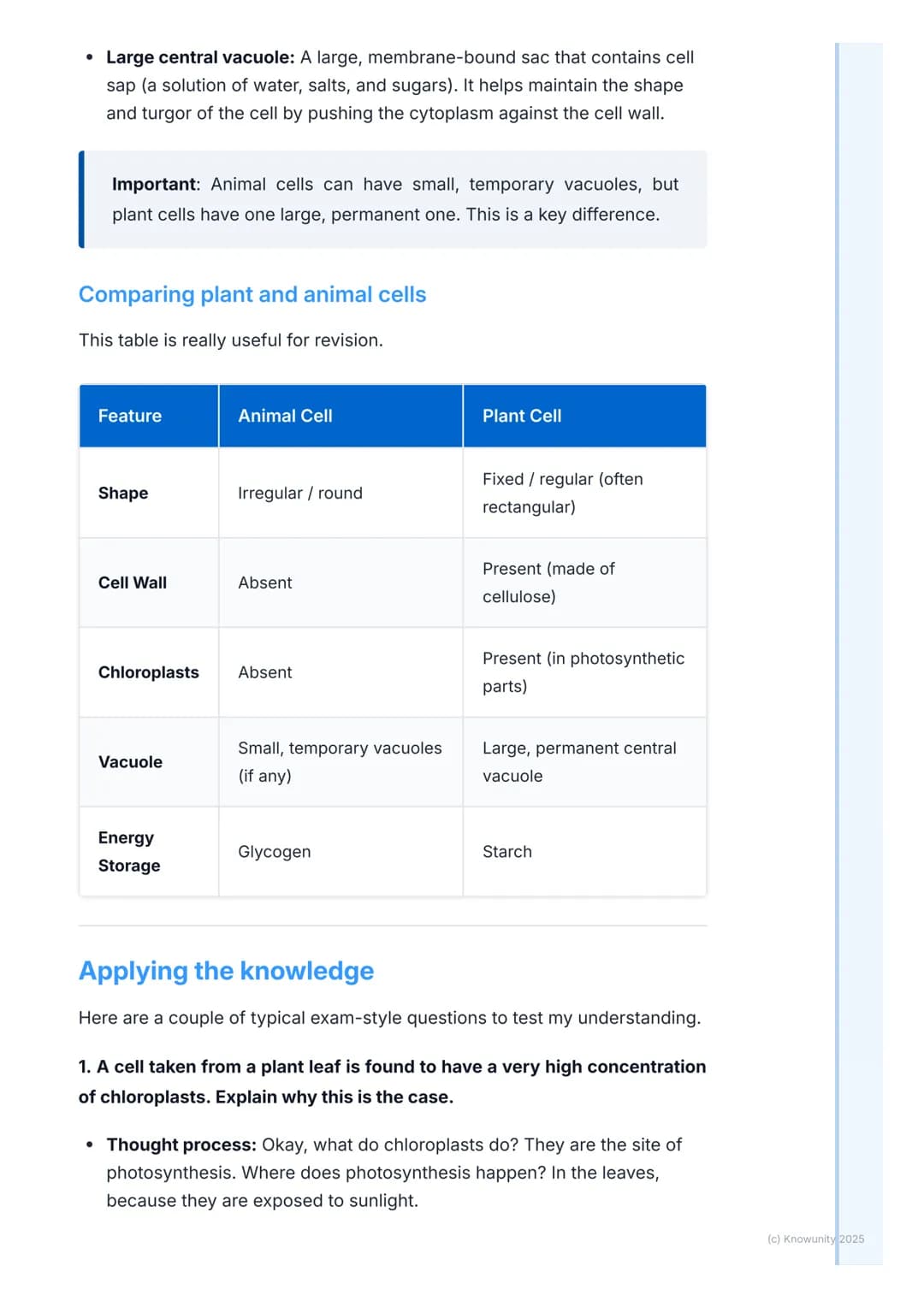
Plant Cell Specialities and Comparison
The large central vacuole is like a plant cell's storage tank and support system rolled into one. It's filled with cell sap (water, salts, and sugars) and helps maintain the cell's shape by pushing outwards against the cell wall - this is called turgor pressure.
Here's a handy comparison: animal cells are irregular and flexible, whilst plant cells are fixed and rectangular. Animal cells store energy as glycogen, plants use starch. Most importantly, plants can photosynthesise thanks to their chloroplasts, whilst animals must get their energy by eating other organisms.
When tackling exam questions, think about structure matching function. Leaf cells packed with chloroplasts? Perfect for photosynthesis. Sperm cells loaded with mitochondria? Ideal for that energy-demanding swim to reach an egg!
Exam Tip: Don't confuse the cell wall (structural support, fully permeable) with the cell membrane - plants have both!
6
of 7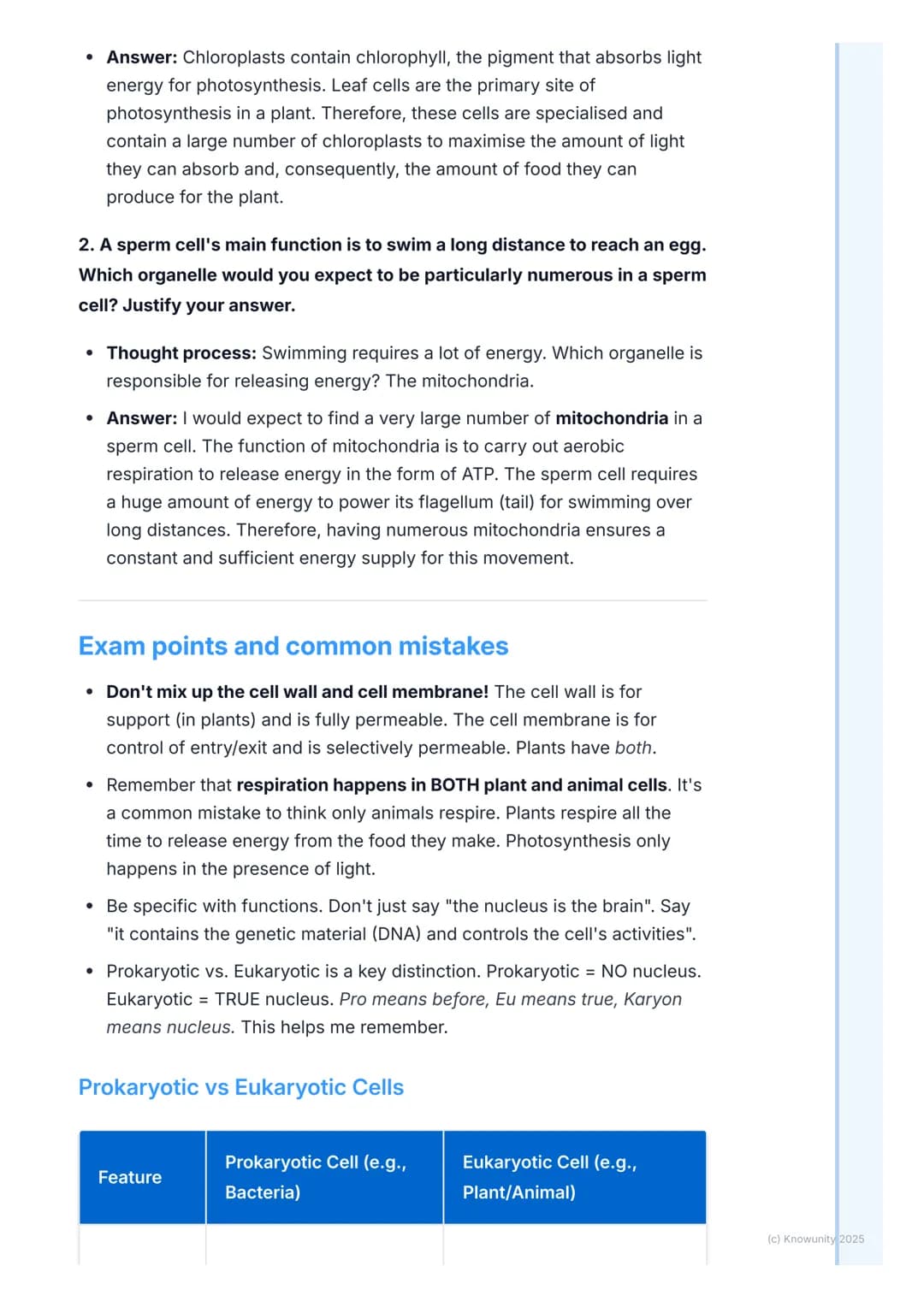
Prokaryotic vs Eukaryotic Cells
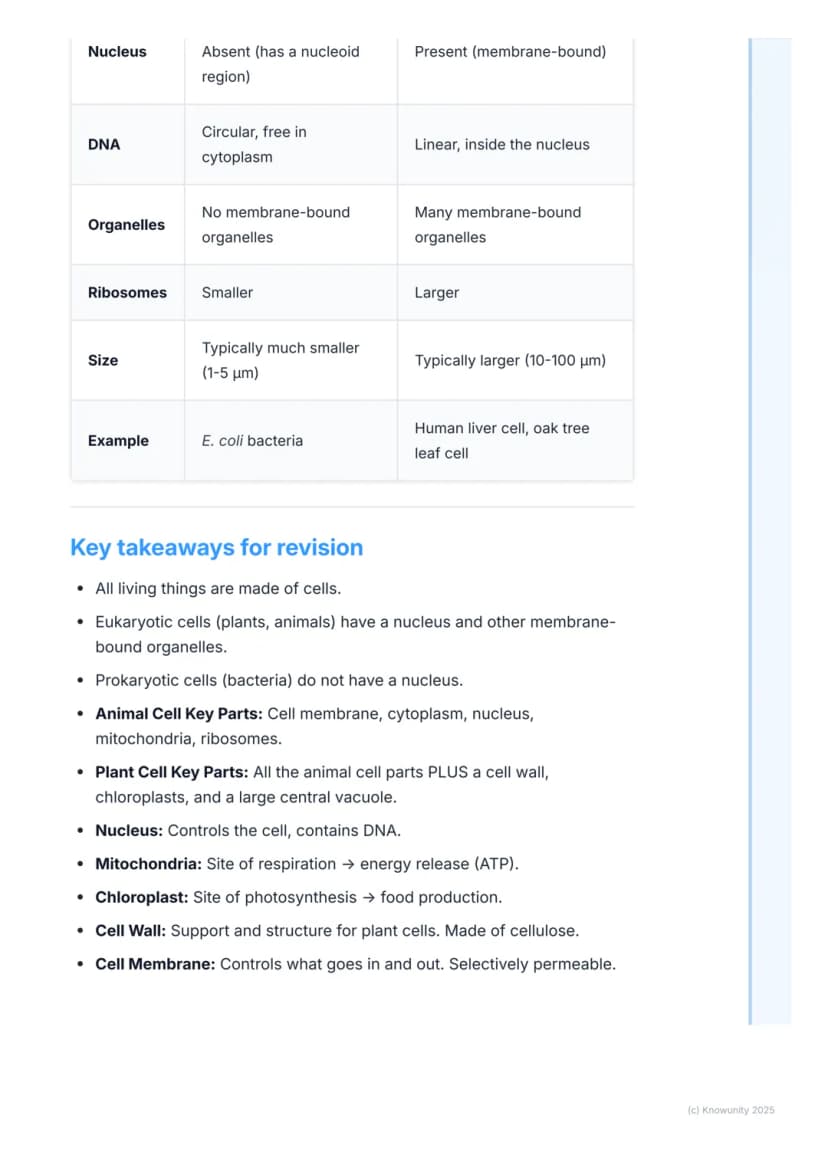
Understanding the difference between prokaryotic and eukaryotic cells is absolutely essential for your exams. Prokaryotic cells (like bacteria) are the minimalists of the cell world - no nucleus, no membrane-bound organelles, just DNA floating freely in a region called the nucleoid.
Eukaryotic cells are the complete opposite - they've got a proper nucleus with DNA neatly packaged inside, plus loads of specialised organelles doing different jobs. They're also much larger than prokaryotic cells .
Remember the word origins: "pro" means before, "eu" means true, and "karyon" means nucleus. So prokaryotic = "before nucleus" (evolved first, no proper nucleus) and eukaryotic = "true nucleus" (evolved later, has a proper nucleus).
Memory Trick: Think of prokaryotic cells as studio apartments (everything in one space) and eukaryotic cells as mansions (lots of separate rooms with specific purposes).
7
of 7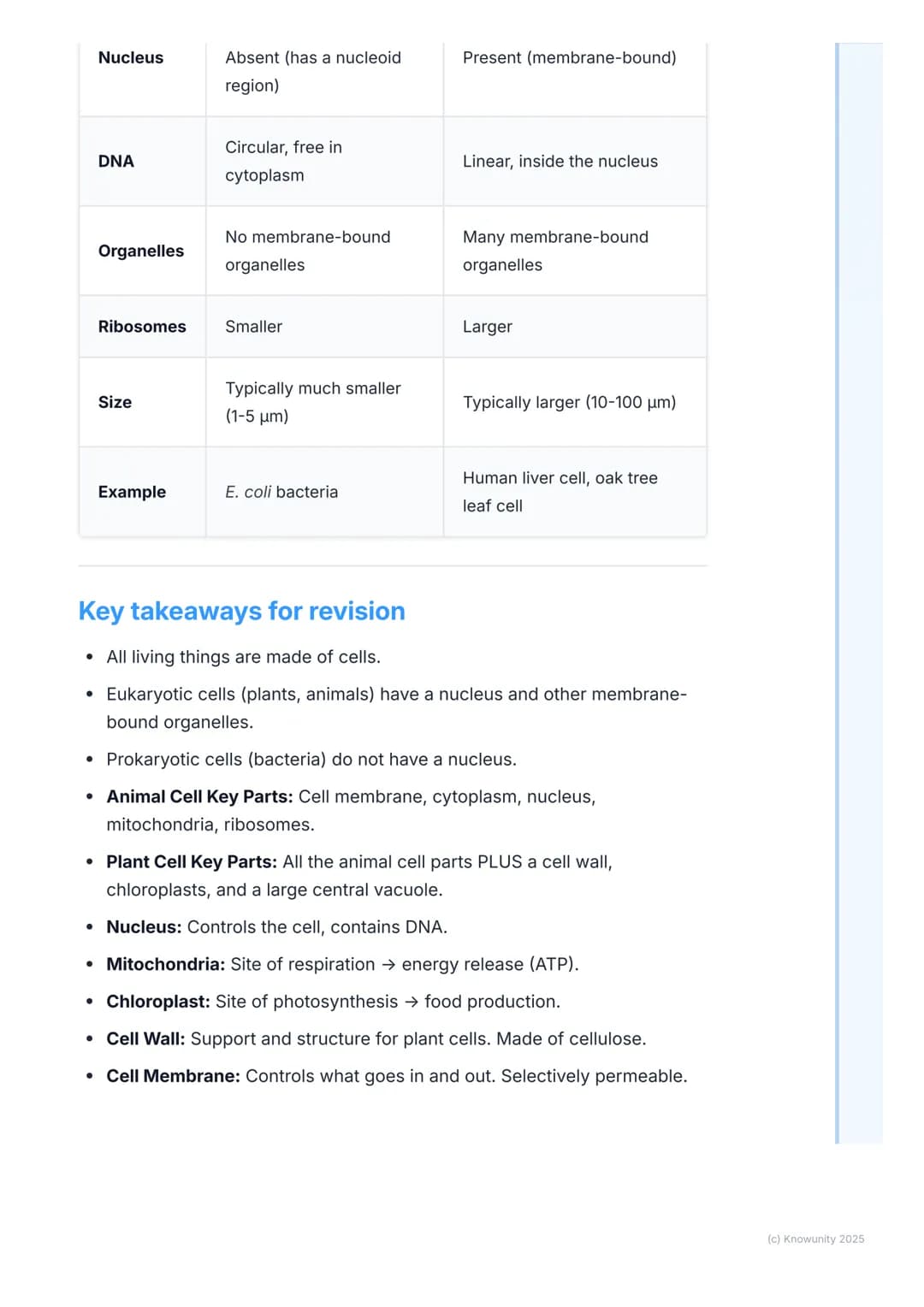
Key Takeaways for Success
Here's what you absolutely must remember: all living things are made of cells, and there are two main types - prokaryotic (bacteria) and eukaryotic (plants, animals, fungi). Animal cells have the basic kit: cell membrane, cytoplasm, nucleus, mitochondria, and ribosomes.
Plant cells have everything animal cells have, plus three crucial extras: a cell wall for support, chloroplasts for photosynthesis, and a large central vacuole for storage and structure. Each organelle has a specific job that matches its structure perfectly.
Common exam mistakes to avoid: don't mix up cell walls and cell membranes, remember that plants DO respire (they need energy too!), and always be specific about functions rather than using vague terms like "the nucleus is the brain."
Final Tip: When answering exam questions, always explain WHY a cell has certain organelles by linking structure to function - this shows real understanding!
Myśleliśmy, że nigdy nie zapytasz...
Czym jest Towarzysz AI z Knowunity?
Nasz asystent AI jest specjalnie dostosowany do potrzeb uczniów. W oparciu o miliony treści, które mamy na platformie, możemy udzielać uczniom naprawdę znaczących i trafnych odpowiedzi. Ale nie chodzi tylko o odpowiedzi, towarzysz prowadzi również uczniów przez codzienne wyzwania związane z nauką, ze spersonalizowanymi planami nauki, quizami lub treściami na czacie i 100% personalizacją opartą na umiejętnościach i rozwoju uczniów.
Gdzie mogę pobrać aplikację Knowunity?
Aplikację możesz pobrać z Google Play i Apple Store.
Czy aplikacja Knowunity naprawdę jest darmowa?
Tak, masz całkowicie darmowy dostęp do wszystkich notatek w aplikacji, możesz w każdej chwili rozmawiać z Ekspertami lub ich obserwować. Możesz użyć punktów, aby odblokować pewne funkcje w aplikacji, które również możesz otrzymać za darmo. Dodatkowo oferujemy usługę Knowunity Premium, która pozwala na odblokowanie większej liczby funkcji.
Najpopularniejsze notatki z Science
7ScienceScience/Physics notes - Speed, density, work
Speed density work formulas
3rd Year81
ScienceAtomic Structure and the Periodic Table
Students will learn about the structure of atoms, including protons, neutrons, and electrons, and how elements are organised and classified in the Periodic Table based on their electronic configuration and chemical properties.
5th Year41
ScienceHuman Body Systems
An introduction to major human body systems such as the digestive, circulatory, respiratory, and nervous systems, understanding their basic functions.
2nd Year131
ScienceJunior Cert Science Notes: The Cell
Notes on the Cell
3rd Year261
ScienceCells
Junior cert science cells summary
1st Year611
ScienceHuman Reproductive System
A basic overview of the male and female reproductive systems, including their main structures and functions.
TY191
ScienceLight and Optics
Exploring the properties of light, including how it travels, reflects, and refracts, and how we perceive colours.
2nd Year50
Najpopularniejsze notatki
9 Irish
IrishIrish oral questions and answers
Questions and answers for the leaving cert oral
5th Year4264
 English
Key Quotes : Sive
Key Quotes and explanations: Sive
6th Year2842
IrishIrish oral questions
Outline of oral questions
5th Year2055
IrishIníon- le hÁine Durkin
Aine Durkin’s poem, Iníon: Themes & summary
5th Year850
IrishIrish poetry 2027
Iníon + Dínit an Bhróin
5th Year1133
IrishLC HL notes- Iníon (poem)
Includes poem in English and Irish, theme, key words & phrases
5th Year2284
EnglishCultural Context : Shawshank Redemption : Sive : Small Things Like These
Comparative Study : Cultural Context : Shawshank Redemption, Sive and Small Things Like These
6th Year1430
IrishMo Ghrá-sa (Idir Lúibíní)
Notes on mo ghrá-sa
5th Year380
IrishAn Gaeilge Aiste
Irish Language essay
6th Year1320
Nie ma nic odpowiedniego? Sprawdź inne przedmioty.
Zobacz, co mówią o nas nasi użytkownicy. Pokochali nas — pokochasz też i Ty.
4.6/5App Store
4.7/5Google Play
Aplikacja jest bardzo prosta i dobrze przemyślana. Do tej pory znalazłem wszystko, czego szukałem i mogłem się wiele nauczyć z innych notatek! Na pewno wykorzystam aplikację do pomocy przy robieniu prac domowych! No i oczywiście bardzo pomaga też jako inspiracja do robienia swoich notatek.
Stefan Sużytkownik iOS
Ta aplikacja jest naprawdę świetna. Jest tak wiele notatek i pomocnych informacji [...]. Moim problematycznym przedmiotem jest język niemiecki, a w aplikacji jest w czym wybierać. Dzięki tej aplikacji poprawiłam swój niemiecki. Polecam ją każdemu.
Samantha Klichużytkownik Androida
Wow, jestem w szoku. Właśnie wypróbowałam aplikację, ponieważ widziałam ją kilka razy reklamowaną na TikToku jestem absolutnie w szoku. Ta aplikacja jest POMOCĄ, której potrzebujesz w szkole i przede wszystkim oferuje tak wiele rzeczy jak notatki czy streszczenia, które są BARDZO pomocne w moim przypadku.
Annaużytkownik iOS
Science2 wyświetleń·Zaktualizowano Jun 3, 2026·7 stronyUnderstanding Cells: Structures and Functions
Every living thing on Earth is made up of cells - from the tiniest bacteria to massive whales and towering oak trees. Think of cells as the LEGO blocks of life: they're the smallest units that can actually be called...
1
of 7
Zarejestruj się, aby zobaczyć notatkę. To nic nie kosztuje!
- Dostęp do wszystkich materiałów
- Popraw swoje oceny
- Dołącz do milionów studentów
The Cell: Basic Unit of Life
You're constantly surrounded by trillions of cells - they're literally everywhere, including the roughly 37 trillion that make up your own body! Cells are the fundamental building blocks of all living organisms, and every single life process happens at the cellular level.
There are two main types of cells you need to know. Prokaryotic cells are the simple ones - think bacteria - that don't have a proper nucleus or organised compartments. Eukaryotic cells are the complex ones that make up plants, animals, and fungi, complete with a nucleus and specialised compartments called organelles.
Living things can be unicellular (made of just one cell, like bacteria) or multicellular (made of many cells working together, like you). For your Leaving Cert, you'll mainly focus on eukaryotic cells, particularly plant and animal cells.
Remember: Organelles are like the "organs" of a cell - each one has a specific job to keep the cell functioning properly.
2
of 7Zarejestruj się, aby zobaczyć notatkę. To nic nie kosztuje!
- Dostęp do wszystkich materiałów
- Popraw swoje oceny
- Dołącz do milionów studentów
Animal Cell Structure
Animal cells are your basic cellular template - they're usually round or irregular in shape and packed with amazing tiny machines. The cell membrane acts like a bouncer at a club, deciding what gets in and out of the cell using its selective permeability.
Inside, the cytoplasm is like a jelly-filled workspace where loads of chemical reactions happen. The nucleus is absolutely crucial - it's the control centre containing all your genetic material (DNA) wrapped up in chromosomes, surrounded by its own protective membrane.
Mitochondria are the real heroes here - they're often called the "powerhouses" because they carry out respiration to release energy as ATP. Muscle cells are packed with these because they need loads of energy! Ribosomes are tiny protein-making factories that can float freely or attach to the endoplasmic reticulum.
Top Tip: Cells that need more energy (like heart muscle cells) contain way more mitochondria - this shows how structure relates to function!
3
of 7Zarejestruj się, aby zobaczyć notatkę. To nic nie kosztuje!
- Dostęp do wszystkich materiałów
- Popraw swoje oceny
- Dołącz do milionów studentów
More Animal Cell Components
The endoplasmic reticulum (ER) is like the cell's internal highway system for transporting materials. There are two types: rough ER (covered in ribosomes, looks bumpy) handles proteins, whilst smooth ER (no ribosomes) deals with lipids and other substances.
Vesicles are like tiny delivery vans - small membrane-bound sacs that transport substances around the cell. They're constantly moving materials from one place to another, keeping everything organised.
These organelles work together like a well-oiled machine. When you understand how each part contributes to the whole system, cell biology starts making perfect sense!
Exam Smart: Remember that animal cells can have small, temporary vacuoles, but they're nothing like the massive ones in plant cells.
4
of 7Zarejestruj się, aby zobaczyć notatkę. To nic nie kosztuje!
- Dostęp do wszystkich materiałów
- Popraw swoje oceny
- Dołącz do milionów studentów
Plant Cell Structure
Plant cells are like upgraded animal cells with some brilliant extras that help them make their own food and stand upright. They typically have a more fixed, rectangular shape thanks to their rigid cell wall made of cellulose.
The cell wall is the plant's suit of armour - it provides structural support and protection whilst being fully permeable (unlike the selective cell membrane). This is why plants can grow so tall without collapsing!
Chloroplasts are the green magic-makers containing chlorophyll, the pigment that captures sunlight for photosynthesis. You'll find loads of these in leaf cells because that's where most photosynthesis happens. They're basically the plant's solar panels!
Key Point: Plant cells have all the same organelles as animal cells PLUS the cell wall, chloroplasts, and a large central vacuole.
5
of 7Zarejestruj się, aby zobaczyć notatkę. To nic nie kosztuje!
- Dostęp do wszystkich materiałów
- Popraw swoje oceny
- Dołącz do milionów studentów
Plant Cell Specialities and Comparison
The large central vacuole is like a plant cell's storage tank and support system rolled into one. It's filled with cell sap (water, salts, and sugars) and helps maintain the cell's shape by pushing outwards against the cell wall - this is called turgor pressure.
Here's a handy comparison: animal cells are irregular and flexible, whilst plant cells are fixed and rectangular. Animal cells store energy as glycogen, plants use starch. Most importantly, plants can photosynthesise thanks to their chloroplasts, whilst animals must get their energy by eating other organisms.
When tackling exam questions, think about structure matching function. Leaf cells packed with chloroplasts? Perfect for photosynthesis. Sperm cells loaded with mitochondria? Ideal for that energy-demanding swim to reach an egg!
Exam Tip: Don't confuse the cell wall (structural support, fully permeable) with the cell membrane - plants have both!
6
of 7Zarejestruj się, aby zobaczyć notatkę. To nic nie kosztuje!
- Dostęp do wszystkich materiałów
- Popraw swoje oceny
- Dołącz do milionów studentów
Prokaryotic vs Eukaryotic Cells
Understanding the difference between prokaryotic and eukaryotic cells is absolutely essential for your exams. Prokaryotic cells (like bacteria) are the minimalists of the cell world - no nucleus, no membrane-bound organelles, just DNA floating freely in a region called the nucleoid.
Eukaryotic cells are the complete opposite - they've got a proper nucleus with DNA neatly packaged inside, plus loads of specialised organelles doing different jobs. They're also much larger than prokaryotic cells .
Remember the word origins: "pro" means before, "eu" means true, and "karyon" means nucleus. So prokaryotic = "before nucleus" (evolved first, no proper nucleus) and eukaryotic = "true nucleus" (evolved later, has a proper nucleus).
Memory Trick: Think of prokaryotic cells as studio apartments (everything in one space) and eukaryotic cells as mansions (lots of separate rooms with specific purposes).
7
of 7Zarejestruj się, aby zobaczyć notatkę. To nic nie kosztuje!
- Dostęp do wszystkich materiałów
- Popraw swoje oceny
- Dołącz do milionów studentów
Key Takeaways for Success
Here's what you absolutely must remember: all living things are made of cells, and there are two main types - prokaryotic (bacteria) and eukaryotic (plants, animals, fungi). Animal cells have the basic kit: cell membrane, cytoplasm, nucleus, mitochondria, and ribosomes.
Plant cells have everything animal cells have, plus three crucial extras: a cell wall for support, chloroplasts for photosynthesis, and a large central vacuole for storage and structure. Each organelle has a specific job that matches its structure perfectly.
Common exam mistakes to avoid: don't mix up cell walls and cell membranes, remember that plants DO respire (they need energy too!), and always be specific about functions rather than using vague terms like "the nucleus is the brain."
Final Tip: When answering exam questions, always explain WHY a cell has certain organelles by linking structure to function - this shows real understanding!
Myśleliśmy, że nigdy nie zapytasz...
Czym jest Towarzysz AI z Knowunity?
Nasz asystent AI jest specjalnie dostosowany do potrzeb uczniów. W oparciu o miliony treści, które mamy na platformie, możemy udzielać uczniom naprawdę znaczących i trafnych odpowiedzi. Ale nie chodzi tylko o odpowiedzi, towarzysz prowadzi również uczniów przez codzienne wyzwania związane z nauką, ze spersonalizowanymi planami nauki, quizami lub treściami na czacie i 100% personalizacją opartą na umiejętnościach i rozwoju uczniów.
Gdzie mogę pobrać aplikację Knowunity?
Aplikację możesz pobrać z Google Play i Apple Store.
Czy aplikacja Knowunity naprawdę jest darmowa?
Tak, masz całkowicie darmowy dostęp do wszystkich notatek w aplikacji, możesz w każdej chwili rozmawiać z Ekspertami lub ich obserwować. Możesz użyć punktów, aby odblokować pewne funkcje w aplikacji, które również możesz otrzymać za darmo. Dodatkowo oferujemy usługę Knowunity Premium, która pozwala na odblokowanie większej liczby funkcji.
Najpopularniejsze notatki z Science
7ScienceScience/Physics notes - Speed, density, work
Speed density work formulas
3rd Year81
ScienceAtomic Structure and the Periodic Table
Students will learn about the structure of atoms, including protons, neutrons, and electrons, and how elements are organised and classified in the Periodic Table based on their electronic configuration and chemical properties.
5th Year41
ScienceHuman Body Systems
An introduction to major human body systems such as the digestive, circulatory, respiratory, and nervous systems, understanding their basic functions.
2nd Year131
ScienceJunior Cert Science Notes: The Cell
Notes on the Cell
3rd Year261
ScienceCells
Junior cert science cells summary
1st Year611
ScienceHuman Reproductive System
A basic overview of the male and female reproductive systems, including their main structures and functions.
TY191
ScienceLight and Optics
Exploring the properties of light, including how it travels, reflects, and refracts, and how we perceive colours.
2nd Year50
Najpopularniejsze notatki
9IrishIrish oral questions and answers
Questions and answers for the leaving cert oral
5th Year4264
EnglishKey Quotes : Sive
Key Quotes and explanations: Sive
6th Year2842
IrishIrish oral questions
Outline of oral questions
5th Year2055
IrishIníon- le hÁine Durkin
Aine Durkin’s poem, Iníon: Themes & summary
5th Year850
IrishIrish poetry 2027
Iníon + Dínit an Bhróin
5th Year1133
IrishLC HL notes- Iníon (poem)
Includes poem in English and Irish, theme, key words & phrases
5th Year2284
EnglishCultural Context : Shawshank Redemption : Sive : Small Things Like These
Comparative Study : Cultural Context : Shawshank Redemption, Sive and Small Things Like These
6th Year1430
IrishMo Ghrá-sa (Idir Lúibíní)
Notes on mo ghrá-sa
5th Year380
IrishAn Gaeilge Aiste
Irish Language essay
6th Year1320
Nie ma nic odpowiedniego? Sprawdź inne przedmioty.
Zobacz, co mówią o nas nasi użytkownicy. Pokochali nas — pokochasz też i Ty.
4.6/5App Store
4.7/5Google Play
Aplikacja jest bardzo prosta i dobrze przemyślana. Do tej pory znalazłem wszystko, czego szukałem i mogłem się wiele nauczyć z innych notatek! Na pewno wykorzystam aplikację do pomocy przy robieniu prac domowych! No i oczywiście bardzo pomaga też jako inspiracja do robienia swoich notatek.
Stefan Sużytkownik iOS
Ta aplikacja jest naprawdę świetna. Jest tak wiele notatek i pomocnych informacji [...]. Moim problematycznym przedmiotem jest język niemiecki, a w aplikacji jest w czym wybierać. Dzięki tej aplikacji poprawiłam swój niemiecki. Polecam ją każdemu.
Samantha Klichużytkownik Androida
Wow, jestem w szoku. Właśnie wypróbowałam aplikację, ponieważ widziałam ją kilka razy reklamowaną na TikToku jestem absolutnie w szoku. Ta aplikacja jest POMOCĄ, której potrzebujesz w szkole i przede wszystkim oferuje tak wiele rzeczy jak notatki czy streszczenia, które są BARDZO pomocne w moim przypadku.
Annaużytkownik iOS