Page 1: Formulas and Calculations for Prisms
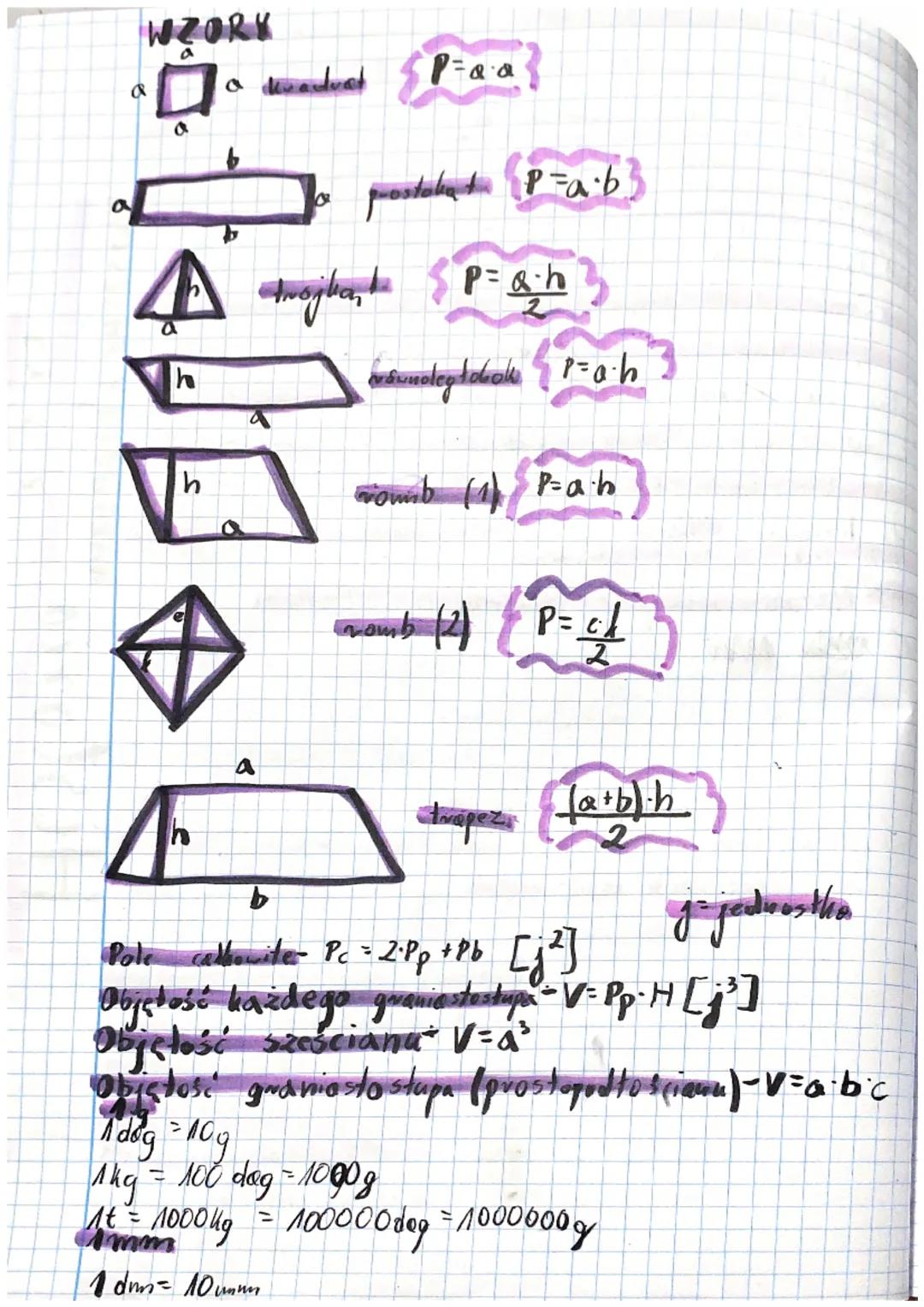
This page presents essential formulas for calculating areas and volumes of prisms, which are crucial for understanding graniastosłupy wzory na pole i objętość.
The page begins with basic geometric formulas for areas of shapes like squares, rectangles, and triangles. These are fundamental for calculating the surface areas of prisms.
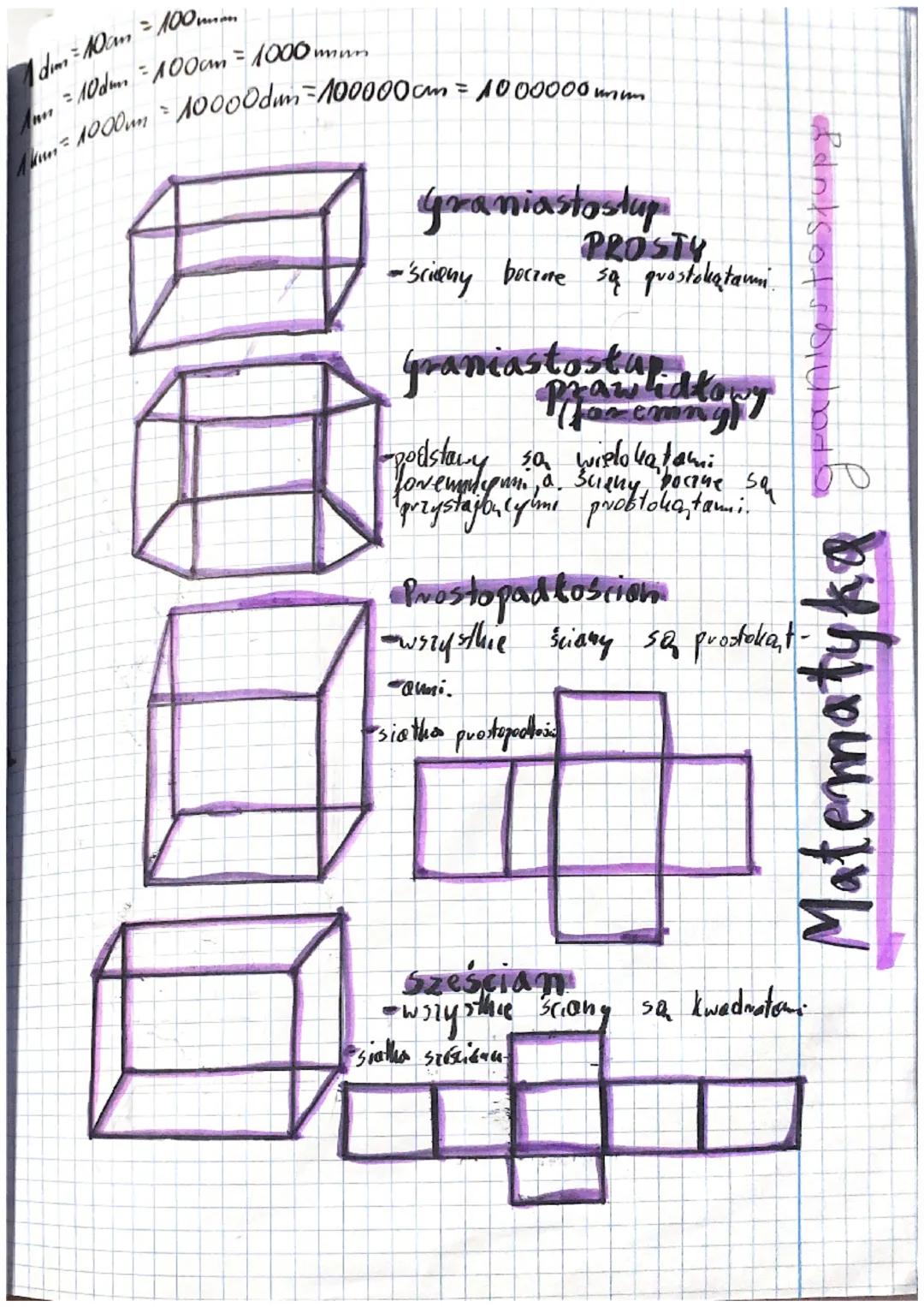
Definition: A prism is a three-dimensional figure with two identical polygonal bases and rectangular lateral faces.
Key formulas presented include:
- Wzór na pole podstawy graniastosłupa: The formula for the base area of a prism, which varies depending on the shape of the base.
- Wzór na pole graniastosłupa: The formula for the total surface area of a prism, given as Pc = 2·Pp + Pb, where Pp is the area of the base and Pb is the lateral surface area.
- Wzór na objętość graniastosłupa: The volume formula for any prism, V = Pp·H, where Pp is the base area and H is the height.
Highlight: The volume of a cube is given by V = a³, where a is the length of an edge.
The page also includes conversion factors for mass units:
- 1 kg = 1000 g
- 1 t = 1000 kg = 100000 dag = 1000000 g
Example: To convert 2 kg to grams, multiply by 1000: 2 kg = 2000 g.
These formulas and conversions are essential for solving problems related to graniastosłupy zadania klasa 8.